Technical SEO for Exporters: 2026 Insights
Expert reviewed

Export websites rarely fail because of one big mistake. They fail because small technical decisions compound across languages, markets, and catalogs until Google can not confidently crawl, index, or rank the right pages.
This tutorial breaks down the technical work that matters most in 2026 for SEO for exporters, with practical patterns for international B2B SEO and supplier website SEO. It is based on exporter-specific research and official guidance from Google, plus current SEO best-practice frameworks (see references throughout).
1) What changed for exporters in 2026 (and what did not)
In 2026, exporters operate in a search environment shaped by AI-driven answer experiences, entity-based understanding, and cross-language retrieval. The direction is clear across multiple industry reports: the sites that win are the ones that make it easy for machines to understand (structure, entities, relationships) and easy for humans to convert (speed, clarity, trust). See the international SEO analysis from Search Engine Land and multilingual measurement guidance from Matomo for how these trends show up in real-world implementations.
Key implications for exporter sites:
- International complexity is now a ranking risk, not just a growth opportunity. Wrong hreflang or canonicals can cause the wrong language to rank, or nothing to rank at all. Google is explicit about correct localized versions and annotations.
- Catalog scale amplifies technical debt. A few bad filter rules can generate millions of low-value URLs and dilute crawl budget.
- Performance must be solved at the template level. Exporter sites often ship heavy images, PDFs, and scripts across slower international connections. Google continues to emphasize Core Web Vitals within the broader page experience signals.
If you only take one strategic lesson: do not aim to fix everything. Identify what truly impacts growth (visibility plus RFQs), and deprioritize everything else.
References: Google's multi-regional and multilingual guidance, Multilingual SEO measurement and optimization (Matomo), International SEO in 2026 (Search Engine Land)
2) International architecture exporters can scale (URLs, hreflang, canonicals)
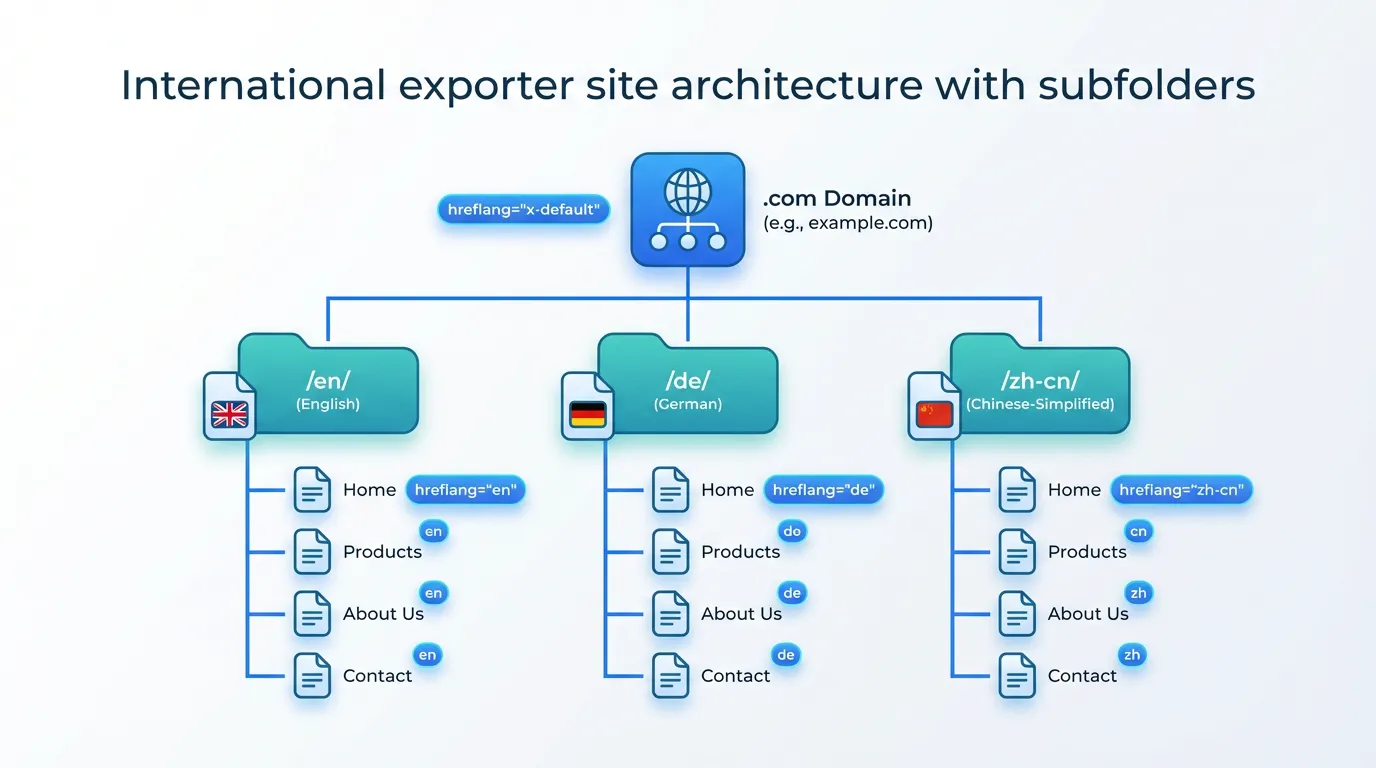
Most exporters are best served by one strong .com domain with language (and sometimes country) subfolders. This keeps authority consolidated and governance simpler as you expand into APAC, the US, and Europe.
A practical starting pattern:
/en/for global English (or/en-us/if you must separate)/de/for German/zh-cn/for Simplified Chinese- Add more markets as subfolders once you prove demand
Why subfolders are commonly favored for exporters:
- Shared authority across regions
- Easier to standardize templates and schema
- Faster to launch new markets without domain overhead
Hreflang rules that prevent exporter-grade failures:
- Use valid ISO codes like
en-US,en-GB,zh-CN. Do not invent regions like EU or APAC. - Ensure every variant references every other variant, plus itself (bidirectional and self-referential).
- Align hreflang with canonicals. A common exporter mistake is canonicalizing localized pages to a single English page, which suppresses local rankings.
Operational UX note:
- Avoid forced IP redirects that block Googlebot from accessing country content. Prefer a visible language/country selector plus an
x-defaultfallback.
If you want a deeper implementation framework, SeekLab.io's multilingual architecture guide is a good companion: The Ultimate Guide to Multilingual SEO Strategy in 2026.
3) Crawlability for supplier catalogs: control filters, click depth, and sitemaps
Supplier and manufacturer sites tend to have three structural pressure points:
- Click depth: your money pages are buried
High-value pages (top categories, top solutions, core industries) should be reachable within 3 clicks from the homepage. This is especially important when buyers arrive in different languages and land on different entry points. - Faceted navigation: parameter chaos
Filters can explode into near-duplicate pages that waste crawl budget. The goal is not to block all filters, it is to intentionally choose which filter combinations deserve to be indexable. - Sitemaps: everything is mixed together
Exporters benefit from segmented sitemaps (products, categories, resources, and sometimes language sets). This makes monitoring indexing and debugging market launches much faster.
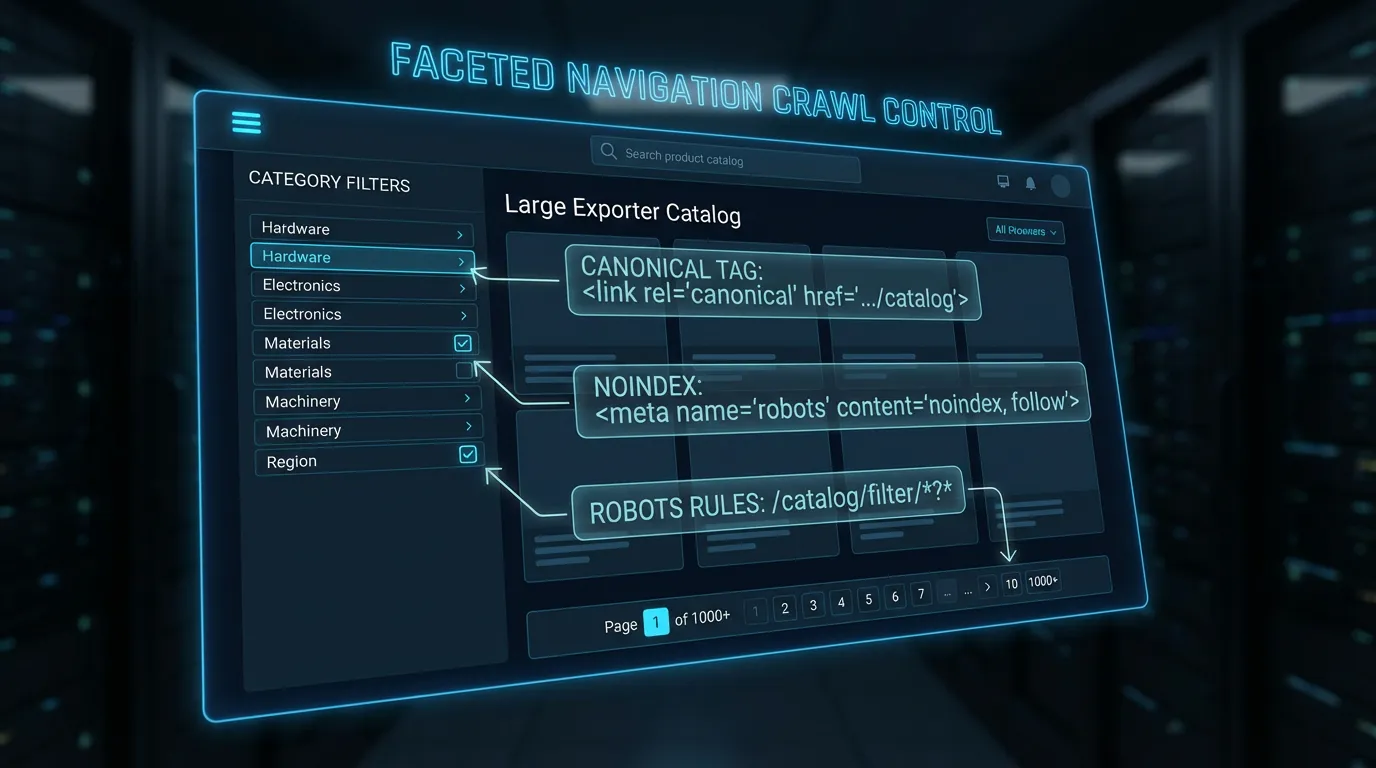
A pragmatic filter policy (simple, but effective):
| Catalog element | Recommended index status | Why it works for exporters |
|---|---|---|
| Core categories | Index | Matches buyer intent and consolidates authority |
| A small set of high-intent attribute combinations (e.g., material + standard) | Index (selectively) | Captures transactional supplier queries without URL sprawl |
| Low-value filters (color, minor dimensions, sort orders) | Noindex or canonicalize to the parent | Prevents thin duplicates and crawl traps |
| Session IDs, internal search result pages | Block in robots.txt when appropriate | Avoids infinite crawl loops |
Also watch for a classic exporter issue: key specs locked inside PDFs only. Keep PDFs as supporting downloads, but place the core spec tables and compliance details in HTML so they can be crawled, understood, and cited.
For architecture patterns that work well for B2B exporters and ecommerce-like catalogs, see: Advanced SEO Site Architecture for B2B and ECommerce Success. For foundational internal linking best practices, Ahrefs provides a strong baseline: 12 SEO Best Practices.
4) Core Web Vitals for exporters: fix templates once, improve thousands of pages
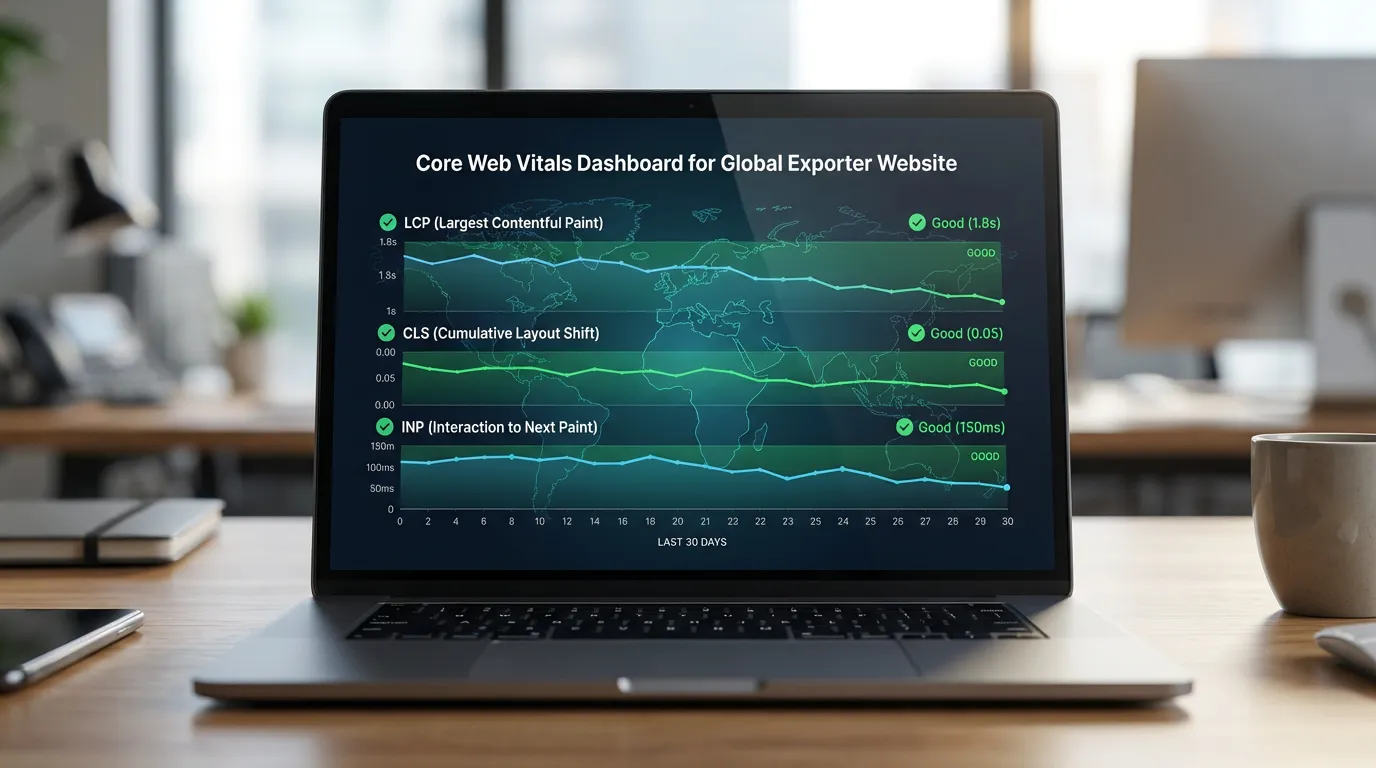
Exporter sites often ship the heaviest templates in the areas that matter most: product lists, product detail pages, and spec-rich solution pages. In 2026, the most efficient performance strategy remains template-level optimization.
What to prioritize:
- LCP: compress and right-size hero and product images, use WebP/AVIF, and preload critical assets.
- CLS: reserve image and embed dimensions, stabilize font loading, and avoid layout-shifting banners.
- INP: reduce third-party scripts, break up long main-thread tasks, and defer non-critical features.
Global delivery matters more for exporters:
- Use a CDN with strong coverage near your key markets (US, EU, major APAC hubs).
- Minimize blocking scripts and self-host critical fonts where possible.
- Treat every extra second as both a ranking and conversion tax, especially for mobile-only buyers in slower regions.
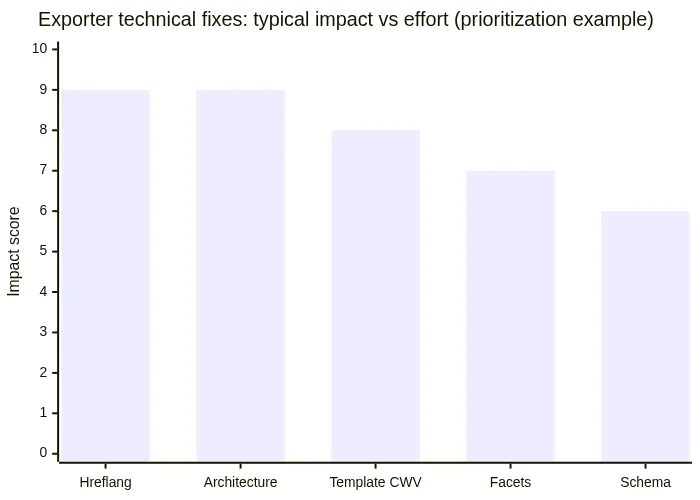
Use this as a prioritization lens, not a universal truth. Your actual order should be driven by baseline data (Search Console, crawl results, and RFQ paths).
5) A 2026 technical SEO checklist (exporter version) + how SeekLab.io approaches audits
Below is a field-ready checklist you can use before launching a new market or rebuilding an exporter catalog.
Exporter technical checklist (quick scan)
| Area | Pass criteria | What to verify |
|---|---|---|
| International setup | One clear URL strategy | Subfolders vs ccTLDs decision is consistent across all markets |
| Hreflang | Complete and valid | Correct ISO codes, self-references, bidirectional coverage, includes x-default where needed |
| Canonicals | Local pages can rank | No blanket canonical to English, canonicals match the intended indexable URL |
| Crawlability | No crawl traps | Filters controlled, parameter rules defined, important pages < 3 clicks |
| Indexing | Priority pages indexed | Category, solution, industry pages appear in index and get impressions |
| Rendering | Content visible to crawlers | Key content and links exist in rendered HTML, not only after client-side actions |
| Performance | Templates meet CWV goals | Focus on LCP, CLS, INP for category and product templates |
| Structured data | Consistent entity signals | Organization, Breadcrumb, Product/Service, FAQ where relevant |
Where SeekLab.io fits (and what exporters usually want next)
SeekLab.io focuses on comprehensive website SEO audits plus clear, developer-ready guidance. That means:
- Full-site crawling and structured analysis
- Indexing, crawling, rendering, and JavaScript compatibility checks
- Internal linking equity and semantic structure analysis
- Schema compliance and scalable template recommendations
- Sitemap.xml and robots.txt validation
- A prioritized roadmap that targets growth and RFQs, not vanity fixes
This is especially relevant if you manage multi-market operations across APAC, the US, and Europe, and need a partner that can balance technical depth with practical execution. SeekLab.io operates with teams and legal entities in Singapore and Shanghai, plus a BD team in Dubai, which helps when exporter stakeholders span time zones.
If you want a second opinion before investing months into content or redevelopment, start with a focused audit and a prioritized plan. Useful next reads:
- Advanced SEO Site Architecture for B2B and ECommerce Success
- The Ultimate Guide to Multilingual SEO Strategy in 2026
Get a free audit report. Contact us and leave your website domain, so we can quickly confirm what is blocking indexing, which templates are holding back performance, and which fixes are most likely to increase qualified inquiries.