Search Intent SEO: Boost 2026 Conversions
Expert reviewed

What Search Intent SEO Really Means in 2026 (and why conversions depend on it)
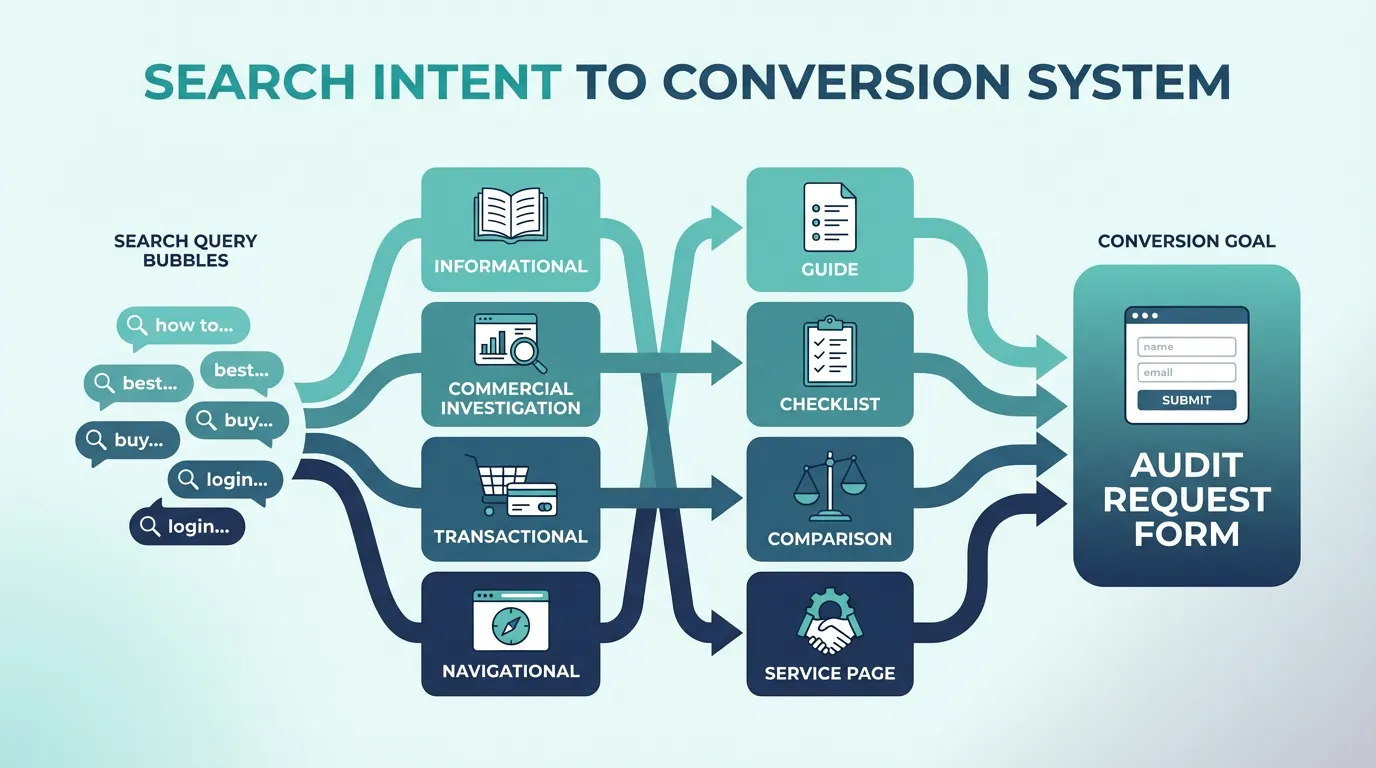
In 2026, SEO wins are less about finding a bigger keyword list and more about building a system around why people search. When your pages, technical foundations, and conversion paths align with the user goal behind a query, you stop attracting "almost right" traffic and start earning qualified leads.
SeekLab.io's practical framing is: diagnose first, then map intent, then execute what actually moves growth. Not every fix matters equally, and not every page deserves the same level of investment.
Here are the key ideas to keep in mind as you plan content and optimization:
- Intent is measurable in SERPs and on-site behavior. Rankings without engagement, leads, or qualified inquiries often indicate intent mismatch.
- Intent mapping is not just content planning. It should also influence what you fix first in crawlability, indexing, performance, internal linking, and structured data.
- Global B2B and exporter sites face "intent drift" by region. The same offering can trigger different questions in APAC, the US, and Europe, and direct translation rarely matches local intent.
If you want a deeper primer that pairs intent with keyword research workflows, use SeekLab.io's guide: Master Keyword Research & Search Intent 2026.
8 SERP clues that reveal intent fast (without guessing)
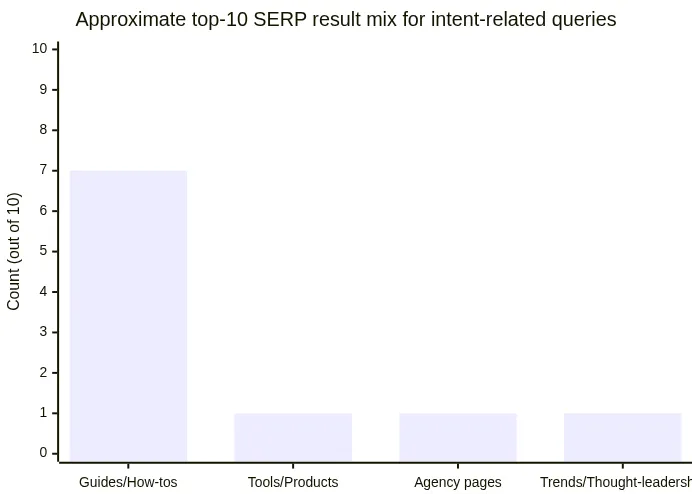
Most "search intent SEO" results are informational guides, which means readers expect clarity, frameworks, and examples before they will consider a service or solution. You can validate intent quickly by reading the SERP like a dataset.
Here are 8 reliable clues:
- Dominant page format in top results (guides vs landing pages vs tools).
- Featured snippet type (definition snippet usually signals top-of-funnel learning intent).
- People Also Ask patterns (shows the next questions users will ask, which you can answer on-page).
- Title verbs ("what is," "how to," "best," "vs," "pricing," "template").
- Comparison modifiers (words like "best," "top," "alternatives" usually signal evaluation).
- Template and checklist modifiers (often mid-funnel; the user wants to implement).
- Local or regional modifiers (a strong hint that hreflang, localization, and regional proof points matter).
- SERP volatility (if rankings swing, the engine may still be testing which format satisfies the query best).
10-step intent mapping checklist (built for real pages, not spreadsheets)
Intent mapping sounds simple until you try to operationalize it across a full site, especially for B2B catalogs, exporter sites, or multilingual architectures. The goal is not to label keywords. The goal is to assign each meaningful query cluster to the right page type, internal links, and next step.
Use this 10-step checklist:
- Group queries by topic first, not by exact wording. In 2026, engines rely more on semantic meaning than exact-match strings.
- Pick one "primary job to be done" per cluster. If the query is mixed, decide what your page will satisfy first.
- Classify the dominant intent. Keep it practical: what would a satisfied user do next?
- Select the page type that matches the intent. Guides for learning, comparisons for evaluation, service pages for high-commitment actions.
- Write a one-sentence intent promise for the page. Example: "By the end, you can diagnose mismatched pages and fix the highest-impact issues."
- Define a single primary CTA that fits the stage. Informational pages should not feel like a hard sell, but they must guide the next step.
- Add 2 to 5 supporting internal links that create an intent path. For example, guide -> checklist -> audit request.
- Decide which visuals are required to satisfy intent. Diagrams, tables, and annotated examples often outperform generic stock images.
- Add structured data where it improves comprehension and extraction. Article and FAQ patterns commonly help for educational pages.
- Validate with behavior metrics, not opinions. If engagement rises but leads do not, your CTA or mid-funnel bridge is likely missing.
Quick reference table: intent to page type and CTA
| Query pattern (example) | Dominant intent | Best page type | CTA that usually converts without forcing |
|---|---|---|---|
| "what is ...", "how to ..." | Informational | Guide, tutorial, glossary | "Get a free audit report" or "Leave your domain for a quick check" |
| "best ...", "tool vs ...", "agency for ..." | Commercial investigation | Comparison, framework, case-style breakdown | "Contact us with your goals and target markets" |
| "pricing", "service", "hire" | Transactional | Service page, landing page | "Request an audit and roadmap" |
| Brand + topic | Navigational | Hub page or the exact destination | Direct navigation to the right page |
7 places where technical SEO either supports intent or silently breaks it
Many sites "do intent mapping" but ignore the technical realities that determine whether the right page can rank, load, and convert. SeekLab.io's advantage is treating intent as a prioritization layer across diagnostics, not a content-only exercise.
Here are 7 technical areas where intent and outcomes collide:
- Indexing and crawlability for intent-critical pages
If your best guide or comparison page is not reliably indexed, your intent strategy never reaches the user. - JavaScript rendering risks on informational content
Important content hidden behind client-side rendering can reduce discoverability. This hurts especially when your page must answer questions clearly and completely. - Core Web Vitals on high-intent pages
Slow or unstable layouts can be tolerable on low-stakes browsing, but they commonly reduce form submissions and inquiry completions on evaluation and action pages. - Internal linking that mirrors the user journey
Informational pages should not be dead ends. Build "intent paths" so a reader can move from learning to evaluating to contacting you. - Site architecture that groups by topic and intent
If exporters have products, certifications, compliance, shipping, and sourcing content, the structure should make those relationships obvious. - Schema markup that clarifies meaning
Structured data helps engines interpret entities and page purpose (for example, Article and FAQ patterns for educational content). - Multilingual and regional routing (hreflang and architecture)
Global sites fail when the "right" content appears in the wrong market. Intent differs by region, so routing and localization strategy must match how people actually search.

If you operate across markets, it also helps to plan content strategy around regional demand signals. Trend context can be supplemented by sources like Semrush's SEO trends coverage.
9 actions you can do in 30 days to boost qualified leads (not just traffic)
This is a list you can hand to a marketing manager or an independent developer and execute without boiling the ocean. The principle is consistent with SeekLab.io's delivery style: focus on what truly impacts growth, deprioritize the rest.
- Pick 10 to 20 pages with traffic but weak conversion signals (high exit, low inquiry rate, low engagement).
- For each page, write down the dominant intent in plain English (one sentence).
- Rewrite the intro to confirm the intent within 5 seconds (reduce pogo-sticking).
- Add one mid-page CTA that matches the stage (example: "Get a free audit report" is a softer bridge than "Buy now").
- Add 3 internal links that form an intent path (guide -> checklist -> consultation).
- Fix the most damaging performance issue on the highest-intent pages first (usually mobile layout shift or slow interaction).
- Validate indexing for the pages you are betting on (no point polishing what cannot surface).
- Add a comparison table or decision framework to your best-performing guide (this often captures evaluation intent without needing a separate page).
- Create one "bridge page" that connects informational learning to commercial investigation, such as an audit explainer or framework overview.

When it makes sense to partner with SeekLab.io
You will usually get the fastest ROI from outside help when:
- You have rankings or traffic but low lead quality, and you suspect intent mismatch.
- You operate across APAC, the US, and Europe, and localization is more than translation.
- You know there are technical issues (performance, rendering, indexing), but you need clarity on what to fix first.
SeekLab.io works across Singapore and Shanghai, with a BD team in Dubai, and the engagement philosophy is deliberately pragmatic: we do not aim to fix everything, we focus on what impacts growth. You also get clear, actionable guidance beyond diagnostics, and monthly review cycles if needed. In some cases, simple technical issues can be resolved at no cost, and there is no charge if the minimum expected results are not achieved.
If you want to start with a low-friction next step, use this as your internal brief, then ask for a snapshot: get a free audit report, contact us, and leave your website domain.