Internal Linking SEO Best Practices for 2026
Expert reviewed

Internal linking remains one of the highest-leverage SEO practices in 2026 because it improves crawl paths, clarifies topical relationships, and helps important pages receive more internal authority. This guide explains the internal linking best practices that matter most, from anchor text and click depth to orphan pages, topic clusters, and contextual links that support both rankings and conversion journeys.
Why internal linking is still the highest-leverage SEO work in 2026
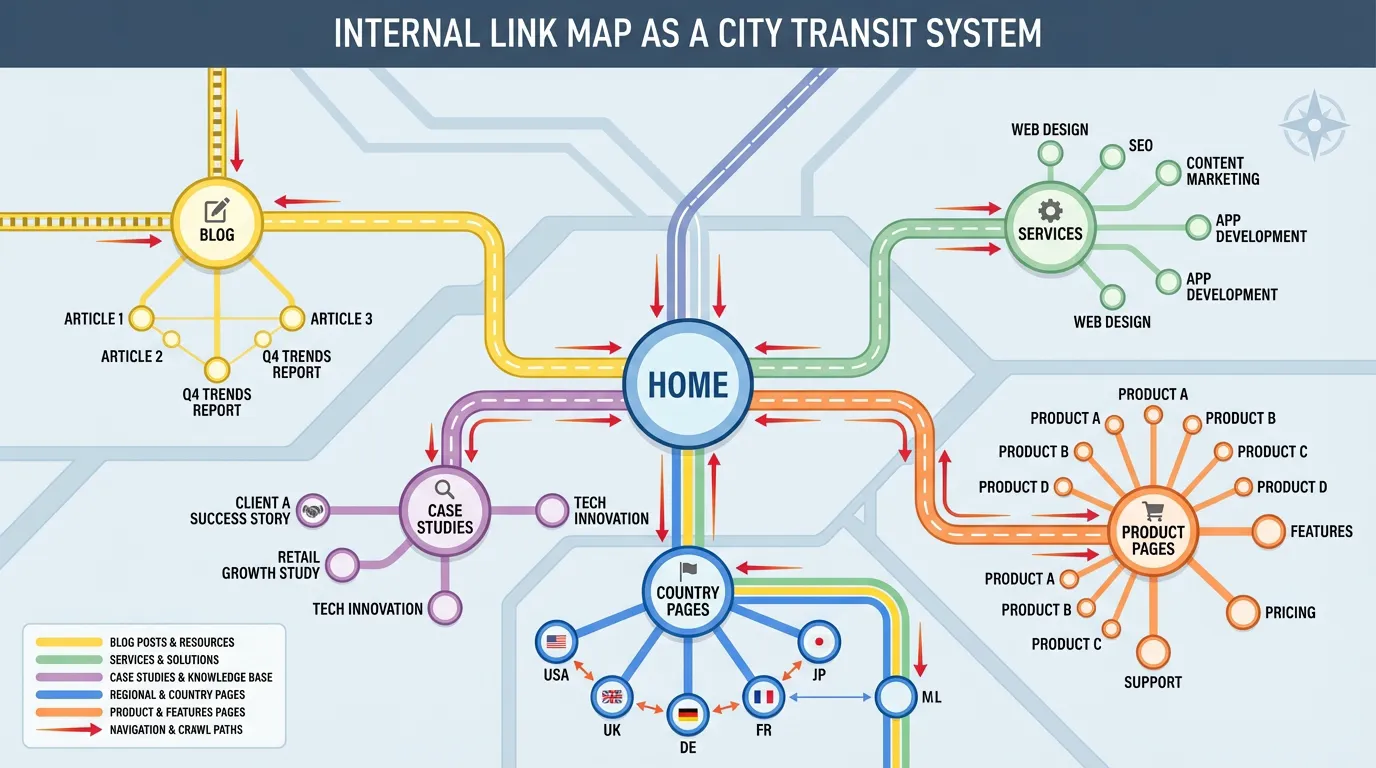
The core rule is simple: internal links should make page importance and page relationships easier to understand. In 2026, that matters not only for traditional ranking systems, but also for AI-driven search experiences that rely on clearer structure, stronger hubs, and more descriptive contextual linking.
In practice, the most useful improvements usually come from a short list of fixes: reducing click depth to priority pages, repairing broken internal paths, improving vague anchor text, connecting orphan pages, and strengthening pillar-to-supporting-page clusters. That is where internal linking stops being “SEO plumbing” and starts acting like a real growth lever.
Google's own guidance emphasizes building a clear site structure and using descriptive linking so crawlers and users can find key pages efficiently. If you want to sanity-check your fundamentals, start with the official documentation: Google's SEO Starter Guide and, for large sites, Google's crawl budget guidance.
In practice, internal linking improvements tend to show up in four business outcomes:
- Faster discovery and better indexation of important pages (especially new or updated content).
- More predictable flow of link equity from your strongest pages to revenue-driving pages.
- Stronger topical authority through clusters (pillars and supporting articles).
- Better user journeys that move people from "I am researching" to "I am ready to inquire."
Industry write-ups and case summaries frequently report meaningful lifts after structured internal linking projects. Treat the numbers as ranges, not promises, but the pattern is consistent across sources like Search Engine Land's internal linking best practices.
The 2026 shift: internal links are now "AI comprehension" infrastructure, not just SEO plumbing
Traditional ranking is still here, but AI-driven search experiences increasingly summarize, connect entities, and cite across multiple pages. In that world, internal links do extra work: they tell machines which pages belong together and which page is the "hub" versus the "detail."
This is where anchor text matters beyond clicks. Descriptive anchor text helps users, and it helps systems understand the destination page's meaning in context. Google explicitly recommends making anchor text descriptive rather than generic in its starter documentation (SEO Starter Guide).
Large-scale experiments also suggest that anchor text variety correlates strongly with organic performance. Cyrus Shepard's discussion of a 23M-link analysis is a useful perspective for 2026 planning: Cyrus Shepard on internal linking study. The takeaway is not "spam more links," but "use fewer, better links with varied, accurate anchors."

A business-first internal linking strategy (the framework I trust)
If your team starts internal linking by saying "let's link to the pages with the biggest keywords," you will waste time. Start with business value and user intent, then let keywords follow.
Here is a simple tiering model that works for B2B service sites, exporters, and multi-region brands:
| Page tier | What it includes | Internal link goal | Where links should come from | Anchor text guidance |
|---|---|---|---|---|
| Tier 1: Growth pages | Service pages, high-margin product/category pages, contact flows | Concentrate link equity and reduce click depth | Homepage, top navigation (limited), high-traffic blog posts, relevant case studies | Descriptive, intent-matching anchors, avoid repetitive exact-match patterns |
| Tier 2: Authority hubs | Pillar guides, core "how it works" explainers, flagship resources | Build topical authority and act as routing hubs | Supporting articles, related modules, breadcrumbs where relevant | Natural variations that reflect subtopics and entities |
| Tier 3: Supporting pages | Long-tail blog posts, FAQs, regional details | Feed Tier 1 and Tier 2 while capturing niche intent | Hub pages, sibling articles, curated "related" blocks | Specific anchors, include qualifiers like region, use case, or role |
Two strategic rules I would defend in any 2026 SEO plan:
- Keep priority pages within roughly 3 clicks from the homepage when feasible, especially for large sites where crawl budget and discovery are real constraints (see Google crawl budget documentation).
- Bias toward contextual, in-content links over bloated mega menus. Context is relevance, and relevance is how internal links stop being "just navigation."
How to audit and implement internal links without creating busy work
The fastest way to lose trust internally is to propose hundreds of "SEO fixes" that do not move growth. Internal linking is powerful, but only if you prioritize.
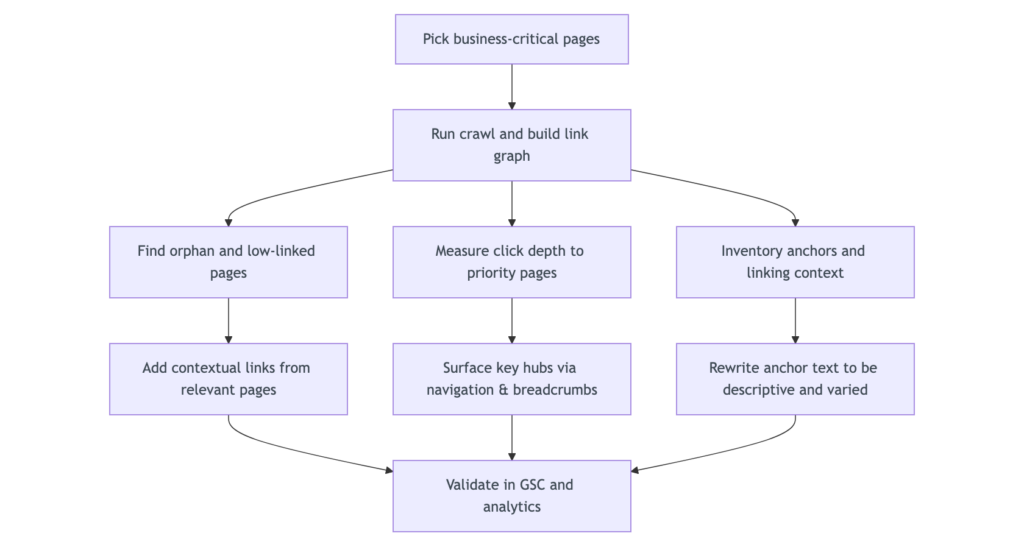
A practical audit sequence looks like this:
- Crawl the site and extract the internal link graph.
- Identify orphan pages and pages with very low internal inbound links.
- Review link depth (which important pages are buried).
- Fix broken internal links and redirect chains first (they waste crawl and annoy users).
- Evaluate anchor text patterns for repetition, vagueness, or mismatch.
- Rebuild clusters: pillar to supporting, supporting back to pillar, and sibling cross-links where it helps users.
If you want an external checklist-style reference, Search Engine Land's guide is a solid baseline.
For multilingual and hreflang-driven sites, my opinion is firm: do not "cross-link everything to everything." Keep internal linking primarily within the same locale, then provide explicit, user-visible links to equivalent translations. That keeps relevance clean and avoids confusing both users and crawlers.
What to measure (and a realistic 90-day expectation)
Internal linking work should be judged on outcomes, not "number of links added." Track:
- Indexation: discovered vs indexed for important sections in Google Search Console.
- Ranking movement for pages you intentionally supported with internal links.
- Organic sessions to those pages and to the cluster as a whole.
- Conversion paths: do users actually click from informational content into money pages?
Here is an illustrative impact model based on ranges discussed across multiple case studies and guides (directionally useful, not a guarantee):
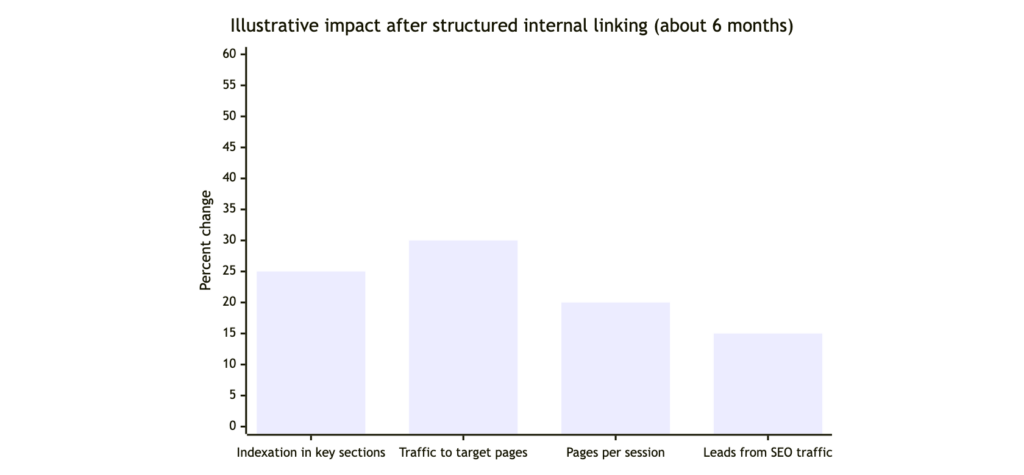
My opinion on execution timing: a 90-day plan is enough to prove whether internal linking is a growth lever for your site.
- Days 1 to 14: crawl, diagnose, and decide what to ignore.
- Days 15 to 45: fix broken links, eliminate redirect chains, connect orphan pages, and improve click depth to Tier 1 pages.
- Days 46 to 90: strengthen 1 to 3 topic clusters, update anchor text patterns, and bake internal link requirements into every content brief so new content is not isolated.
If you want this done with a "diagnose first, prioritize what impacts growth" mindset, SeekLab.io's work style fits that approach: not just identifying technical issues, but delivering clear, actionable implementation guidance and focusing on changes that drive leads, not vanity metrics.
Get a free audit report, contact us, and leave your website domain so we can map your internal link equity, flag orphan pages, and recommend the smallest set of changes most likely to move rankings and conversions.