Canonical Tags & SEO Architecture: 2026 Strategy
Expert reviewed

Canonical tags in 2026: think architecture, not a single HTML line
Canonical tags (<link rel="canonical" href="...">) are still one of the clearest ways to tell search engines which URL should represent a set of near-identical pages. But in 2026, the real win is architectural: canonicals must align with internal links, sitemaps, redirects, hreflang, rendering, and template rules. Otherwise, search engines may cluster your pages incorrectly and pick a different canonical than you intended.
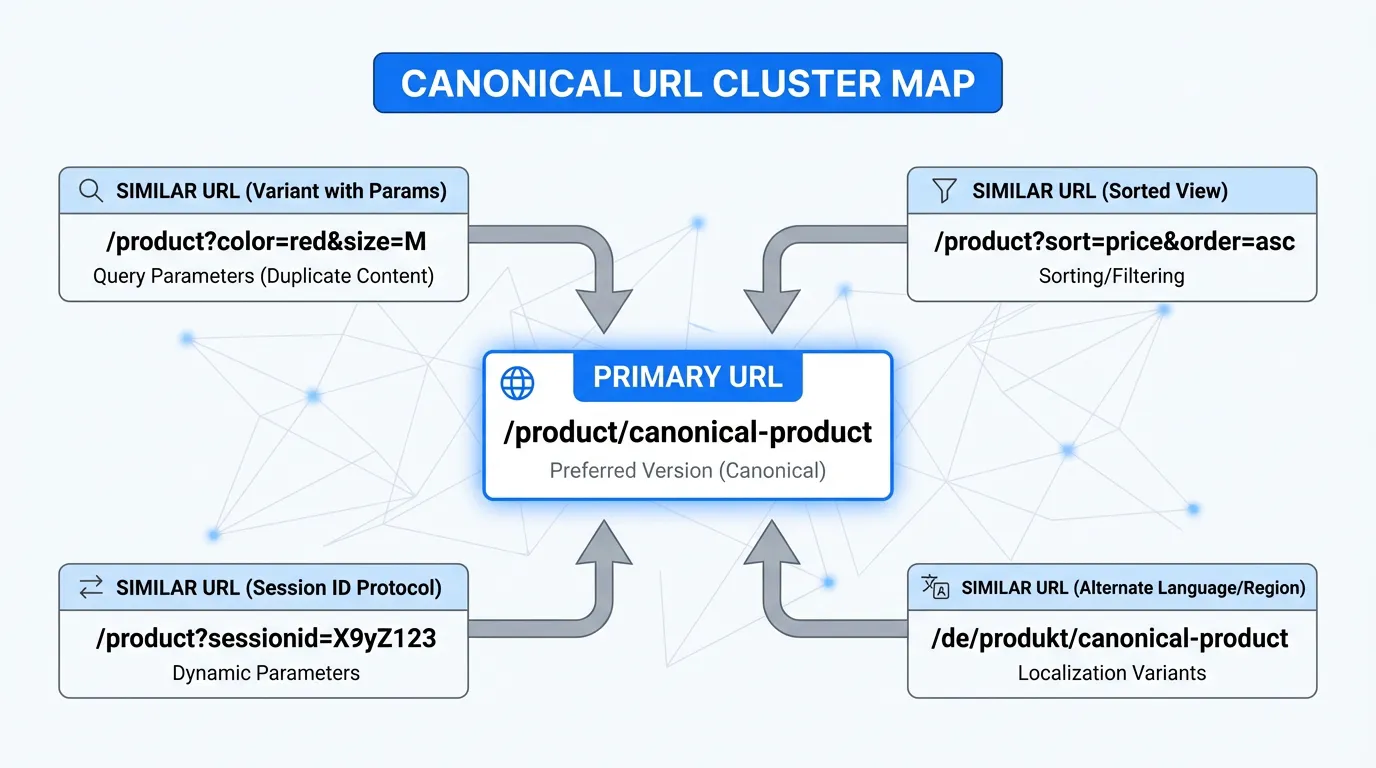
A key reminder from Google: canonical is a hint, not a directive. If your signals conflict, Google can ignore your declared canonical and choose a different one. See Google's guidance on consolidating duplicates in the Search Central documentation on duplicate URL consolidation, and how Google discusses clustering and canonical selection in the "Handling Dupes - Same Same or Different?" episode.
The 2026 decision framework: canonical vs redirect vs noindex vs hreflang
Use this table as a practical decision layer before you touch templates.
| Situation | Best primary action | Why it works | Common mistake to avoid |
|---|---|---|---|
| Old URL should never be used again | 301 redirect | Transfers users and consolidates signals | Leaving old URLs live and only adding canonical |
| Multiple URLs must remain accessible (variants, parameters) | Canonical tag | Consolidates ranking signals while keeping variants usable | Pointing canonical to a redirecting or non-indexable URL |
| Page is useful for UX but should not rank (internal search, some filters) | noindex (often with follow) | Keeps it out of search while preserving navigation | Putting these URLs in the XML sitemap |
| Same content concept, different language/region | Self-canonical + hreflang | Lets each locale rank appropriately | Cross-canonicalizing locales and breaking regional visibility |
For international pages, pair self-referencing canonicals with hreflang, as emphasized in Google's docs on consolidation and international setups (Search Central documentation).
Canonical best practices that prevent "Google chose a different canonical"
These are the non-negotiables that reduce ambiguity in duplicate clusters:
- Self-referencing canonical on every indexable page. Even your main pages should canonical to themselves to avoid accidental clustering.
- One canonical per page, in the HTML head. Avoid duplicates created by templates, plugins, or JS head managers.
- Canonical targets must be indexable and final. Your canonical target should return HTTP 200 and not be blocked by robots.txt or marked noindex.
- Make signals agree. Internal links, sitemap URLs, breadcrumbs, and canonical targets should consistently point to the same preferred URL.
- Do not rely on deprecated parameter controls. Google deprecated the URL Parameters tool; site owners are expected to handle parameter duplicates through canonicals, internal linking, and crawl controls (see the URL Parameters deprecation announcement).

Scenario playbooks: ecommerce, international, content hubs, and JavaScript
Ecommerce and faceted navigation
What usually breaks:
- Product variants (color, size) generate multiple URLs with the same core content.
- Filters and sorting create thousands of parameter combinations.
Playbook:
- Pick a primary product URL and use self-canonical there.
- Canonical variants back to the primary only when the variant does not deserve its own search presence.
- For filters, canonical low-intent parameter URLs to the base category, and reserve indexable pages for high-demand curated categories.
- For pagination, keep self-canonicals per page; do not canonical everything to page 1 (this can hide deeper items).
Multilingual and multi-region
If you operate across APAC, the US, and Europe, the most expensive mistake is making one region the canonical for all others.
Playbook:
- Each locale page uses a self-referencing canonical.
- hreflang connects alternates (including self).
- Avoid mixing clean and parameterized URLs across canonical and hreflang references.
Blogs and knowledge bases
Overlapping articles cause internal competition and confusing clusters.
Playbook:
- Define one "pillar" URL per core topic (as a strategy decision).
- Supporting articles should be distinct, self-canonical, and internally link to the pillar.
- Print/PDF versions should canonical to the main HTML article (or be blocked from indexing if purely for offline use).
JavaScript and headless frameworks
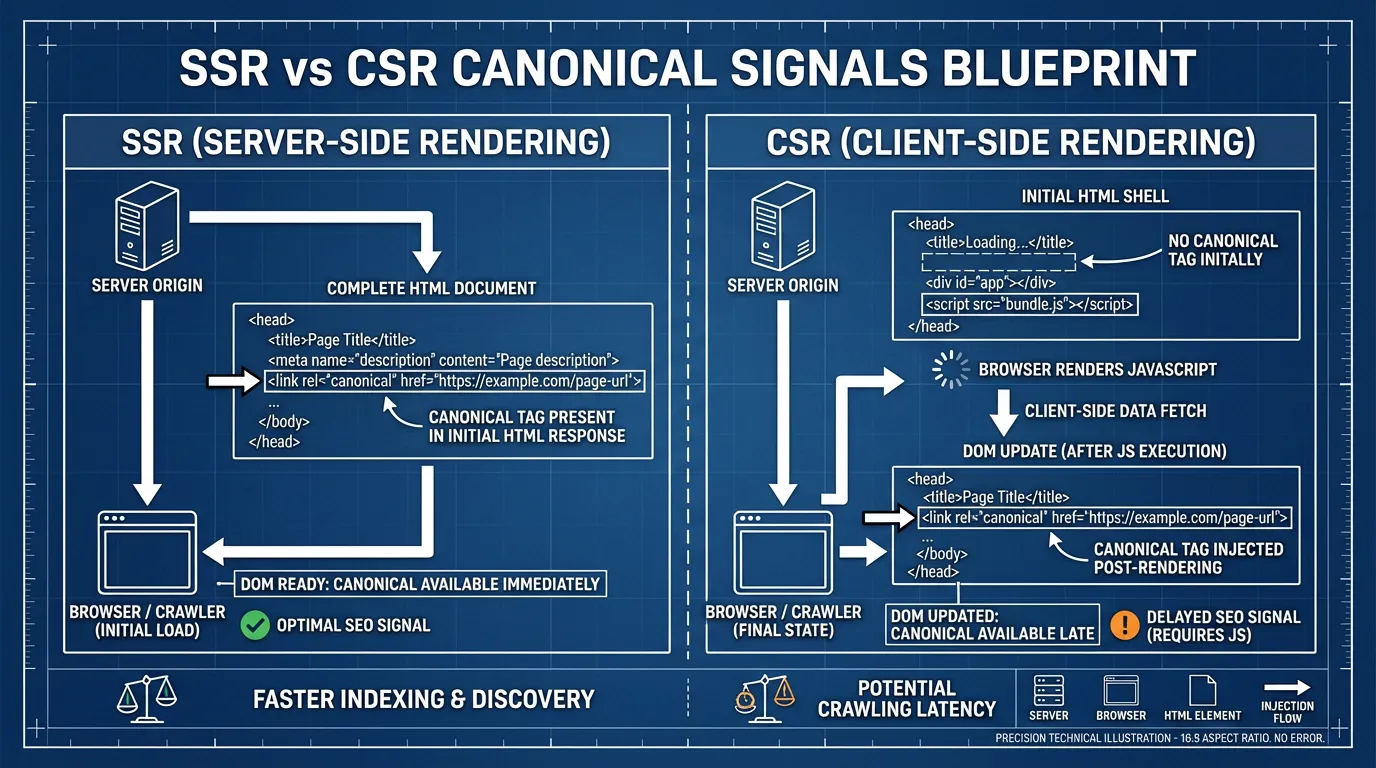
Google can process JS-injected canonicals, but it is not the preferred implementation path. The safer pattern is to render canonicals in the initial HTML, aligned with Google's JavaScript SEO guidance (JavaScript SEO basics) and industry summaries of canonical handling in JS rendering (Search Engine Journal coverage).
Playbook:
- SSR or pre-render critical signals (canonical, hreflang, structured data) whenever possible.
- Ensure the canonical in raw HTML matches the canonical after rendering.
- Avoid "canonical changes during hydration" that create conflicting signals.
A practical canonical audit workflow (what to check first)
A strong audit combines crawling, Search Console signals, and business context. Use the workflow below as your repeatable process.
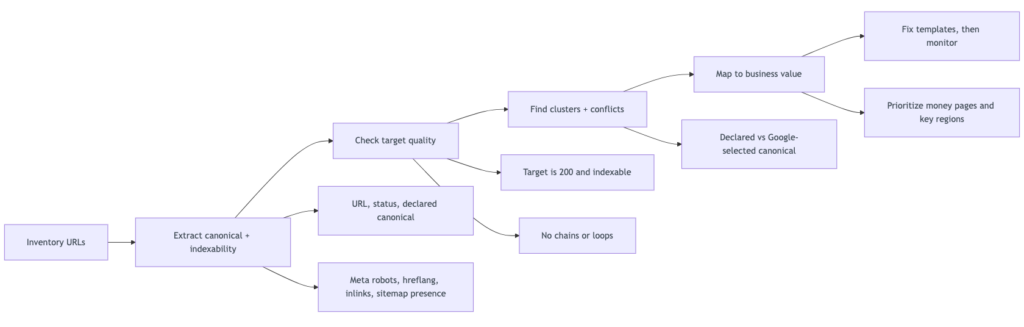
To keep prioritization honest, focus on what actually impacts growth, and deprioritize cosmetic canonical formatting issues when Google is already choosing correctly.
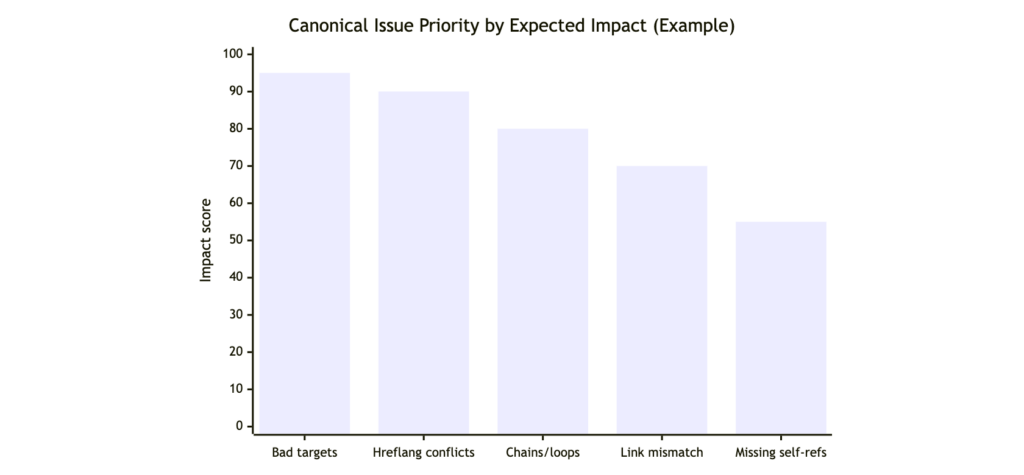
Turning canonical fixes into measurable SEO outcomes
Canonical work should reduce wasted crawling, concentrate authority on the right pages, and prevent the wrong URLs from ranking or being cited in AI-driven answers. That is why SeekLab.io treats canonicalization as part of a full technical and content system: diagnose first, decide the canonical model per section, implement at the template level, and monitor continuously.
If you want a second set of expert eyes on your canonical architecture, request a free audit report. Contact us and leave your website domain, and we will highlight what is truly holding back growth, what can be deprioritized, and what your team can implement with clear, actionable guidance.