AI Writing for SEO: Avoiding Generic Content
Expert reviewed

Why AI Writing for SEO Often Fails, and 7 Ways to Avoid Generic Content
AI writing for SEO is not the problem. Generic execution is.
That distinction matters for marketing and operations managers who are under pressure to publish faster, rank better, and still generate qualified leads. AI can absolutely reduce drafting time. But when teams use it without strategy, the result is usually the same: flat, repetitive articles that sound polished enough to publish, yet fail to rank strongly, fail to earn trust, and fail to convert.
According to Google's guidance on AI-generated content, the issue is not whether content is written by AI. The issue is whether the content is helpful, original, people-first, and created to add value instead of manipulating rankings. That is why a strong human + AI workflow now beats both extremes: AI-only content production and overly slow manual publishing.
For companies running independent websites, B2B sites, exporter websites, and multilingual properties, the real risk is not "using AI". The real risk is publishing AI content SEO assets that ignore business context, technical constraints, and search intent.

1. Generic AI Content Usually Shows the Same 7 Red Flags
If your current ai writing for seo process creates content with several of the signs below, the problem is not volume. It is direction.
-
It explains the topic without saying anything new
The article defines terms, repeats common advice, and never adds experience, nuance, or decisions tied to real business scenarios. -
It sounds smooth but empty
Generic intros, predictable transitions, and safe conclusions create the illusion of quality while avoiding specifics that buyers actually care about. -
It ignores search intent
A query may look informational, but the reader may really want a framework, comparison, checklist, or proof before taking action. -
It has no real-world examples
This is a common failure in AI content SEO. A B2B exporter in APAC does not have the same constraints as a SaaS startup in the US or a catalog-heavy ecommerce brand in Europe. -
It is disconnected from site structure
Content without a supporting internal linking plan often becomes an isolated URL with weak discovery and low business impact. This is why a deliberate internal linking strategy matters. -
It lacks strong visuals and structured elements
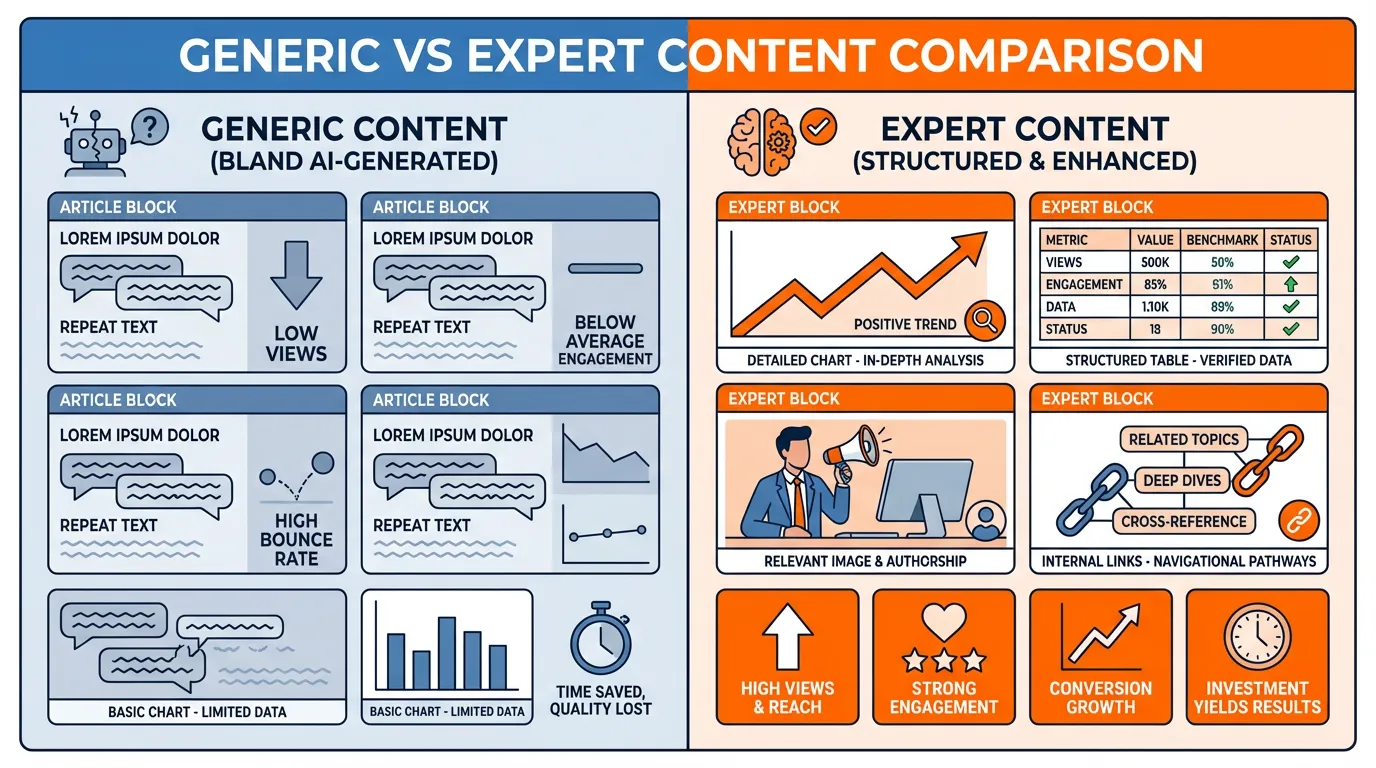
High-performing posts are not just text. Tables, diagrams, and well-planned images help both users and machine interpretation. -
It is published before technical issues are understood
If crawlability, indexing, rendering, or Core Web Vitals are weak, even strong content may underperform. A focused technical SEO audit should come before aggressive scaling.
Here is a practical comparison:
| Content approach | Typical outcome in rankings | User trust | Lead quality | Revision burden |
|---|---|---|---|---|
| Generic AI-only draft | Low to moderate | Low | Low | High |
| AI draft + light edits | Moderate | Moderate | Moderate | Moderate |
| Expert-led + AI assist | High | High | High | Lower over time |
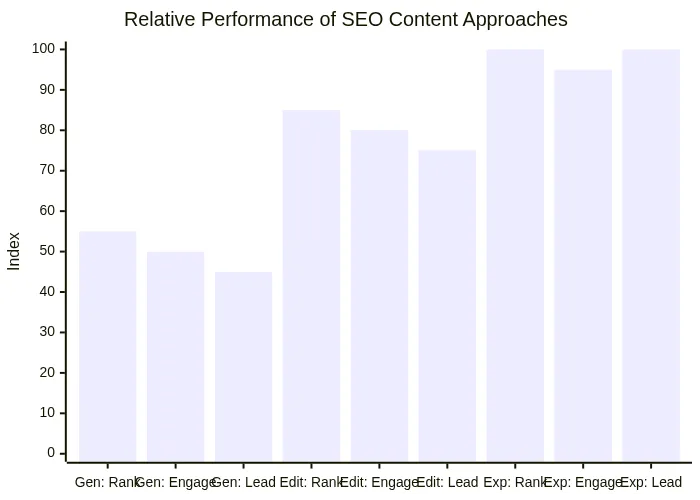
In practice, the best results come from expert-led planning with AI used as an accelerator, not a substitute for judgment.
2. What Search Engines Actually Reward in AI-Assisted SEO Content
A lot of teams still ask whether AI-written content is "safe". That is the wrong first question.
A better question is: what kind of content are search engines and AI answer systems rewarding now?
Based on the research report and current official documentation, the strongest signals include:
- Clear alignment with user intent
- Original insights or useful synthesis
- Demonstrated experience and expertise
- Logical structure and readability
- Strong internal linking and site architecture
- Clean crawlability and indexability
- Helpful visuals, tables, and supporting formats
- Structured data and entity clarity
Google's generative AI content documentation and spam policies make this clear: scaled, low-value pages created mainly to manipulate rankings are risky, regardless of whether AI helped produce them.
That is why SeekLab.io approaches content as a system problem, not a writing-only problem. Before publishing at scale, teams need to know:
- What should actually be prioritized
- What can be safely deprioritized
- Which technical issues are suppressing growth
- Which topic clusters are worth building now
- How to avoid heading in the wrong direction before writing begins
This is also where SEO content strategy becomes more valuable than random content production. The goal is not to fix everything. It is to identify what truly impacts growth first.
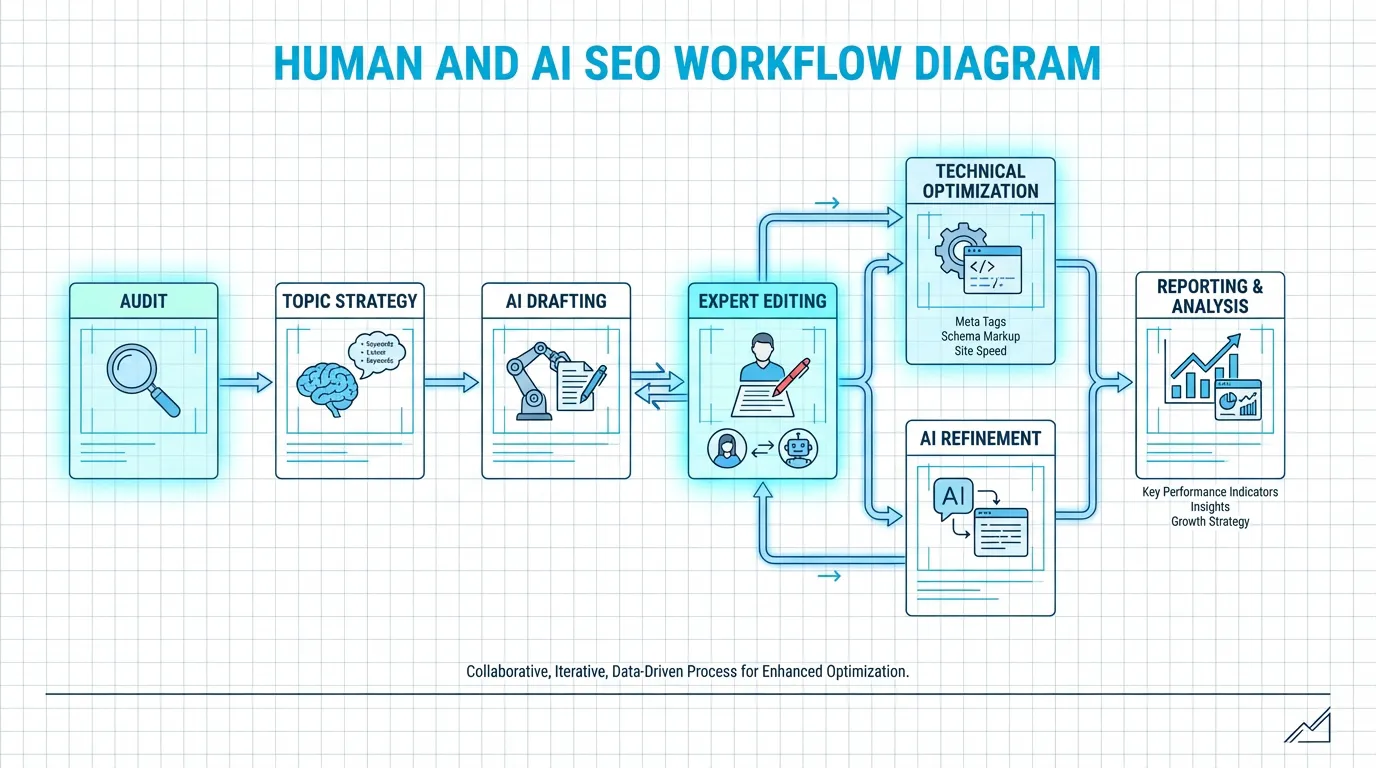
3. A Human + AI Workflow That Produces Better SEO Outcomes
The most reliable model is simple: humans lead the strategy, AI helps with speed, and humans finish the job.
That human + ai workflow is especially useful when your site serves multiple countries, long buying cycles, or technical products and services. SeekLab.io supports this by combining diagnostics, content planning, structured analysis, visual guidance, and technical consultation rather than treating content as a standalone deliverable.
A strong workflow looks like this:
| Stage | Human responsibility | AI responsibility | Why it matters |
|---|---|---|---|
| Diagnosis | Identify growth blockers and business priorities | Summarize large datasets | Prevents writing on a weak foundation |
| Topic selection | Define intent, audience, and commercial relevance | Expand SERP patterns and question sets | Avoids wrong-topic production |
| Brief creation | Set angle, examples, visuals, entities, CTA | Draft outline and coverage suggestions | Reduces generic output |
| Drafting | Guide structure and required proof points | Produce first-pass copy | Speeds production |
| Editing | Add expertise, scenarios, trust signals, brand voice | Support phrasing improvements | Improves E-E-A-T and clarity |
| Optimization | Add internal links, schema notes, conversion paths | Assist on-page formatting | Improves discoverability and performance |

This workflow is where SeekLab.io has a meaningful advantage. It can support:
- Full-site crawling and structured analysis
- Core Web Vitals and rendering diagnostics
- Indexing and crawlability checks
- Topic selection based on user intent and contextual scenarios
- High-quality blog creation with visually appealing images
- Structured recommendations for schema, internal links, and semantic layout
- Monthly review and performance reporting
- Clear technical guidance beyond diagnostics
If your team already has content but it feels thin or disconnected, a good starting point is improving high-quality blog content optimization before scaling production further.
4. Why Technical SEO Determines Whether AI Content Gets Seen
Many discussions about ai writing for seo stop at prompts and editing. That misses the bigger issue: content only works when the site can support it.
Technical SEO still decides whether your content is discovered, rendered, indexed, interpreted, and converted. This is especially important for modern stacks, international sites, and content-heavy publishing workflows.
Here are the technical areas that most often affect AI-assisted content performance:
| Technical area | What goes wrong | Business consequence |
|---|---|---|
| Crawlability | Important pages are blocked, orphaned, or buried | Content is not discovered efficiently |
| Indexing | Non-canonical signals or weak sitemap hygiene | Strong pages remain invisible |
| Core Web Vitals | Slow loading, unstable layout, heavy images | Lower engagement and weaker conversions |
| JavaScript rendering | Main content loads too late | Search systems may miss critical text |
| Schema markup | Poor entity clarity | Fewer rich search signals and weaker machine understanding |
| Site architecture | Topic clusters are not connected well | Lower topical authority |
| Hreflang setup | Wrong-language pages rank | Reduced international relevance |
This matters even more for brands active across APAC, the US, and Europe. If you publish localized AI-assisted content without aligning URL structure, canonicals, and hreflang, you can create more confusion than visibility.
The bigger lesson is simple: before you start writing content or fixing technical issues, make the right strategic decisions first. SeekLab.io's model is useful here because it does not stop at issue detection. It prioritizes what matters most, provides actionable solutions, and can resolve some simple technical issues for clients at no charge.
5. How to Build Non-Generic AI Content That Still Converts
If the goal is not just traffic, but qualified inquiries, your content needs more than polish. It needs commercial usefulness.
Here are five ways to make AI-assisted content more specific and more conversion-oriented:
1. Start every article with a business scenario
For example, instead of writing generally about content quality, frame the issue around a website owner seeing rankings rise while inquiry volume stays flat. That is a real pain point and immediately changes the content angle.
2. Require proof elements in the brief
Every brief should specify:
- target persona
- region
- search intent
- examples to include
- visual plan
- internal links
- desired CTA
3. Build around topic clusters, not isolated keywords
This is how topical authority grows. A post about ai writing for seo should naturally connect to technical audits, content planning, internal links, and AI search citation readiness.
4. Add visuals that explain decisions
Images should not be decorative only. They should help the reader understand tradeoffs, workflows, or data patterns.
5. Include a realistic next step
For readers who suspect their current content is generic, the best CTA is practical and low-friction: get a free audit report, contact us, and leave your website domain.
A useful review checklist is below:
| Before publishing, ask: | Yes/No |
|---|---|
| Does this article reflect a real buyer scenario? | |
| Does it say something beyond common definitions? | |
| Is the page connected to related internal content? | |
| Are visuals, tables, and structure helping comprehension? | |
| Have technical blockers been reviewed? | |
| Is there a clear conversion path for the reader? |
Spotting trending topics before they go viral also matters. SeekLab.io's process is designed to help brands build presence ahead of competitors, rather than publishing after the market is already saturated.
Final takeaway
The future of ai writing for seo belongs to teams that treat AI as part of a larger operating model, not as a one-click publishing shortcut.
If your current AI content SEO output feels repetitive, shallow, or disconnected from revenue, the fix is rarely "write more". The fix is to combine diagnosis, stronger briefs, expert editing, better visuals, technical SEO, and clearer internal structure.
That is the value of a disciplined human + ai workflow.
SeekLab.io helps teams do exactly that: identify what truly impacts growth, avoid wasted effort, create in-depth content built for both Google and AI search citation logic, and align traffic gains with conversion goals.
If you want to see where your site is losing visibility or publishing effort on the wrong priorities, get a free audit report, contact us, and leave your website domain.