From SEO to GEO: Adapting Content for AI Search
Expert reviewed

What GEO Adds to Traditional SEO (And Why It Is Not a Replacement)
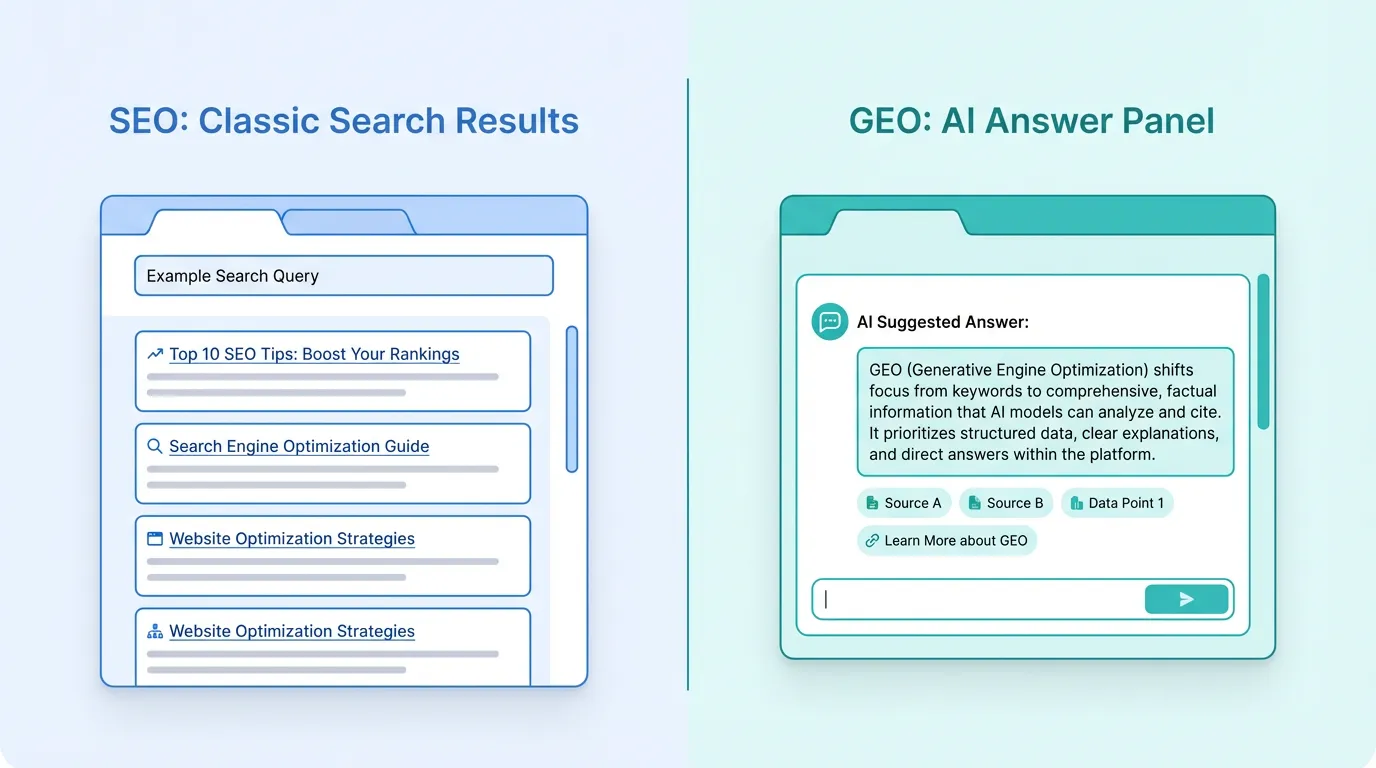
If you are comparing seo vs geo, the simplest way to think about it is this: SEO helps your pages get crawled, indexed, and ranked, while GEO helps your content get selected, cited, and recommended inside AI-generated answers.
Industry definitions converge on GEO as optimizing content and online presence so generative engines can use it in responses (see the Wikipedia definition of Generative engine optimization).
Here is a practical comparison you can use in planning meetings:
| Dimension | SEO (classic search) | GEO (AI answer engines) |
|---|---|---|
| Primary objective | Earn clicks by ranking in SERPs | Earn selection and citations inside AI answers (even when clicks are fewer) |
| What gets optimized | Individual pages and queries | Topic clusters and entities (brand, products, locations, experts) |
| Content that wins | Relevance + usability + authority | Fact-dense, clearly scoped, answer-ready content that is easy to quote |
| Technical baseline | Crawlability, indexing, Core Web Vitals, schema | All SEO fundamentals plus stronger entity clarity, structured data depth, and AI-crawl accessibility |
| Success metrics | Rankings, impressions, CTR, sessions, conversions | AI citations/mentions, topic share of voice in AI answers, plus leads and revenue impact |
One important strategic shift: GEO raises the cost of publishing generic content. If AI can answer it safely without visiting your site, the business value of that content drops fast.
AI Search vs Google Search: Why Clicks Are Shrinking (Even When Visibility Grows)
The ai search vs google search conversation is not just about user experience. It is about traffic mechanics.
Multiple studies show zero-click behavior is now the default for a large share of queries. SparkToro reports that in 2024, about 58.5 percent of US Google searches and 59.7 percent of EU searches ended without a click to the open web. Search Engine Land summarizes similar findings (Search Engine Land coverage).
When AI Overviews appear, click-through to organic results tends to drop sharply. Ahrefs observed meaningful CTR declines when AI Overviews are present (Ahrefs analysis).
A useful way to communicate this internally is to frame it as "attention share" shifting upward on the SERP:
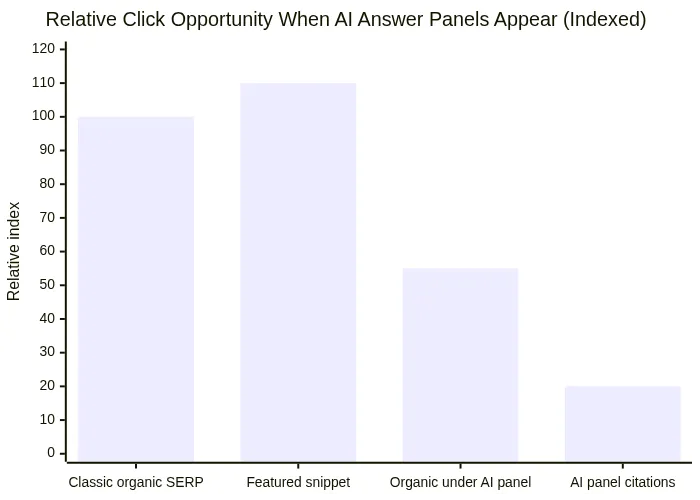
This is why many independent sites feel like they are "visible but not visited." The fix is not to abandon SEO. The fix is to publish and structure content that AI systems can cite confidently, and that real buyers still need to click for.

9 GEO-Ready Content Moves That Still Improve SEO (A Practical List)
Use this list as an execution checklist for content teams and web developers. It is designed for companies that cannot afford wasted effort and need measurable lead impact.
- Start with commercially meaningful topics, not "easy" informational ones
Prioritize queries tied to buying decisions, compliance, implementation, pricing logic, and vendor evaluation. AI can summarize definitions, but it struggles to replace supplier-specific proof, specs, and constraints. - Write for prompts, not just keywords
Turn real buyer questions into headings and FAQs. Search Engine Land highlights the importance of adapting content strategy for AI-powered SERPs and LLM behavior (guidance here). - Make pages quotable: concise definitions + detailed evidence
Add short "what it is" paragraphs, then follow with specifics: steps, constraints, numbers, standards, screenshots, examples, and decision criteria. - Use tables where buyers compare options
Tables are easy for humans to scan and easier for AI systems to extract accurately. - Build topic clusters with explicit internal links
A pillar page should summarize the theme. Supporting pages should answer narrow questions deeply and link back with descriptive anchor text. This strengthens both SEO site architecture and entity context. - Strengthen E-E-A-T signals without fluff
Add author attribution, real-world experience notes, and update dates where relevant. Avoid filler. Google is explicit about creating helpful, people-first content (Google Search Central guidance). - Implement schema that matches the page purpose
Use JSON-LD for Organization, Article, FAQPage, Product, BreadcrumbList, and other relevant types. Schema helps machines map relationships, which supports both rich results and AI understanding. - Reduce JavaScript dependency for critical content
If key copy only appears after client-side rendering, some crawlers and systems may not see it reliably. For modern stacks, consider SSR or hybrid rendering for your commercial pages, docs, and key articles. - Treat performance as a conversion lever, not a technical vanity metric
Core Web Vitals improvements often correlate with better user engagement and lead completion, especially on mobile.

A Lean Measurement Framework for the SEO + GEO Era
Because AI answers can reduce clicks, relying on rankings alone can create the exact overpromising problem many teams want to avoid.
Use a two-layer reporting approach:
- Classic SEO outcomes (still required): impressions, rankings, indexed pages, organic sessions, conversion rate, and assisted conversions.
- GEO indicators (lightweight but consistent):
- A shortlist of strategic prompts (10 to 30) that reflect your buyer journey.
- Quarterly manual checks across major AI experiences (for example, whether your content is cited or your brand is recommended).
- A simple log: prompt, cited sources, your presence (yes/no), page cited, and what content format won (guide, table, checklist, product page).
This keeps measurement honest: fewer vanity metrics, more visibility into whether AI systems trust your pages enough to reference them.
Where SeekLab.io Fits: Prioritize What Drives Growth, Then Execute
SeekLab.io is built for marketing and operations managers, plus independent site developers, who need clarity before investing more time and budget.
Practically, that means:
- Full-site crawling and structured analysis to find what is blocking growth.
- Diagnostics across Core Web Vitals, indexing, rendering, schema, internal linking, and multilingual structure (especially relevant across Asia-Pacific, the US, and Europe).
- Content topic selection and blog creation that is structured for both SEO and AI citation logic, with high-quality visuals.
- A "do the impactful work first" approach: not everything must be fixed, but the right things must be fixed.
If you want a deeper perspective on adapting strategy, reference SeekLab.io's analysis: Generative SEO in 2026: How to Adapt Your Strategy.
When you are ready to evaluate your site, you can take the next step here: Get a free audit report, contact us, and leave your website domain.