Generative SEO in 2026: How to Adapt Your Strategy
Expert reviewed

Generative SEO is no longer a buzzword—it's the layer of SEO that decides whether AI assistants actually mention and send traffic to your site. For independent websites and foreign trade businesses that rely on Google SEO for overseas leads, ignoring it is risky.
This guide explains what Generative SEO is, how search is changing through 2026, and a practical step‑by‑step plan to adapt—built around SeekLab's strengths in technical SEO, GEO (Generative Engine Optimization), and performance-based delivery.

What Is Generative SEO (GEO) and Why It Matters Now
Generative SEO (also called Generative Engine Optimization, GEO) is the practice of optimizing your brand, website, and content so that AI systems can easily find, understand, and trust you enough to cite or recommend you.
That includes:
- Google's AI Overviews in search results
- Bing + Copilot answers
- ChatGPT with browsing, Perplexity, You.com, and similar AI search/answer engines
Traditional Google SEO focuses on getting clicks from the "10 blue links". Generative SEO focuses on:
- Being selected as a source inside AI-generated answers
- Turning those mentions into qualified inquiries and revenue
For independent websites and foreign trade SEO, this is critical because:
- Simple informational traffic will continue to shift to AI answers[1]
- Buyers will often ask AI directly for suppliers, not just search in Google
- Only a handful of sources are cited—either you are in that shortlist, or you disappear
Low‑risk way to start:
Try Free Audit – Get a free SEO + GEO readiness audit and one 1,000‑word optimized article from a SeekLab technical specialist.
How AI Is Changing Search from 2024 to 2026
Google and Bing still crawl and index websites the same way—but how they present answers is changing fast.
- Google launched SGE, then AI Overviews, which show AI-written summaries at the top of results and link to a few sources.[2][3]
- Bing integrated Copilot answers directly into search.[4]
- Standalone AI engines (Perplexity, ChatGPT with browsing, etc.) synthesize answers from a small set of authoritative pages.[1:1][5]
From "rankings" to "selection"
For many queries:
- AI Overviews or Copilot answer the question directly
- Users may never scroll to traditional organic listings
- Only a few sources are cited—and they’re chosen based on overall authority, clarity, structure, and trust signals[2:1][6]
The relative interest in "Generative SEO" and related themes is already rising:
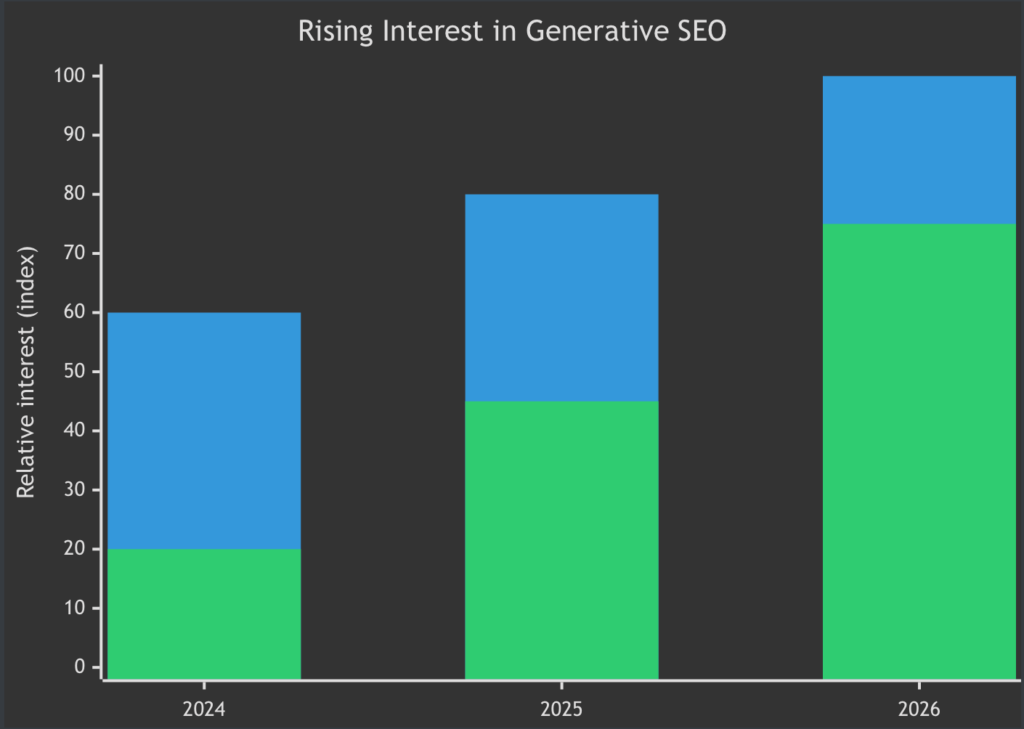
(Illustrative trend based on industry commentary and tool data.)[1:2]
For independent and foreign trade websites, the implication is:
- Fewer easy clicks on "what is…" content
- Higher value from each click that reaches you (buyers are more informed and closer to action)
- A need to optimize for both classic SEO and AI answer selection
Generative SEO vs "Just Using AI to Write Content"
A dangerous misconception is that Generative SEO simply means "publish more AI‑generated articles".
In reality:
- Google's Helpful Content and spam systems actively downgrade low‑value, mass‑produced AI content.[6:1]
- Bing and other engines follow similar quality principles.[4:1]
- LLMs prefer fact‑dense, well‑structured, original pages they can safely quote.
AI content tools are just production methods. Generative SEO is a strategy for:
- Structuring your site for AI understanding
- Demonstrating E‑E‑A‑T (Experience, Expertise, Authoritativeness, Trust)
- Becoming the most reliable source on your topics[6:2]
SeekLab uses AI where it helps (research, drafts, localization), but every deliverable is human‑reviewed, technically optimized, and aligned with business goals, not just word counts.
Traditional SEO vs Generative SEO: Key Differences
| Dimension | Traditional SEO (pre‑2024) | Generative SEO (2024–2026) |
|---|---|---|
| Main goal | Rank pages in top 10 results for specific keywords | Be selected and cited in AI answers across engines |
| Primary surfaces | Google/Bing organic listings | AI Overviews, Copilot, ChatGPT/Perplexity + classic SERPs |
| Focus unit | Individual pages | Topic clusters + entities (brand, products, locations)[5:1] |
| Content style | Keyword‑optimized, readable | Structured, fact‑dense, answer‑ready, clearly scoped[5:2] |
| Measurement | Rankings, traffic, CTR | AI citations, topic visibility, leads & revenue |
| Risk of low‑quality AI use | Lower (pre‑Helpful Content emphasis) | High: can trigger devaluation or spam signals[6:3] |
Step 1 – Get Your Technical Foundations Ready for Generative Search
Generative engines still rely on the same indexes and crawlers as classic search.[2:2][4:2] If your site is slow, confusing, or poorly indexed, you won't be cited.
Technical priorities
- Crawlability & indexation
- Fix broken links, redirect chains, and duplicate URLs
- Ensure important pages are reachable within a few clicks
- Performance & UX
- Improve Core Web Vitals (LCP, CLS, INP) for mobile and desktop[2:3]
- Use clean design and fast hosting
- Site structure
- Logical categories and subfolders (e.g., /products/valves/ball-valves/)
- Clear language/country setup for cross‑border SEO (hreflang, localized sections)
- Structured data (schema.org)
- Implement Organization, Product/Service, Article, FAQ, and LocalBusiness (where relevant) to clarify entities and relationships[2:4]
SeekLab's technical team can:
- Run a free SEO technical audit for new clients
- Propose practical fixes or custom development (e.g., schema automation, internal linking modules)
- Implement changes quickly—and does not charge if agreed minimum results are not achieved
Check your foundations now:
Try Free Audit – Includes one free 1,000‑word Generative SEO‑optimized blog article.
Step 2 – Build Topic Clusters and Entity Clarity
Generative SEO is built around topics and entities, not just individual keywords.[5:3]
How to structure topic clusters
For a foreign trade exporter (e.g., aluminum extrusion manufacturer):
- Pillar page: "Aluminum Extrusion Services for Global OEMs"
- Supporting articles:
- "Aluminum Extrusion Tolerances: International Standards Explained"
- "Surface Treatments for Aluminum Profiles (Anodizing, Powder Coating, etc.)"
- "Lead Time, MOQ, and Packaging for Aluminum Extrusion Exports"
- "Exporting Aluminum Profiles to the EU: Compliance and Certificates"
Interlink them logically and consistently use the same company name, product names, and target regions to help AI models map your expertise.
SeekLab’s AI‑enhanced keyword and topic research identifies:
- Natural‑language questions buyers ask AI assistants
- Gaps in your current coverage
- A topic roadmap for the next 3–6 months
Step 3 – Create Content That AI Engines Want to Cite
To be cited by AI answers, your content must be both machine‑friendly and buyer‑friendly.
Structure for answer extraction
- Use clear headings that reflect real questions:
- "What is Generative SEO?"
- "How to Choose a Valve Manufacturer for EU Imports"
- Add TL;DR / Key Takeaways sections near the top
- Include FAQ blocks for natural‑language questions
- Use tables, bullet lists, and step‑by‑step instructions that LLMs can easily convert into concise answers[2:5][5:4]
Go beyond generic AI content
Especially for B2B and foreign trade SEO, include:
- Technical specs (materials, pressure ratings, tolerances)
- Compliance and certifications (CE, ISO, FDA, etc.)
- Trade details (MOQ, Incoterms, lead times, payment terms)
- Real experience: case studies, photos, process explanations
Human + AI workflow (how SeekLab operates)
- AI helps with:
- Topic ideation and outlines
- Drafts and localized variations
- Human experts handle:
- Fact‑checking and adding real‑world examples
- Ensuring brand‑appropriate tone and clarity
- Aligning pages with E‑E‑A‑T and your sales process
Every new SeekLab client can experience this with a complimentary 1,000‑word GEO‑optimized article as part of the free audit.
Step 4 – Strengthen Off‑Site Authority and Brand Signals
When multiple sites cover similar topics, generative engines lean on off‑site signals to decide who to trust.[6:4][5:5][7]
Key elements:
- High‑quality backlinks
- From industry associations, trade portals, niche publications, and reputable blogs
- Contextual mentions (not random link farms)
- Brand/entity mentions
- Company name + topic mentioned across the web—even without links—helps models connect you with your niche
- Reviews & testimonials
- Third‑party reviews and detailed case studies support trust
- Author & organization visibility
- Expert author bios with credentials, conference talks, whitepapers
SeekLab's off‑site SEO focuses on quality and relevance, not volume, to increase the chance your brand becomes the default recommendation for your niche.
Step 5 – Measure Success When AI Answers Reduce Clicks
If AI Overviews answer more queries directly, you need to look beyond raw traffic.
Metrics to watch
| Metric type | What to monitor | Why it matters in Generative SEO |
|---|---|---|
| Classic SEO | Organic traffic, rankings, CTR | Still show visibility in traditional SERPs |
| Topic visibility | Impressions and average position for key topics in GSC | Indicates how often you're considered, even if clicks plateau |
| Brand strength | Brand + topic searches, direct traffic | Shows whether you're becoming a "known name" |
| GEO proxies | Manual checks of AI Overviews, Copilot, ChatGPT, Perplexity | Confirm if your site is cited for target queries |
| Conversion & revenue | "Send Inquiry" forms, RFQs, calls, closed‑won deals | Aligns SEO/GEO with real business outcomes |
SeekLab’s performance‑based model typically aligns tiers with:
- Growth in qualified organic leads
- Improved visibility for agreed commercial topic clusters
- Conversion‑rate impact from SEO/GEO initiatives
Want a KPI plan tailored to your site?
Send Inquiry – We'll propose performance‑linked targets and pricing.
A 90‑Day Generative SEO Action Plan
You don’t need to rebuild everything at once. Focus on disciplined execution over 90 days.
| Phase (30 days) | Focus areas | Example actions for an independent / foreign trade site |
|---|---|---|
| Days 1–30 | Audit & technical fixes | Full SEO + GEO audit, fix critical crawl/index issues, basic schema roll‑out |
| Days 31–60 | Topic clusters & content | Define 1–2 key clusters, create pillar page + 2–3 supporting articles |
| Days 61–90 | Authority & measurement | Begin targeted link/PR outreach, set up dashboards, first AI citation review |
SeekLab supports this with:
- Pre‑engagement: Free audit + 1,000‑word article
- During engagement:
- Tiered pricing by performance
- Free fixes for some simple technical issues
- Monthly data review and performance reports
- After engagement:
- Ongoing risk monitoring and alert notifications for your website
How SeekLab Reduces SEO Risk for Independent and Foreign Trade Sites
Many independent site owners and marketing managers worry about:
- Paying agencies and seeing no real results
- Working with teams that lack technical depth
- Increasing rankings/traffic but not leads or sales
SeekLab is structured to address exactly these concerns:
- Performance‑based, tiered pricing
- Fees linked to agreed result thresholds; no charge if minimum expected results are not achieved
- Deep technical capability
- Teams in Singapore and Shanghai handle complex site structures, multilingual SEO, and custom development
- A BD team in Dubai understands cross‑border trade flows and buyer behavior in key markets
- Full‑stack SEO + GEO
- Website development, site structure optimization, indexing/crawling, on‑page SEO, backlinks, and off‑site SEO
- AI large‑model brand visibility monitoring: track how often your brand appears in AI assistants
- AI‑driven keyword and topic research tailored to Google SEO and Generative SEO
- Transparent process and reporting
- Monthly performance reports tied to leads and business outcomes
- Continuous risk monitoring and alerts after implementation
Ready to see how Generative SEO can protect and grow your international leads?
Try Free Audit Send Inquiry or Contact Us for a custom plan.
Conclusion: Generative SEO Is Here to Stay
By 2026, Generative SEO won't replace traditional SEO—it will sit on top of it as a new requirement, the way mobile‑friendly design and structured data did in the past.[7:1]
For independent websites and foreign trade businesses, the winning approach is clear:
- Technical excellence so search engines and AI can access and trust your site
- Topic‑driven, structured content that answers real buyer questions in a machine‑friendly way
- Strong off‑site authority to become the go‑to recommendation in your niche
- Measurement tied to leads and revenue, not vanity metrics
If you want a partner who shares risk with you and is accountable for performance, SeekLab’s Generative SEO services are designed for exactly that.
Citations
Brightter – Why Generative Engine Optimization will replace traditional SEO in 2026 (GEO vs SEO outlook). https://www.brightter.com/articles/why-generative-engine-optimization-will-replace-traditional-seo-in-2026 ↩︎ ↩︎
eMarketer – Generative Engine Optimization in 2026 (market and behavior analysis). https://www.emarketer.com/content/generative-engine-optimization-2026 ↩︎ ↩︎ ↩︎
Google Search Essentials & structured data guidelines. https://developers.google.com/search/docs/essentials and https://developers.google.com/search/docs/appearance/structured-data ↩︎ ↩︎ ↩︎ ↩︎ ↩︎ ↩︎
Search Engine Land – Google Generative AI library (news and analysis of AI Overviews/SGE). https://searchengineland.com/library/google/google-generative-ai ↩︎
Bing Webmaster Guidelines – Technical and content best practices for Bing and Copilot. https://www.bing.com/webmasters/help/webmasters-guidelines-30fba23a ↩︎ ↩︎ ↩︎
Go Fish Digital – Generative Engine Optimization strategies (topics, entities, GEO best practices). https://gofishdigital.com/blog/generative-engine-optimization-strategies/ ↩︎ ↩︎ ↩︎ ↩︎ ↩︎ ↩︎
Google Helpful Content & E‑E‑A‑T documentation. https://developers.google.com/search/docs/fundamentals/creating-helpful-content ↩︎ ↩︎ ↩︎ ↩︎ ↩︎