2026 Global High-Ticket Product Search Trends & Buyer Decision Pathways
Expert reviewed


High-ticket buying is no longer a neat funnel. It is closer to a loop: buyers bounce between discovery, validation, internal alignment, and risk reduction until enough uncertainty is removed to move forward. That shift is now visible in both consumer and B2B behavior, and it is reshaping how global search demand forms, how pages should be structured, and how conversions actually happen.
Multiple reputable studies point to longer, multi-touch journeys: buyers commonly consult 8 to 12 information sources before committing, moving back and forth between exploration and evaluation rather than progressing linearly (see Think with Google on the "messy middle" of purchase behavior). In B2B, the buying group often includes 6 to 10 stakeholders, each doing their own independent research before sales ever gets involved (see Gartner on the B2B buying journey).
Below is an opinionated, execution-oriented view of what those shifts mean for independent websites, exporters, and B2B brands heading into 2026, especially across APAC, the US, Europe, and Dubai-centric cross-border trade routes.
1) The 2026 shift: search is still the entry point, but not the whole journey
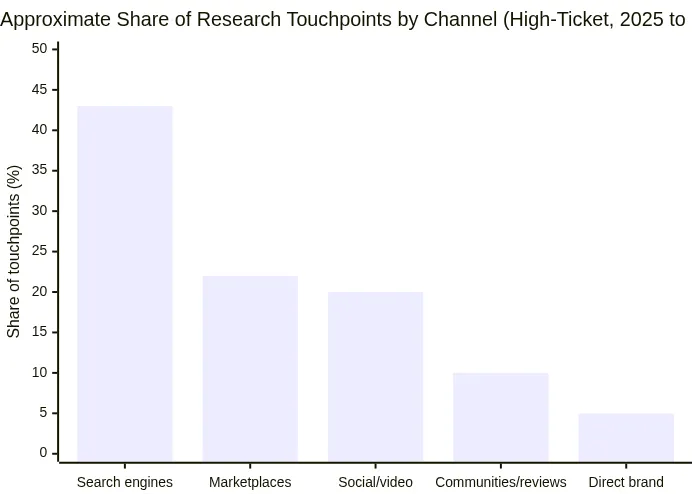
Search engines remain the primary discovery layer, but in high-ticket categories they increasingly share influence with marketplaces, social video, and communities during evaluation.
A practical way to think about 2025 to 2026 is "search starts the conversation, other channels close the trust gap":
- Search engines: still dominate early problem framing and initial vendor discovery.
- Marketplaces and B2B portals: compress comparison because buyers can scan options, pricing ranges, and shipping logic quickly.
- Social and video: de-risk complex decisions with demonstrations, walk-throughs, and real-world proof.
- Communities and reviews: act as a third-party credibility layer that buyers trust more than vendor claims.
Two additional shifts matter for conversion design:
- Mobile leads discovery, but desktop still wins complex configuration. Global benchmarks show mobile drives the majority of traffic and a large share of orders overall, yet high-ticket buyers often switch to desktop for deeper comparison, configuration, or contract steps (see the Salesforce Global Shopping Index for device behavior context).
- Zero-click and answer-style SERPs are compressing generic traffic. Estimates suggest fewer than half of Google searches now end in a click (see SparkToro's analysis). That does not kill SEO for high-ticket categories, but it punishes shallow pages and rewards structured, evidence-rich content that can be surfaced or cited.
If you rely on generic top-of-funnel blog posts, you may see impressions without meaningful leads. High-ticket SEO is increasingly about decision support, not just visibility.
2) Buyer decision pathways: intents evolve, and buyers loop back under risk
High-ticket queries evolve in predictable stages, even when the journey is messy. The key is to map content to intent, and intent to the decisions buyers are trying to make.
Here is a simplified, high-ticket pathway model you can actually build around:
| Buyer stage | Dominant intent | What the buyer is trying to resolve | Content that wins |
|---|---|---|---|
| Problem awareness | Informational | "Do I have a problem worth solving?" | Explainers, checklists, regulatory primers |
| Solution exploration | Informational + Commercial | "What approaches exist, and what fits my scenario?" | Category guides, use-case pages, constraints by region |
| Vendor and product comparison | Commercial | "Which short list is defensible to others?" | Comparison pages, case studies, ROI and TCO logic |
| Commitment and purchase | Transactional + Navigational | "Can I confidently buy, RFQ, or book a demo?" | Conversion pages, pricing logic, RFQ flows, localized contact paths |
| Implementation and support | Informational | "Will this work after I pay?" | Setup guides, troubleshooting hubs, documentation |
| Advocacy and renewal | Informational + Commercial | "Was it worth it, and should we expand?" | Customer stories, upgrade paths, review prompts |
Across the full cycle, the global intent mix typically skews heavily toward education and evaluation, not pure "buy now" terms:
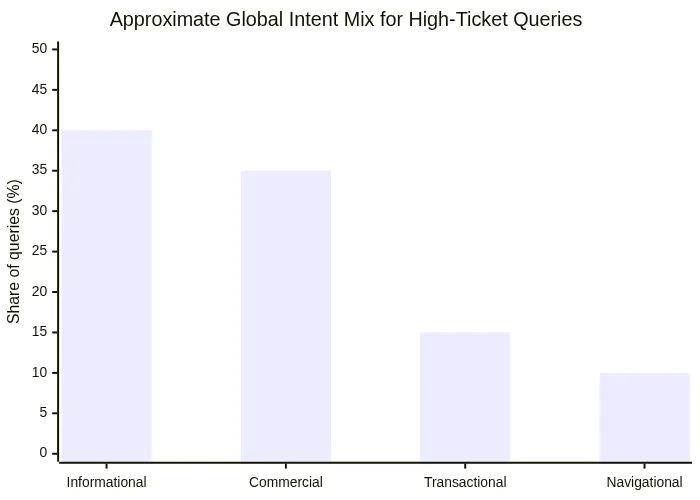
The practical implication: if your site only invests in transactional pages (product pages, RFQ forms, pricing pages), you will lose the research phase where shortlists are formed, and you will pay for it later in lead quality and sales cycle length.
3) What content actually moves high-ticket buyers (and why UGC is non-negotiable)
High-ticket buyers do not just want answers. They want proof, edge cases, and post-purchase reality. That is why reviews, Q&A, and community-driven evidence are so influential in expensive decisions.
Multiple commerce studies report that over 90 percent of shoppers read reviews before high-value purchases, and conversion lifts when product pages include robust reviews and Q&A (see PowerReviews on the power of reviews). In parallel, product content research highlights that richer product information and authentic user content materially change buying confidence (see Salsify's 2025 behavior summary).
For independent sites and exporter catalogs, this creates a clear "content stack" that tends to outperform generic blogging:
- Decision pages (comparison, alternatives, "best for X") that help justify the shortlist.
- Implementation content that reduces perceived risk after purchase.
- Proof assets: case studies, certifications, warranty details, and structured reviews.
Regional nuance that many teams miss
- APAC: video demonstrations and super-app driven conversations often shape late-stage decisions, so your content must be easy to share and verify. Buyers may mix English with local-language spec terms, which makes multilingual architecture and consistent product data more important than clever copy.
- Europe: regulation, sustainability, and certifications appear more often in query patterns, so decision pages need compliance context, not just features.
- Dubai and the Middle East trade hub dynamic: late-stage steps may move to WhatsApp or email negotiation, which means your site must surface trust elements and clear contact paths without friction.
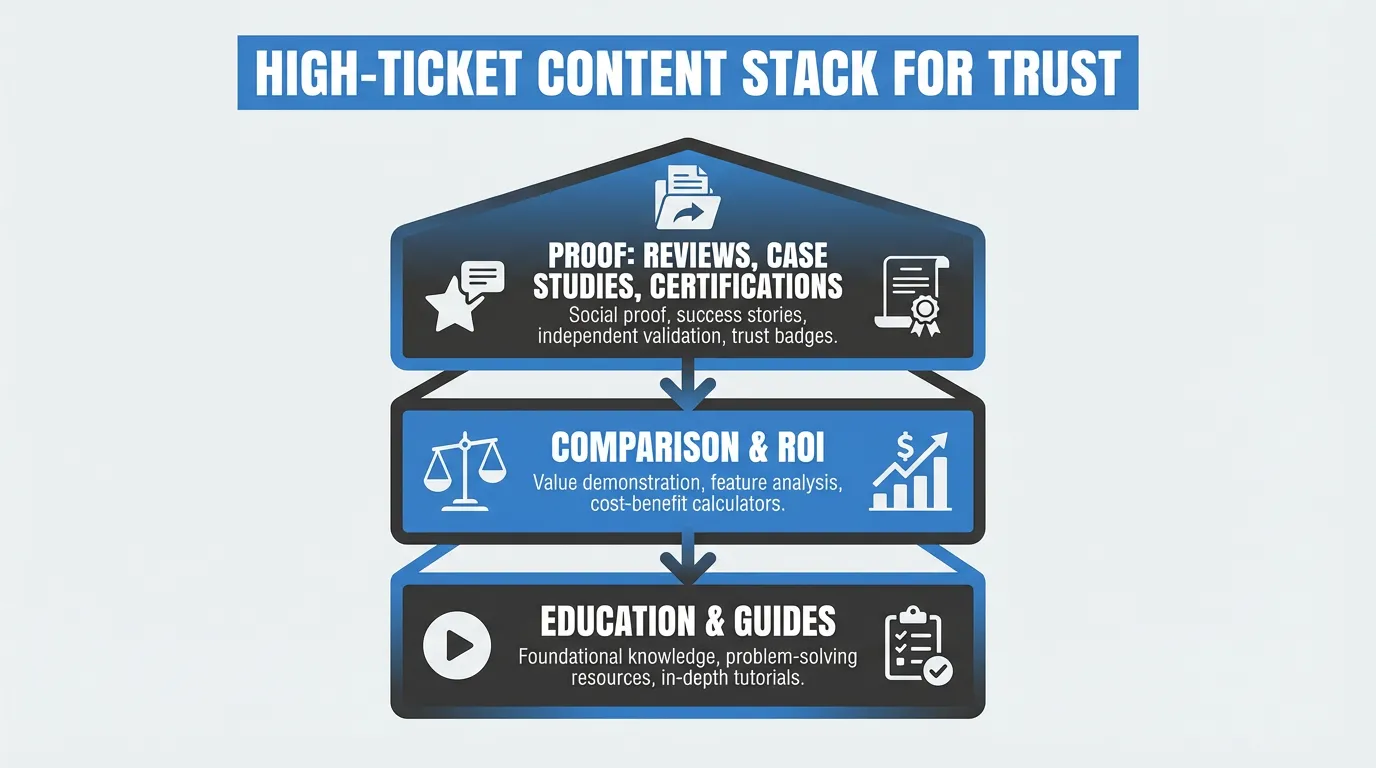
If you only publish informational articles without building comparison and proof layers, you will attract researchers who never become internal champions.
4) Technical SEO becomes the gatekeeper for both rankings and conversions
In high-ticket journeys, technical weaknesses do not just reduce rankings. They break trust during evaluation and introduce friction when buyers try to validate details across devices and stakeholders.
Four technical themes consistently matter most:
Site architecture and internal linking: make evaluation paths obvious
High-ticket sites win when they behave like decision systems. A shallow, logical structure helps both crawling and human evaluation. It also makes your internal linking strategy far more effective because guides can reliably link into commercial pages, and commercial pages can link back to proof and implementation.
If you want a deep dive on how to structure this for B2B and ecommerce templates, see SeekLab.io's article: "Advanced SEO Site Architecture For B2B & ECommerce Success".
Core Web Vitals and performance: slow pages lose the shortlist
High-ticket evaluation sessions are long. Buyers open many tabs, compare specs, and revisit pages multiple times. Poor LCP, CLS, or INP is not a minor UX issue in this context. It increases abandonment risk at exactly the stage when buyers are narrowing choices (see Marketing Refresh's B2B SEO trend summary for performance emphasis).
JavaScript and rendering: ensure key info exists at load
Configurators, filters, and dynamic product experiences are common in B2B and exporter catalogs. If critical content is not reliably rendered and indexable, you can end up with:
- pages that rank poorly despite strong demand,
- mismatched specs between regions,
- missing product details in search previews.
Schema markup and entity clarity: make your evidence machine-readable
Structured data (Product, Offer, Review, FAQPage, Organization) helps search engines and answer-style experiences interpret your content. In a world where many searches never click, machine-readable clarity is increasingly a prerequisite to being surfaced and cited.
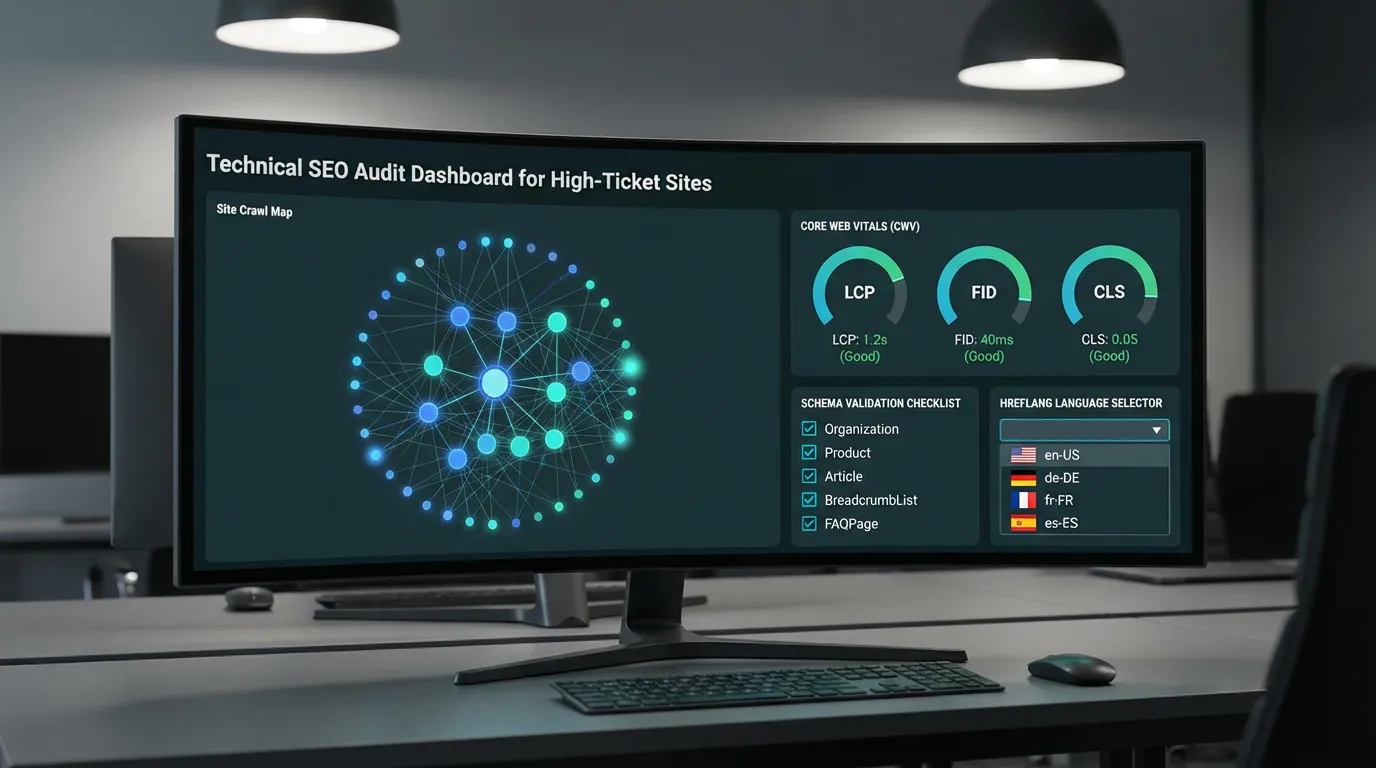
International SEO and hreflang: exporters hit ceilings here first
For multi-region growth, poor hreflang SEO and fragmented site architecture frequently block results more than "not enough content." Exporters also face region-specific trust and compliance questions (warranties, tariffs, certifications), which means localization must include more than translation.
A practical rule: keep core product entities consistent globally (names, specs, key benefits), then localize the decision drivers (compliance, currency, shipping terms, service coverage).
5) A decision-first SEO plan for 2026 (what to do next, and what to ignore)
High-ticket SEO fails when teams try to "fix everything." The more scalable approach is to identify what truly impacts growth, deprioritize the rest, and build a system that supports the buyer's pathway end-to-end.
Here is a pragmatic plan that works well for independent sites, B2B teams, and exporters:
- Map buyer pathways by region and role.
- Include APAC, US, and Europe differences.
- For B2B, explicitly map stakeholder questions (technical, finance, operations).
- Audit what blocks the pathway.
- Crawlability and indexation of revenue-critical templates.
- Performance issues on category and product templates.
- Rendering and JavaScript compatibility for key pages.
- Schema coverage for products, offers, reviews, and FAQs.
- International setup, especially hreflang and canonical logic.
- Build decision clusters, not random topics.
- One pillar that matches the category decision.
- Supporting guides that resolve constraints.
- Comparison content that earns shortlist placement.
- Proof and implementation assets that reduce regret risk.
- Measure what high-ticket SEO actually influences.
- Lead quality, not just volume.
- Deal velocity and assisted conversions.
- Engagement depth on decision and proof pages.
This is also where many marketing and operations managers want accountability. If you are worried about paying for SEO work that does not translate into business outcomes, you are asking the right question.
SeekLab.io's approach is built around strategy-first decisions, comprehensive diagnostics (technical and non-technical), and clear prioritization: focus on what drives growth, deprioritize what does not, and provide actionable guidance rather than a list of problems.
If you want a starting point tied to your specific site architecture, international setup, and buyer pathway, use the CTA below to request a free audit report and share your domain: Get a free audit report, contact us, and leave your website domain.