Master Keyword Research & Search Intent 2026
Expert reviewed

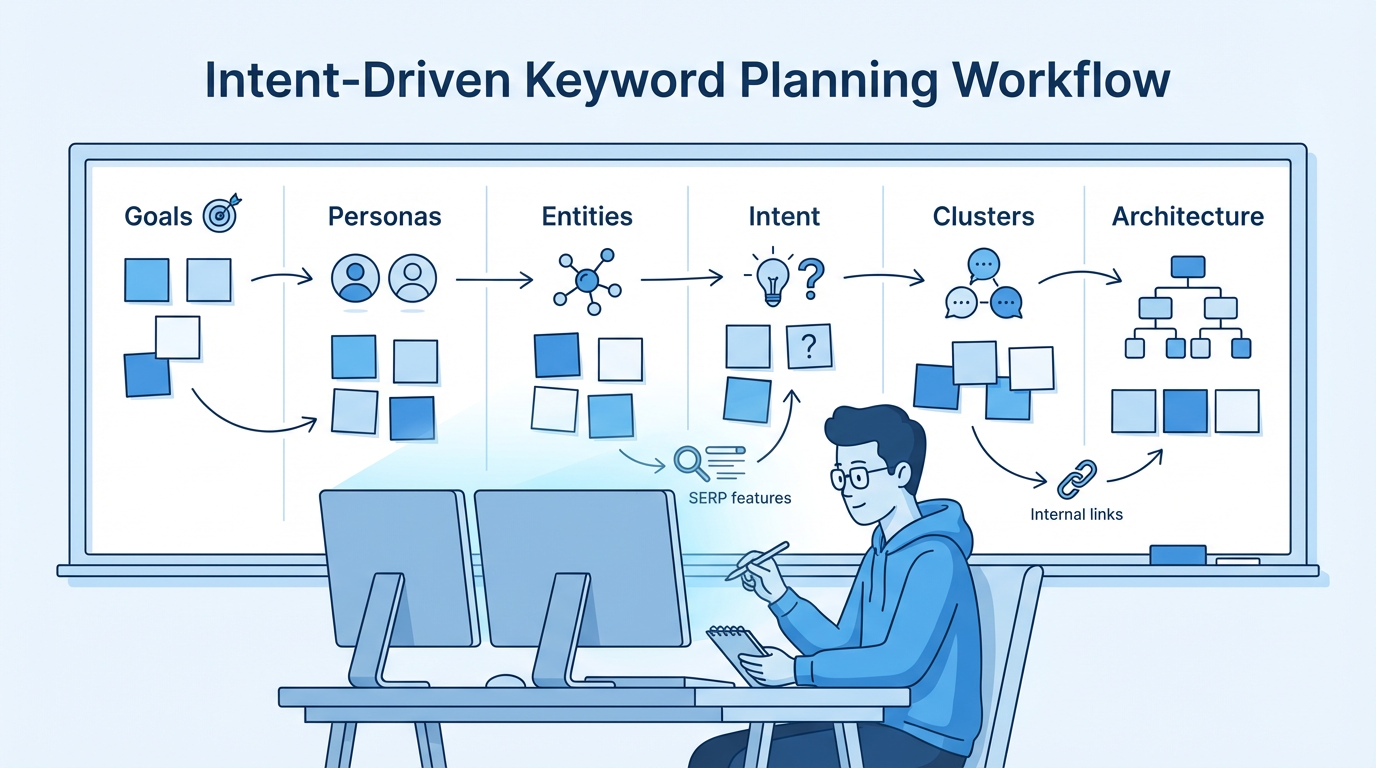
Modern keyword research in 2026 is no longer about collecting a big spreadsheet and chasing the highest volume terms. It is a strategic system that connects business goals, entities/topics, keyword clustering, and search intent, then validates everything against what actually ranks and what your site can technically support. Done well, it reduces wasted content production, prevents cannibalization, and improves lead quality, not just traffic.
What changed (2024 to 2026): from keywords to intent and entities
Across major SEO publications, the consistent pattern is a shift from exact-match terms to semantic coverage, with intent as the primary filter for ranking and UX. This aligns with how modern systems interpret meaning and relationships between entities (topics, brands, concepts) rather than just strings of text. See broader trend context from sources like Search Engine Land and Semrush: Search intent overview, SEO trends.
Three practical implications for teams managing independent and corporate websites:
- Business fit beats raw volume. A smaller query set that matches your services, markets, and conversion path will outperform "popular" topics that attract the wrong visitors.
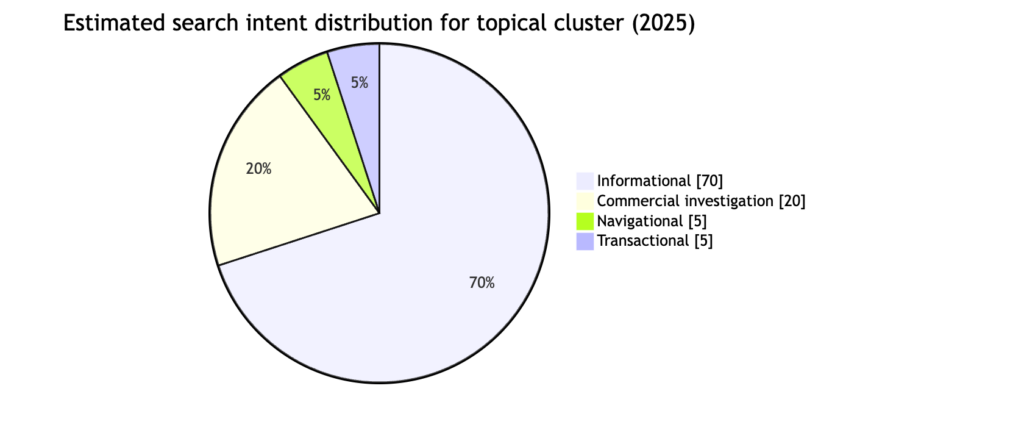
- SERPs are mixed-intent more often. Many head terms blend informational and commercial investigation intent, especially in B2B and tool-adjacent topics.
- Execution depends on technical reality. Even the best plan underperforms if pages are slow, hard to crawl, blocked from indexing, or fragmented by poor internal linking.
The intent mix below is a useful mental model for planning content depth and CTAs:
A 2026-ready keyword research framework (strategy first, execution second)
Use this workflow when you want decisions you can defend to stakeholders and measure over time.
Step 1: Define outcomes and constraints
- Primary conversions: inquiry, contact, audit request, quote request.
- Markets and languages (especially if you operate across APAC, the US, and Europe).
- Internal limitations: content bandwidth, dev capacity, template restrictions, tracking constraints.
Step 2: Build an entity-first topic map
Instead of starting with a list of terms, list the entities you must be known for (services, problems, industries, technical concepts). This helps you plan topical coverage and internal linking like a system.
Step 3: Expand keywords by real-world language
Combine:
- Sales/support questions (what prospects actually ask).
- SERP features (People Also Ask-style questions, related searches).
- Tool discovery (directionally), then validate by manual SERP inspection.
Step 4: Label intent using SERP evidence
Do not trust intent labels blindly. Manually check what ranks and note:
- Guides, definitions, FAQs (informational).
- Comparisons, "best," "vs," tool lists (commercial investigation).
- Service pages and strong conversion layouts (transactional).
This concept is covered well in Search Engine Land's guide: Search intent overview.
Step 5: Decide what deserves investment
This is where SeekLab.io's philosophy matters: don't aim to fix everything. Prioritize what truly impacts growth and deprioritize low-yield work until the high-impact bottlenecks are removed.

Keyword clustering that supports site architecture (not just a spreadsheet)
Keyword clustering is most valuable when it directly informs site structure, internal links, and content templates.
Three clustering methods you can combine:
- Rule-based grouping: modifiers like "template," "for ecommerce," "2026," "checklist." Easy to QA, limited scale.
- SERP-based grouping: keywords are "similar" if top results overlap. Grounded in reality, but thresholds can be noisy.
- Semantic clustering (embeddings): captures nuance and language variants. Powerful, but needs careful validation.
A simple way to operationalize clustering is to separate topic and intent first, then map to pages:
| Cluster goal | What you group by | What you avoid | Typical output |
|---|---|---|---|
| Prevent cannibalization | Same topic, different intent | One page trying to do everything | Separate pages (guide vs service vs comparison) |
| Build topical authority | Same entity/topic neighborhood | Random unrelated posts | Pillar + supporting articles |
| Improve crawl and discovery | Related pages in a logical section | Orphan pages, flat blog structure | Clean folders, breadcrumbs, internal link paths |
If you run multilingual or multi-regional sites, avoid translating clusters word-for-word.
Map intent to content types, internal links, and technical SEO checks
This is where many teams lose leads: they publish content that ranks but does not match the user's next step, or the page experience is too slow or confusing to convert.
1) Match intent to format (and conversion design)
| Dominant intent | What users expect | Content patterns that work | Conversion next step |
|---|---|---|---|
| Informational | Clear explanation + steps | Guides, checklists, FAQs, diagrams | Soft CTA to audit your current setup |
| Commercial investigation | Options and decision criteria | Comparison tables, pros/cons, evaluation framework | CTA to talk to an expert, request an audit |
| Transactional | Fast proof and trust | Service pages, case studies, clear scope | CTA to contact and leave your domain |
2) Validate technical feasibility before publishing at scale
Before you produce a new cluster, check whether the site can support it:
- Crawlability and indexing (sitemaps, robots rules, rendering issues).
- Core Web Vitals and performance on the template you plan to use.
- Internal link equity: can new pages be discovered quickly and supported by relevant links?
- Schema alignment: Article/FAQ structured data where appropriate.
This "content meets technical" approach is especially relevant for international sites (hreflang mapping, canonical handling, and clean regional targeting).
Metrics, timelines, and when to ask for help
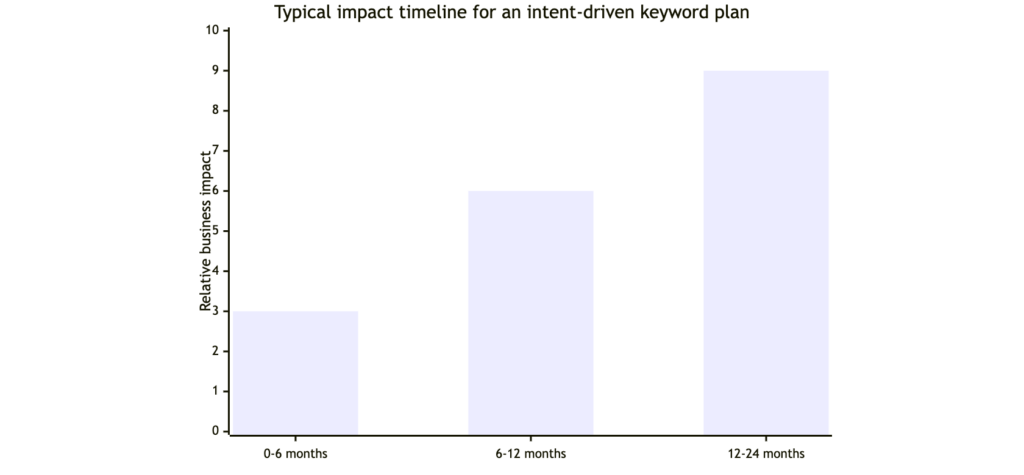
Good planning should reduce risk, but SEO outcomes still take time. Multiple industry references converge on realistic windows for meaningful results, often starting with early movement in months and compounding over 6 to 12 months.
Track success at the cluster level, not single keywords:
- Visibility for cluster heads + long tails.
- Engagement (CTR, time on page, scroll depth).
- Leads/inquiries from organic sessions.
- Technical impact (index coverage changes, Core Web Vitals stability).
A simple expectation curve looks like this:
If you are seeing any of these, it is a strong signal to get an outside audit:
- Content ranks but does not generate inquiries.
- Multiple pages compete for the same intent (cannibalization).
- International pages do not appear in the right country/language results.
- Technical constraints (rendering, performance, internal linking) keep recurring.
SeekLab.io is built for teams that need clarity and accountability: comprehensive diagnostics (technical and non-technical), actionable recommendations, and guidance on implementation. If you want to turn your current plan into a prioritized roadmap, get a free audit report, contact us, and leave your website domain.