Scale Your Production with SEO Content Briefs
Expert reviewed

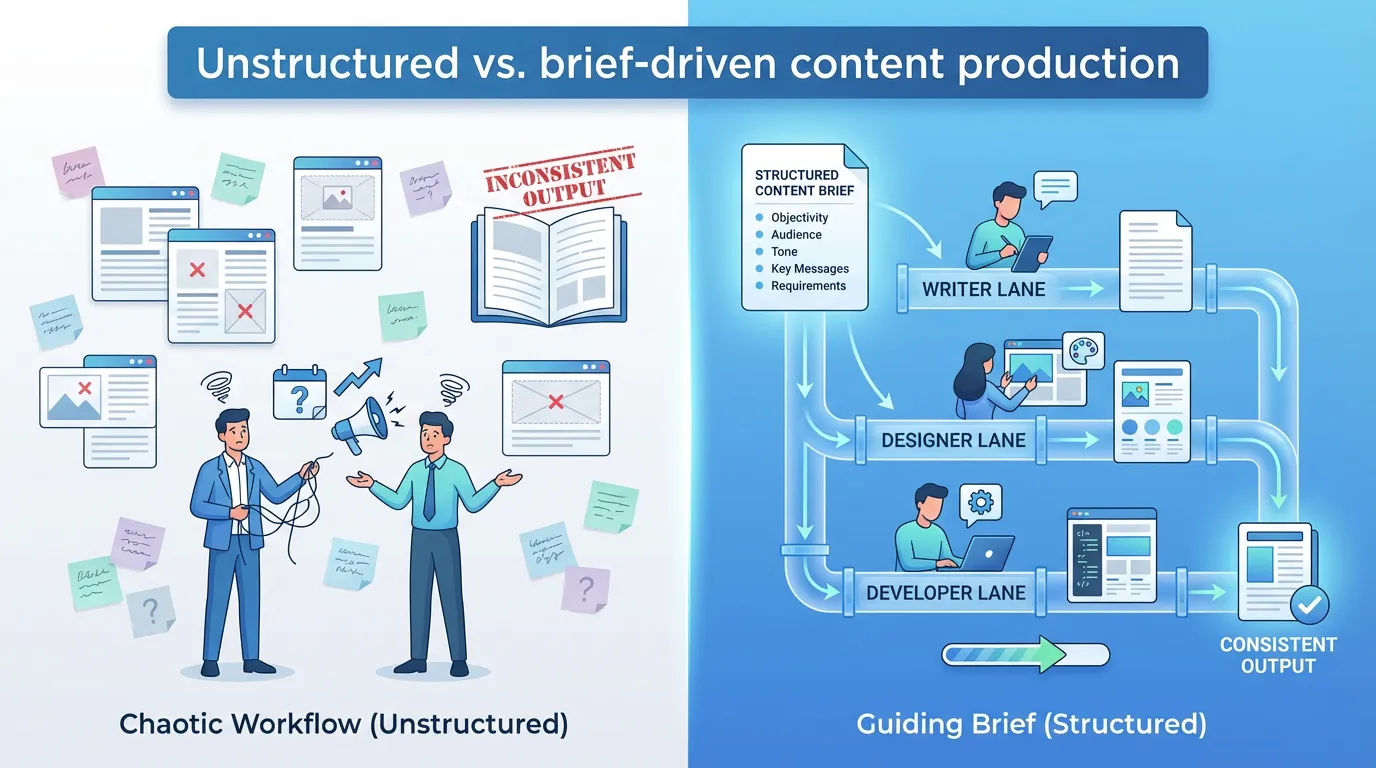
When content production ramps up, quality and results often drop first. You get more drafts, more revisions, more "SEO-optimized" pages that still feel generic, and more technical surprises after publishing. A well-built seo content brief fixes that by turning strategy (audit findings, search intent, positioning, conversion goals) into repeatable instructions that writers, designers, and developers can execute consistently.
Why content production breaks when you try to scale
Most teams do not fail because they "lack writers." They fail because they lack a single source of truth that connects what SEO needs with what production can realistically ship.
Common failure modes (especially for independent sites and international trade teams):
- Misalignment on intent: One writer targets definitions, another targets "best tools," and a third writes a sales pitch. None matches what the SERP rewards.
- Thin, repetitive drafts: Vague instructions push writers toward generic outputs and predictable phrasing.
- Visuals become an afterthought: Articles ship without diagrams, screenshots, or tables, even when those elements are what make the page useful.
- Traffic without leads: Pages rank (sometimes) but do not guide readers toward a meaningful next step.
- Technical constraints are ignored: Performance, crawlability, internal links, and schema are discovered late, when changing things is expensive.
The scaling fix is not "more content." It is better briefs that reduce uncertainty and prevent wasted output.
What an SEO content brief is (and how it differs from a generic brief)
An SEO content brief is a structured document that tells your team how to create a specific page that can rank and convert. It combines search intent, SERP observations, keyword and entity targets, outline guidance, internal linking, on-page requirements, and measurement.
This is consistently reinforced across widely used brief frameworks and process guides.
Generic brief vs. SEO content brief (practical comparison)
| Element | Generic content or creative brief | SEO content brief |
|---|---|---|
| Primary goal | Message consistency and creative direction | Match search intent, earn rankings, and drive measurable actions |
| Inputs | Audience, brand voice, deliverables, timeline | Everything in a generic brief plus SERP snapshot, query targets, internal links, schema considerations |
| Structure guidance | Optional or high-level | Explicit section-by-section outline and what each section must answer |
| SEO requirements | Often "add keywords" at the end | Title, meta description, URL slug, linking plan, image and alt text guidance, technical notes |
| Success metrics | Qualitative approval | Rankings, organic entrances, engagement, conversions, reduced revision cycles |
If your current brief template does not explicitly include outline and on-page requirements, you are relying on individual writer habits. That is exactly what breaks at scale.
A brief template you can reuse (step-by-step)
Below is a practical brief template designed for teams that want repeatable production without losing quality. It is intentionally structured so marketing, writers, and developers each get the inputs they need.
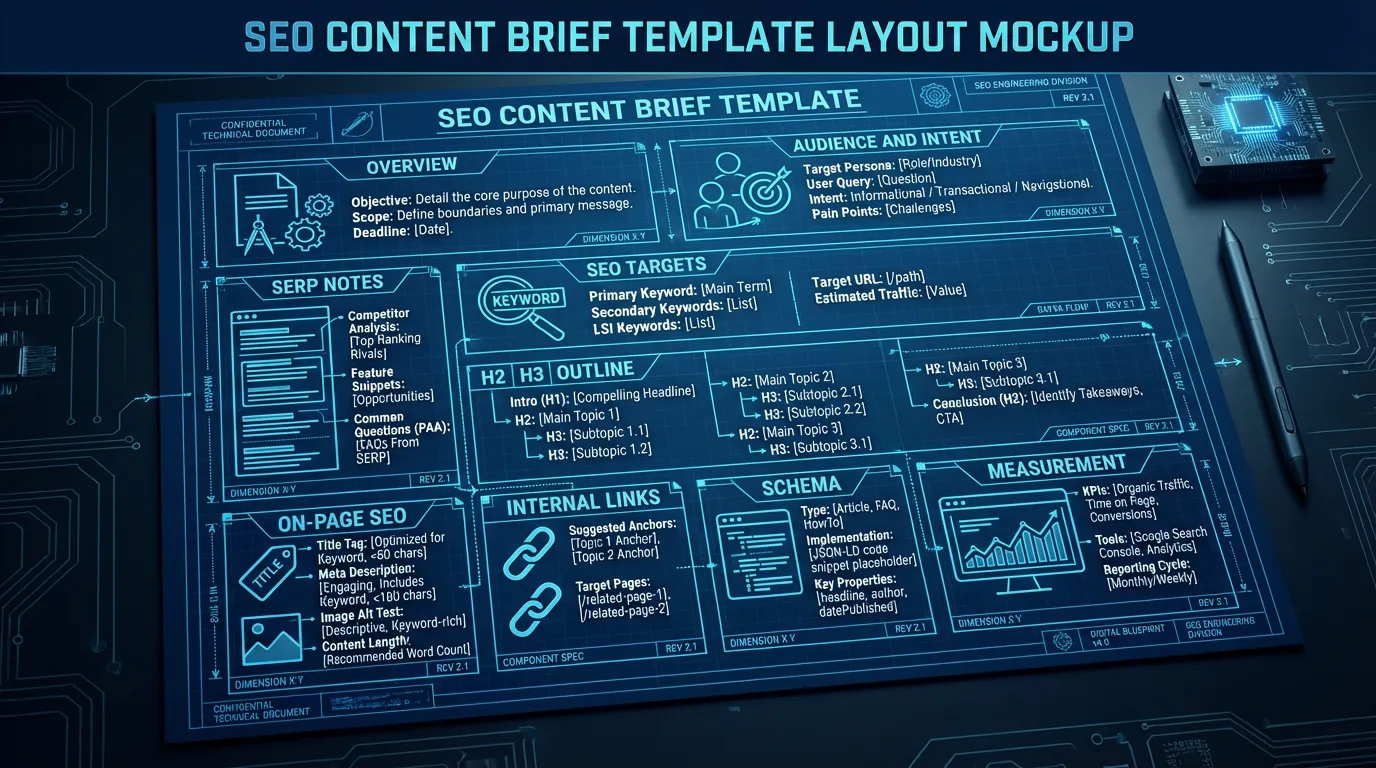
1) Overview (what you are building)
Include:
- Page type (blog, landing page, FAQ, support).
- Target locale and language (critical for APAC, US, and Europe rollouts).
- Funnel stage and business goal (lead gen, consultation requests, support deflection).
- Owner, reviewer, and due date.
2) Audience and intent (what must be true when they finish reading)
Write one sentence each:
- Primary persona and pain point.
- Dominant search intent (informational for this topic).
- The job-to-be-done (what the reader needs to accomplish).
3) SEO targets (what the page should be about, not just "what to include")
List:
- Primary keyword: seo content brief
- Secondary keywords: brief template, content outline seo
- Supporting entities and scenarios (for example: editorial workflow, internal linking, schema, Core Web Vitals, internationalization).
Avoid rigid keyword frequency rules. Multiple frameworks warn that overly prescriptive "use it 15 times" guidance is counterproductive (see RankUp).
4) SERP and competitor snapshot (what users expect to see)
Capture:
- Common sections across top results (definitions, components, templates, FAQs).
- Gaps you will cover (technical constraints, internal linking, visuals, conversion logic, multilingual notes).
- People Also Ask style questions to answer directly.
5) Page structure and content requirements (the content outline SEO section)
Give your writer a wireframe-like outline. Example skeleton for this topic:
- H2: Why scaling content breaks
- H2: Definition and differences
- H2: Template and must-have fields
- H2: Technical integration (schema, internal links, performance)
- H2: Measurement and optimization loop
- H3: FAQs
For each section, add bullets like:
- What question it answers.
- Any example you require.
- Which visual should appear near it (diagram, table, screenshot-style mockup).
6) On-page SEO and technical notes (publish-ready requirements)
At minimum:
- Draft title tag and meta description.
- Proposed URL slug.
- Image guidelines and alt text approach.
- Schema types to consider (Article, FAQPage, BreadcrumbList).
- Internal link requirements.
7) Measurement plan (how you will judge "done")
Define:
- Primary KPIs: organic entrances, rankings trend, leads (form fills or contact requests).
- Operational metrics: time-to-publish and revision rounds.
- Review cadence: typically every 6 to 12 months, or sooner if the SERP shifts.
Connecting briefs to technical SEO and site architecture (so content can actually win)
This is where many templates stop, and where teams lose money: the brief must reflect technical reality.
A high-performing brief should incorporate prioritized findings from technical SEO work, including:
- Crawlability and indexing: Where the page sits in the hierarchy, whether it should be in the XML sitemap, and any robots constraints.
- Internal link equity: Which hub or pillar pages must link to it, and which related pages it should link out to.
- Core Web Vitals and performance constraints: If performance is fragile, specify image sizes, compression expectations, and whether heavy embeds are allowed.
- JavaScript rendering considerations: If your CMS or framework renders content client-side, note what developers must do so search bots can access primary content and schema.
- Schema compliance and enhancement: Specify which schema type(s) to implement and what fields must be filled.
For teams operating across regions, add a localization block:
- Which markets need localized versions.
- Whether content is direct translation or requires localized examples.
- Hreflang and sitemap notes (so international pages do not compete with each other).
How SeekLab.io helps you scale with confidence (and what to do next)
SeekLab.io's approach is designed for marketing and operations managers and independent developers who need clarity before they produce more pages:
- Full-site crawling and structured analysis.
- Core Web Vitals and performance diagnostics.
- Indexing, crawlability, rendering, and JavaScript compatibility checks.
- Internal link equity and semantic structure analysis.
- Schema compliance and enhancement.
- Evaluation of AI search friendliness and citation readiness.
- Topic selection driven by trends and intent, plus high-quality blog production with strong visuals.
- Clear prioritization: focus on what truly impacts growth, deprioritize the rest.
- Actionable solutions and technical guidance, not just a list of problems.
- Global delivery experience across APAC, the US, and Europe, with teams and legal entities in Singapore and Shanghai and a BD team in Dubai.
- A results policy: in defined engagements, there can be no charge if minimum expected results are not achieved, and some simple technical issues may be resolved free of charge (scope-dependent).
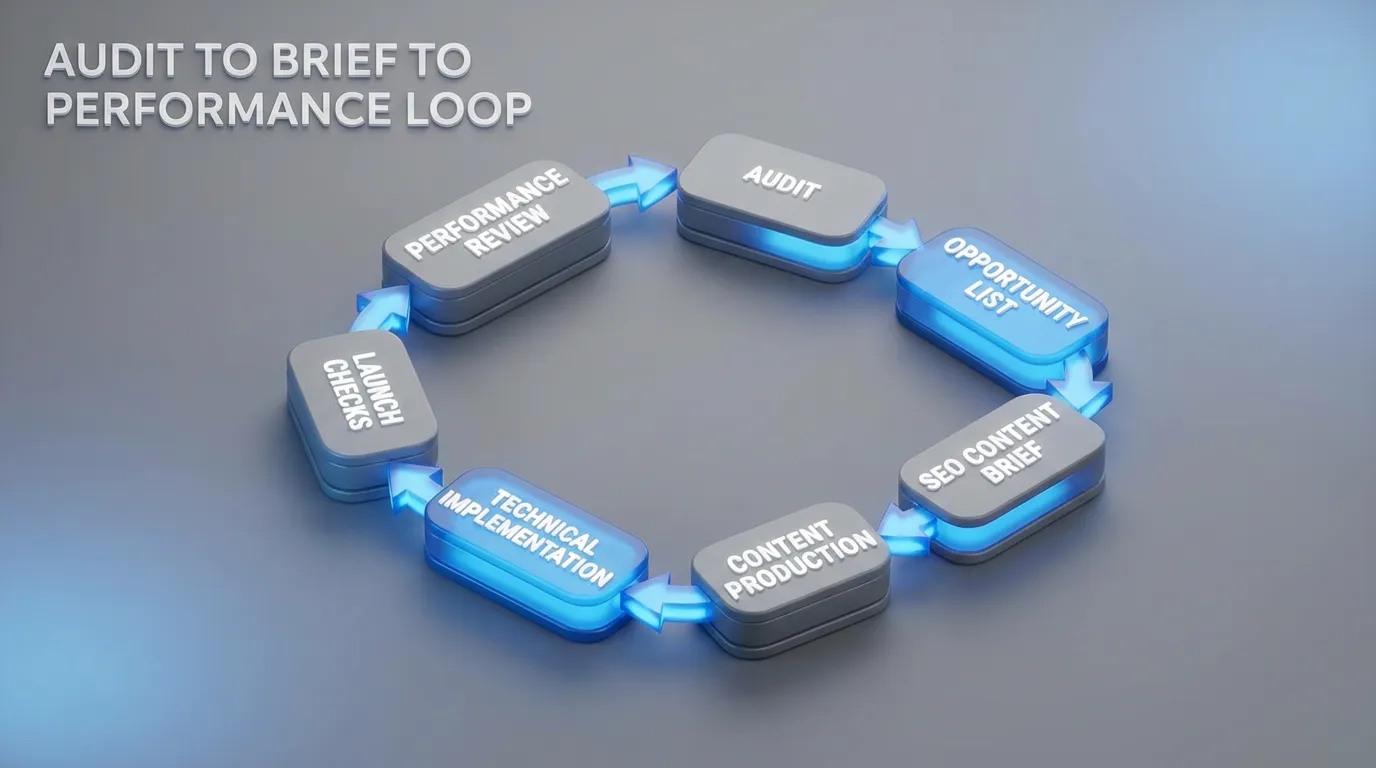
If you want to operationalize this immediately, use this rollout plan:
- Run a focused audit to identify what blocks growth (technical and non-technical).
- Create 5 to 10 briefs for the highest-impact topics and pages.
- Publish, QA (on-page, internal links, schema), and verify indexing.
- Review performance monthly, then refine the brief template based on what actually moved rankings and leads.
CTA: If you suspect your content is not aligned with technical reality, request a free audit report. Share your website domain, and contact SeekLab.io to start with a prioritized opportunity list.
FAQs
What is an SEO content brief?
A structured document that guides writers and developers to create a page that matches intent, targets the right queries, uses the right structure, and includes on-page requirements like internal links and schema.
What should be included at minimum?
Primary keyword, intent, audience, SERP notes, H2/H3 outline, title and meta guidance, internal links, CTA, and a word-count range.
Do I need a separate brief for every article?
For important URLs, yes. For a series, you can use a master brief plus per-article variations, but each key page should still have its own specific instructions.
How do I measure whether briefs are working?
Track revision rounds and time-to-publish, then connect each briefed URL to organic entrances, ranking trends, and conversions or qualified inquiries.
Can briefs support multilingual SEO?
Yes. Create one master brief, then add localized keyword sets, examples, and hreflang notes per market so scaling does not erase local relevance.