2026 AI Writing for SEO: Human + AI Workflow
Expert reviewed

Why ai writing for seo needs a human + ai workflow in 2026
By 2026, the debate around ai writing for seo is no longer about whether AI can help. It can. The real question is whether your workflow produces content that is useful, credible, technically discoverable, and commercially relevant.
For marketing managers, operations teams, independent site owners, and international brands, that distinction matters. Search engines and AI answer systems are getting better at filtering out generic, low-effort content. At the same time, they still reward content that is structured well, aligned with search intent, and backed by genuine expertise.
That is why the winning model is not AI-only publishing. It is a disciplined human + ai workflow where AI improves speed, while humans shape direction, quality, technical alignment, and conversion logic.
SeekLab.io works in exactly this space. The company helps brands improve search visibility and AI-era discoverability through high-quality content production and technical optimization. That includes structured site diagnostics, content topic selection, expert blog creation, internal linking guidance, schema improvement, multilingual SEO support, and technical consultation. The goal is not to fix everything. It is to identify what truly impacts growth first, then act on the highest-leverage opportunities.

Quick answer: what works now?
Here is the short version of what works in ai content seo today:
| Approach | Speed | Content quality | SEO reliability | Conversion potential |
|---|---|---|---|---|
| Fully automated AI publishing | High | Low | Low | Low |
| AI draft with light human edits | Medium to high | Medium | Medium | Medium |
| Human-led strategy with AI support | Medium | High | High | High |
If your current process creates polished but repetitive posts, weak lead quality, or rising traffic without inquiries, the issue is often not volume. It is workflow design.
1. ai writing for seo is effective only when strategy comes first
A common mistake is treating AI as a shortcut for content production before understanding what the website actually needs.
That leads to predictable problems:
- Content gets published on pages with crawlability or indexing issues.
- Articles target high-volume topics with little commercial value.
- Drafts sound smooth but add nothing new.
- Internal linking is ignored, so content remains isolated.
- Multilingual pages are produced without proper hreflang, canonical alignment, or regional adaptation.
This is why strong ai writing for seo starts before drafting. It starts with strategic decisions.
A practical pre-content checklist looks like this:
| Question | Why it matters |
|---|---|
| Which topics are closest to qualified inquiries? | Rankings alone do not create revenue. |
| Are there technical blockers on the site? | Great content can still underperform if pages are hard to crawl, render, or index. |
| Which markets and languages matter most? | International websites need different structures and localization choices. |
| What should be prioritized and what can wait? | Not every issue deserves equal effort. |
| What proof or scenario should each article include? | This is what separates helpful content from generic output. |
This is also where a structured audit becomes valuable. Before scaling content, many teams need a clearer view of site readiness, content gaps, and topic priorities. SeekLab.io's approach to AI Writing For SEO: Avoiding Generic Content reinforces this by focusing on business scenarios, internal structure, and practical quality control instead of content volume for its own sake.
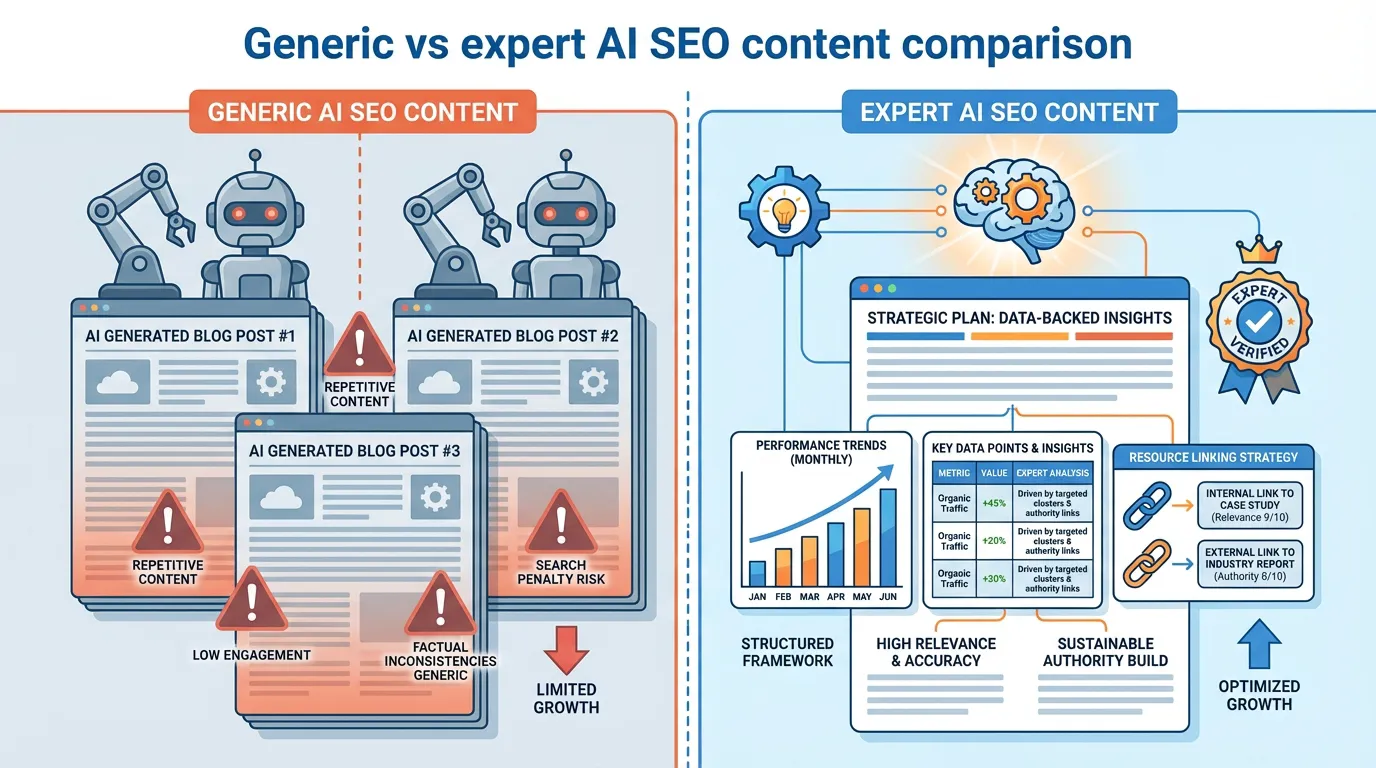
2. ai writing for seo fails when ai content seo becomes generic
Most weak ai content seo has the same symptoms. It may look polished on the surface, but it lacks depth, specificity, and decision-making value.
Here are five red flags to watch for in ai writing for seo output:
- It repeats common SERP definitions without adding insight.
- It ignores the reader's actual business situation.
- It uses broad statements instead of concrete examples.
- It has no supporting visuals, tables, or structure.
- It is disconnected from the site's technical and internal linking foundation.
That matters more in 2026 because search engines and AI systems increasingly favor content that is easy to trust and easy to interpret.
What generic AI content usually misses
| Weak content trait | What it looks like | Business consequence |
|---|---|---|
| Surface-level explanations | Definitions with no real scenarios | Low trust |
| No clear search intent match | Informational text when the reader wanted a checklist or framework | Low engagement |
| No EEAT depth | No experience, examples, or trade-offs | Weak authority |
| Poor structure | Long blocks of text without tables or summaries | Lower readability |
| Weak technical integration | No schema, poor internal links, unclear hierarchy | Lower discoverability |
For example, a B2B exporter, a SaaS brand, and a multilingual manufacturer may all search around ai writing for seo, but they do not need the same article. One may need guidance on localized content governance. Another may care more about lead quality and content briefs. Another may be blocked by JavaScript rendering or internal architecture.
That is why a human editor must add scenario depth and business relevance. AI can accelerate drafting, but it cannot independently supply lived experience, commercial judgment, or brand accountability.
3. ai writing for seo works best inside a human + ai workflow
The strongest 2026 model is simple: humans lead, AI assists, and humans finalize.
Below is a practical human + ai workflow for modern SEO teams.
| Stage | Human role | AI role | Main safeguard |
|---|---|---|---|
| SEO diagnosis | Identify growth blockers and priorities | Summarize large datasets | Do not scale content on a weak technical foundation |
| Keyword and intent mapping | Judge business value and buyer intent | Cluster keywords and extract patterns | Avoid low-value topics |
| Content brief creation | Define angle, audience, examples, visuals, CTA | Draft outlines and FAQs | Require proof elements in every brief |
| Drafting | Guide structure and verify claims | Produce first-pass copy | Keep drafts constrained and specific |
| Expert editing | Add experience, nuance, and brand voice | Improve phrasing and consistency | Rewrite thin sections aggressively |
| Technical optimization | Add links, schema, headings, alt text | Suggest supporting elements | Validate before publishing |
| Measurement | Review rankings, engagement, leads | Detect patterns and anomalies | Optimize for business impact, not vanity metrics |
Here is a visual summary of that workflow:

This model is particularly effective for independent sites, B2B websites, exporter websites, and multilingual brands because those environments involve more complexity than simple content generation.
SeekLab.io also connects this content workflow to broader search changes. In From SEO To GEO: Adapting Content For AI Search, the emphasis is on making pages clearer not only for traditional SEO, but also for AI-driven discovery and citation.
4. ai writing for seo depends on technical SEO more than most teams expect
Many discussions about ai writing for seo focus only on prompts, tone, and editing. But content cannot perform well if the website structure blocks discoverability.
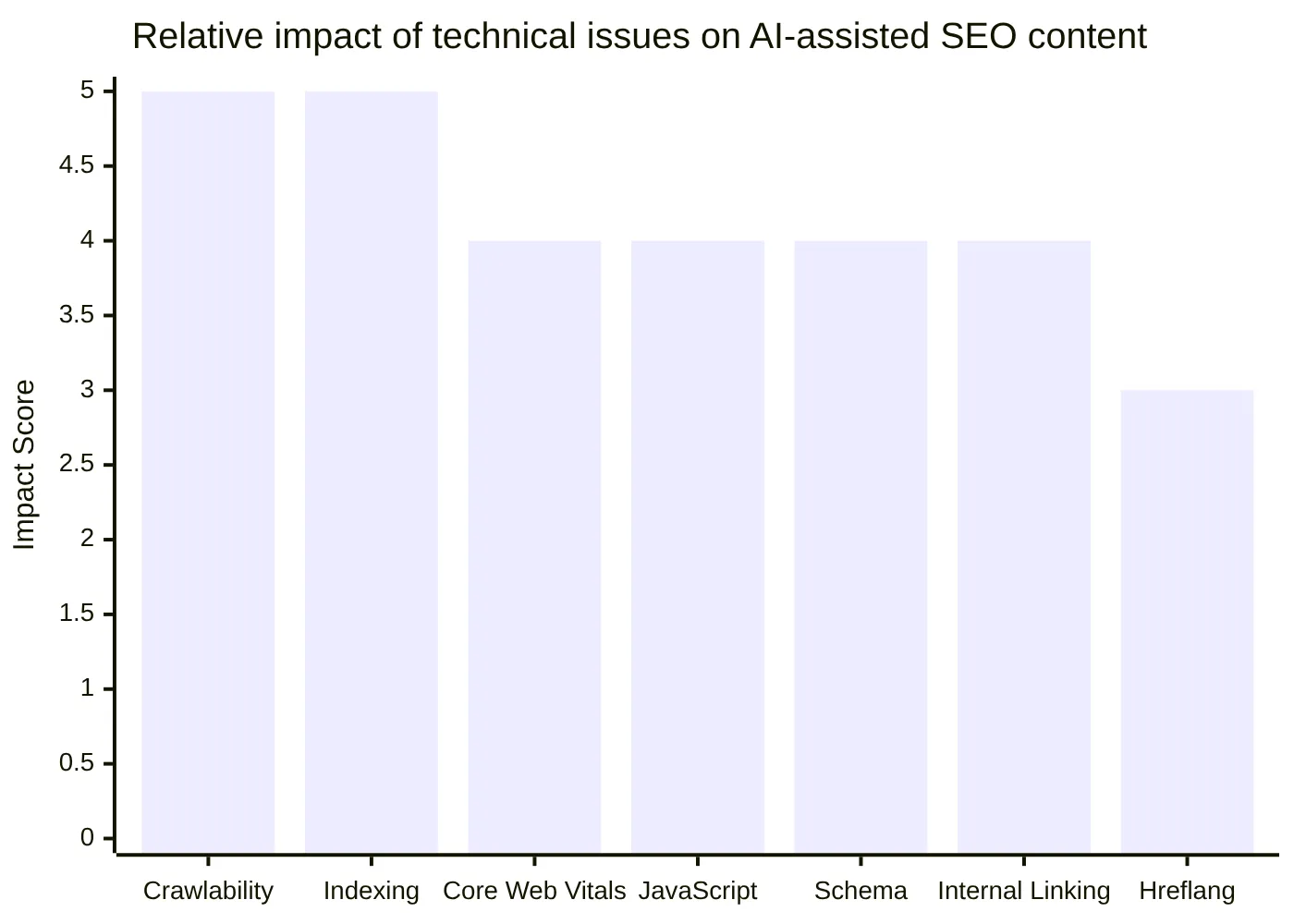
For AI-assisted content, technical SEO issues often show up in these areas:
| Technical area | Common issue | Likely impact |
|---|---|---|
| Crawlability | Important pages are buried or orphaned | New content is discovered slowly |
| Indexing | Duplicate or near-duplicate content creates confusion | Wrong pages get indexed |
| Core Web Vitals | Heavy pages and unoptimized images slow performance | Lower engagement and weaker conversions |
| JavaScript rendering | Main content loads late or inconsistently | Search systems may miss critical text |
| Schema markup | Entity signals are weak | Lower machine understanding |
| Internal linking strategy | Topic clusters are disconnected | Lower authority and weaker navigation |
| Hreflang SEO | Wrong-language pages surface in search | Poor international relevance |
The relative impact often looks like this:
This is one reason SeekLab.io's service model is different from content-only providers. The company combines content production with full-site crawling, performance diagnostics, indexing checks, rendering analysis, schema review, internal linking analysis, and multilingual structure support. That combination helps ensure content is not just written, but actually visible and useful.
If your website serves multiple countries or languages, the technical side becomes even more important. SeekLab.io's multilingual guidance in The Ultimate Guide To Multilingual SEO Strategy In 2026 highlights why localization should be human-led even when AI assists with first drafts.

5. ai writing for seo should be measured by visibility, trust, and inquiries
A big reason teams become disappointed with ai content seo is that they measure the wrong outcomes.
If the only metric is article output or ranking movement, it is easy to overestimate success. A stronger measurement model connects visibility to conversion.
Better KPIs for a human + ai workflow
| KPI layer | What to measure | Why it matters |
|---|---|---|
| Visibility | Impressions, rankings, indexed pages | Confirms discoverability |
| Engagement | Engaged sessions, scroll depth, page interaction | Shows whether content holds attention |
| Conversion | Form submissions, quote requests, contact clicks | Ties SEO to business outcomes |
| Technical health | Core Web Vitals, crawl stats, schema errors | Prevents hidden performance losses |
| AI-era signals | AI citations, brand mentions, answer visibility | Reflects discoverability beyond classic SERPs |
A balanced KPI view might look like this:
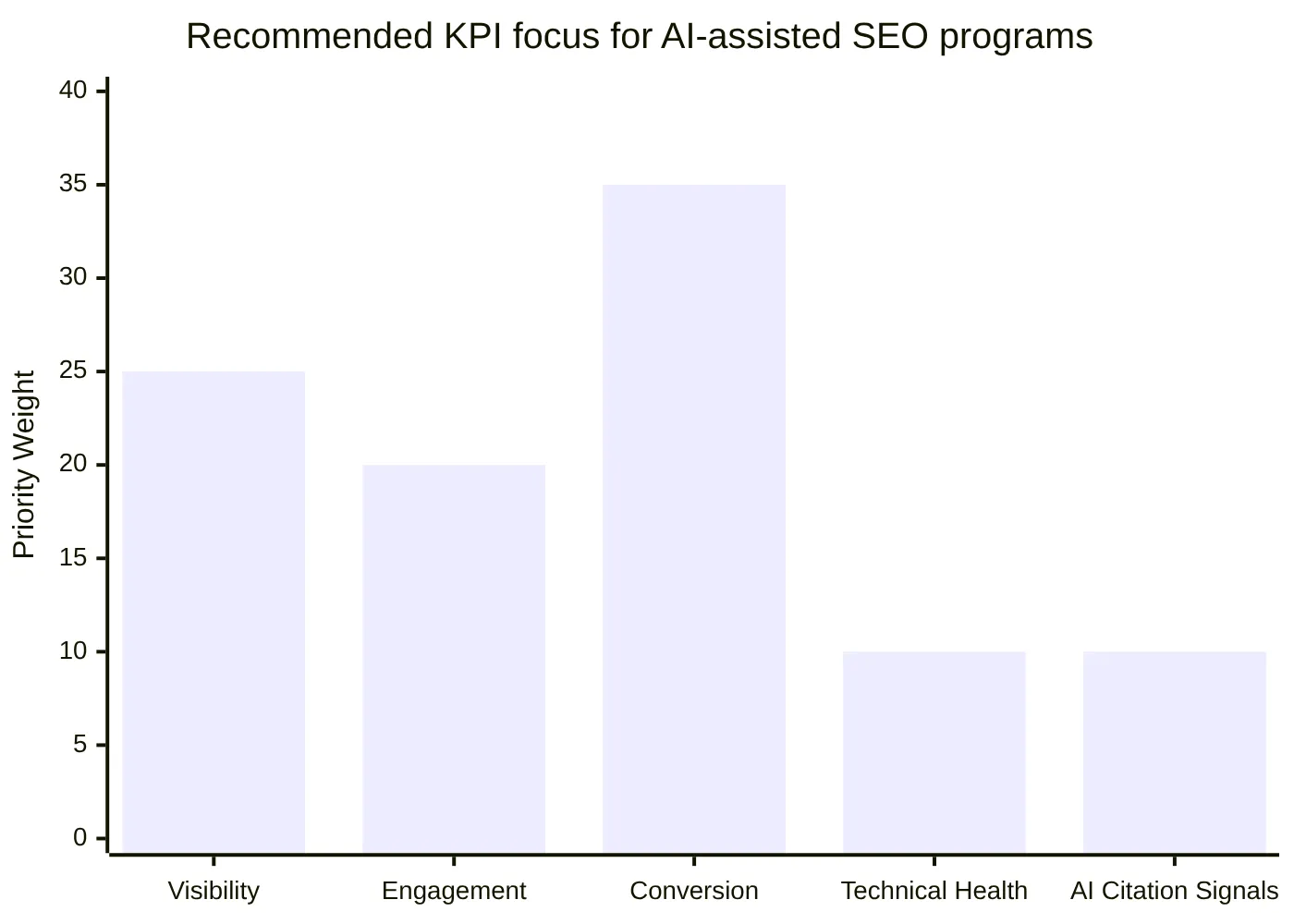
This is also where SeekLab.io's positioning matters. The company emphasizes data-driven reporting, monthly reviews, and clear prioritization. Rather than pushing activity for its own sake, the focus is on what actually improves visibility, credibility, and conversion potential across both search engines and AI systems.
6. ai writing for seo in 2026: 7 practical rules to follow
To make this actionable, here is a concise listicle-style framework for better ai writing for seo results:
-
Start with a real business scenario
Write for an actual problem, not just a keyword. -
Use AI for acceleration, not replacement
AI should support research, outlines, and first drafts, not final accountability. -
Build every article from a structured brief
Include search intent, target audience, proof points, visuals, internal links, and CTA. -
Edit for expertise, not just grammar
Add examples, trade-offs, regional nuance, and buyer objections. -
Connect ai content seo to technical SEO
Review crawlability, indexation, Core Web Vitals, schema, and site architecture. -
Design around topic clusters
Support each article with internal links and related content instead of publishing isolated pages. -
Measure qualified outcomes
Look beyond rankings to trust, inquiries, and long-term growth.
A useful editorial checklist is below:
| Before publishing ai writing for seo content, ask this | Yes/No |
|---|---|
| Does the article address a real search intent and buyer scenario? | |
| Does it say something beyond standard definitions? | |
| Are the visuals helping explain the topic? | |
| Are internal links connected to relevant pages? | |
| Has the content been reviewed for factual accuracy? | |
| Has technical readiness been checked? | |
| Is there a clear next step for a serious reader? |
Final takeaway: human + ai workflow beats AI-only production
In 2026, ai writing for seo is not a shortcut. It is an operating model.
The brands that benefit most will be the ones that combine AI speed with human judgment, technical SEO discipline, and commercially useful content design. That is especially true for independent websites, official company sites, exporters, B2B brands, and multilingual businesses trying to grow across the US, Europe, and Asia-Pacific.
A good human + ai workflow helps you avoid publishing the wrong topics, reduce generic output, improve technical readiness, and produce assets that support both rankings and conversion.
If your current ai content seo process feels repetitive, underperforming, or disconnected from business outcomes, the next step is not necessarily to publish more. It is to diagnose what is actually holding growth back and fix the right things first.
SeekLab.io helps brands do exactly that through technical audits, content strategy, high-quality blog creation, multilingual SEO support, and practical optimization guidance. If you want a clearer view of where your site is losing visibility or where content efforts are heading in the wrong direction, you can contact us or request a free audit report through SeekLab.io.