A simulated fruit fly brain shows how small AI can think
Expert reviewed

Fruit fly brain simulation studys in how intelligence can emerge from structure, constraint, and feedback rather than raw scale. In this article, you will get a practical breakdown of what the March 2026 fruit fly brain simulation actually showed, why it matters for whole-brain emulation, neuromorphic computing, embodied AI, and biological intelligence, and what independent websites can learn from it.
The short version is simple: researchers simulated a complete fruit fly brain in a virtual body and environment, and the model produced behaviors like walking, grooming, and feeding without explicit task training. That matters because it challenges a common assumption in AI: that more parameters and more data are always the main path forward. It also creates a sharp analogy for website strategy. A site does not need endless pages to perform well. It needs clean structure, purposeful internal links, and user journeys that work.
Why the fruit fly brain simulation matters beyond the lab
The 2026 fruit fly brain simulation built on the adult Drosophila melanogaster connectome and placed that whole-brain emulation inside a physics-based virtual body. According to Eon Systems' embodied brain emulation update, the model used the FlyWire adult fly connectome and ran in a MuJoCo environment. Coverage from The Register, Futurism, and the original viral X discussion helped push the story into the broader AI conversation.
What makes this important is not just that a digital fly moved. It is that the fruit fly brain simulation produced recognizable behavior without reinforcement learning loops, behavior trees, or task-specific supervised training. Walking happened because the wiring, sensors, and motor outputs were connected in a biologically grounded way. Grooming happened because virtual antennae fed signals into the right circuits. Feeding happened because the body and environment created the right sensorimotor loop.
That is a very different picture from mainstream large-model development. Large language models usually get stronger by adding more compute, more data, and more parameters. This fruit fly brain simulation points to another route: a smaller system with tighter structure and more meaningful interaction with its environment.
A practical reason this story resonates is that many businesses make the same mistake in content strategy that AI labs make in model strategy. They assume scale alone will solve the problem. More pages, more categories, more translated copies, more blog posts. But if the structure is weak, the result is usually clutter rather than capability.
How the fruit fly brain simulation works as whole-brain emulation
To understand the fruit fly brain simulation, it helps to separate the stack into four parts.
| Layer | What it means in the fruit fly brain simulation | Why it matters |
|---|---|---|
| Connectome | The synapse-level wiring diagram of the adult fly brain | Structure is the starting point, not an afterthought |
| Neuron model | Simplified spiking or rate-based neuron behavior | Makes simulation feasible on modest hardware |
| Embodiment | A virtual body with legs, antennae, and feeding organs | Allows closed-loop behavior instead of isolated prediction |
| Environment | Physics, friction, obstacles, and food cues in MuJoCo | Gives the model something real to react to |
The structural base came from FlyWire, which mapped the adult female fruit fly brain at full-brain scale, around 130,000 to 140,000 neurons and more than 50 million synapses. Earlier reporting from UC Berkeley had already shown that an unembodied whole-brain emulation could predict certain fly behaviors such as feeding and grooming. The 2026 step added embodiment, which is the part many AI systems still lack.
This is where whole-brain emulation becomes more than a graph exercise. A brain model sitting alone in software can be interesting, but limited. Once the model has a body and a world, behavior starts to emerge through feedback. A leg movement changes position. Position changes sensory input. Sensory input alters neural activity. That loop is the core of embodied AI, and it is one reason biological intelligence often looks efficient in ways pure text-trained systems do not.
The result is not magic and it is not proof that all animal cognition is now solved. Some synaptic strengths and neuron dynamics are still approximated. Even so, the fruit fly brain simulation is one of the clearest examples so far of whole-brain emulation producing meaningful behavior in a virtual environment.
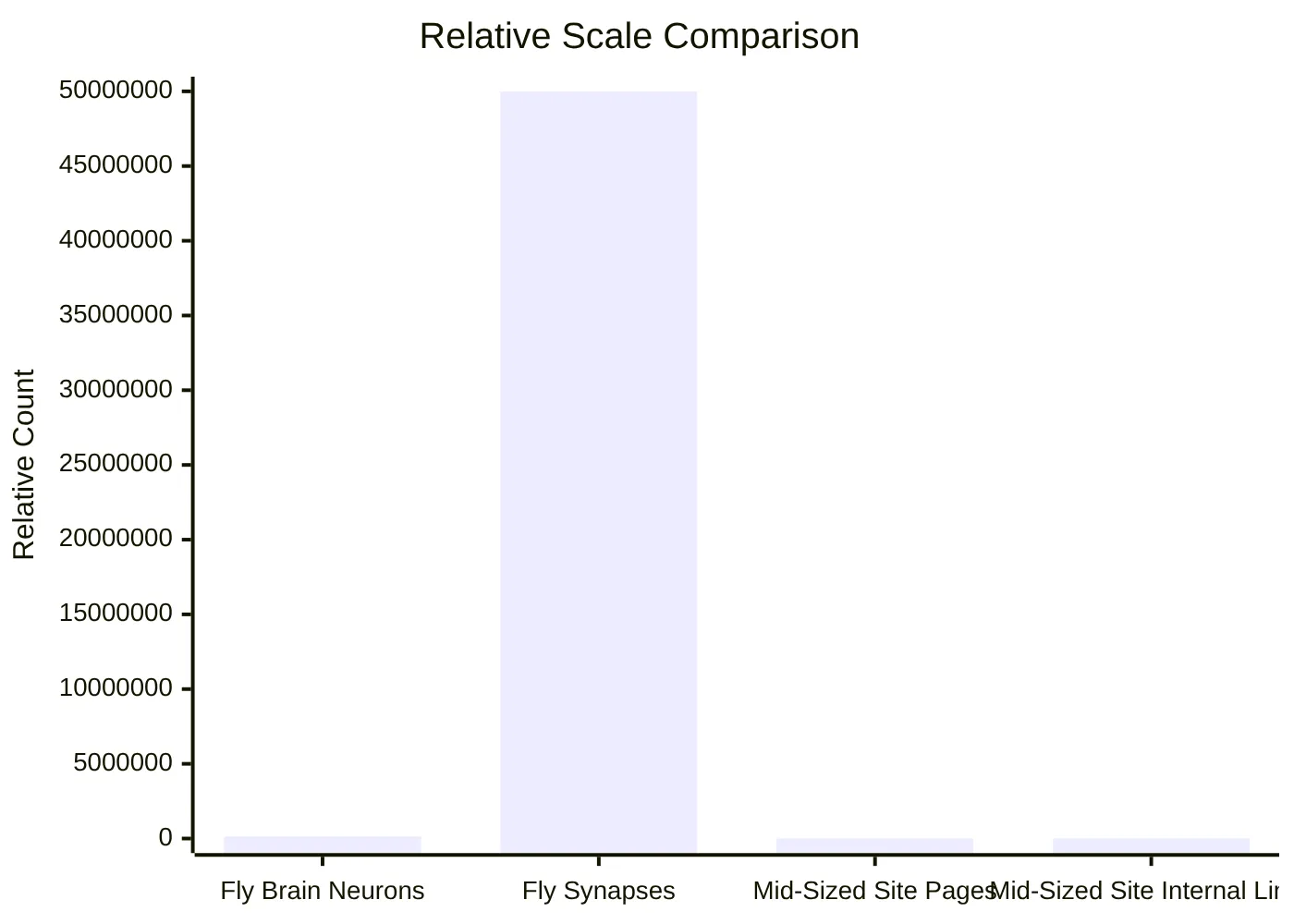
That chart is crude by design, but it makes an important point. A mid-sized website can be structurally weak with just a few hundred pages. A fruit fly can be behaviorally competent with around 140,000 neurons because those neurons are organized with purpose.
What the fruit fly brain simulation suggests about neuromorphic computing and embodied AI
The fruit fly brain simulation matters to AI because it strengthens four ideas that have often been treated separately: whole-brain emulation, neuromorphic computing, embodied AI, and biological intelligence.
First, it reinforces the value of structural priors. In the fly, core behavior is not learned from scratch through giant datasets. It is largely built into the architecture. That is a useful provocation for AI system design. Some tasks may benefit more from better priors than from bigger models.
Second, it highlights the value of recurrence and modularity. Biological systems rely on loops, state, and specialized subsystems. They do not behave like one uniform matrix doing everything. This matters because a lot of current AI still pays a heavy compute tax for dense, generalized processing where more specialized structures might do better.
Third, the fruit fly brain simulation is relevant to neuromorphic computing. Neuromorphic systems aim to process information in brain-like, event-driven ways with much lower energy use than conventional deep learning hardware. Research directions summarized in sources such as this neuromorphic computing review suggest strong efficiency potential, especially for control and sensory tasks. A fruit fly-scale emulation offers a more realistic benchmark than toy examples.
Fourth, it clarifies what embodied AI actually adds. Without embodiment, a system can classify, predict, or generate. With embodiment, the environment becomes part of the computation. The fly does not "know" walking as an abstract label. It knows walking through closed-loop control. That is a useful distinction because many AI products still look smart in demos but break down in interactive settings.
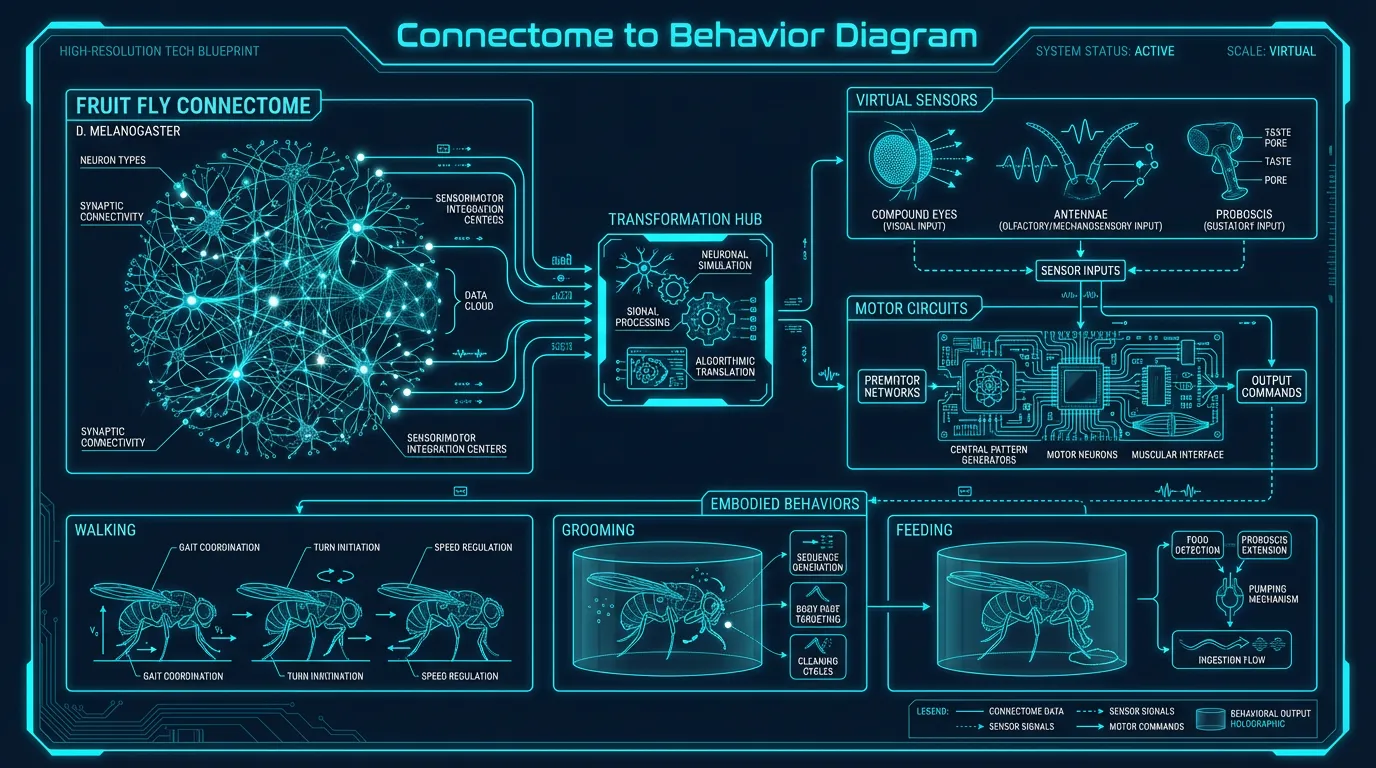
A common overreaction is to read this as "small models will replace large models." That is not the right lesson. The better lesson is that architecture matters more than many teams admit. Large models remain useful for language, synthesis, and broad reasoning. But for control, adaptation, and constrained problem solving, bio-inspired structures may become much more important.
What fruit fly brain simulation teaches websites about structure over scale
This is where the metaphor becomes commercially useful. The fruit fly brain simulation shows that capability comes from how parts are organized, not just how many parts exist. The same applies to websites.
Many independent sites underperform because they are bloated in the wrong places and thin in the important ones. You will often see dozens of blog posts that overlap, location pages with barely differentiated copy, and internal links that come mostly from menus and footers rather than contextual pathways. That is not scale. That is noise.
A structurally intelligent site looks different:
| Brute-force site pattern | Structurally intelligent site pattern |
|---|---|
| Many near-duplicate pages | Fewer but clearer topic clusters |
| Weak contextual internal linking | Purposeful links between related intent stages |
| Broad publishing with little depth | Modular content built around real tasks |
| Confusing path to conversion | Clear user journey from discovery to inquiry |
| Translation everywhere, maintenance nowhere | Selective localization with strong architecture |
This is close to how SeekLab.io approaches website growth. SeekLab.io helps brands build search visibility and AI-era discoverability through high-quality content production and technical optimization. That means improving content structure, information clarity, page architecture, internal linking, and overall site readiness so websites are easier for search engines, AI systems, and real users to understand. The work is not limited to technical issue detection, and it is not about fixing everything. It is about identifying what actually impacts growth, what can be deprioritized, and what should be done first.
If you want a useful reference point for content quality and structural improvement, SeekLab.io has already published guidance on high-quality blog content optimization, which aligns closely with the same principle: structure first, then scale.
A good way to apply the fruit fly brain simulation metaphor is to think in circuits rather than pages. For example:
- Discovery circuit: educational article -> solution page -> proof or case material -> contact form
- Validation circuit: industry page -> technical detail page -> FAQ -> inquiry point
- Recovery circuit: related links, breadcrumbs, and hub pages that help users change course without bouncing
That is a more useful model than "publish 50 articles and hope something ranks." It also aligns with the kind of crawl-based analysis, internal link equity review, and structured content planning that SeekLab.io uses in audits.
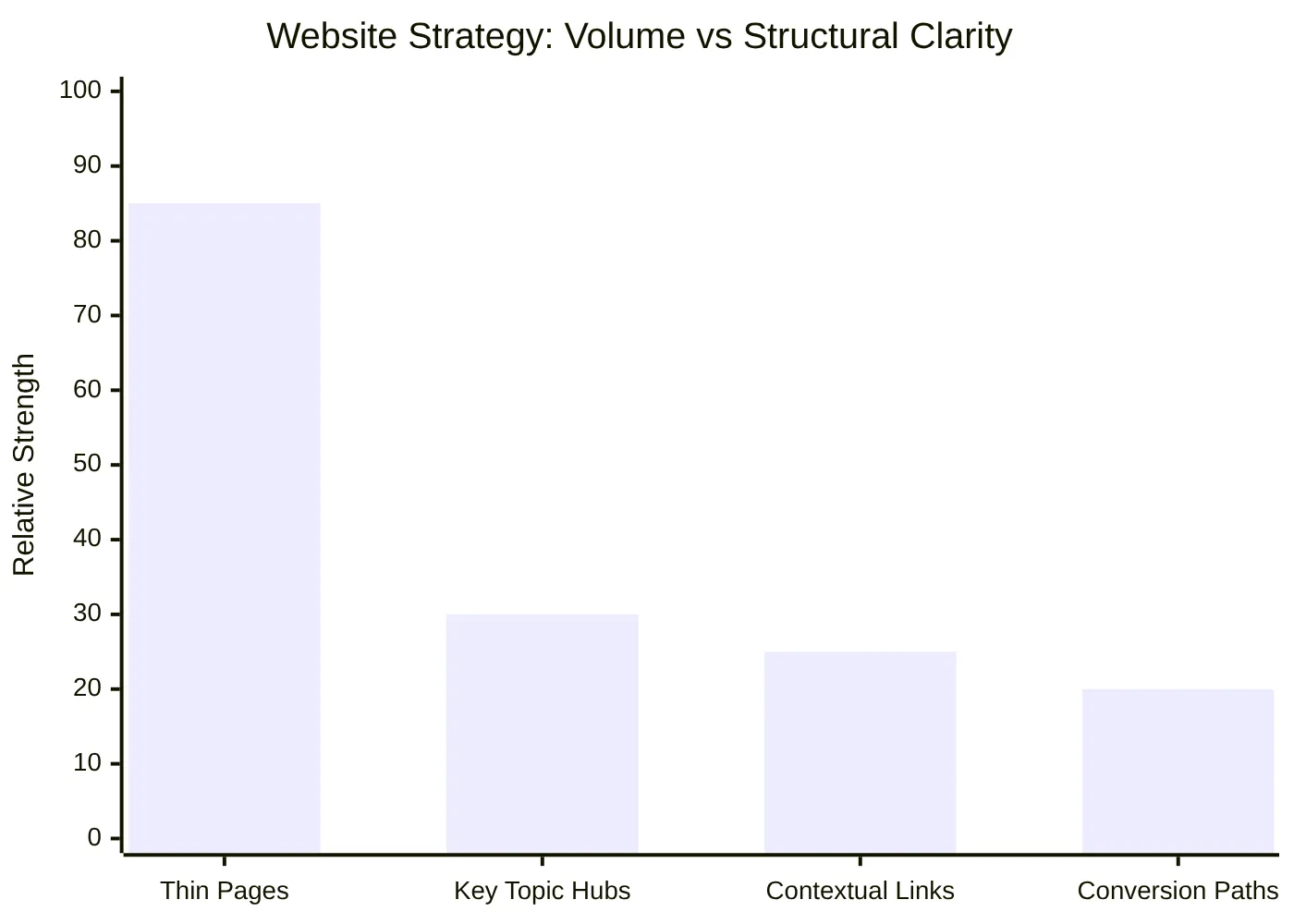
The chart above represents a common weak-site pattern: too many pages, too little structure. The fix is usually not another publishing sprint. It is better information architecture, stronger semantic relationships, and fewer dead ends.
How to use the fruit fly brain simulation as a practical SEO decision framework
For operators, the value of the fruit fly brain simulation is not philosophical. It is diagnostic. It gives you a simple filter for deciding whether your website is becoming more intelligent or just larger.
Use these five checks.
-
Does each important topic cluster support a real task?
A strong cluster helps a visitor do something specific: compare options, understand a process, evaluate fit, or make contact. A weak cluster just repeats general information. -
Are internal links behaving like circuits?
If your most important pages only receive template links, they are probably not getting enough contextual support. SeekLab.io's work around internal linking and semantic structure is directly relevant here. So is their broader focus on technical readiness and content alignment. -
Are you localizing strategically rather than mechanically?
For international sites, not every page deserves full local expansion. A cleaner multilingual structure usually outperforms a larger but inconsistent one. If this is a constraint on your site, SeekLab.io's thinking around technical SEO roadmaps for early-stage growth and technical JavaScript SEO and indexing solutions is especially relevant because structural issues often hide behind rendering, indexation, and architecture problems. -
Are technical issues cutting key behavioral paths?
A broken rendered menu, blocked resources, or weak Core Web Vitals on high-intent pages can break the user journey in the same way a damaged pathway breaks a circuit. This is why SEO should not be treated as content-only work. -
Are you publishing because the strategy is clear, or because the calendar says so?
One of the most expensive mistakes in SEO is creating content before making the right strategic decisions. SeekLab.io's value here is not just topic production. It is helping teams avoid heading in the wrong direction in the first place.
The best takeaway from the fruit fly brain simulation is that "small" is not automatically better, and "big" is not automatically smarter. What matters is whether the system is coherently built. In AI, that means architecture, embodiment, and constraint. In SEO, that means information architecture, internal linking, content depth, technical clarity, and real conversion paths.
For businesses running independent or official company websites, that distinction matters. Traffic without clarity usually does not convert. Content without structure usually does not compound. And technical work without prioritization often burns budget without moving results.
The March 2026 fruit fly brain simulation gave AI researchers a working example of intelligence without brute-force scale. It gives website teams a useful operating principle too: build for coherence first. Then grow. If you want to see where your own site is structurally weak, where your content circuits break down, or which issues are worth fixing now versus later, you can get a free audit report or contact SeekLab.io for a more focused review.