What is GEO? SeekLab’s Practitioner Definition (Not the Textbook Definition)
May 28, 2026 ·
13 Min Read
Expert reviewed

One of the articles SeekLab published for a Web3 client got 11,874 impressions and 13 clicks in its first month. It ranked #1 on Google. It was cited in Google's AI Overview.
Thirteen clicks from nearly twelve thousand impressions.
Most SEOs would call that a failure. We call it the clearest illustration of what GEO actually is — and why the old way of measuring search performance is no longer enough.
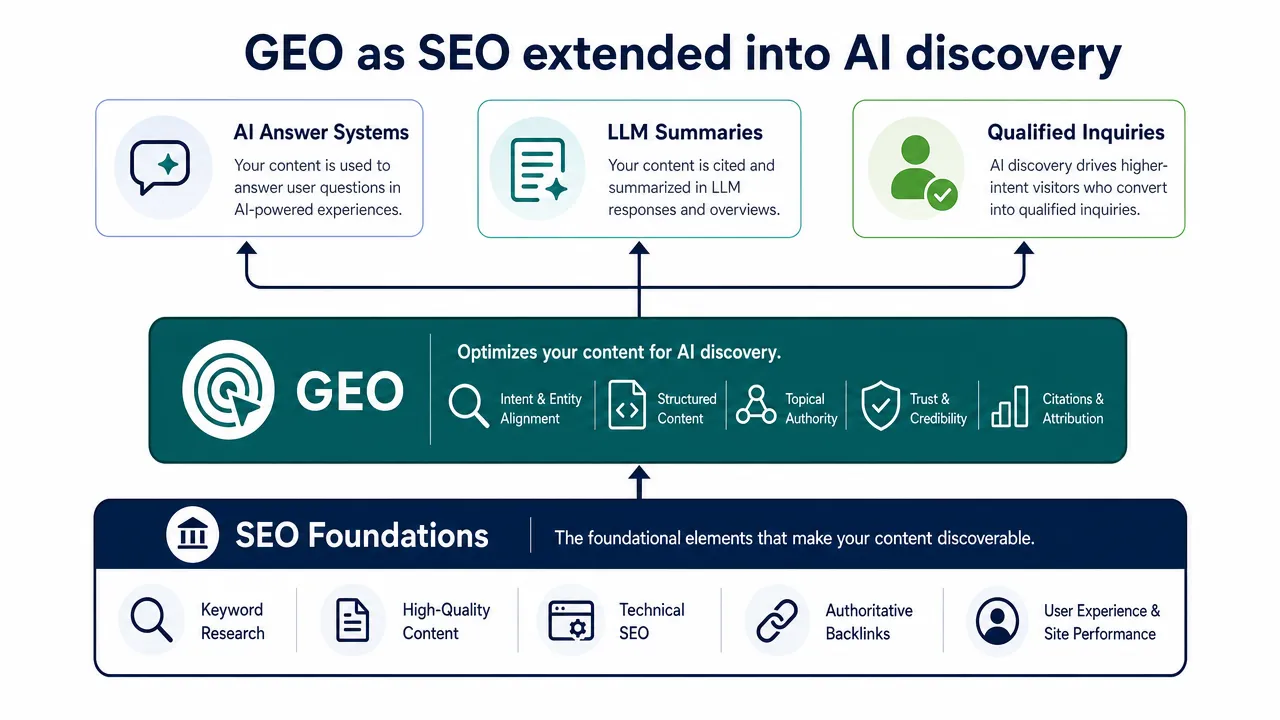
The most common mistake is treating GEO as a layer that can be added after the fact with a few formatting changes. Formatting helps, but it cannot rescue a weak content system. If a site has competing pages on the same topic, no internal links to service pages, inconsistent terminology, and no visible proof of expertise, the GEO problem is not just "missing AI-friendly wording." It is a structure and trust problem.
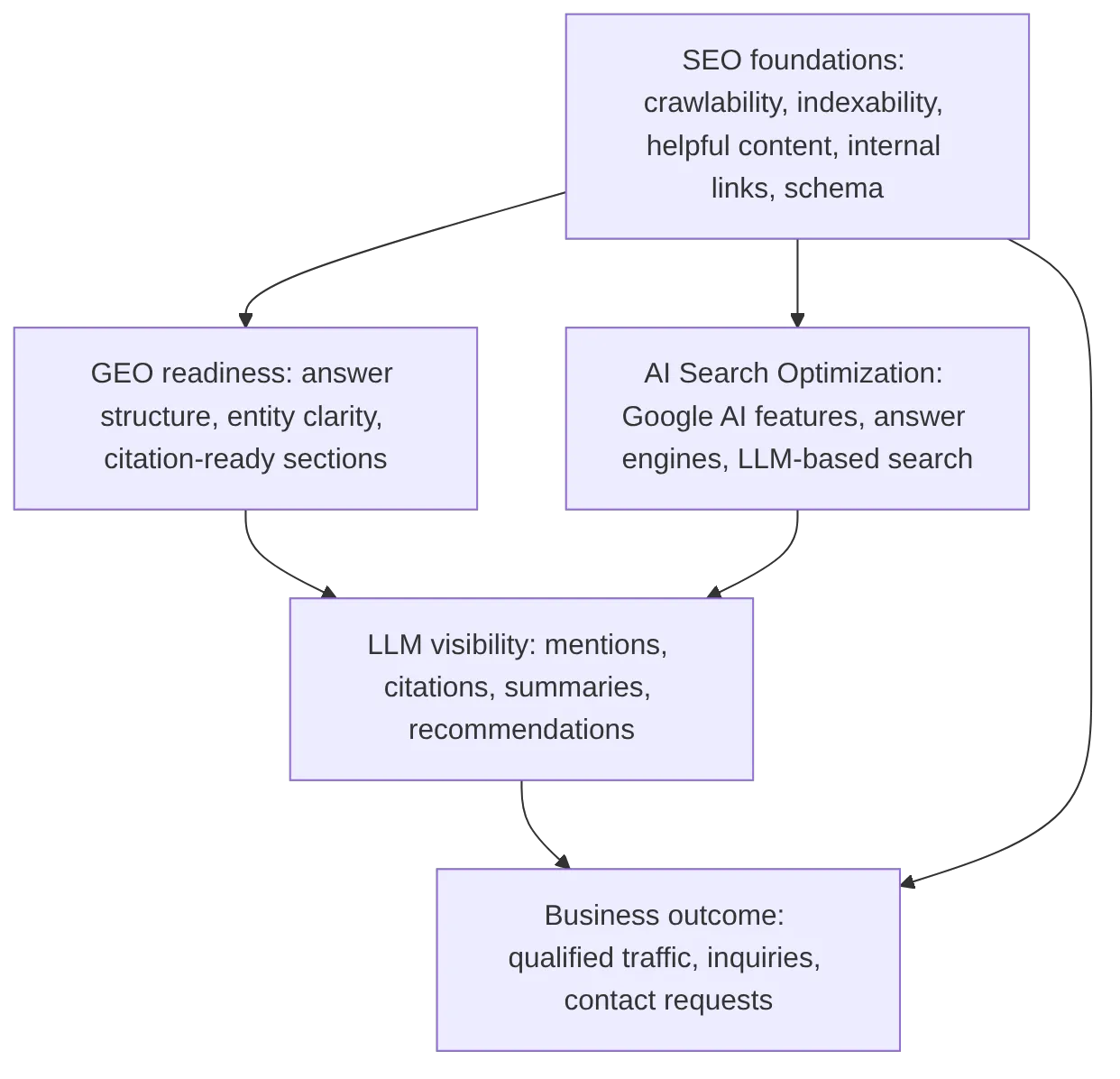
Google's own guidance on AI features reinforces this foundation-first view: website owners should follow core Search fundamentals for AI features, including crawlability, indexability, helpful content, and technical accessibility. GEO should be built on real SEO foundations, not positioned as a shortcut around them.
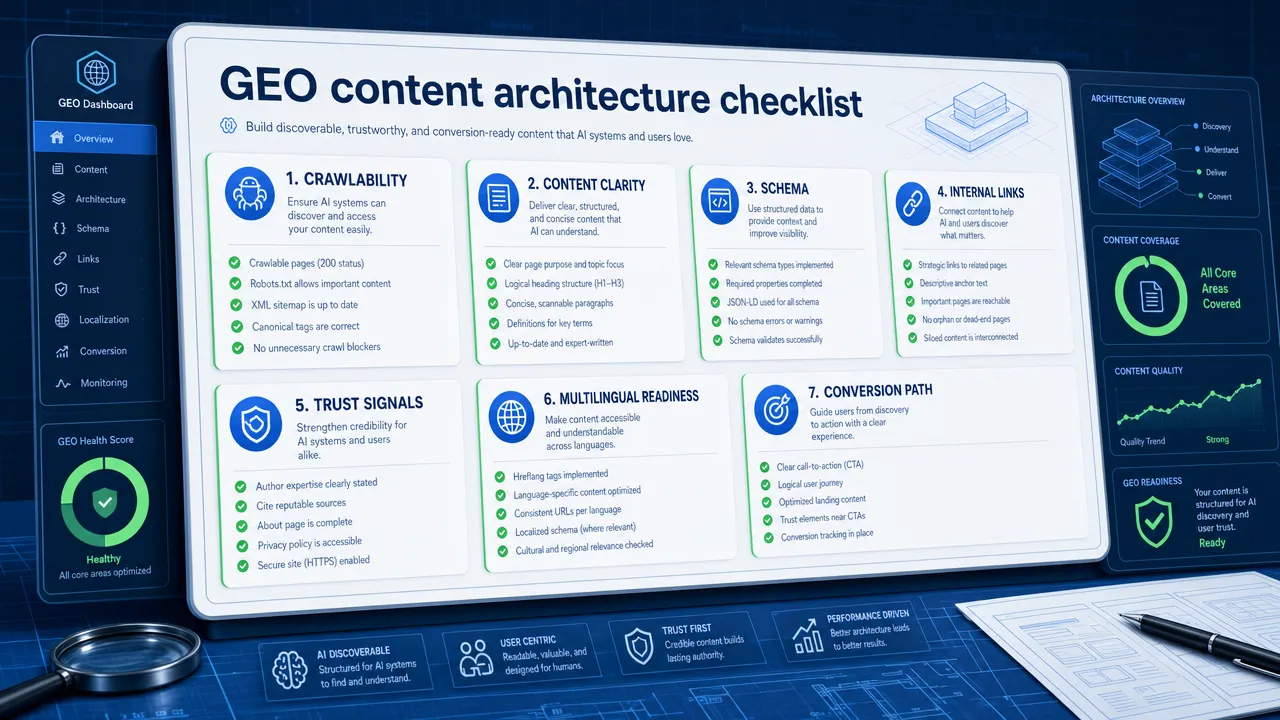 Next comes content structure. AI prompts are often longer and more contextual than traditional keyword searches. A buyer might not search only a short product term — they may ask for differences between options, certifications, regional availability, or how to choose. GEO-ready content should answer the main question directly, then support it with examples, comparisons, tables, FAQs, images, and internal links.
Entity clarity and schema are also central. A site should describe its brand, services, products, and expertise consistently. A company that uses different names for the same product across English and other language pages creates unnecessary ambiguity for search engines and AI systems.
Next comes content structure. AI prompts are often longer and more contextual than traditional keyword searches. A buyer might not search only a short product term — they may ask for differences between options, certifications, regional availability, or how to choose. GEO-ready content should answer the main question directly, then support it with examples, comparisons, tables, FAQs, images, and internal links.
Entity clarity and schema are also central. A site should describe its brand, services, products, and expertise consistently. A company that uses different names for the same product across English and other language pages creates unnecessary ambiguity for search engines and AI systems.
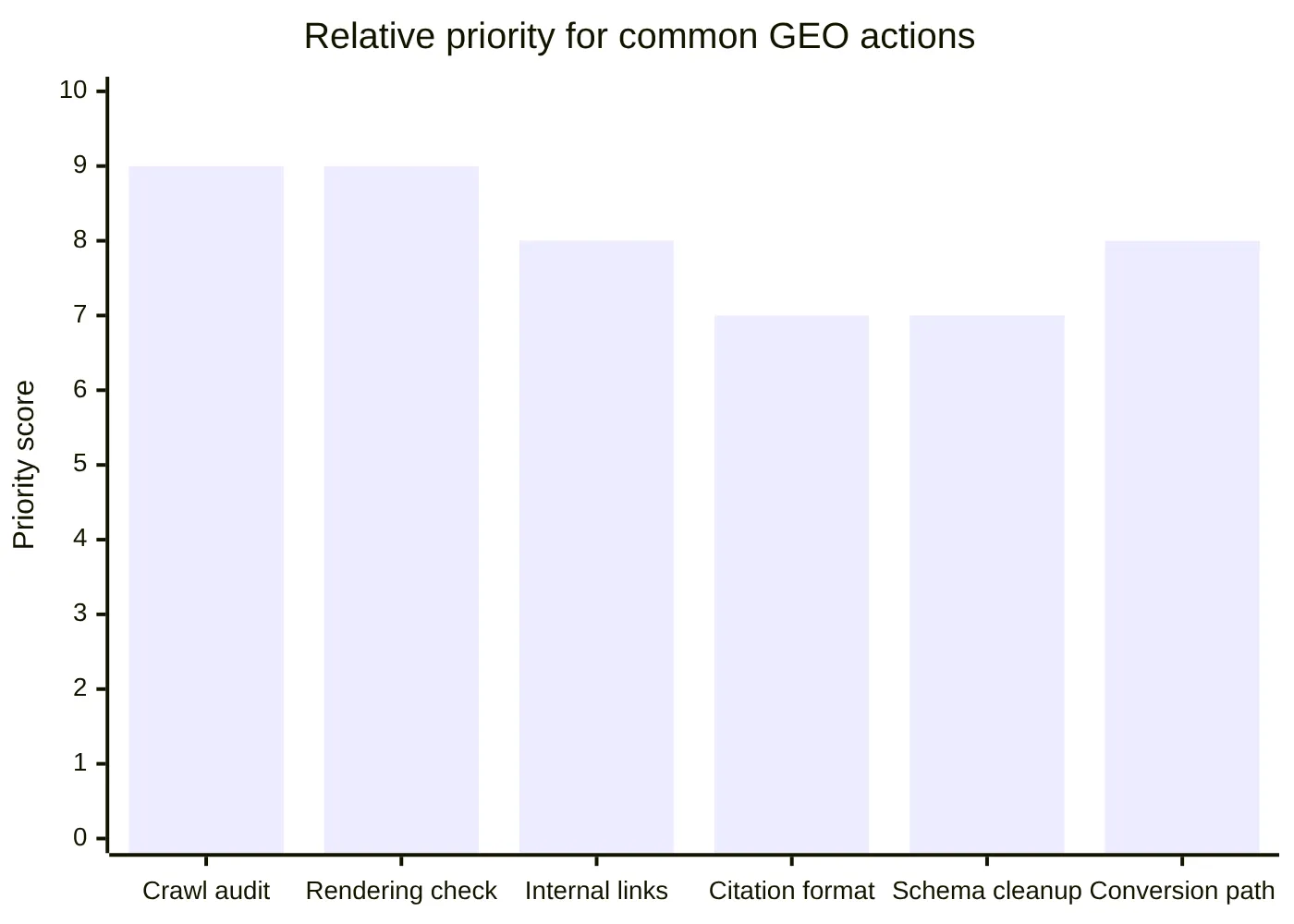 Here is a practical priority view for common GEO work:
The highest priority is not always the most fashionable task. A site with blocked service pages does not need a larger content calendar first. A multilingual site with hreflang conflicts does not need more translated posts before the architecture is repaired. A blog that already gets traffic but no inquiries may need better conversion paths before new articles.
The Textbook Definition (and Why It's Incomplete)
Generative Engine Optimization — GEO — was formally defined in a 2024 paper by researchers at Princeton, IIT Delhi, Georgia Tech, and Allen AI. Their definition: a set of methods for optimizing content to increase its visibility in AI-generated responses. That is accurate. It is also incomplete in a way that matters practically. The textbook definition treats GEO as a content optimization technique — something you do to a webpage to make it more likely to appear in AI answers. What it does not capture is the fundamental shift in what "appearing in search" now means, and why optimizing for AI citation requires a completely different success metric than optimizing for clicks.The Practitioner's Definition
Here is how SeekLab defines GEO after running campaigns across multiple clients: GEO is the practical process of making a website easy for search engines, AI answer systems, and LLMs to discover, understand, trust, extract from, cite, summarize, and connect to a useful next step. That definition changes the work. It moves GEO away from acronym debates and toward execution. In plain English, GEO is not just "getting mentioned by AI." It is the work that helps Google, Bing, AI Overviews, Perplexity-style answer engines, and LLM-based search experiences discover your pages, understand your brand, extract useful answers, cite or summarize you accurately, and send qualified users toward a real business action. This matters most for independent websites, official company websites, and multilingual brand sites that do not have unlimited authority, massive PR coverage, or a large technical team. Before writing more content or chasing AI mentions, the better starting point is identifying what actually blocks growth.
What Google's AI Overview Actually Is
Google AI Overview — the AI-generated answer box that now appears above all organic search results for millions of queries — is the most consequential product launch in search since PageRank. When a user searches a research query, they no longer necessarily see ten blue links. They see a generated paragraph answering their question directly, with small green source badges linking to the pages Google's AI drew from. The user reads the answer. They may or may not click the sources. For the brands whose content appears in those source badges — whose name is in that AI-generated answer — this represents something more valuable than a position-3 ranking below the fold. It is a direct recommendation at the exact moment the user is deciding. For the brands whose content does not appear there, it is as if they do not exist for that query — regardless of how well they rank in the traditional results below. This is the split that GEO addresses. SEO gets you into the traditional results. GEO gets you into the AI answer.What the 11,874 Impressions Actually Mean
Back to those numbers. One article. One month. 11,874 impressions. 13 clicks. 10 organic backlinks. The article was a comparison piece published for a tech client operating in a competitive niche. It ranked #1 within 14 days and got cited in Google's AI Overview. The impressions are mostly from users who saw the client's brand cited in Google's generated answer — the majority of them got their answer without clicking. That is the AI Overview effect. The 10 organic backlinks came from other sites in the space that found the article and linked to it without any outreach. The content attracted them because it was the most comprehensive, well-structured comparison available. The 13 clicks are, honestly, the least interesting number in the dataset. Click-through rates from AI Overview citations will always be lower than traditional ranking positions. That is not a failure of GEO — it is the nature of AI-mediated search. Google's own research notes that AI Overviews now capture a significant share of clicks that previously went to external websites. The metric that matters is citation frequency — how often the brand's content appears as a source in AI-generated responses across a defined set of target queries. That number, for this client, grew from zero to consistent presence across their category queries within 14 days of publication. That is what GEO looks like in practice.GEO vs SEO: How They Overlap
GEO and SEO should not be treated as competing disciplines. GEO depends on SEO because AI answer systems still need accessible, reliable, structured web content.| Term | Plain-English meaning | Practical work | What to measure |
|---|---|---|---|
| SEO | Improving organic search visibility | Technical SEO, content, links, schema, page experience | Rankings, impressions, clicks, conversions |
| GEO | Improving readiness for AI-generated answers | Citation-ready content, entity clarity, crawlability, schema | Citation frequency, cited pages, AI-assisted referrals |
| AI Search Optimization | Visibility across all AI-powered search surfaces | SEO plus GEO, answer formatting, technical readiness | All of the above plus AI referral quality |
| LLM Visibility | Accuracy and frequency in LLM responses | Brand consistency, topical authority, extractable content | Brand mentions, citation frequency, sentiment |
The Two Gates of AI Visibility
Most GEO frameworks treat AI citation as a single problem. SeekLab's work across multiple campaigns shows it is actually two separate problems that require two separate solutions. Gate 1: Retrieval selection. The AI system has to find your content and include it in its retrieval pool. This is primarily a technical SEO problem — your content needs to be crawled, indexed, and semantically associated with the right topics. A non-indexable page cannot be cited. A page that is not topically coherent will not be selected. Gate 2: Answer absorption. Once your content is in the retrieval pool, the AI has to extract something useful from it and surface it in the generated answer. This is where GEO-specific content structure matters — direct answer blocks, named frameworks, specific verifiable data, comparison tables, and "best for" labels. Content that does not contain extractable units of information will be retrieved but not absorbed. Most brands that are not appearing in AI answers are failing at Gate 1. They are not being retrieved at all. Most brands that appear occasionally but not consistently are failing at Gate 2. They are being retrieved but not absorbed.What a GEO Practitioner Actually Audits
A GEO practitioner does not begin by asking "how do we trick AI systems into citing us?" The better first question is "can machines and buyers understand this website without guessing?" The audit starts with discovery:- Are important URLs crawlable and indexable?
- Are canonicals correct and sitemaps clean?
- Are internal links available in HTML?
- For JavaScript-heavy sites — is the main content visible after rendering?
Next comes content structure. AI prompts are often longer and more contextual than traditional keyword searches. A buyer might not search only a short product term — they may ask for differences between options, certifications, regional availability, or how to choose. GEO-ready content should answer the main question directly, then support it with examples, comparisons, tables, FAQs, images, and internal links.
Entity clarity and schema are also central. A site should describe its brand, services, products, and expertise consistently. A company that uses different names for the same product across English and other language pages creates unnecessary ambiguity for search engines and AI systems.
Here is a practical priority view for common GEO work:
| Priority | GEO action | Why it matters |
|---|---|---|
| 1 | Crawl and indexing audit | Blocked pages cannot be cited regardless of content quality |
| 2 | Rendering check | JavaScript-hidden content may not be accessible to AI crawlers |
| 3 | Internal linking | Connects pages into topical clusters AI systems treat as authoritative |
| 4 | Citation-ready content structure | Direct answer blocks, tables, FAQs, specific data |
| 5 | Schema cleanup | Helps machines understand what each page represents |
| 6 | Conversion path | GEO is weak if a cited user arrives and has no next step |
The SeekLab GEO Content Framework
Based on SeekLab's campaign data, these are the seven structural elements that most consistently produce AI citations: 1. Direct answer blocks. Every section targeting a specific question should open with a one or two sentence direct answer — the claim before the evidence. AI systems extract the claim. They do not summarize. 2. Comparison tables. Structured tabular data appears in AI-generated answers at a disproportionately high rate. A well-structured comparison table is one of the most citable content elements you can produce. 3. Specific verifiable numbers. "The client's article ranked #1 and produced 10 organic backlinks in 30 days" is citable. "The article performed well" is not. AI systems cite sources that contain specific, attributable facts. 4. Named evaluation frameworks. Giving a methodology a name — the SeekLab GEO Content Framework, the Citation Lag Problem, the Two-Gate Model — creates a citable unit that AI systems can attribute to a specific source. 5. Best-for labels. Explicit "Best for: [use case]" labels per item in comparison or listicle content map directly to how AI systems generate recommendation answers. 6. FAQ sections. FAQ content in FAQPage schema format generates AI Overview citations at a measurably higher rate than equivalent information presented in paragraph form. 7. Internal topical clustering. AI systems evaluate the topical authority of the domain, not just individual pages. A site with fifteen interlinked articles on a topic will be cited more frequently than a site with one excellent standalone article.What GEO Is Not
GEO is not a replacement for SEO. Traditional SEO remains essential. Gate 1 of AI visibility is fundamentally a technical SEO problem. GEO is not a content hack. Adding FAQ sections and direct answer blocks is necessary but not sufficient. The underlying content still needs to be accurate, useful, and authoritative. AI systems are remarkably good at detecting thin content dressed up in GEO-optimized structure. GEO is not a one-time optimization. This is what SeekLab calls the Citation Lag Problem — AI citations take 6-8 weeks to build after content is published, and they decay 3-4 weeks after publishing stops. GEO is a continuous publishing practice, not a one-time pass. GEO is not only about Google. Google AI Overviews are the highest-traffic AI citation opportunity in 2026 because of Google's search volume dominance. But Perplexity, ChatGPT Search, and Gemini are growing fast. A complete GEO strategy addresses all of them — and they each have different retrieval mechanisms. GEO is not a guarantee of AI citations. No provider controls how every LLM retrieves, ranks, summarizes, or cites sources. The responsible promise is improved readiness: clearer content, stronger technical access, better entity signals, and more useful pages.SeekLab's Framework for Independent and Multilingual Websites
SeekLab's GEO framework starts with one operating principle: fix the parts of the website that affect discovery, understanding, trust, and business action. That does not mean fixing everything at once. It means identifying the constraints that actually limit growth, then sequencing the work.| SeekLab GEO layer | What it checks | Why it matters |
|---|---|---|
| Strategic topic selection | Search intent, AI prompt patterns, buyer questions | Prevents content teams from publishing in the wrong direction |
| Technical readiness | Crawling, indexing, rendering, Core Web Vitals, sitemap | Ensures important content can be discovered and processed |
| Content architecture | Headings, definitions, examples, tables, FAQs, internal links | Makes pages easier to parse, summarize, and use |
| Entity and schema clarity | Brand, service, product, article, breadcrumb signals | Helps machines understand who the brand is and what the page represents |
| Multilingual structure | hreflang, localized URLs, canonical logic, regional CTAs | Supports correct language-market matching |
| Conversion path | Contact prompts, service links, inquiry quality | Connects visibility to business outcomes |
| Measurement and review | Citation frequency, cited pages, traffic quality, leads | Prevents teams from optimizing only for vanity metrics |