SEO vs GEO Agencies: What’s the Difference and Which Type Do You Need?
Expert reviewed

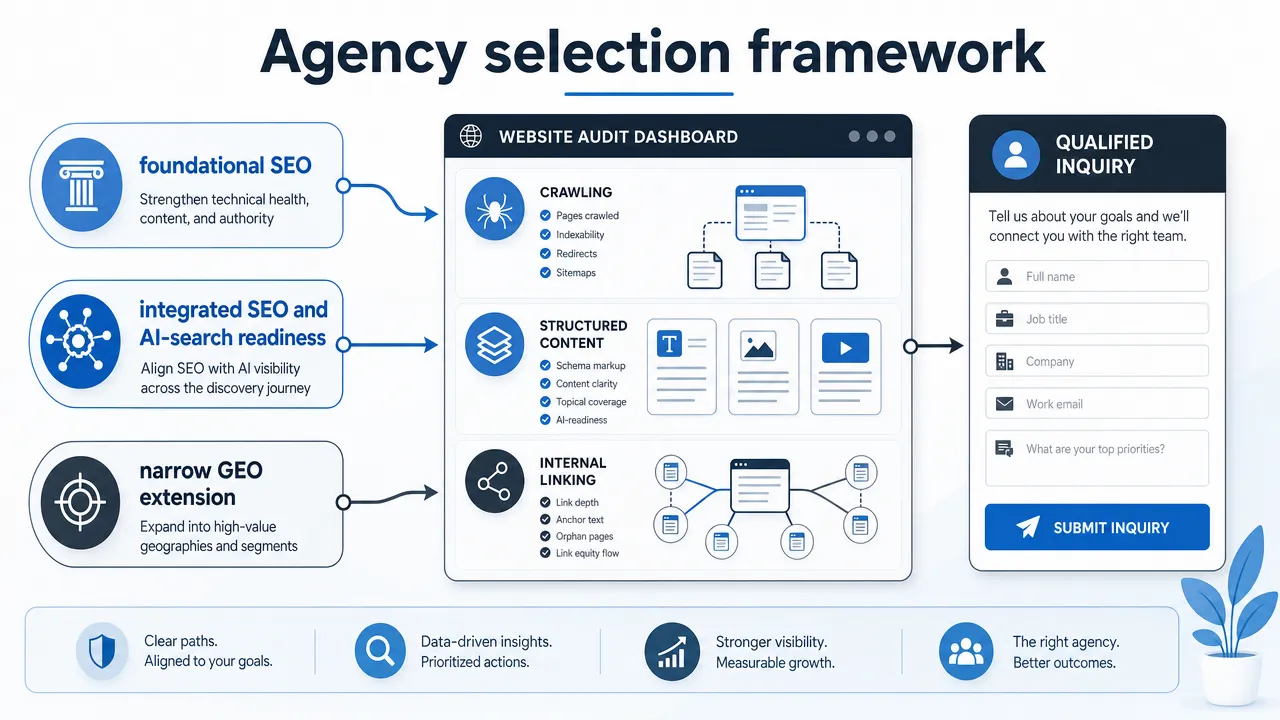
SEO vs GEO agencies are not two cleanly separate choices: SEO fixes the conditions that make a site discoverable, while GEO adds AI-search-oriented research and content improvements on top of those foundations. For most independent, B2B, exporter, and multilingual websites, the right decision is SEO-first remediation or an integrated engagement, not a standalone GEO retainer.
The practical test is simple. Look for the constraint that is actually limiting growth: poor crawling, JavaScript rendering failures, weak indexation, unclear product pages, thin content, fragmented language versions, or poor inquiry paths. An agency label does not solve any of these on its own. The useful provider is the one that can diagnose the issue, prioritize the work, support implementation, and measure whether it improves qualified discovery and conversion potential.
SEO vs GEO agencies: Start with the growth blocker, not the trend
An SEO agency typically focuses on organic search performance through technical SEO, content strategy, internal linking, site architecture, structured data, indexing, and reporting. Its work is meant to make pages easier to find, understand, and rank in traditional search results.
A GEO agency, where GEO means Generative Engine Optimization, usually positions its work around AI-assisted search experiences. That can include reviewing how a brand or topic appears in generated answers, improving entity clarity, creating answer-ready content, and monitoring selected mentions or citations.
The important distinction is that GEO is still an emerging label. It is not a standardized agency category, a platform certification, or a replacement for SEO. The original Generative Engine Optimization research paper helped establish the term, but its controlled research findings do not guarantee commercial outcomes across Google, Bing, or conversational AI platforms.
Google has been clear on the operational point that matters most: websites do not need special AI-only markup or new machine-readable files to qualify for its AI search experiences. Pages still need to meet core technical requirements for Google Search, including crawl access, indexable content, useful internal links, and structured data that matches visible page content. See Google's guidance on AI features and websites for the platform's current position.
That is why the first agency decision should be based on site maturity.
| Your current condition | Best starting point | Why |
|---|---|---|
| Important pages are not indexed, render poorly, or have crawl issues | Technical SEO or an integrated provider working SEO-first | AI-search-oriented work cannot compensate for inaccessible pages. |
| Rankings are improving but leads remain weak | SEO and conversion-focused content support | The issue may be offer clarity, page intent, trust signals, or the inquiry path. |
| The site has strong technical health and an established content program | Integrated SEO and AI-search-readiness support | The business can test AI-answer patterns without neglecting organic growth. |
| The site operates across languages and markets | International SEO-capable integrated provider | Architecture, localization, technical consistency, and market-specific content must work together. |
| There is no analytics baseline, owner, product clarity, or implementation capacity | Short diagnostic engagement or delay | An ongoing retainer will struggle without decisions, data, and delivery support. |
A useful agency should be willing to deprioritize work. A site with thousands of duplicated URLs does not need another generic blog cluster first. A product page with no clear specification, proof point, or next action does not become commercially useful because it appears in a chatbot answer.
SEO vs GEO agencies: Where the practical differences begin and end
The difference between SEO and GEO agencies is mainly a difference in emphasis, research scope, and measurement. Their technical and content requirements overlap far more than agency marketing often suggests.
| Area | SEO agency | GEO agency | What to verify before buying |
|---|---|---|---|
| Primary objective | Organic discoverability, qualified visits, and conversion potential | Better representation and reference potential in AI-assisted answers | Ask how the work connects to commercially useful outcomes. |
| Technical work | Crawling, indexation, canonicalization, rendering, speed, sitemaps, robots.txt, internal links | Should include the same fundamentals | Treat a GEO offer without technical competence as a risk. |
| Content work | Search intent, topical coverage, commercial relevance, editorial quality | Clear claims, self-contained answers, entities, evidence, comparisons | Ask what makes content more useful than a competitor's version. |
| Architecture | Page hierarchy, topic clusters, navigation, descriptive internal links | Relationships among products, topics, claims, and support material | Request a page-level plan, not a keyword list alone. |
| Structured data | Relevant markup validated against visible content | Often presented as a readability signal | Reject claims that special "AI schema" guarantees inclusion. |
| Measurement | Indexation, impressions, clicks, sessions, conversions, inquiries | Selected mentions, citations, prompt coverage, referrals | Keep AI observations separate from business outcomes. |
| Main risk | Ranking reports without conversion relevance | Repackaged SEO, opaque monitoring, or unsupported promises | Require clear deliverables, limits, and implementation ownership. |
A capable SEO agency may already cover much of what is being sold as AI Search Optimization. For example, a proper technical audit should test whether priority content is accessible in raw and rendered HTML, whether internal links are crawlable, whether canonical signals are aligned, and whether structured data reflects what users can see.
A capable GEO provider should add something specific beyond a renamed audit. That may include:
- Reviewing the priority buyer questions that appear in AI-assisted search journeys.
- Identifying where the brand description, product definitions, comparisons, or proof points are unclear.
- Designing pages that answer a narrow question without stripping away the detail a real buyer needs.
- Checking whether critical facts are attributable, current, and consistent across relevant pages.
- Monitoring a defined query set across selected platforms and markets, while disclosing the limits of that monitoring.
Those extensions can be useful. They are not magic. AI-generated answers can change by query wording, location, language, platform, timing, available sources, and platform behavior. No agency can credibly guarantee citations, AI Overview inclusion, rankings, traffic, inquiries, or revenue.
Google's guidance for succeeding in AI search experiences reinforces the same point from another angle: helpful, original content and sound technical foundations remain relevant. The work is less about finding an AI shortcut and more about making a site genuinely easier to interpret.
For that reason, a search marketing agency should not be selected because it uses newer terminology. It should be selected because it can show how its process changes decisions on your site.
SEO vs GEO agencies: The technical and content foundation both must cover
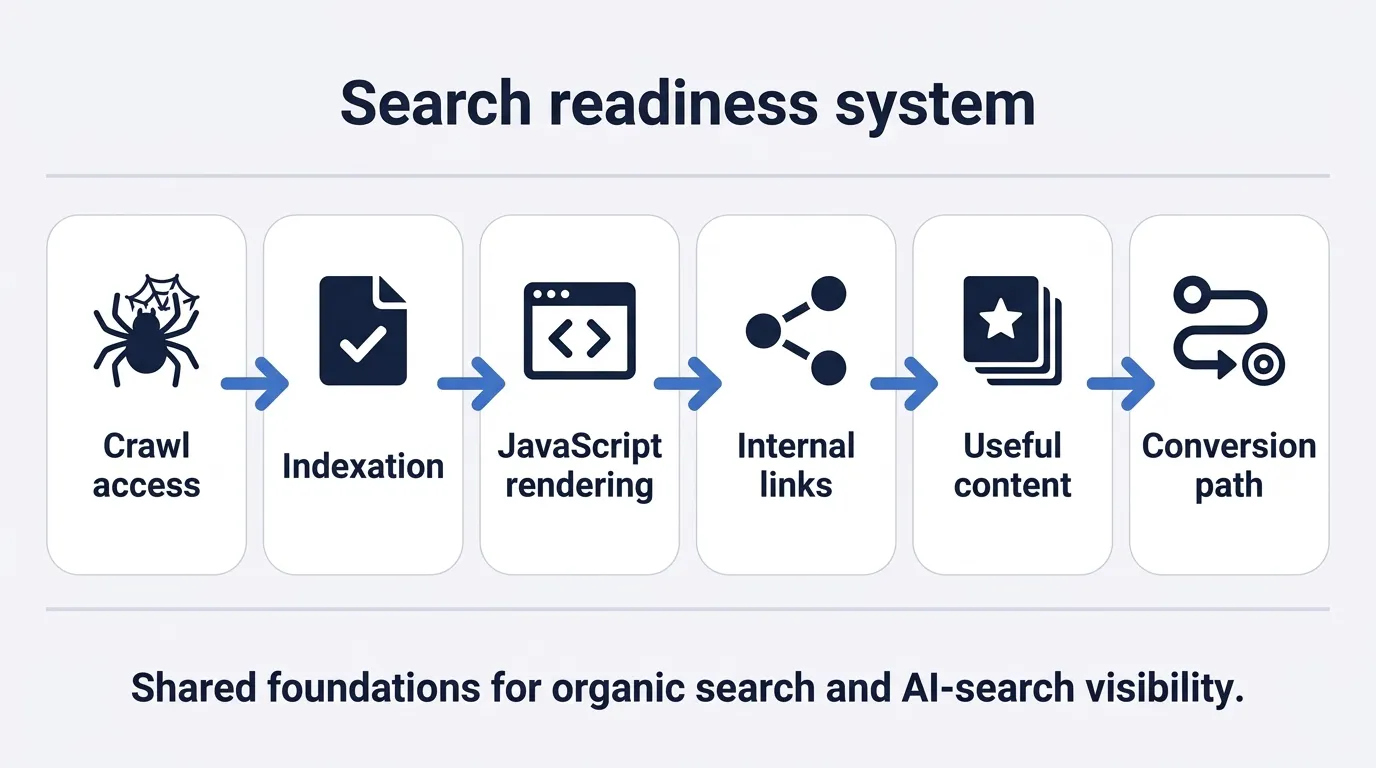
The most expensive mistake in this category is paying for new content before confirming whether existing pages can be crawled, rendered, indexed, understood, and converted.
For modern independent websites, especially those built on JavaScript-heavy stacks, a visual page check is not enough. A page can look complete to a visitor while essential copy, product specifications, navigation links, or language-switching controls are missing from the version search systems process.
A credible technical scope should include the following.
| Requirement | What the agency should inspect | Commercial consequence if ignored |
|---|---|---|
| Crawl access | robots.txt, server responses, CDN rules, bot access, blocked assets | Search systems may never reach key pages or resources. |
| Indexation | Canonicals, noindex directives, duplicate pages, sitemap coverage, excluded URLs | Valuable pages may fail to appear while low-value versions compete. |
| JavaScript rendering | Raw HTML, rendered HTML, client-side links, delayed content, route behavior | Product content or navigation can become difficult to discover. |
| Internal linking | Orphan pages, weak anchors, depth, contextual links, hierarchy | Important pages receive less context and fewer discovery paths. |
| Page performance | Template-level bottlenecks, image delivery, scripts, server latency | Slow pages can weaken user experience and expose technical debt. |
| Structured data | Validity, relevance, visible-content alignment, template consistency | Markup may be ignored or create misleading page signals. |
| Sitemap.xml and robots.txt | Canonical URL coverage, freshness, accidental blocking, deployment changes | Search systems receive inconsistent discovery signals. |
| Conversion path | CTA relevance, forms, quote routes, product details, trust evidence | More visits may still produce no useful inquiries. |
Bing has also stated that XML sitemaps and freshness signals remain relevant in AI-powered search. Its sitemap guidance is a reminder that basic discovery hygiene is still operational work, not legacy work.
Content has an equally practical role. Generic posts built from a flat keyword sheet rarely help a technical buyer compare suppliers or justify an inquiry. Strong content should clarify a decision. It should explain constraints, terminology, specifications, trade-offs, use cases, evidence, and the next sensible step.
For example, an exporter selling engineered components may need a page that explains compatibility, material limits, certifications, lead times, and the questions a buyer should ask before requesting a quote. That page is more useful to users, organic search, and AI-assisted systems than a broad article repeating general industry definitions.
A commercially useful organic search strategy connects:
- Demand and search intent.
- A suitable page type.
- Accurate subject-matter input.
- Internal links to related commercial and supporting pages.
- A conversion route that matches the visitor's stage.
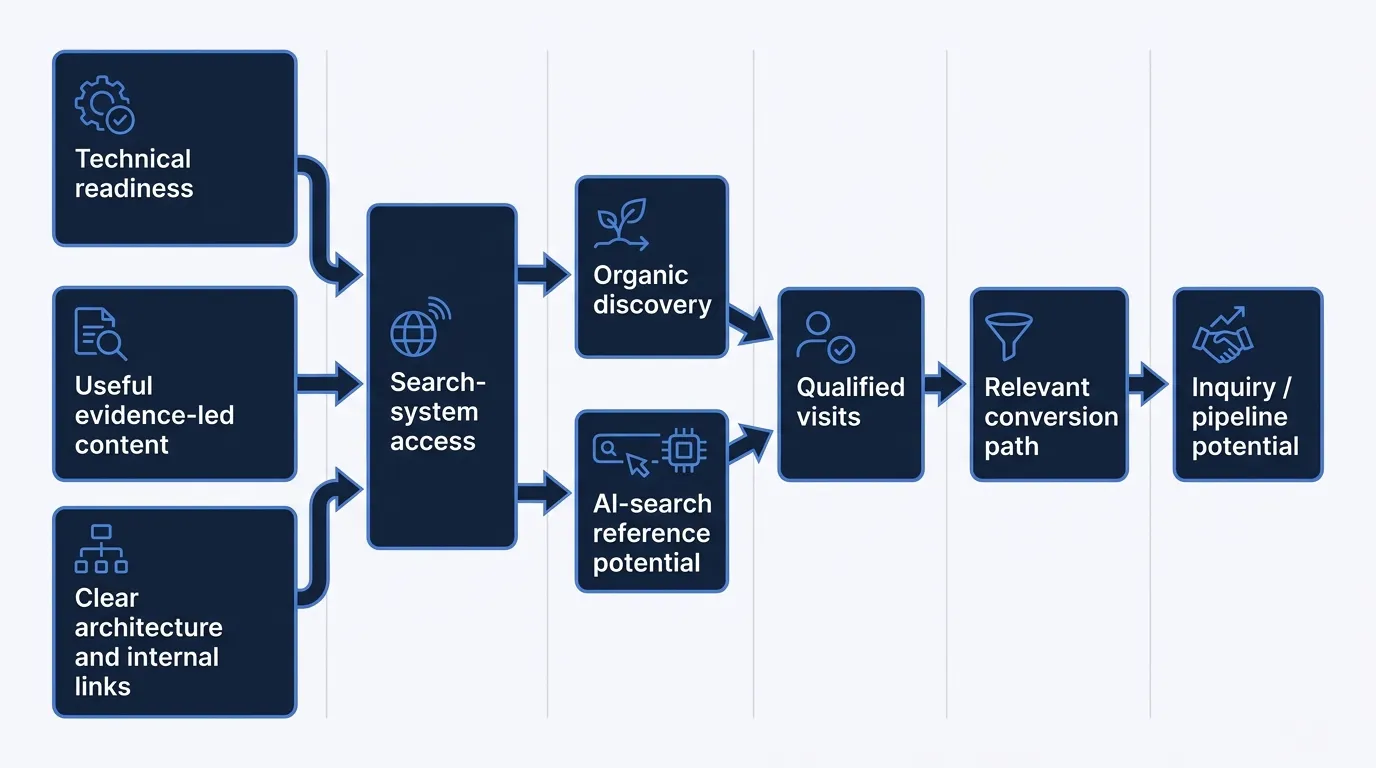
SeekLab.io applies this integrated logic through technical and content services, combining full-site diagnostics, topic prioritization, content development, internal-link analysis, structured-data checks, and implementation guidance. The point is not to fix every low-impact issue. It is to identify what is blocking growth now and what can wait.
SEO vs GEO agencies: Which type of agency do you need for your site?
The answer to which type of agency do you need depends on the order of your constraints. Start with what prevents useful discovery today, not with the newest reporting category.
Choose an SEO-focused agency when foundations are weak. This is the right route for a new website, a poorly indexed site, a site with rendering issues, or a business that has never mapped high-value queries to the right commercial pages. The first deliverables should be a prioritized audit, a technical implementation plan, a content opportunity map, and an analytics baseline.
Choose an integrated provider when the site needs growth across search and AI-assisted discovery. This is often the best fit for established B2B companies, exporters, and multi-market brands. The provider should combine technical SEO, content strategy, architecture, conversion analysis, and AI-search-readiness research in one prioritized program.
Consider GEO services as a focused extension when the fundamentals are genuinely sound. The business should already have crawlable pages, stable indexation, usable analytics, clear products or services, and a functioning conversion path. In this case, AI-answer landscape research and content clarity work may reveal gaps that conventional reporting misses.
Delay a large engagement when internal conditions are not ready. An agency cannot resolve unclear positioning if nobody can confirm the product value proposition. It also cannot deliver fast implementation if developers are unavailable, the CMS is unmanaged, or no one owns content approvals.
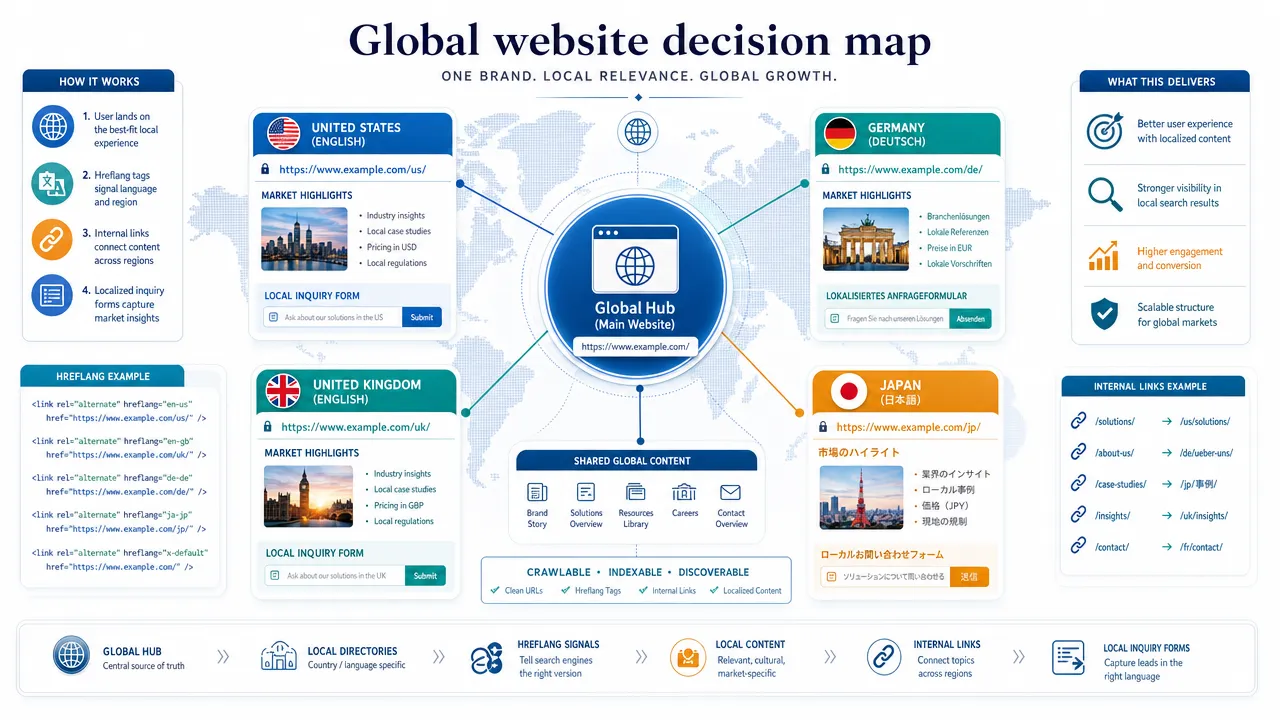
For multilingual and cross-border sites, the selection test must be broader. A company may have technically correct English pages and still underperform internationally because it copied keywords into another language, deployed generic translations, or allowed language versions to compete with each other.
A market-language plan should address:
- Which countries and languages are commercially important.
- Whether country and language URLs are unique and crawlable.
- Whether hreflang, canonicals, sitemaps, and internal links point to the correct version.
- Whether local keyword research reflects actual search behavior rather than direct translation.
- Whether each market has appropriate proof points, terminology, images, specifications, and calls to action.
- Whether reporting separates country, language, directory, and conversion type.
For a deeper operational framework, see SeekLab.io's multilingual SEO strategy guide. Its core principle is particularly relevant here: do not translate or optimize everything. Focus first on pages that support real demand, revenue, and qualified inquiries in each target market.
SEO vs GEO agencies: Questions and red flags before you sign
A strong agency should answer direct questions without hiding behind dashboards, vague methodology, or fashionable labels.
| Ask this question | A credible answer should include |
|---|---|
| What business outcome are you optimizing beyond rankings? | A definition of qualified inquiries, priority markets, conversion events, and commercial page goals. |
| What will you audit before recommending content scale? | Crawlability, indexation, rendering, architecture, content gaps, and conversion paths. |
| How will you prioritize issues? | Severity, affected templates, business relevance, implementation effort, and what will be deprioritized. |
| Who owns implementation and QA? | Named responsibilities for technical tickets, content approvals, development, validation, and reporting. |
| How do you turn keyword research into page decisions? | Intent mapping, existing asset review, page types, content briefs, internal links, and commercial relevance. |
| What makes your AI Search Optimization work distinct from baseline SEO? | A defined research method, answer-pattern analysis, content clarity improvements, and stated measurement limitations. |
| Can you guarantee citations or AI placements? | No. The agency should explain why outcomes are platform-controlled and variable. |
| How do you evaluate multilingual pages? | Market-language mapping, local intent research, hreflang and canonical checks, localization decisions, and market reporting. |
| What will the monthly report show? | Completed work, implementation status, organic performance, conversion indicators, blockers, hypotheses, and next actions. |
| What client inputs do you require? | Product documentation, subject-matter review, access, market priorities, technical support, and sales feedback. |
Watch for these red flags:
- Guaranteed AI citations, first-page rankings, lead volumes, or AI Overview placements.
- A GEO proposal that contains only prompt tracking, metadata changes, or generic content volume.
- No review of crawlability, rendering, indexation, internal links, or technical ownership.
- "AI schema" presented as a secret mechanism without valid documentation or visible-content alignment.
- A report full of screenshots from generated answers but no explanation of query sampling, markets, timing, or limitations.
- Content plans built only around search volume, with no product fit, subject-matter evidence, or conversion path.
- A long list of technical issues with no sequencing, impact assessment, or implementation guidance.
- Direct translations treated as a multilingual content strategy.
- No discussion of lead quality after organic traffic arrives.
The right SEO agency vs GEO agency decision is usually less dramatic than it appears. Most businesses need a provider that can combine strong technical diagnostics with content judgment. The work should improve information clarity for search engines, AI systems, and real buyers, while still giving a qualified visitor a credible reason to contact the business.
SeekLab.io supports that approach with technical audits, industry-informed content, structured topic selection, multilingual architecture, and ongoing data review. If you need to establish which problems are worth fixing first, get a free audit report.