Advanced Schema Markup SEO Services | SeekLab.io
Expert reviewed


Schema markup SEO has shifted from a technical nice-to-have to a core part of how search engines and AI answer systems understand your pages. It does not directly boost rankings on its own, but it can increase eligibility for rich results and improve how clearly your brand and content entities are interpreted, which can lift CTR, impressions, and conversions when implemented correctly. For official company websites, exporters, and multilingual brands, the difference is often not "adding schema," but auditing, prioritizing, and maintaining it as part of technical SEO.
If you want the official baseline definitions and rules, start with Google's guide to structured data and the Schema.org vocabulary.
Why schema markup SEO matters (and what it realistically changes)
Think of structured data as a machine-readable contract: you are explicitly telling Google what the page is about, which entity is behind it, and which pieces of information are safe to extract.
In practice, schema markup SEO helps in three main ways:
- Rich results eligibility: Enhanced listings (where eligible) can improve SERP real estate and CTR. Google recommends using JSON-LD for structured data because it is easier to maintain than inline markup. See Google's intro to structured data and search gallery.
- Entity clarity (brand understanding): Strong entity signals support Knowledge Graph consistency and reduce ambiguity for global brands.
- Answer readiness for AI search: Clean, consistent entities and Q and A blocks make it easier for systems to cite and summarize your content accurately.
A practical rule SeekLab.io uses: we do not aim to fix everything. We identify what truly impacts growth, what can be deprioritized, and what needs a repeatable template so it does not break during future content updates.
FAQ schema: when it helps, when it backfires, and how to use it safely
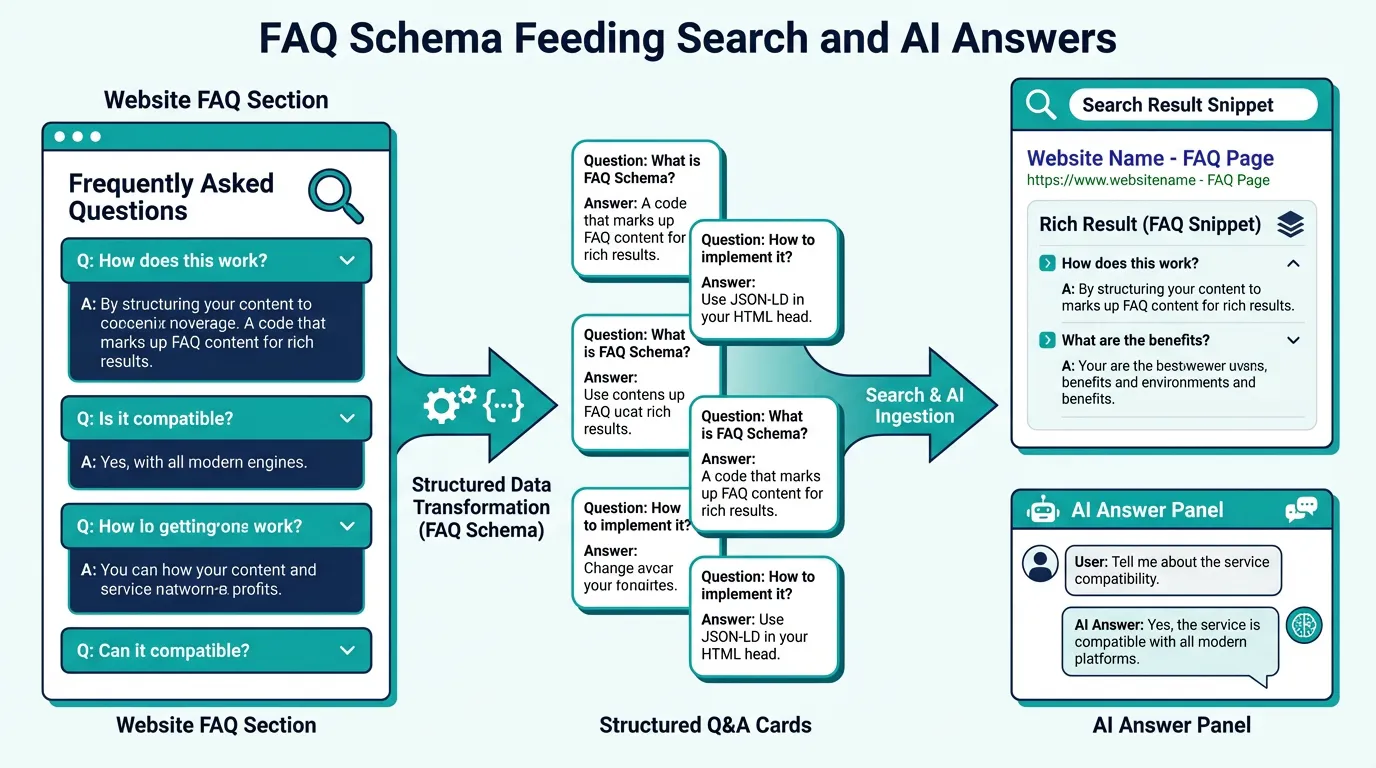
FAQ schema (FAQPage) is designed for pages with editor-written questions and answers that are visible to users. The official requirements are in Google's FAQPage documentation.
Best-fit use cases
- Service pages that must handle objections: timelines, deliverables, data access, reporting cadence.
- High-intent pillar pages where concise answers reduce friction and improve conversions.
- Complex B2B offers where buyers need clarity before they contact you.
Common failure modes
- Marking up content that is not visible on the page (Google can ignore it).
- Using FAQPage for user-generated Q and A (that should be a different schema type).
- Copy-pasting the same questions across dozens of pages, creating duplicate Q and A at scale.
A safe guideline
Keep it selective and useful, often 3 to 8 high-quality questions per page, and ensure the schema matches the on-page text exactly.
Organization schema: the foundation for entity SEO and consistent brand signals

Organization schema is the anchor that helps search engines understand "who" is behind your website. Google's guidance is in Organization structured data, and the underlying type definition is on Schema.org Organization.
What strong Organization schema typically includes
- A stable
@idfor the entity (used consistently site-wide). name,url,logo,description.contactPointfor business contacts.- Optional:
areaServedto reflect coverage (useful for APAC, the United States, and Europe). - For multi-office operations, you can model locations carefully to avoid conflicting entities.
Why it matters operationally
Many sites accidentally publish multiple conflicting Organization objects via plugins, themes, and custom snippets. That is why Organization schema should be audited as a site-wide system, not treated as a one-off paste-in.
How SeekLab.io delivers schema work as part of a technical SEO audit (not a plugin checkbox)
Schema is most effective when it is integrated with crawling, rendering, and template strategy.
SeekLab.io's approach aligns schema with the same audit pillars you use to grow reliably:
- Full-site crawling and structured analysis.
- Indexing, crawling, rendering, and JavaScript compatibility checks.
- Internal link equity and semantic structure analysis.
- Schema data compliance and enhancement.
- International SEO considerations (including multilingual architecture).
If you are planning broader remediation, pair schema planning with a full audit roadmap. The playbook in The Complete SEO Audit Checklist For 2026: A Step-by-Step Guide is a solid starting point, and multilingual brands should also review The Ultimate Guide To Multilingual SEO Strategy in 2026.
Schema priority map (what to implement first)
| Priority | Template type | Why it comes first | Typical schema types |
|---|---|---|---|
| Phase 1 | Site-wide foundation | Establish the "who" and the site entity | Organization, WebSite |
| Phase 1 | Navigation and structure | Improve clarity of hierarchy in SERPs | BreadcrumbList |
| Phase 2 | Content templates | Support consistent attribution and extraction | Article or BlogPosting, Person (authors) |
| Phase 2 | Money pages | Align offers with conversion intent | Service or Product (where appropriate) |
| Phase 3 | Select pages only | Add Q and A clarity where it reduces friction | FAQPage |
QA tools we expect every serious implementation to use
- Rich Results Test for Google eligibility and errors.
- Schema Markup Validator for general schema correctness.
- Search Console monitoring via Google's help doc on structured data reports.
How to measure results (and what "success" should look like)
Schema work should be measured like any other SEO initiative: visibility, behavior, and outcomes.
A realistic measurement stack:
- Search Console enhancement coverage: errors down, valid items up.
- SERP performance change: CTR and impressions on affected templates.
- Conversion impact: more qualified form submissions or inquiries from pages where FAQs reduce uncertainty.
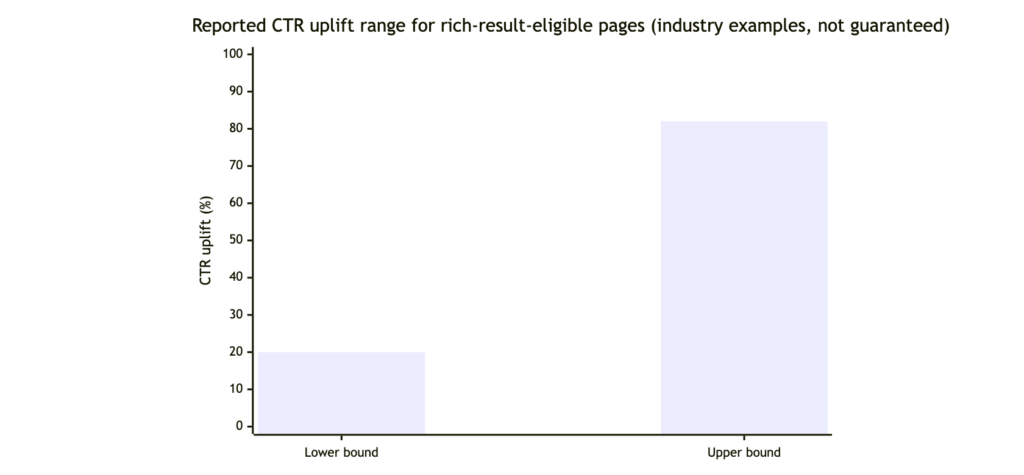
Industry case reporting suggests rich-result-eligible pages can see meaningful CTR gains in some contexts, but results vary by site, vertical, and eligibility rules.
FAQs about schema work (practical, not theoretical)
Does schema markup directly improve rankings?
No. It is primarily about rich result eligibility and better machine understanding. Rankings usually move because the overall page experience, relevance, and authority improve, with schema supporting those signals.
How long does it take to see an impact?
Validation results can appear quickly, but performance impact typically needs enough impressions to be statistically meaningful. For many sites, that is weeks, not days.
Can you implement this on JavaScript-heavy sites?
Yes, but it must be validated with rendering in mind. If schema is injected too late client-side, crawlers may miss it. The implementation pattern depends on your framework and rendering strategy.
What should I do next?
Get a free audit report, contact SeekLab.io, and leave your website domain so we can identify which schema fixes will actually move growth metrics and which ones can be deprioritized.