Advanced SEO Site Architecture for B2B & eCommerce Success
Expert reviewed

Many B2B and eCommerce teams feel they've done SEO but still see pages stuck out of the index, weak category visibility, and blog content that doesn't turn into inquiries. In almost every case, the missing piece is not another keyword, but the underlying SEO site architecture.
When the skeleton of the site is wrong, every new page you publish has to fight uphill. When the architecture is right, even small content and technical improvements compound across thousands of URLs.
This case study-style walkthrough combines two anonymized projects handled by SeekLab.io:
- A B2B exporter/SaaS hybrid selling compliance software into APAC, the US, and Europe.
- A mid-sized eCommerce manufacturer with a complex catalog and plans to expand into multilingual markets.
Both had invested in content and basic optimization. Neither could break through until their SEO site architecture was rebuilt around crawlability, internal linking, and international structure.
The Architecture Problem: Two Real-World Scenarios
Case 1: B2B Exporter with Invisible High-Value Pages
The B2B exporter had:
- Strong products and real customer wins.
- Dozens of solution pages and hundreds of blog posts.
- Separate English and Chinese sections for Asia-Pacific and Europe.
Yet:
- Key solution pages were >4 clicks from the homepage.
- Case studies were hidden behind PDF links and not interlinked.
- Multiple language versions had conflicting canonical and hreflang tags, causing Google indexing issues in key markets.
Leads from organic search were inconsistent and skewed toward low-intent queries ("what is…" very early-stage).
Case 2: eCommerce Manufacturer Trapped in Faceted URLs
The eCommerce manufacturer had:
- Thousands of SKUs across categories, subcategories, and filters.
- Parameterized URLs for color, size, region, and availability.
- Heavy JavaScript rendering for product grids.
Symptoms:
- Crawl stats from Google Search Console showed a large share of crawl budget wasted on low-value filtered URLs.
- High-margin categories had weak rankings despite solid backlinks.
- Mobile Core Web Vitals metrics were poor across category templates, hurting both SEO and conversions.
In both cases, SeekLab.io's conclusion was the same: without restructuring SEO site architecture, more content or isolated fixes would produce diminishing returns.
Diagnosing SEO Site Architecture with Data, Not Guesswork

SeekLab.io's process starts with a full-site technical SEO audit focused on architecture, rather than isolated page tweaks.
What the Audit Looked At
For both projects, the team combined:
- Full-site crawling and structured analysis to map all HTML links, depth, and status codes.
- Website crawlability and index coverage using Google Search Console's "Coverage" and "Crawl stats" reports (Google Search Central).
- Internal linking strategy and anchor text patterns, guided by research from Ahrefs on internal links and hub-and-spoke structures (https://ahrefs.com/blog/internal-links-for-seo/).
- Canonical tag SEO behavior across categories, filters, and language variants, checked against Google’s documentation.
- Core Web Vitals SEO performance by template, using Page Experience guidance from Google (https://developers.google.com/search/docs/appearance/page-experience).
- JavaScript SEO diagnostics, ensuring rendered HTML contained navigational links and important content (https://developers.google.com/search/docs/crawling-indexing/javascript).
- Schema markup SEO and JSON-LD coverage on product, solution, and article templates.
The result was not just a list of errors, but a map of where architecture was blocking growth.
Key Findings (Summarized)
| Area | B2B Exporter (Before) | eCommerce Manufacturer (Before) |
|---|---|---|
| Click depth to core pages | 4–6 clicks from home for key solutions & industries | 4+ clicks for many top categories due to nested filters |
| Internal linking | Blog posts rarely linked back to solution pages | Product pages linked only up to category, no lateral linking |
| Crawl budget usage | Many low-value tag/archive pages indexed | Large share of crawl on near-duplicate filter URLs |
| Canonical tag SEO | Mixed signals between language versions | Inconsistent canonicals on category + filtered URLs |
| Core Web Vitals SEO | Slow solution templates due to heavy scripts | CLS and LCP issues across category grids |
| hreflang SEO | Partial implementation, non-reciprocal in places | Not implemented; planned expansion on hold |
Estimated Impact of Architecture Fixes
SeekLab.io modeled the relative impact of different architecture improvements on organic sessions for the B2B exporter. The numbers below are indexed (Baseline = 100) and are illustrative, but they mirror what we commonly observe in mid-sized sites.
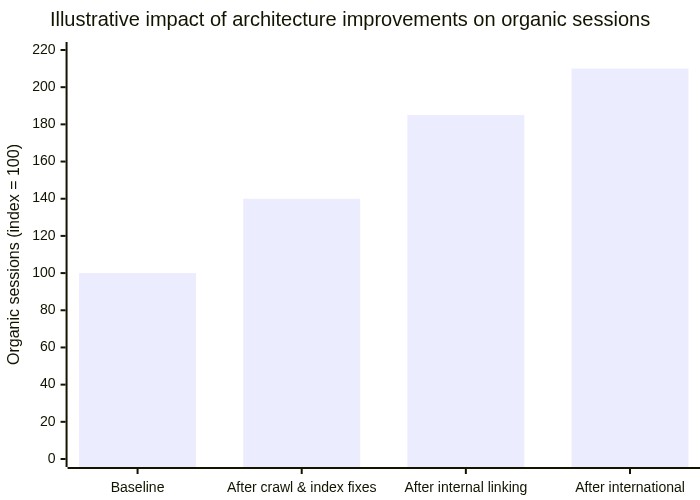
The key insight: fixing crawlability, indexation, and internal linking produced the biggest step changes—much more than simply rewriting titles or adding more content in isolation.
Rebuilding for Scale: From Chaotic URLs to Structured Growth
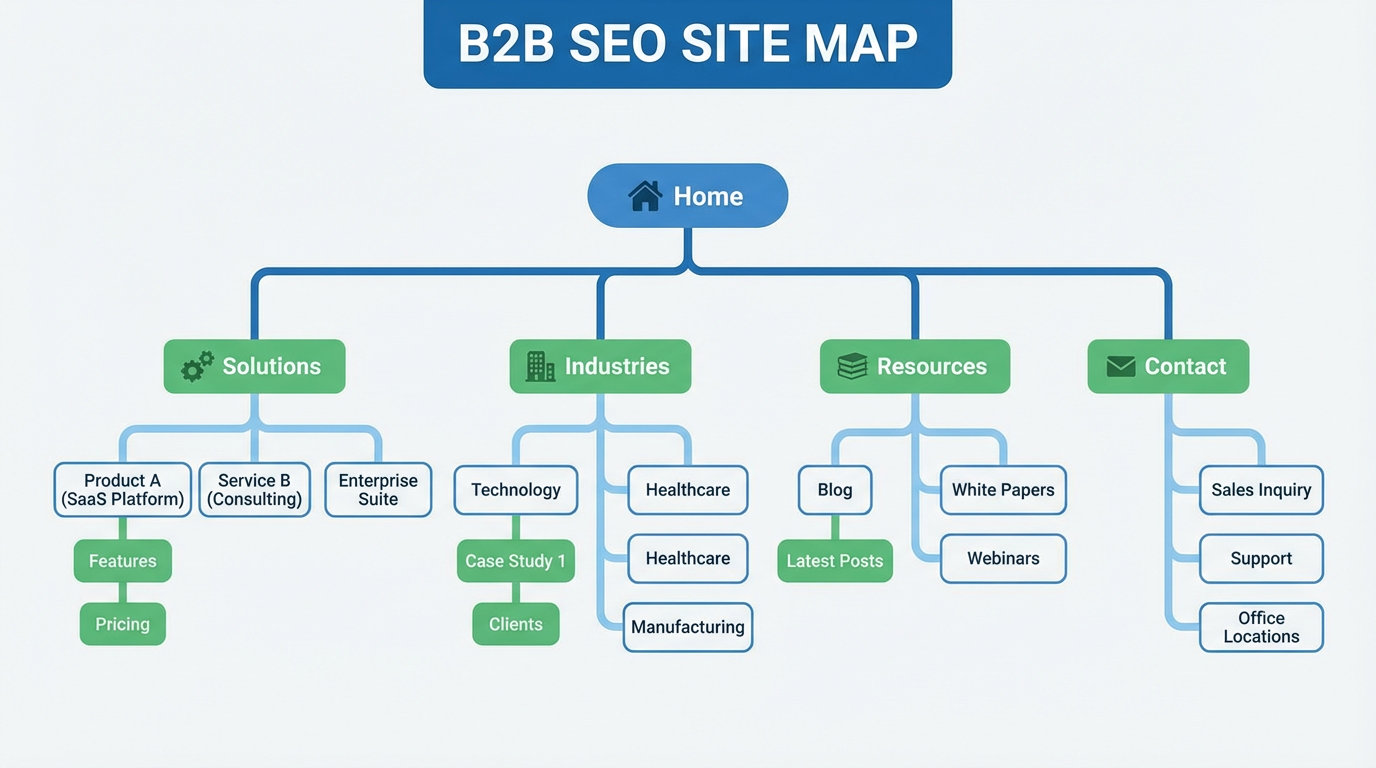
Once diagnostics were complete, the question became: which architectural changes would truly impact growth, and which could be safely deprioritized?
SeekLab.io applied a simple principle: protect and grow revenue-critical pages first, then unlock blocked opportunities, while ignoring cosmetic changes that don't move the needle.
B2B Exporter: Structuring Around Buyer Journeys
Research on B2B SEO (for example, Moz's strategy guides at https://moz.com/blog/adapt-b2b-seo-strategy-for-success and Siege Media's content strategy framework at https://www.siegemedia.com/creation/b2b-seo-content-strategy) aligns closely with what this exporter needed:
- Navigation and hierarchy redesigned
- Introduced top-level "Solutions" and "Industries" sections.
- Ensured all high-value solution and industry pages were within three clicks of the homepage, following information architecture guidance from Databox (https://databox.com/website-structure-for-seo).
- Reduced reliance on deep, ad-hoc folders.
- Internal linking strategy rebuilt
- Defined pillar pages for each core solution and industry.
- Clustered existing blogs, guides, and documentation around those pillars using descriptive anchor text.
- Implemented breadcrumbs to expose hierarchy sitewide, in line with best practices from Moz (https://moz.com/learn/seo/internal-link).
- Content hubs and case studies surfaced
- Created a central resources hub (blogs, whitepapers, case studies, webinars).
- Linked case studies both from relevant solution and industry pages, reducing orphan content.
- Designed SEO content brief templates so each new article would reinforce one or more pillars and internal links.
- Schema, Core Web Vitals, and conversion paths optimized
- Added
Organization,Service,FAQPage, andArticleschemas to key templates. - Simplified global scripts and improved image loading on solution pages, aligning with Google's page experience recommendations.
- Clarified calls-to-action—demo, consultation, or quote—on all high-intent pages, balancing search rankings with conversion.
- Added
eCommerce Manufacturer: Taming Categories and Facets
For the eCommerce brand, SeekLab.io followed patterns consistent with eCommerce SEO guides from OuterBox (https://www.outerboxdesign.com/articles/seo/20-ways-improve-ecommerce-seo/) and Crystallize (https://crystallize.com/blog/ecommerce-seo-guide):
- Category and subcategory taxonomy cleaned
- Reorganized sprawling categories into a shallow hierarchy: Home → Category → Subcategory → Product.
- Validated category labels and groupings against real keyword research and user behavior.
- Enriched category pages with unique intro copy, internal links to top subcategories, and FAQs.
- Faceted navigation and parameters controlled
- Designated a small set of high-value filters (e.g., brand, material) as indexable.
- Applied
noindexand appropriate canonical patterns to low-value or highly specific combinations. - Standardized URL parameters to avoid infinite, duplicative variations.
- Product detail templates upgraded
- Rewrote critical product descriptions to differentiate from supplier content.
- Implemented structured data for
Product,Offer,Review, andBreadcrumbList. - Added logical related products and links to buying guides to improve internal linking and conversion.
- Template-level Core Web Vitals improvements
- Optimized category grid images and script loading once, benefiting thousands of URLs simultaneously.
- Prioritized LCP and CLS improvements following Google’s Core Web Vitals thresholds.
Change vs. Impact Snapshot
| Change Type | Priority | Primary Impact Area |
|---|---|---|
| Shortening click depth to solutions/categories | High | Faster discovery, stronger ranking signals |
| Rebuilding internal linking hubs | High | Topical authority, PageRank distribution |
| Faceted navigation rules & canonical logic | High | Crawl budget, duplicate content control |
| Template-level Core Web Vitals improvements | Medium | Rankings stability, user conversion |
| Cosmetic URL "prettifying" only | Low | Minimal incremental value |
SeekLab.io deliberately deprioritized low-impact cosmetic adjustments so teams could focus on what would measurably influence traffic, leads, and revenue.
International Expansion and hreflang SEO in Practice
Both clients needed a site architecture that could scale internationally—especially across the Asia-Pacific region, the US, and Europe.
Choosing the Right Model
Based on Google’s guidance for multilingual and multi-regional sites, SeekLab.io recommended:
- Subfolder-based approach (
/en/,/zh-cn/,/de/) for the B2B exporter to consolidate authority while enabling regional customization. - A phased subfolder rollout for the eCommerce brand, starting with their highest-value export markets.
This balanced SEO benefits with operational complexity and legal considerations.
Implementing hreflang SEO Correctly
Referencing Google's localized versions documentation (https://developers.google.com/search/docs/specialty/international/localized-versions), SeekLab.io:
- Ensured each language/region variant referenced itself and all other variants using
hreflangtags or sitemaps. - Used correct codes such as
en-US,en-SG,zh-CN,ar-AE, aligning with the brands’ regional priorities. - Aligned canonical tag SEO with hreflang, so each localized page was canonical to itself and never to a different language.
For the B2B exporter, this resolved long-standing conflicts where English pages were mistakenly treated as the canonical for Chinese content, undermining visibility in mainland China and Southeast Asia.
Brand Consistency Across Global Deployments
To support marketing and operations teams in Singapore, Shanghai, and Dubai, SeekLab.io provided:
- Shared architectural blueprints and navigation logic for all regions.
- Standardized schema templates (Organization, Product/Service, FAQ) in multiple languages.
- Guardrails so local teams could adapt content without breaking core SEO structure.
This approach made expansion into new languages and markets more predictable and less risky.
Results, Lessons, and a Practical Next Step
Within six months of implementation and content updates, both clients saw architecture-driven improvements that directly tied to business outcomes.
Measurable Outcomes
B2B exporter (lead-gen):
- Significant increase in impressions and clicks for solution and industry pages after internal link restructuring.
- Higher-quality leads: a larger share of inquiries mentioning specific regions and compliance scenarios the new architecture targeted.
- Shorter sales cycles as visitors more easily found case studies and documentation without manual links from sales.
eCommerce manufacturer:
- Noticeable growth in organic traffic to key categories once crawl budget was reallocated from low-value filter URLs.
- Improved rankings for high-margin categories after canonicals and on-page content were aligned.
- Better mobile conversion rates as Core Web Vitals improved at template level.
In both projects, some simple but high-impact technical issues were resolved free of charge, and ongoing monthly reporting kept teams focused on the small number of changes that mattered most.
Strategic Lessons for Marketing and Operations Teams
- Architecture first, content volume second
Before scaling blog production or adding thousands of SKUs, ensure the underlying architecture can support discovery, indexing, and internal linking. - Buyer journeys and search intent must drive structure
For B2B, organize around problems, solutions, and industries—not internal org charts. For eCommerce, align categories and subcategories to how users actually search. - Internationalization is structural, not just linguistic
Domain model, URL patterns, and hreflang SEO should be decided early. Retrofits are more expensive and disruptive. - Don't try to fix everything at once
SeekLab.io's philosophy is to identify what truly impacts growth and what can be safely deprioritized. That’s how you avoid multi-month projects that don’t move the numbers. - Content quality and images matter as much as code
In-depth, well-structured content with professional, relevant visuals performs better for both search engines and humans than generic, AI-sounding articles.
How SeekLab.io Can Help You Apply This
SeekLab.io supports B2B brands, exporters, and eCommerce sites across APAC, the US, and Europe with:
- Comprehensive SEO health check and technical SEO audit focused on architecture, crawlability, Core Web Vitals, JavaScript, and schema.
- SEO content strategy, keyword research, and topic selection that avoid heading in the wrong direction and capture trending topics early.
- High-quality blog and resource creation aligned with real industry scenarios, including structured layouts, internal links, and JSON-LD.
- Clear, actionable technical guidance for your developers—plus ongoing SEO reporting and monthly performance reviews.
If you suspect your SEO site architecture is holding back growth—whether that’s weak international visibility, underperforming categories, or content that never seems to rank—now is the time to address the foundation.
You can get a free audit report, or contact SeekLab.io and leave your website domain for an initial assessment tailored to your B2B or eCommerce site.