SEO Title Tags & Meta Descriptions: Best Practices for 2026
Expert reviewed

SEO title tags and meta descriptions still shape how pages are understood and clicked in 2026. This guide covers the best practices that matter most: how to write clearer title tags, stronger meta descriptions, and cleaner on-page structure so users and search engines can understand the page faster. You’ll also find examples, common mistakes, and practical rules you can apply to blog posts, landing pages, and service pages.
Google's guidance continues to emphasize helpful, people-first content and clear structure (see the Google Search Central SEO Starter Guide). Meanwhile, AI-driven search experiences tend to extract answers from pages that are easy to scan: strong titles, clean headings, and tight summaries in the opening section.
What on page SEO means in 2026 (and what changed)
On page SEO is the practice of optimizing what's on the webpage itself so search engines can understand it, index it correctly, and rank it for the right intent, while users can quickly confirm they are in the right place.
What changed most since 2020 is interpretation:
- Search engines reward clarity and satisfaction signals. If your page structure makes it easy to find answers, users stick around longer and convert more often.
- AI-driven results rely on structure. Titles, headings, and early-page summaries are frequently used to form snippets and answer summaries.
- "One page, one purpose" matters more. Vague pages with mixed intent tend to get rewritten (titles/metas) or underperform.
For marketing and operations teams (especially international sites), this is why on-page work should not be isolated. It should be tied to audits, templates, and measurable outcomes like CTR and qualified inquiries.
Title tag optimization in 2026: write "query contracts," not slogans
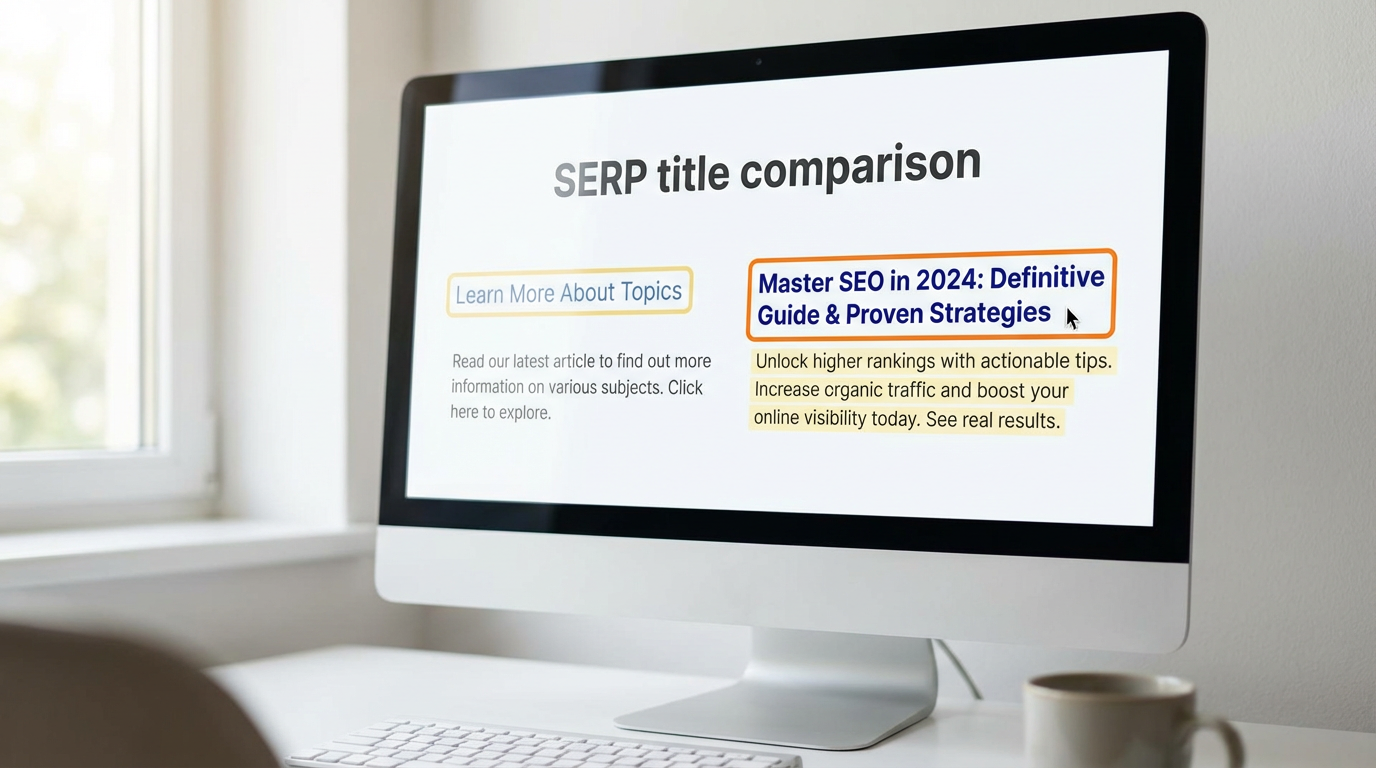
Your title tag is still one of the strongest on-page relevance signals, and it heavily influences whether someone clicks. But it only works when it accurately matches what the page delivers. Google can rewrite titles that look misleading, overly long, or inconsistent with on-page content (see Google Search Central documentation).
Practical rules that hold up in 2026
- Aim for clarity first, then worry about length. A common target is roughly 30 to 60 characters, but pixel width is what determines truncation.
- Front-load the main topic naturally (especially on competitive queries).
- Add a specific hook (scope, audience, year, or outcome).
- Keep branding consistent, usually at the end.
Title patterns you can reuse (with B2B and global context)
| Page type | Reliable title tag formula | Example you can adapt |
|---|---|---|
| Informational guide | Primary topic + outcome + year | On-Page SEO: Titles, Metas, and Structure for 2026 |
| Service page | Service + qualifier + location/market | Technical SEO Audit for B2B Sites (US, EU, APAC) |
| Exporter category page | Product category + use case + qualifier | Industrial Valves for Exporters: Specs, Compliance, Shipping |
| Comparison/selection | Best + category + criteria | Best SEO Audit Checklist: What to Validate Before Scaling Content |
Implementation tip: If you operate multiple templates (blog, categories, product/service pages), standardize title rules at the template level so you do not "fix" the same problem hundreds of times manually.
Meta description best practices: earn the click, pre-qualify the lead
A meta description is not a direct ranking factor, but it is a major CTR lever. It's also often rewritten if it's missing, duplicated, or mismatched to the query. In 2026, that matters even more because search interfaces may pull summaries from your snippet or opening paragraph.
A safe target range is often 120 to 160 characters, with mobile usually truncating earlier.
A conversion-focused meta description structure
Use this simple structure to reduce "traffic that doesn't convert":
- Confirm intent (what the page is about)
- State value (what they'll get, specifically)
- Add a soft CTA (what to do next)
| Intent | Meta description template | Example you can adapt |
|---|---|---|
| Learn/How-to | Learn how to + topics covered + outcome | Learn how to improve title tags, meta descriptions, and heading structure in 2026 to lift CTR and engagement. |
| Diagnostic/Audit mindset | Identify + common issues + what to fix first | Identify missing metas, duplicate titles, and messy headings, plus what to prioritize first for real growth. |
| International site | Localize + markets + avoid common pitfalls | Localize titles and metas across APAC, the US, and Europe, and avoid hreflang and duplication traps. |
Avoid these meta description mistakes
- Duplication at scale (common on ecommerce and international templates)
- Overpromising (high CTR, low trust, poor lead quality)
- No specificity (generic "Welcome to our website" style text)
If you only have time for one meta improvement this quarter: rewrite descriptions on pages that already have high impressions but low CTR.
Heading structure that matches search intent (and improves accessibility)
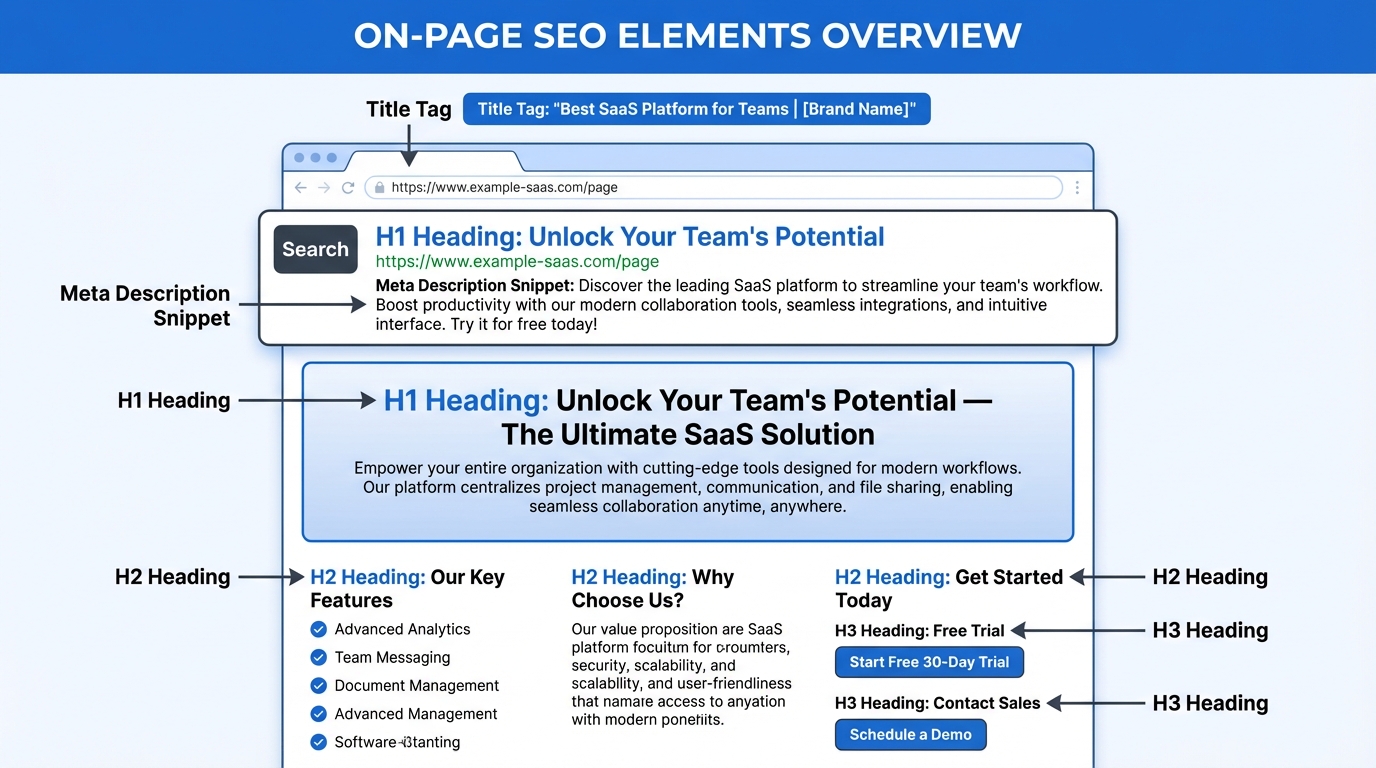
A clean heading structure does three jobs at once: it helps search engines understand sections, helps users scan, and improves accessibility for screen readers.
A simple hierarchy that works for most pages
- Use one H1 that states the primary topic.
- Use H2s for the main sections users expect.
- Use H3s for steps, examples, edge cases, FAQs, and supporting detail.
Common mistakes to fix immediately:
- Multiple H1s created by themes or page builders
- "Design headings" that do not describe the section (e.g., "Welcome")
- Skipping levels randomly (H1 to H4) without a semantic reason

Map headings to questions (this is how you win snippets)
When your H2s mirror real user questions, your page becomes easier to summarize and extract:
- H2: "How to optimize title tags in 2026"
- H3: "Length and truncation"
- H3: "Examples for B2B and exporters"
- H2: "Writing meta descriptions that earn clicks"
- H3: "Value proposition patterns"
- H3: "How to avoid duplication at scale"
This is also how SeekLab.io approaches content planning: structure first, then draft. It prevents wasted effort on sections that do not match intent.
International on-page SEO + an audit-first workflow (what to prioritize)
If your site targets APAC, the US, and Europe, localization raises the bar. Titles, metas, and headings should not be copied across markets unchanged. Beyond translation, they often need transcreation: matching local terminology, units, and intent.
International pitfalls to watch
- English titles reused on non-English pages
- Truncation problems in different character sets and SERP layouts
- Inconsistent localized page focus, which weakens indexing and relevance signals
Prioritization checklist (so you do not fix everything)
SeekLab.io's philosophy is to focus on what truly impacts growth and deprioritize the rest. Use the table below to prioritize in the same way.
| Element | What to detect | How to spot it fast | Priority when... |
|---|---|---|---|
| Title tag | Missing, duplicated, misleading, too long | Crawl + spot-check top landing pages | High impressions, low CTR, revenue/lead pages |
| Meta description | Missing, duplicated, off-intent | Crawl + SERP spot checks | You need CTR lift without rewriting the whole page |
| Heading structure | Missing H1, multiple H1s, messy hierarchy | Template review + sample pages by type | Users bounce or cannot scan; AI snippets pull the wrong text |
| Internal alignment | Headings do not match title/intent | Compare H1 + first H2s to title | Rankings plateau despite "more content" |
| International consistency | Localization mismatches by market | Compare localized templates side by side | You operate multiple regions/languages |
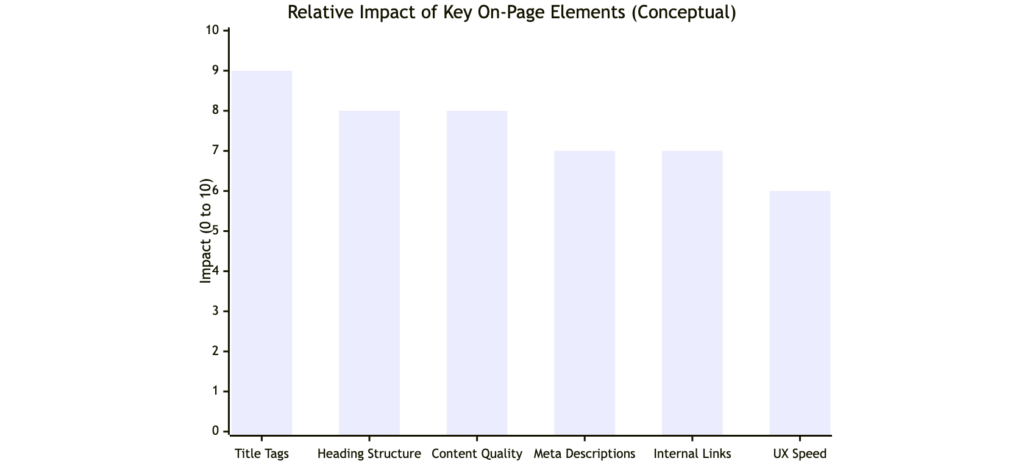
Visual: relative impact (conceptual)
Measurement: prove results without overpromising
To avoid the "we paid for SEO but cannot see impact" problem, track changes per page:
- Search visibility: impressions, average position
- Engagement: CTR, time on page, scroll depth
- Outcomes: inquiry submissions and assisted conversions
For algorithm context and why measurement timing matters around updates, use an industry timeline like Search Engine Journal's Google algorithm history.
Next step: get clarity before you rewrite hundreds of pages
If you are unsure whether your current titles, meta descriptions, or heading structure are holding back growth, do not start by rewriting everything. Start by identifying:
- Which pages and markets actually drive revenue or qualified inquiries.
- Which pages have high impressions but weak CTR.
- Which templates are producing duplicated or broken on-page elements.
SeekLab.io helps marketing teams and developers turn audits into implementable recommendations (technical plus content), with clear prioritization so you avoid low-impact work.
Get a free audit report by leaving your website domain, or contact us if your site spans multiple regions and languages and you want a structured plan for titles, metas, and headings.
References for deeper guidance: