Search Trend Shifts in 2026: How Buyer Queries Are Evolving Across Industries
Expert reviewed

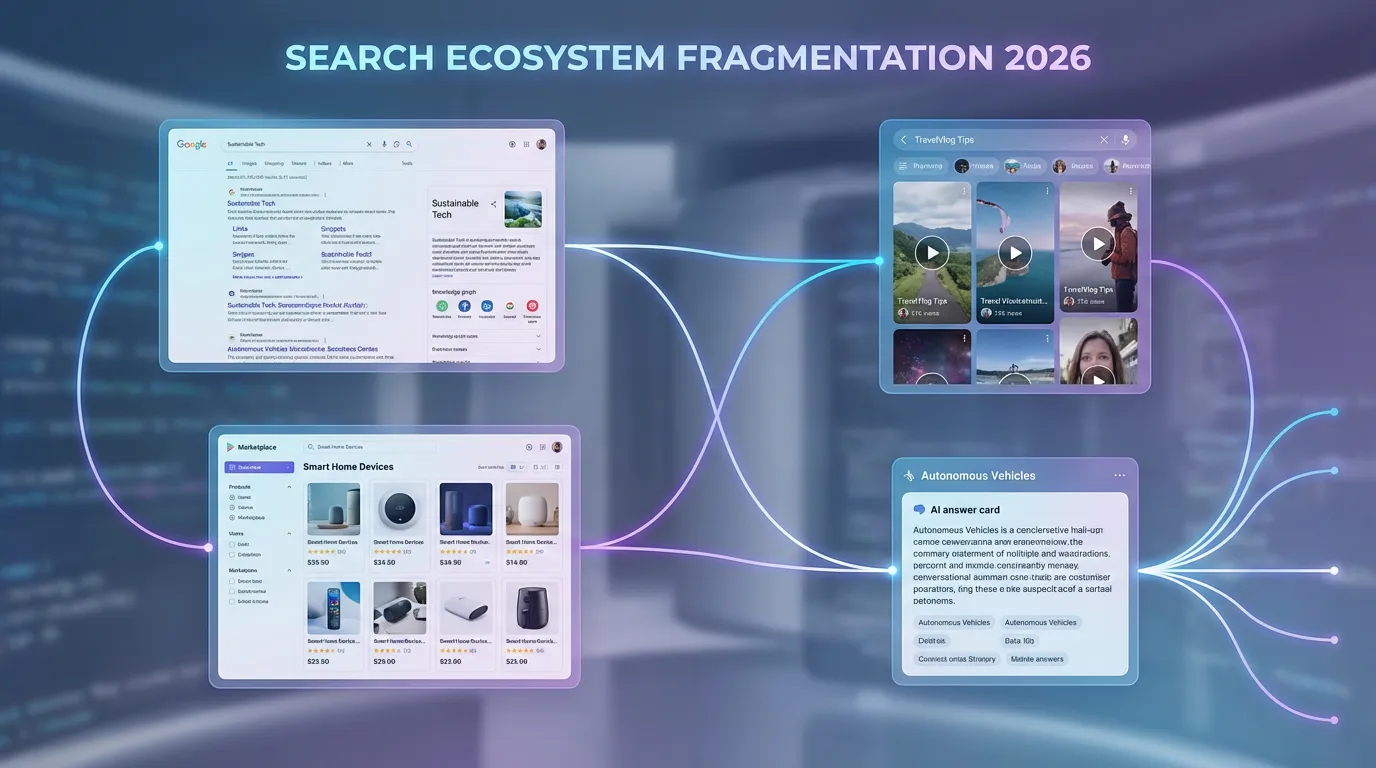
Search in 2026 is no longer a single channel where people type a short phrase into Google and click the top blue link. Buyer journeys are now fragmented across classic SERPs, marketplaces, social platforms, and AI-assisted answer experiences, which is why keyword trend analysis has become less about chasing volume and more about tracking intent, entities, and decision paths across platforms.
1) The 2026 shift: From "keywords on Google" to "decisions across many surfaces"
Here are the highest-impact changes behind today's search trend shifts 2026 planning:
- Google still dominates classic search, but it is no longer the whole journey. Google retains roughly 90 percent plus global search engine market share in traditional search contexts. But many users validate decisions elsewhere (marketplaces, communities, video, AI-assisted answers).
- AI-assisted answers are now a material layer of discovery and validation. Forecasts suggest AI assistants and AI-enhanced interfaces could handle around a quarter of global queries by 2026 (directional forecast, not a single audited market measurement). This changes how buyers phrase questions and how they consume content (summaries first, deeper clicks later).
- Query language is more conversational and more specific. You see more long-tail questions, more "best for X" modifiers, and more multi-step follow-ups. The practical result: content strategies built only on head terms miss the queries that actually convert.
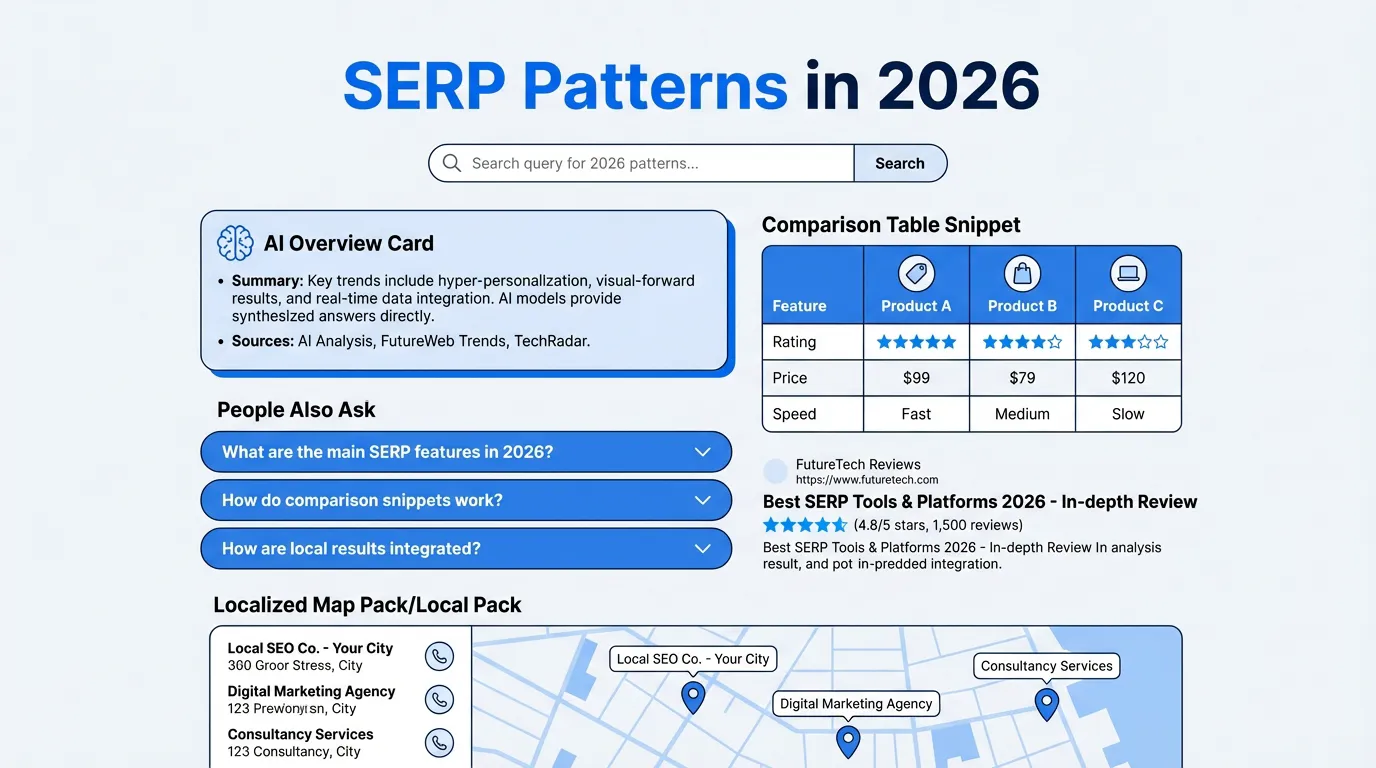
- Commercial investigation has expanded into mid-funnel and even top-funnel. Buyers increasingly search in patterns like "best", "vs", "alternative", "reviews", and "pricing" earlier than they used to.
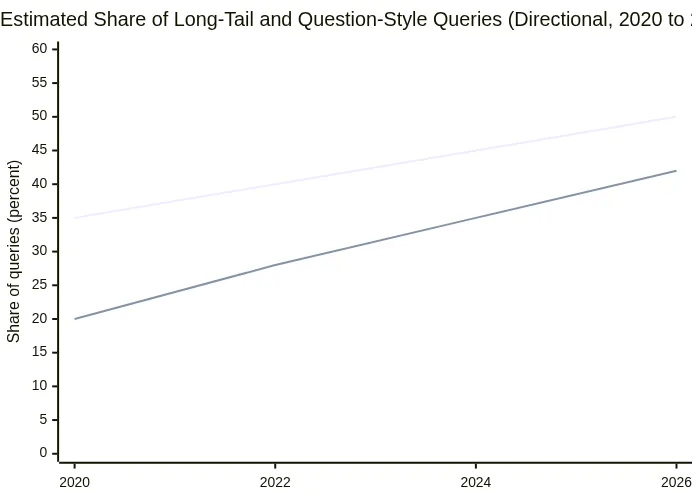
Directional chart: long-tail and question-style growth (illustrative)
The exact global percentages vary by dataset, but the direction is consistent across industry commentary and tool observations. Here is a conservative, illustrative view of how these query types have likely grown:
2) 8 buyer query patterns growing fastest across industries (and what to publish for each)
Use this as a practical listicle for capturing evolving search behavior without bloating your content calendar.
1) Question-first problem solving ("how do I...")
- Common in: B2B SaaS, services, exporters, technical products
- What wins: Step-by-step guides, checklists, tightly scoped sections that answer one sub-question at a time
- Why it matters: These pages often become the entry point into your topic cluster.
2) Best-for-use-case ("best X for Y")
- Common in: Ecommerce, SaaS categories, professional services
- What wins: "Best for" pages with clear criteria, comparisons, and strong internal links to product or service pages.
3) Comparisons ("X vs Y")
- Common in: SaaS, agencies, high-consideration ecommerce
- What wins: Neutral comparison pages that explain who each option is for, plus a decision framework.
4) Alternatives ("alternative to X")
- Common in: SaaS and B2B services, especially when incumbents dominate head terms
- What wins: Alternative pages that focus on scenarios and constraints, not generic feature lists.
5) Reviews and risk reduction ("is X legit", "X reviews", "X case study")
- Common in: B2B, services, marketplaces-driven ecommerce
- What wins: Case studies, implementation notes, proof pages, and FAQ sections that remove uncertainty.
6) Pricing and cost modifiers ("pricing", "cost", "quote", "budget")
- Common in: SaaS, professional services, exporters
- What wins: Transparent pricing explainers, cost drivers, scope boundaries, and "what's included" tables.
7) Local and near-me intent (even for B2B)
- Common in: Services, logistics, support, regulated industries
- What wins: Region-specific landing pages and localized proof points.
8) Cross-border sourcing and multilingual mixed queries
- Common in: APAC and Europe-heavy buyer journeys, exporter and importer queries
- What wins: Country and language variants, correct international targeting, and content that addresses compliance and delivery realities (not just product specs). Broader behavior trends are reinforced in sources like StartUs Insights consumer behavior trends.
Cheat sheet table: query pattern to page format, structure, and internal links
| Query pattern | What the buyer is really doing | Best page type | On-page structure that tends to work in 2026 | Internal link target (examples) |
|---|---|---|---|---|
| How-to questions | Trying to solve a problem fast | Guide + FAQ | Short answer at top, steps, pitfalls, FAQ | Service page, audit page, related cluster articles |
| Best-for-use-case | Building a shortlist | "Best X for Y" roundup | Criteria table, recommendations by scenario, pros and cons | Product or service category page |
| X vs Y | Deciding between two options | Comparison page | Side-by-side table, "choose X if..." section | Pricing, demo, contact page |
| Alternatives | Looking for a safer or cheaper fit | Alternatives hub | "Reasons to switch", "best for", migration steps | Core solution pages |
| Reviews / proof | Reducing risk | Case study / proof page | Context, approach, results, constraints, FAQ | Consultation / contact |
| Pricing | Validating affordability and scope | Pricing explainer | Price drivers table, packages, FAQs | Inquiry form / contact |
| Local | Seeking availability nearby | Local landing page | Service area, trust signals, localized FAQ | Primary service page |
| Cross-border | Checking feasibility and compliance | Country-focused hub | Regulations, shipping, timelines, localized glossary | International service pages, localized contact |
If you want a deeper intent-first framework (without relying on generic keyword lists), use SeekLab.io's guide: Master Keyword Research and Search Intent 2026.
3) A 2026-ready workflow for turning trend signals into leads (not just traffic)
Most teams fail here: they spot a trend, publish content, and only later discover the site cannot rank well due to crawl, rendering, performance, or architecture issues. A better workflow ties trend discovery to technical reality early.

Two practical rules that keep the plan honest:
- Treat "topics" as decision pathways, not articles. Example: a buyer might go from "how to reduce shipping delays to Europe" to "best freight option vs direct export" to "pricing" to "reviews". Your pages should connect those steps with intentional internal links.
- Do not fix everything. Fix what moves growth. A technical SEO backlog can be endless. Prioritize issues that block crawling, indexing, speed, and correct regional targeting.
For tooling and process options, see: Best Keyword Tools for Content Strategy 2026 and validate implementation against the Google Search Central SEO Starter Guide.
4) Regional buyer behavior in 2026: US vs Europe vs APAC (and what it means for site architecture)
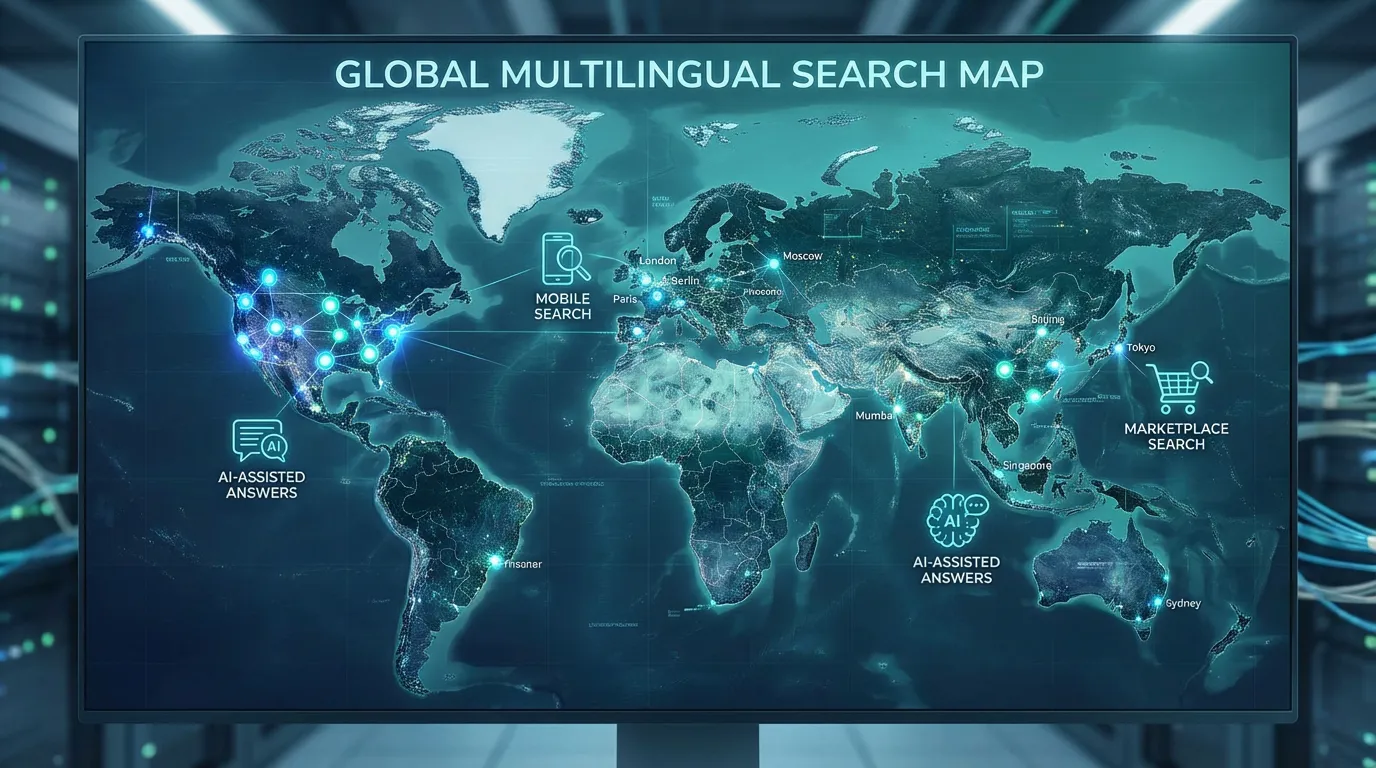
Even when industries look similar, regions differ in platform mix, language expectations, and late-funnel behavior:
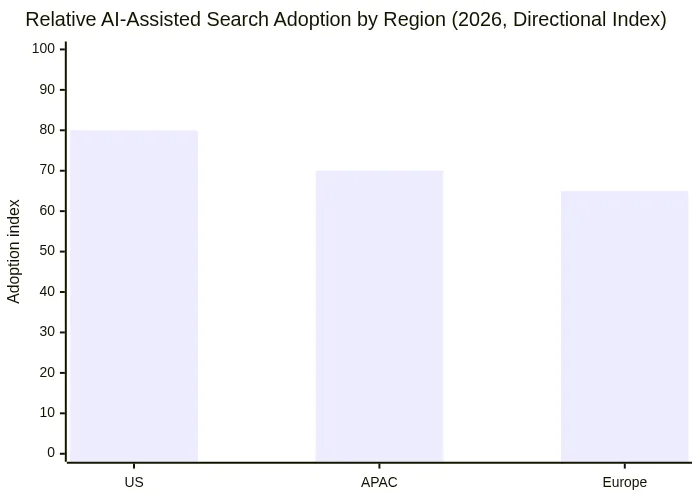
- United States: Strong Google usage, heavy mobile behavior, faster adoption of AI-enhanced search experiences.
- Europe: Similar Google dominance, but multilingual demand is higher and late-funnel queries often perform best in local languages due to trust and precision. Regulatory and privacy constraints can also shape measurement and personalization.
- Asia-Pacific: More fragmented engines and stronger app-centric habits, plus high growth in cross-border sourcing behaviors.
Directional index: AI-assisted search adoption by region (illustrative)
Architecture actions that usually matter more than "more content"
- Build regional hubs, not isolated translations. If you have an English hub for a topic, connect it to localized variants through intentional internal links and clean navigation paths.
- Implement hreflang correctly (and validate it). Incorrect hreflang can cause cannibalization, wrong-country rankings, or indexing waste.
- Use language and region-specific sitemaps when needed. This improves discoverability for large international sites.
- Avoid machine-only localization for money pages. For late-funnel pages like pricing, compliance, implementation, and support, human-edited localization tends to outperform direct translation.
If you want examples of what "structure-aware on-page" looks like in 2026, SeekLab.io's reference on page layouts and headings is here: On-Page SEO 2026: Titles, Metas and Structure.
5) A prioritized 2026 checklist: what to do now, next, and later
This list is designed for marketing and operations managers who need results without overpromising, and for developers who need a clear technical plan.
Do now (foundation that unlocks everything)
- Run a full technical SEO audit with prioritization. Focus on crawlability, indexing, Core Web Vitals, JavaScript rendering, canonicalization, and international targeting.
- Rebuild internal linking around buyer intent. Informational pages should lead to comparison, pricing, and inquiry paths, not just "more blog posts."
- Create 3 to 5 high-intent content assets per core entity. Pick topics that match real buyer search trends: comparisons, alternatives, pricing explainers, case studies, and implementation guides.
Do next (compounding growth)
- Expand topical hubs by region and language. Segment planning for APAC, US, and Europe rather than copying a single global content plan.
- Add structured data where it improves clarity. Article, FAQ, Product, Organization, and other relevant schema types help machines interpret your pages consistently (see Google Search Central).
Deprioritize (unless you have a specific, proven reason)
- High-volume head terms with mixed intent if they do not map to conversion paths.
- Large-scale content output that looks generic and does not reflect real scenarios, constraints, and buyer questions.
- Complex initiatives before the basics work (site architecture and technical hygiene first).
Quick priority table for teams with limited bandwidth
| Priority | What to validate | Why it impacts 2026 search behavior | What to measure |
|---|---|---|---|
| Highest | Crawl, indexation, rendering | If bots cannot reliably parse pages, trend-driven content will not surface | Indexed pages, crawl stats, key template rendering |
| High | Speed and stability | Mobile-first behavior and AI extraction favor fast, clean pages | Core Web Vitals, template load time |
| High | Intent-to-CTA mapping | Buyers want comparisons and proof, then a clear next step | Lead quality, assisted conversions |
| Medium | Regional architecture | Cross-border and multilingual journeys require structure | Country rankings, hreflang coverage |
| Medium | Schema consistency | Helps engines interpret entities and page purpose | Rich results presence, extractable FAQs |
For more reference material, browse the SeekLab.io blog, which covers intent-led planning, international SEO considerations, and execution standards.
Get a free audit report
If you are seeing traffic without inquiries, or you suspect technical blockers are preventing your content from ranking, get a free audit report from SeekLab.io. Contact us and leave your website domain. We will identify what truly impacts growth, what can be deprioritized, and what the next actions should be based on your market (APAC, US, Europe) and your buyer journey.