Arctic ice collapse is reshaping global forecasts
Expert reviewed

Arctic ice collapse is a forecasting problem with real consequences for trade routes, military planning, resource competition, and model design. This article breaks down what the March 2026 record-low Arctic winter maximum actually means, where climate modeling and geopolitical AI still fall short, and why long-range forecasting in unstable systems demands more humility than most AI narratives admit.
You will get five practical things here: a clear definition of Arctic ice collapse in forecasting terms, a summary of what changed in 2026, a comparison of physical and human-system uncertainty, a look at why climate modeling and geopolitical AI struggle in the Arctic, and a decision-oriented framework that marketers, operators, and technical teams can apply to other uncertain environments. That last part matters because the same mistakes that damage climate forecasts also show up in SEO strategy: too much confidence, not enough diagnostics, and poor handling of structural change.
1. Arctic ice collapse changed the starting point for long-range forecasting
In March 2026, Arctic sea ice reached a record-low winter maximum of about 14.29 million square kilometers, statistically tied with 2025 as the lowest in the satellite record, according to NASA and NSIDC's Charctic interactive graph. That is not just another weak year. It means the melt season now starts from a thinner, less resilient base.
A lot of public discussion treats Arctic ice collapse as shorthand for one dramatic future moment, usually "the first ice-free summer." That is too narrow. The more useful interpretation is regime shift. The Arctic is losing not just extent, but age and thickness. Multi-year ice has been replaced by more fragile first-year ice, which breaks, drifts, and melts faster, as highlighted in the NOAA Arctic Report Card and IPCC AR6.
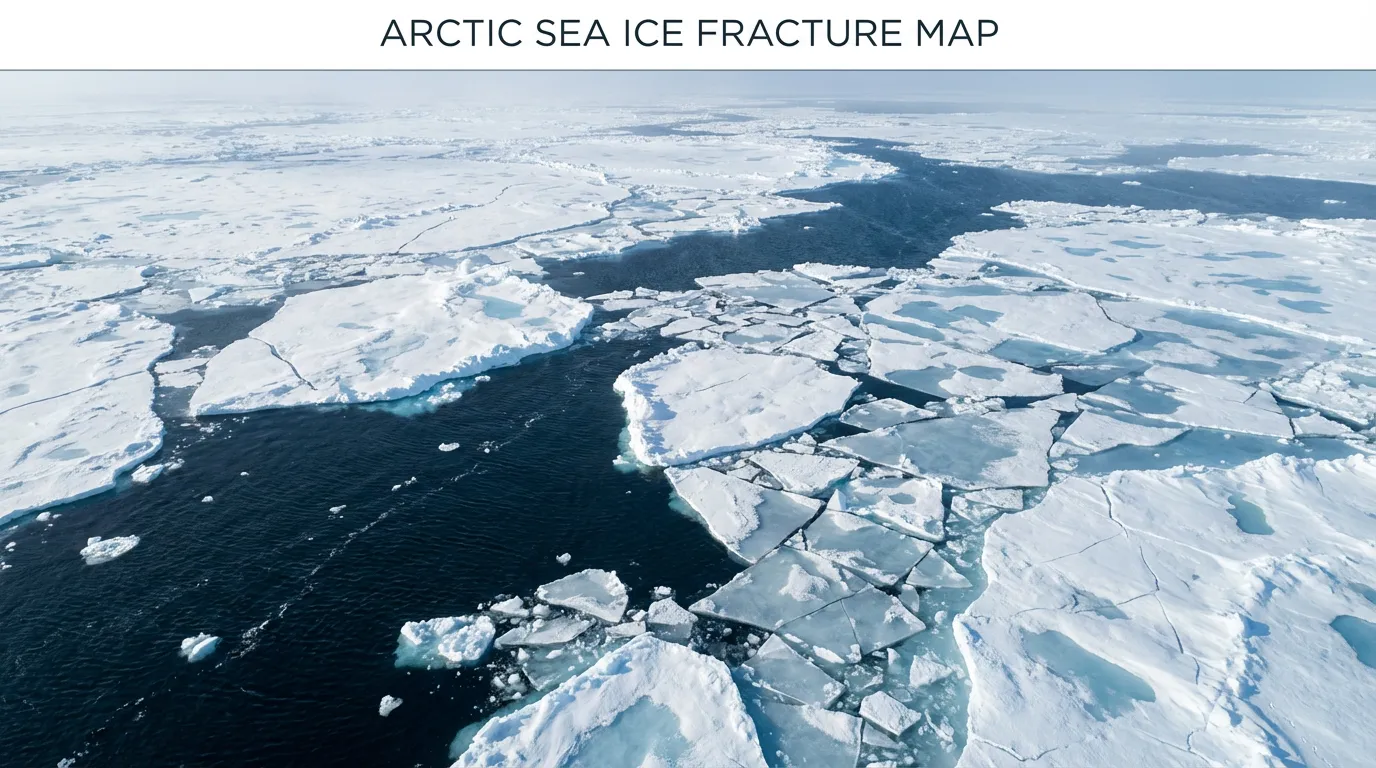
For forecasters, that weak winter maximum matters because it changes assumptions before summer even begins. A stronger winter pack can absorb bad weather and warm intrusions. A weaker pack cannot. Once that buffer shrinks, the system becomes more sensitive to storms, ocean heat, and circulation anomalies. That is why the phrase Arctic ice collapse has become less about a date and more about a structural forecasting challenge.
The table below shows why this matters operationally.
| Signal | What changed | Why forecasters care |
|---|---|---|
| Winter maximum | March 2026 tied record low | Melt season starts with less resilience |
| Ice age | Less multi-year ice | Thin ice melts and fractures faster |
| Spatial weakness | Barents, Bering, Okhotsk anomalies | Regional route access changes unevenly |
| Trend direction | Long-term decline continues | Old baselines are less useful |
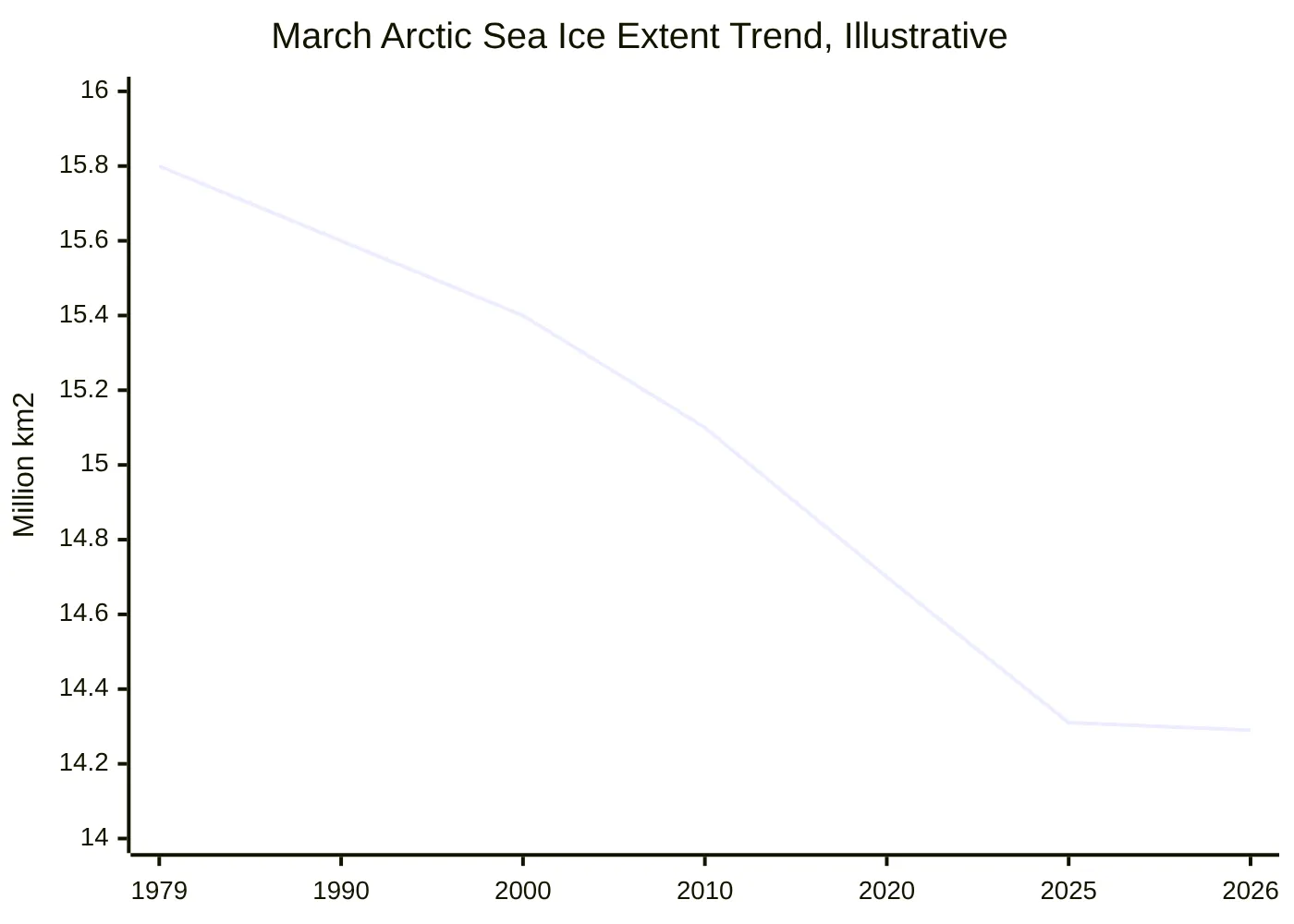
One practical distinction often gets missed: Arctic ice collapse does not mean the Arctic will now remain open water year-round. It means the odds of extended, nearly ice-free summers are rising, while re-freeze is getting less reliable. That difference matters for anyone modeling ports, shipping schedules, insurance risk, or defense posture.
2. Arctic ice collapse is rewriting trade and security assumptions
The commercial appeal is obvious. If Arctic sea ice keeps thinning, the Northern Sea Route can shorten some Asia-Europe voyages by around 10 to 15 days compared with the Suez route, based on analysis from the Arctic Institute. But distance savings alone are the kind of neat model input that creates bad real-world forecasts.
The actual picture is messier. Physical access may improve while commercial use stays constrained by sanctions, insurance costs, military tension, escort requirements, and weak search-and-rescue infrastructure. The Arctic Council shipping update points to growing ship traffic, but 2025 cargo results also showed the Northern Sea Route falling well below earlier political targets, largely because geopolitics overrode geography.
That is where Arctic ice collapse stops being a climate-only issue. It becomes a coupled system problem. More open water can increase commercial possibility, but also intensify Russian control concerns, NATO monitoring, Chinese strategic interest, and legal disputes over passage rights. The CSIS Arctic Military Tracker and the Atlantic Council's Arctic analysis both make clear that the Arctic is no longer peripheral in security planning.
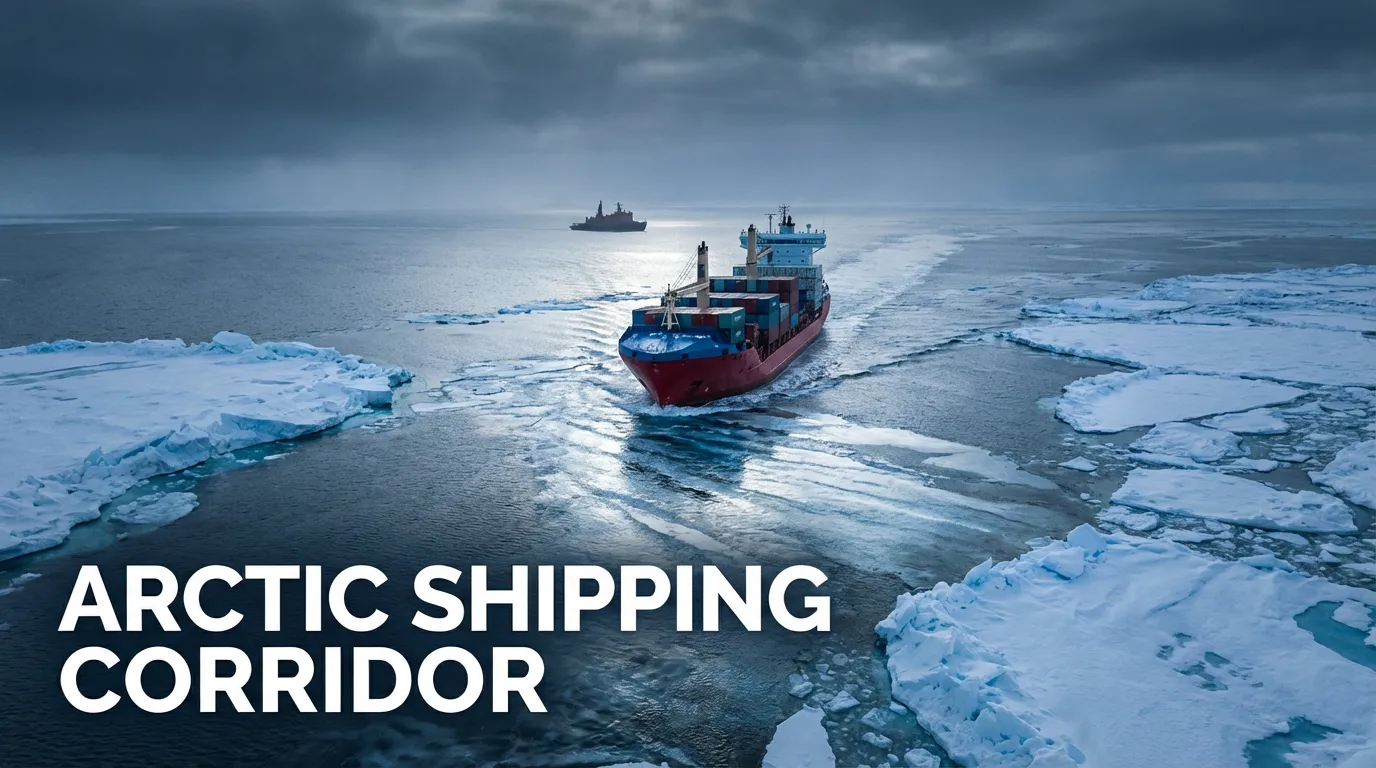
A forecast that says "route opens" is incomplete. The more useful question is: open for whom, under what rules, at what cost, with which political dependencies, and with what tail risk if the season shifts unexpectedly? That is why single-number projections are often worse than scenario trees.
| Forecast domain | Simplistic view | Better view |
|---|---|---|
| Shipping | Shorter route equals lower cost | Cost depends on sanctions, escorts, insurance, timing |
| Security | More access means more trade | More access can also mean more militarization |
| Resources | More thaw means more extraction | ESG pressure, liability, and politics can block projects |
| Infrastructure | Longer season means stable planning | Volatility still matters for long-term investment |
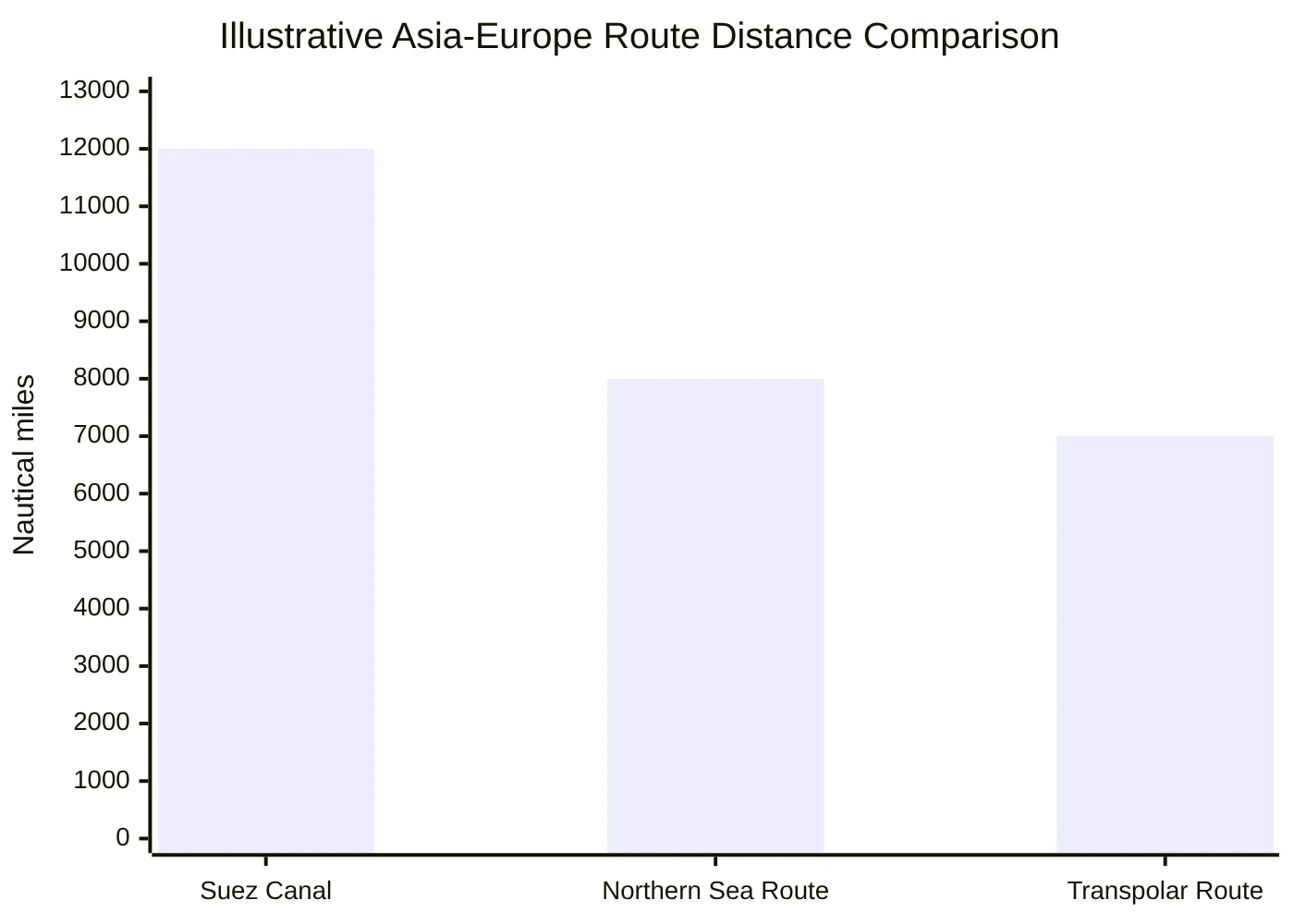
This is also where long-range forecasting gets politically fragile. A climate model can estimate ice probability. It cannot cleanly predict sanctions escalation, naval incidents, regulatory tightening, or a sudden shift in insurer behavior. Those decisions are not noise around the model. They are part of the system.
3. Arctic ice collapse exposes the hard limits of climate modeling and predictive uncertainty
Climate modeling has improved a lot, but the Arctic remains one of the places where uncertainty is easiest to underestimate. Global climate models still work with coarse grids relative to the physical complexity of sea ice. Features that matter on the ground, or rather on the water, such as ridges, leads, melt ponds, and narrow passages, are often parameterized rather than directly resolved.
That creates a serious issue for predictive uncertainty. In the Arctic, you have both aleatory uncertainty and epistemic uncertainty at the same time.
Aleatory uncertainty is the irreducible variability of weather and circulation. A storm track shift, warm air intrusion, or unusual spring pattern can move one melt season far away from the average.
Epistemic uncertainty is more uncomfortable. It comes from not knowing enough, or from models representing the system imperfectly. That includes weak handling of melt ponds, uncertain ocean heat transport, sparse under-ice observations, and structural differences across models.
A lot of executives dislike this distinction because it weakens confidence. But it is exactly the distinction that matters in serious planning.
| Type of uncertainty | Arctic example | Planning implication |
|---|---|---|
| Aleatory | Weather variability, storm timing | Expect volatile year-to-year outcomes |
| Epistemic | Missing processes, weak model structure | Treat projections as ranges, not certainties |
| Forcing uncertainty | Emissions and policy pathways | Long-term timing remains scenario-dependent |
| Human-system uncertainty | Shipping response, sanctions, military strategy | Forecasts must include non-physical branches |

The research community has already been forced into more careful language. The ESA sea ice analysis notes that most models project at least one ice-free September before 2050, while observationally constrained work suggests the first such summer could arrive earlier, potentially in the 2030s. That gap is not a minor disagreement. It is a reminder that model structure, baseline assumptions, and internal variability all matter.
A practical mistake appears again and again in climate communication: people quote the median as if it were the plan. If the mean projection says 2040, decision-makers often act like 2040 is the year. But if the plausible window is 2030 to 2050, then infrastructure, regulation, and risk management should be built against that window, not the comforting center point.
4. Arctic ice collapse is a stress test for geopolitical AI and long-range forecasting
This is where the discussion gets especially relevant for AI. Systems trained on historical patterns tend to do well when the environment is stable, the feedback loops are contained, and the cost of being a little wrong is manageable. The Arctic is none of those things.
Climate data are non-stationary. The baseline itself is moving. Human responses also change the system: shipping routes, soot deposition, defense posture, extraction plans, and regulation all feed back into future conditions. That makes Arctic forecasting a coupled human-Earth problem, not just a geophysical one.
AI tools are already useful in narrower tasks. IceNet has shown strong seasonal sea ice prediction performance, and FourCastNet 3 points to major gains in fast, large-ensemble weather forecasting. Those are real advances. But they should not be confused with trustworthy end-to-end long-range forecasting of Arctic geopolitics, trade behavior, and regime change.
That distinction matters because the current AI sales pattern is to collapse very different tasks into one promise. Good seasonal ice maps do not imply good decade-scale shipping forecasts. Good physical-field emulation does not imply good strategic forecasting. Good performance on the average case does not imply good handling of rare, high-impact events.
The Arctic is especially bad for overconfident models because long-tail events matter more than average outcomes. A shipping firm can survive a routine forecast miss. It may not survive an underestimated hazard cluster, a sanction shock, or a badly timed low-ice season that triggers overexposure to risk. This is why geopolitical AI remains constrained in exactly the areas that make headlines.
A more honest framework looks like this:
- Use AI where pattern recognition is strong and scope is narrow.
- Use ensembles where structural uncertainty is high.
- Use scenarios where human strategy dominates outcomes.
- Communicate limits clearly instead of pretending the model "sees the future."
That is not model pessimism. It is operational maturity.
5. Arctic ice collapse offers a better way to think about strategy, including SEO
This is the part many business readers will recognize quickly. The Arctic is a vivid example of what happens when people ask a forecasting system to do more than it can honestly do. The same pattern shows up in SEO all the time.
A weak agency model says: here is the traffic curve, here is the ranking promise, here is the content volume plan. A stronger model says: first diagnose the real constraints, identify what truly affects growth, and make decisions that still hold up if conditions shift. That is much closer to how serious climate work handles predictive uncertainty.
For teams running independent websites, multilingual company sites, or international B2B sites, this matters because visibility is shaped by interacting systems: search engines, AI-generated answer layers, competitors, user intent shifts, technical architecture, and conversion friction. That environment is not identical to the Arctic, but the planning discipline is surprisingly similar.
This is where SeekLab.io has a useful angle. The company helps brands build search visibility and AI-era discoverability through high-quality content production and technical optimization. More importantly, its working logic matches what uncertain systems require: diagnostics before prescriptions, structured analysis before execution, and prioritization instead of trying to fix everything.
If your site is growing slowly, the problem may not be "more content needed." It may be weak page architecture, bad rendering, confused internal linking, poor entity clarity, or content aimed at the wrong search behavior. That is why a structured SEO audit is often more valuable than another quarter of random publishing.
The same applies to topic selection. If you are publishing on fast-moving themes like climate modeling, predictive uncertainty, geopolitical AI, or long-range forecasting, the issue is not stuffing keywords into a page. The issue is whether your content reflects real search intent, brings judgment to the subject, and is supported by a site structure that search engines and AI systems can actually parse. SeekLab.io's work in high-quality blog content optimization and topic planning reflects that more disciplined approach.
One reason this matters commercially is that many teams are not short on effort. They are short on decision quality. Before you start fixing technical issues or commissioning more content, you need to know which direction is actually worth pursuing. That is a big part of why SeekLab.io focuses on full-site crawling, structured analysis, Core Web Vitals diagnostics, internal link equity, schema compliance, and strategic topic selection rather than offering vague promises.
A simple decision framework adapted from the Arctic lesson looks like this:
| Strategy question | Weak approach | Better approach |
|---|---|---|
| Forecasting | One confident projection | Range-based scenarios |
| Execution | Fix everything | Prioritize impact |
| Content | Publish more | Publish what matches real demand |
| Technical work | Chase surface issues | Solve blockers first |
| Reporting | Vanity metrics | Visibility plus conversion potential |
If your team wants to make the right strategic decisions before investing in the wrong fixes, explore SeekLab.io's services overview or contact the team to get a free audit report. That is a better first step than guessing which forecast to trust.
The deeper lesson of Arctic ice collapse is not that prediction is useless. It is that strong strategy comes from respecting predictive uncertainty, not hiding it. In climate modeling, long-range forecasting, geopolitical AI, and SEO alike, the teams that win are usually the ones that diagnose clearly, communicate limits honestly, and adapt faster than the ones selling certainty.