Seasonal AI works better when it understands March rituals
Expert reviewed

If you are looking for a practical way to turn St. Patrick's Day content into better SEO decisions, this article lays out the framework. You will see why March rituals are not just content hooks, but recurring behavior patterns that should shape planning, internal linking, schema, image strategy, and multilingual site priorities.
More specifically, this list covers how St. Patrick's Day content reveals the limits of generic AI, what cultural algorithms, seasonal AI, context-aware systems, and ritual intelligence actually mean in practice, and how independent websites can use those ideas to drive qualified traffic instead of one-week spikes. For marketing and operations teams, the point is simple: if your system does not understand why people wear green on March 17, it will usually miss the timing, tone, and conversion path that matter.
1. Why St. Patrick's Day content exposes a real gap in seasonal AI
St. Patrick's Day content looks lightweight on the surface. In reality, it is one of the clearest examples of ritual-driven search behavior. People do not just search for recipes, green outfits, party decor, and event ideas because a keyword tool tells them to. They do it because a shared calendar event changes what feels relevant, fun, and socially acceptable for a short period.
That matters because the demand is predictable. The National Retail Federation reported that 60% of U.S. consumers planned to celebrate in 2026, with average spending reaching about $47.45 per person, for roughly $7.7 billion in total spend across food, beverages, apparel, and decorations. For SEO teams, that is not random traffic. It is a repeatable demand window with commercial intent behind it.
Blogs in March 2026 leaned hard into St. Patrick's Day content for exactly this reason. Content roundups promoted post ideas like green recipes, themed gift guides, and what-to-wear lists. Retail and creator marketing guides pushed time-limited promotions and themed visuals in the week before March 17. The pattern is useful because it keeps showing up year after year.

Most AI systems still flatten this into a keyword cluster. They can generate "St. Patrick's Day recipes" on command, but they often miss the practical distinctions that affect results: early March research versus last-minute party planning, U.S. demand versus low-interest markets, or informational clicks versus pages that can actually convert. That is why seasonal AI needs more than a date field. It needs temporal and cultural judgment.
2. How St. Patrick's Day content helps explain cultural algorithms and ritual intelligence
The easiest way to understand these terms is to tie them back to a real use case.
| Concept | What it means in practice | St. Patrick's Day content example |
|---|---|---|
| Cultural algorithms | Systems that model culturally meaningful behavior, not just individual clicks | Recognizing that wearing green signals participation, not just color preference |
| Seasonal AI | AI that treats recurring time windows as decision inputs | Refreshing St. Patrick's Day pages in late February, not on March 16 |
| Context-aware systems | Systems that adapt based on time, location, device, and user situation | Showing event content in the U.S. while deprioritizing it in less relevant regions |
| Ritual intelligence | The ability to respond to collective ceremonies and social habits | Mapping March 17 to recipes, outfits, gifts, events, and seasonal landing pages |
Cultural algorithms matter because human behavior is structured by rituals more often than most content plans admit. A buyer searching for St. Patrick's Day content is not only revealing a topic interest. They are entering a temporary cultural mode. That mode changes what imagery works, what products feel timely, what offers make sense, and what internal links are worth surfacing.
Seasonal AI matters because timing errors are expensive. A strong article published too late often loses to weaker pages that were refreshed two weeks earlier. This is a common problem on independent websites: the team has the right idea, but the workflow is not built to act before the demand curve steepens.
Context-aware systems matter because March is crowded. A brand operating in the U.S., Europe, and APAC does not face one uniform seasonal calendar. St. Patrick's Day may deserve prominent placement on English pages aimed at U.S. and Irish audiences, while other markets need different March priorities. A generic content calendar usually gets this wrong by forcing one seasonal template across every locale.
Ritual intelligence is the deeper layer. It means understanding that March 17 is not merely a date. It is a ceremonial moment tied to group behavior: wearing green, attending parades, hosting gatherings, ordering themed products, posting themed photos, and responding to specific visual cues. A site that understands that can create St. Patrick's Day content that feels timely instead of machine-made.
3. What better St. Patrick's Day content looks like on real websites
The best St. Patrick's Day content usually falls into a small number of repeatable formats. That is useful because it lets teams build clusters instead of isolated posts.
| Content type | Typical search intent | Best business use |
|---|---|---|
| Recipes and food ideas | Informational | Attract seasonal traffic and connect to product or category pages |
| Outfits and apparel guides | Informational to commercial | Drive users from inspiration to product collections |
| Gifts, decor, and party kits | Commercial | Support seasonal bundles and limited-time offers |
| Events and travel content | Local or commercial | Capture time-sensitive searches and booking intent |
| Printable and social content | Awareness | Expand reach and support internal linking into deeper pages |
One common mistake is publishing a single article like "5 St. Patrick's Day Marketing Ideas" and expecting it to carry the whole season. It rarely does. A stronger approach is to build a small, connected cluster: one hub, a few intent-specific support pages, and clean links into commercial destinations.
This is where structured planning matters more than sheer output. As covered in SeekLab.io's guidance on planning your SEO content strategy and content calendar, isolated posts are usually weaker than clusters with a defined hub and internal hierarchy. Seasonal topics make that even more obvious because the traffic window is short and the conversion path has to be clear.

A second mistake is using generic visuals. If the page is about St. Patrick's Day content and the imagery looks like stock shamrocks pasted onto a bland layout, users notice. Strong seasonal pages use images that match realistic situations: office parties, family dinners, parade outfits, tabletop decor, or product bundles prepared for a March event window. That helps both engagement and conversion because it makes the page feel grounded in real behavior.
4. How to build St. Patrick's Day content with seasonal AI and context-aware systems
A workable system does not need to be complicated. It needs to make better choices earlier.
First, identify which markets actually need St. Patrick's Day content. A multilingual site serving the U.S., Europe, Singapore, and the Middle East should not push the same March theme everywhere. Regional relevance should shape page priority, homepage modules, internal link placement, and translation effort.
Second, map St. Patrick's Day content to categories you already have. If you sell food products, it may connect to recipes and party bundles. If you run an event or SaaS site, it may connect to event templates, landing pages, or campaign checklists. If you are in B2B or export, it may connect to seasonal demand planning, campaign support, or market-specific buyer guides.
Third, refresh before the spike. A lot of seasonal pages fail because they are technically weak right when demand arrives. Large hero images, uncompressed media, broken internal links, and messy metadata can drag down pages that should be winning easy seasonal clicks. SeekLab.io's SEO audit checklist for 2026 is relevant here because seasonal content often breaks on the same fundamentals: crawlability, Core Web Vitals, internal links, schema, and template stability.
A practical workflow looks like this:
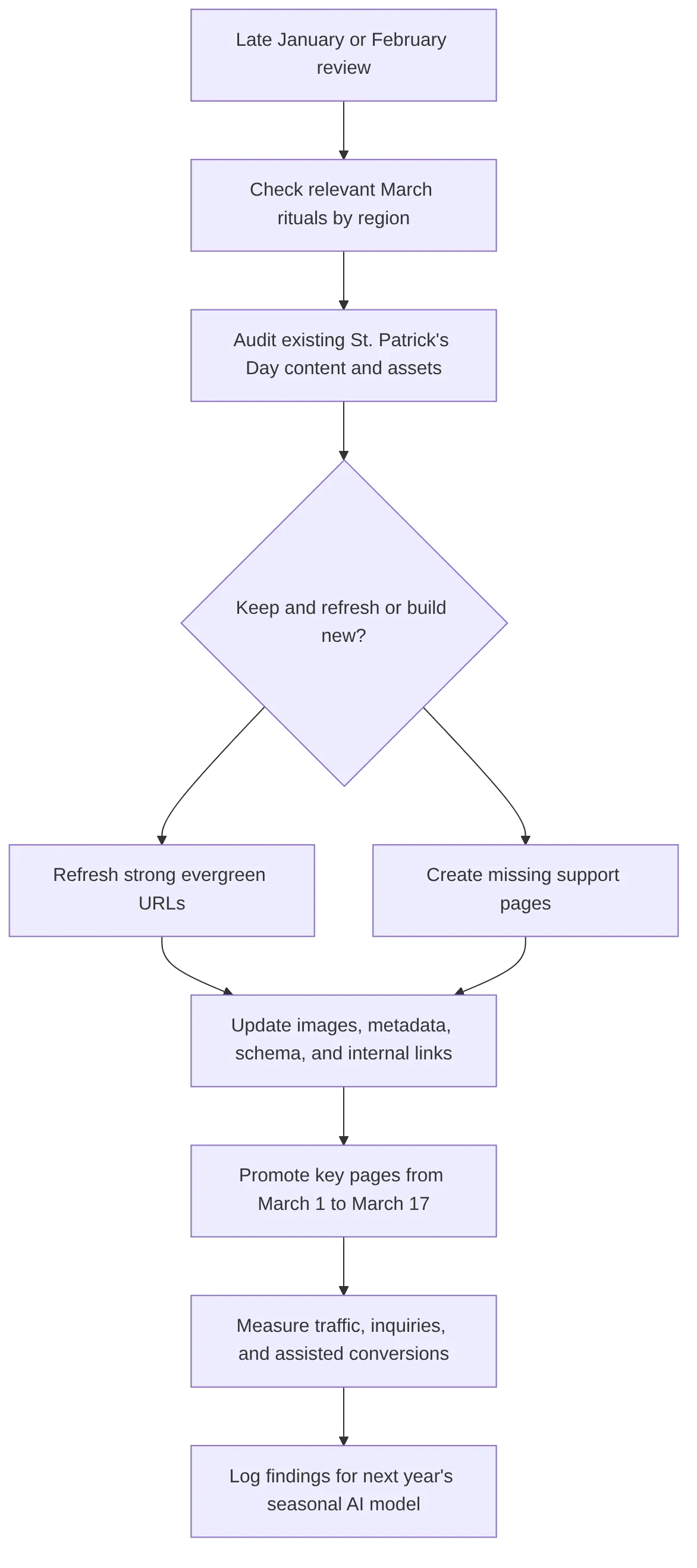
Fourth, treat internal linking as part of the campaign, not a cleanup task. A seasonal hub should receive links from related blog posts, category pages, and relevant service pages before the peak period. If you need a benchmark for what strong blog structure should support, SeekLab.io's article on high-quality blog content optimization tips is a useful reference for improving images, internal linking, and conversion paths together.
Finally, use schema where it fits. Recipes, events, products, and limited-time offers all benefit from cleaner structured data. This is especially important for content that needs to be understood quickly by both search engines and AI systems.
5. Why St. Patrick's Day content should change technical SEO decisions, not just editorial ones
The operational lesson is larger than one March holiday. St. Patrick's Day content is a test case for whether a site can adapt to recurring rituals without rebuilding from scratch each year.
For many independent websites, the right move is an evergreen seasonal URL that gets refreshed annually rather than a brand-new page every March. That keeps authority concentrated and makes internal linking easier to manage. It also reduces the content sprawl that weak teams create by publishing near-duplicate seasonal posts every year.
| Decision area | Weak approach | Stronger ritual-aware approach |
|---|---|---|
| URL strategy | New St. Patrick's Day post every year | Maintain one core URL and update it annually |
| Internal linking | Add a few links after publishing | Rewire links intentionally before seasonal demand peaks |
| Images | Generic clipart or recycled stock images | Visuals matched to real seasonal scenarios and buyer intent |
| Technical prep | Publish first, fix later | Audit performance, rendering, and schema before the season |
| Measurement | Track traffic only | Track inquiries, assisted conversions, and year-over-year lift |
This is where context-aware systems and technical SEO meet. If the site is slow, hard to crawl, or poorly structured, St. Patrick's Day content can still attract clicks but fail to produce qualified outcomes. That is why SeekLab.io approaches SEO as both content and technical readiness. The company focuses on making websites easier for search engines, AI systems, and real users to understand through cleaner information architecture, internal linking, content structure, and site-wide technical diagnosis.

If your site relies on modern frontends, this gets even more important. Seasonal landing pages with heavy JavaScript, late-rendered content, or unstable layouts can quietly underperform. SeekLab.io's work on technical JavaScript SEO and indexing solutions is especially relevant for teams whose March pages look fine in-browser but expose weak crawl and rendering signals underneath.
The bigger point is strategic. Not every issue deserves equal attention. SeekLab.io does not try to fix everything for the sake of completeness. It focuses on what actually impacts growth, what can wait, and what should never have been prioritized in the first place. That mindset is useful for seasonal planning because ritual content has narrow timing, clear user intent, and obvious technical failure points.
6. A practical St. Patrick's Day content checklist for independent sites
If you want a short operating list, use this before your next March cycle:
- Confirm whether St. Patrick's Day content is genuinely relevant in each target region and language.
- Choose one primary St. Patrick's Day content hub and define supporting pages around real intent.
- Refresh existing URLs before March, instead of rushing new ones at the last minute.
- Improve images so the page reflects actual March behavior, not generic seasonal decoration.
- Add internal links from related blog, category, and service pages.
- Validate schema for recipes, events, products, or offers where appropriate.
- Check Core Web Vitals, crawlability, and rendering on seasonal templates.
- Track not only visits, but form submissions, inquiry assists, and page-to-page conversion paths.
Here is a simple view of how ritual-aware planning changes outcomes:
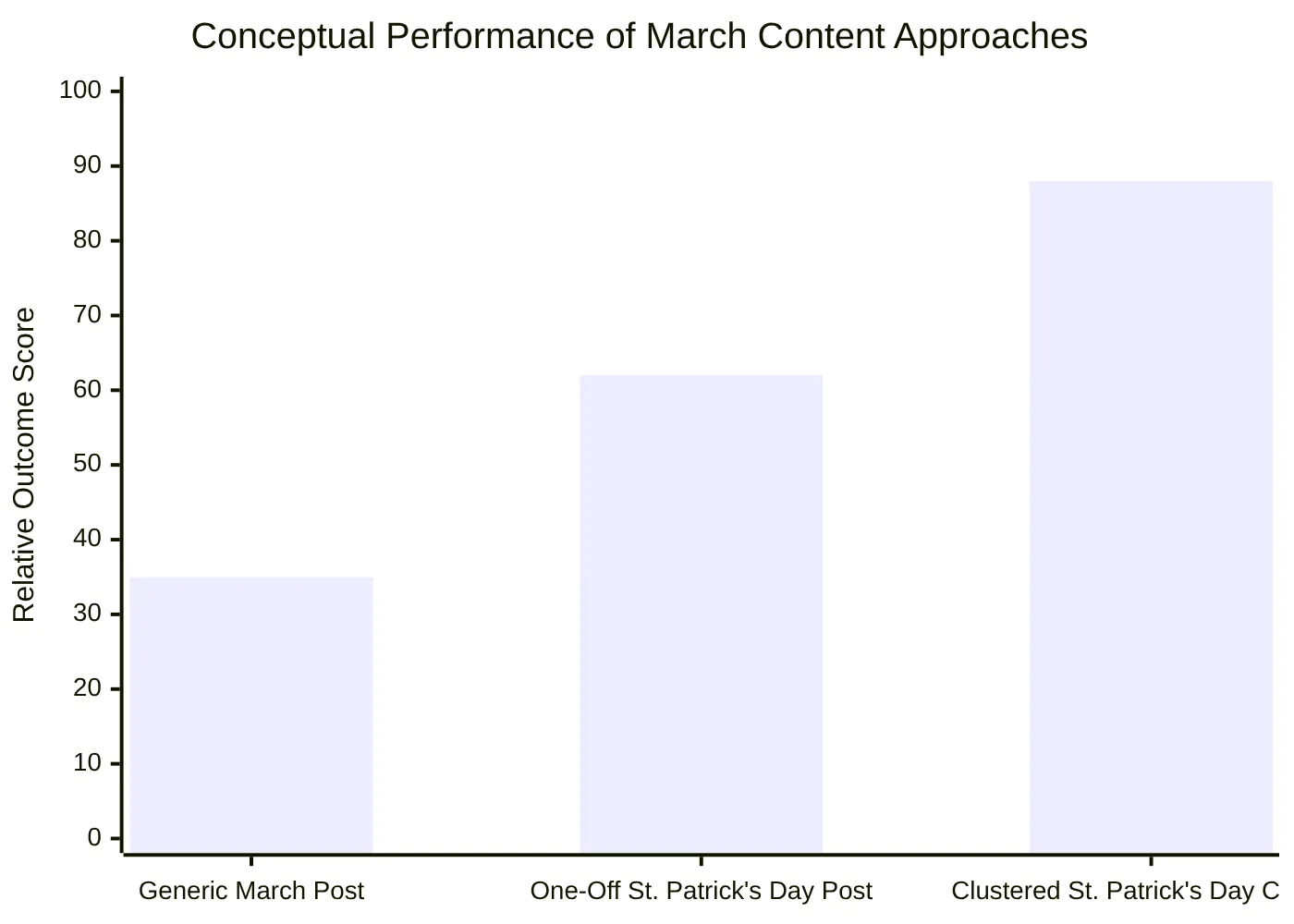
The gap between average and strong performance usually comes from structure, timing, and relevance. Not from writing more words.
St. Patrick's Day content is useful because it shows where AI still feels disembodied. It can generate text, but often cannot tell which ritual matters in which market, when intent shifts, what imagery makes sense, or how to connect a seasonal page to a real conversion path. Seasonal AI, cultural algorithms, context-aware systems, and ritual intelligence are not abstract ideas when you are running a real site. They are the difference between a themed post and a seasonal asset that actually performs.
If your website needs help deciding which seasonal opportunities are worth building, which technical issues are quietly limiting growth, or how to structure content so it supports both ranking and leads, SeekLab.io can help. You can learn more about the team's approach on the About Us page or contact us to get a free audit report.