Automated SEO Audit vs Expert SEO Audit: What Each Can and Cannot Find
Expert reviewed

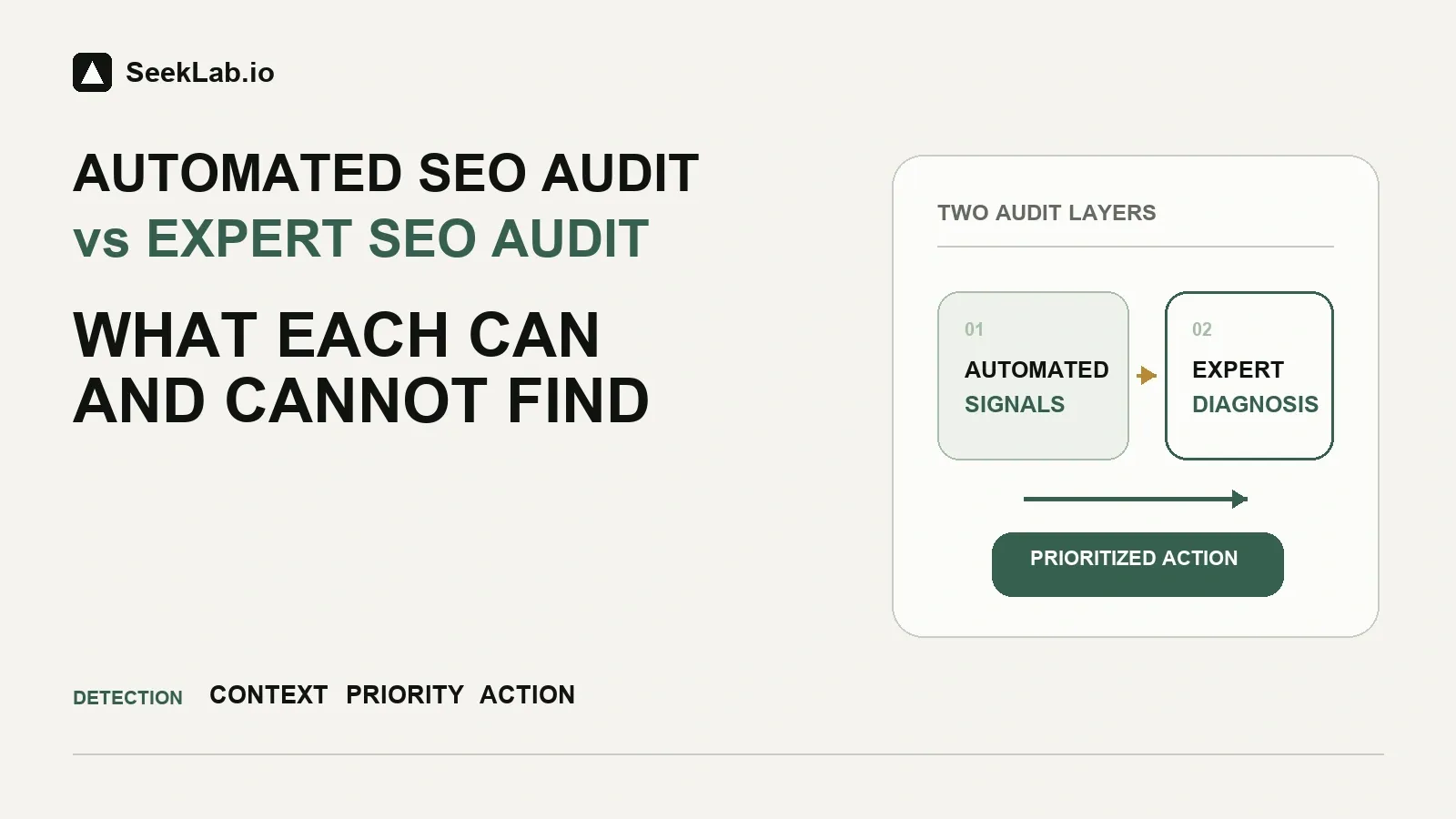
Automated SEO audits are best at repeatable detection and monitoring across many URLs. Expert SEO audits are best at validating the findings, diagnosing root causes, prioritizing the work, and connecting technical issues to search intent and business outcomes.
The two approaches are complementary. Audit software can inventory status codes, redirects, metadata, canonical tags, sitemaps, robots directives, internal links and structured-data syntax efficiently. Human review adds the context needed to decide which findings matter, whether they share a template-level cause, how they affect priority pages and who should implement the fix.
For international, multilingual and multi-market websites, that distinction matters even more. A crawler may confirm that hreflang annotations are syntactically valid, for example, while an expert still needs to evaluate whether the locale structure, canonical logic and localized page intent make sense together.
Automated SEO Audit vs Expert SEO Audit: The Short Answer
An automated SEO audit is the right starting point when you need a repeatable technical baseline or recurring monitoring. An expert audit is more useful when the report requires interpretation: persistent visibility loss, a migration, rendering uncertainty, conflicting signals, international architecture or a long list of warnings with no clear implementation order.
| Diagnostic Dimension | Automated SEO Audit | Expert SEO Audit | Practical Implication |
|---|---|---|---|
| Primary method | Applies repeatable rules to crawled pages and connected data sources. | Combines crawl evidence with Search Console, logs where useful, SERP review, site architecture and business context. | Automation finds patterns; expert review confirms their meaning. |
| Scale and frequency | Well suited to recurring crawls, inventories and post-release checks. | Better suited to focused diagnosis, architecture decisions and implementation planning. | Use automation for monitoring and experts for questions the report cannot resolve alone. |
| Technical coverage | Strong for status codes, redirects, canonicals, metadata, directives, sitemaps, links and many rendering checks. | Stronger for validating rendered output, tracing template or platform causes and reconciling conflicting evidence. | A tool may report many affected URLs; an expert can determine whether one system rule is responsible. |
| International and multilingual logic | Can test hreflang syntax, return links and common locale-code issues. |
Can assess URL strategy, canonical interaction, localization quality and market-specific search intent. | Valid annotations do not by themselves prove that the international setup is appropriate. |
| Structured data and AI readiness | Can validate syntax, coverage and crawl accessibility. | Can evaluate whether visible content, entities, internal links and answer structures communicate a coherent topic. | Passing a validator is necessary evidence, not proof of citation or recommendation. |
| Content and page usefulness | Can surface duplicate text, thin pages, headings, metadata patterns and missing attributes. | Can assess search intent, first-hand evidence, information hierarchy, commercial usefulness and user pathways. | Content quality and usefulness require judgment beyond a rule-based alert. |
| Prioritization | Usually groups findings by a product-defined severity model that teams can customize. | Can rank confirmed issues by impact, effort, page value, owner and dependency. | Severity is a starting signal; implementation order depends on the site. |
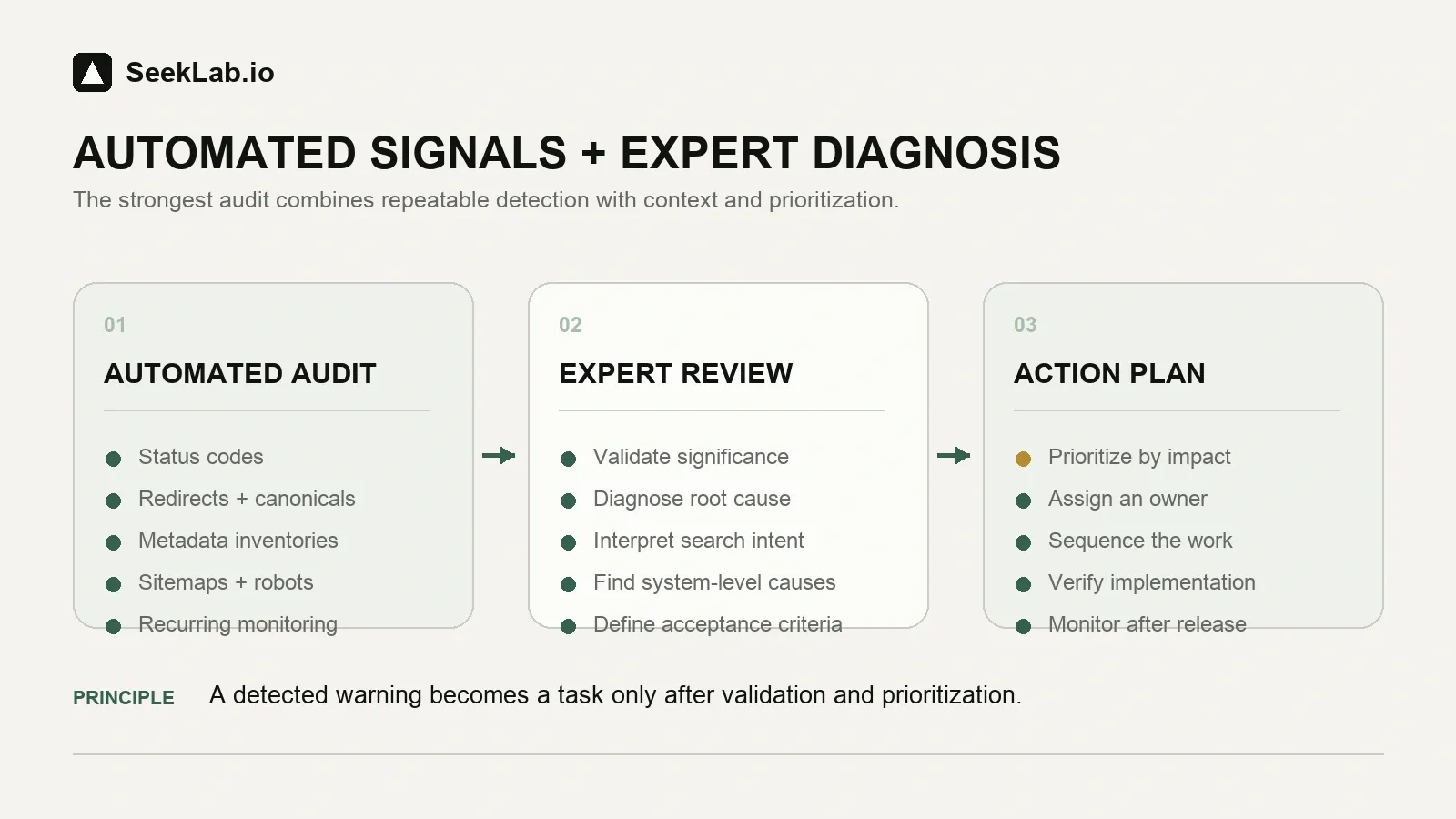
What Automated SEO Tools Can Find
Tools such as Ahrefs Site Audit, Semrush Site Audit and Screaming Frog SEO Spider are useful because they apply the same checks consistently across many URLs. Their exact coverage varies by configuration, integrations and crawl limits, but they are commonly used for:
- Status codes and redirects: mapping
200,3xx,4xxand5xxresponses, redirect chains and loops. - Metadata and heading inventories: identifying missing, duplicated or unusually long titles, descriptions and headings.
- Indexation directives: checking canonical tags, robots meta directives,
robots.txtaccess and sitemap consistency. - Internal-link data: finding broken links, deep pages, orphan candidates when additional URL sources are supplied, and uneven internal-link distribution.
- Structured-data syntax: identifying invalid markup and differences in schema coverage.
- Performance signals: collecting lab data and, where supported, connected field data for further review.
- Recurring monitoring: comparing crawls and detecting technical changes after deployments, template updates or releases.
For a faster starting point, SeekLab's free automated audit is narrower than a full crawler or SEO suite. It provides three free reports with no signup, completes in minutes and runs roughly 30 checks across nine categories. Use it for a quick diagnostic baseline. Use tools such as Ahrefs, Semrush or Screaming Frog when you need deeper crawling, recurring monitoring or large-scale technical data collection. Neither route replaces human review when the findings require root-cause diagnosis, prioritization or business context.
Automated tools are not limited to raw HTML. Some can execute JavaScript, connect to Search Console or analytics data, and accept URL lists or sitemap sources. That makes them valuable diagnostic systems—not merely syntax checkers. Their output still depends on crawl settings, available data and the question being investigated.
Where Automated Findings Need Manual Validation
1. JavaScript rendering and state differences
JavaScript-capable crawlers can compare source and rendered HTML, but their rendering configuration may not reproduce every state that Google or a real user encounters. Google’s JavaScript SEO documentation explains that crawling, rendering and indexing are separate stages. When critical content depends on client-side rendering, an audit should compare crawler output with Google Search Console inspection and live browser behavior before drawing a conclusion.
2. URLs outside the discovered crawl graph
A crawl that starts only from the homepage and internal links may miss unlinked staging URLs, legacy paths or parameter combinations. This is a limitation of the input set, not proof that audit software cannot find them. Supplement the crawl with XML sitemaps, Search Console exports, analytics, backlink data, server logs or known URL lists where appropriate.
3. Symptoms that share one system-level cause
A crawler may report duplicate metadata across many URLs, while the underlying cause is a single template rule, CMS setting or canonical pattern. The report is still useful: it defines the affected set. Expert review turns that set into a root-cause hypothesis and an implementation plan.
4. Warnings without business context
Tool severity is generic by design. A broken link on a priority acquisition page and a missing description on an archived page may both appear in the same export, but they should not necessarily receive the same implementation priority.
What Expert SEO Audits Add
An expert audit does not replace crawl data. It interprets and tests it.
1. Root-Cause Analysis Across Templates and Systems
Expert review compares affected URL patterns, templates, rendered output, canonical behavior and deployment history to identify the system producing the warning. Where useful, Search Console and server logs can show whether the issue is visible to Googlebot and how frequently affected URLs are requested.
2. Search Intent, Internal Linking and Page Pathways
Automated tools can count links and identify anchor patterns. Human review evaluates whether those links support the intended journey: from an informational page to a relevant service, category or product page; from a broad topic to proof and specification; and from discovery to an appropriate next action.
3. International and Multilingual Architecture
For multilingual or multi-market websites, expert review can test how URL structure, canonicals, hreflang, redirects and localized content interact. The question is not only whether annotations reciprocate, but whether each locale has a distinct purpose and whether crawlers and users can access it consistently.
4. Search Crawling, AI Controls and AI-Search Visibility
These controls should be evaluated separately:
- Search crawling and indexing: Googlebot access, indexation directives, canonicalization and Search Console evidence determine whether content can appear in Google Search.
- AI crawler access: services may use their own crawler or retrieval user agents, each with separate documentation and controls.
- Training and grounding preferences:
Google-Extendedis a standalone control token. Google states that it does not have a separate HTTP user-agent string, does not control inclusion in Google Search and is not a Google Search ranking signal. It manages whether Google-crawled content may be used for specified Gemini training and grounding purposes. See Google’s crawler documentation. - AI-search visibility: access alone does not guarantee that a page will be cited, summarized or recommended. Clear, verifiable content and strong entity/context signals still matter. Google’s guidance for AI features in Search remains tied to normal Search controls and quality practices; see AI features and your website.
An audit should therefore avoid grouping Google-Extended with retrieval crawlers as though they perform the same function.
How Expert Review Improves Content and Conversion Context
A technically accessible page can still be poorly matched to the query it targets. Expert review can identify when the page’s purpose, evidence, structure or next step is unclear without claiming that an audit alone can diagnose every revenue problem.
Consolidating Overlapping Content
When several pages compete for the same intent, an expert can decide whether to consolidate, differentiate or redirect them. The decision should consider existing rankings, backlinks, conversion role and the site’s broader topic architecture—not word count alone.
Improving Information Design
Automated checks can flag missing image attributes or oversized files. Human review determines whether a diagram, comparison table, screenshot or clearer hierarchy would make a difficult concept easier to understand. The objective is useful information design, not decoration.
Connecting Informational and Commercial Pages
When a high-traffic article does not support an appropriate next step, the solution may be a clearer internal link, a better-matched service page or a more useful CTA. That is a hypothesis to test against analytics and user behavior, not an automatic conclusion from crawl data.
Strategic Prioritization: What to Fix First
A useful audit should not treat every warning as equal. After validating the evidence, group findings into a qualitative framework:
A. Deprioritize
- Cosmetic or low-impact findings on non-priority pages
- Intentional configurations that have been verified
- Warnings unrelated to the pages or outcomes under review
B. Quick Fix
- Broken internal links on important pages
- Obvious redirect chains
- Sitemap or robots mistakes with a clear correction
C. High Priority
- Indexation blockers
- Rendering failures that hide critical content or links
- Canonical or template faults affecting page groups
- International targeting failures
- High-value page intent or content problems
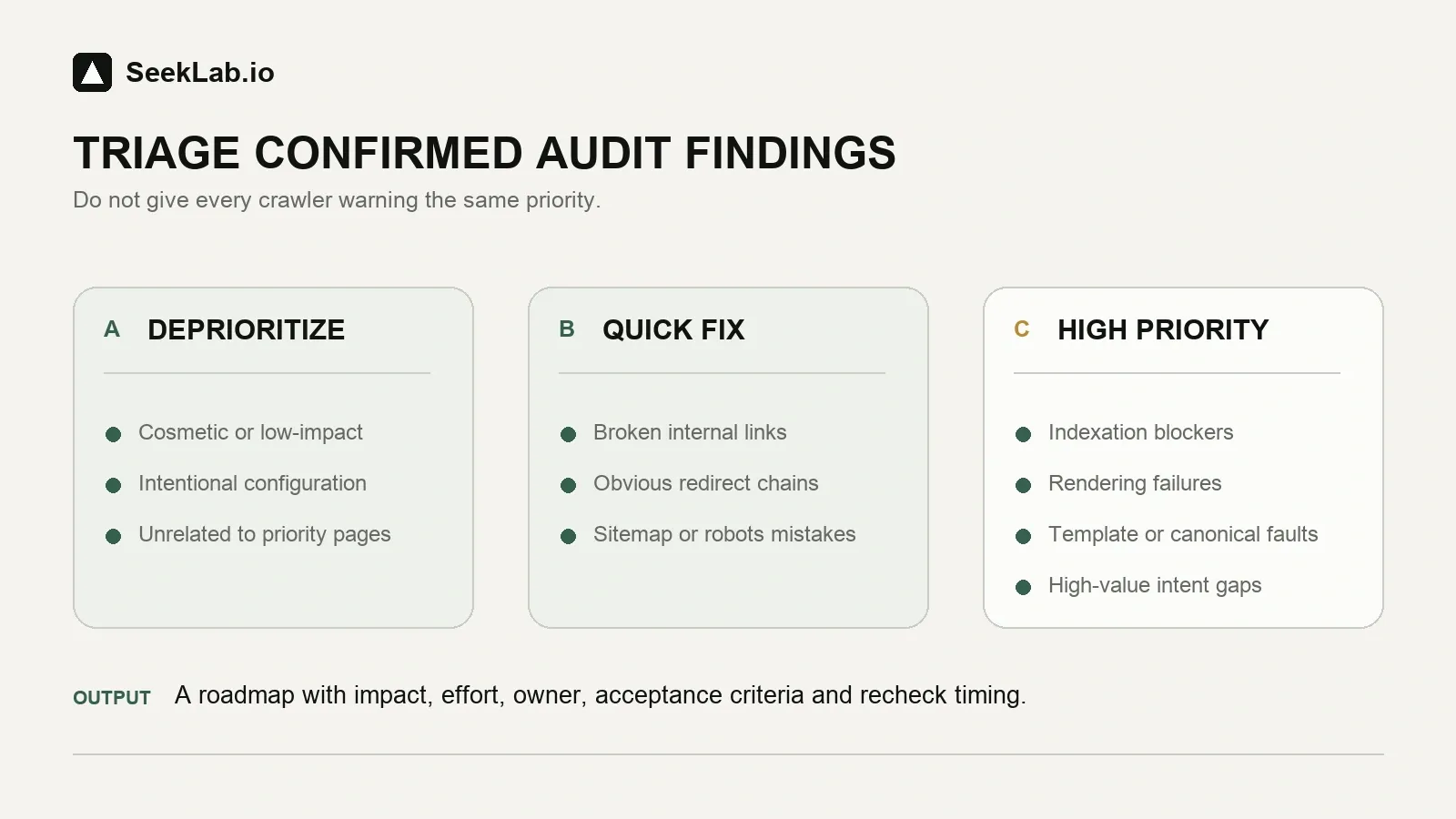
For every confirmed issue, add an owner, impact, effort, dependency, acceptance criterion and recheck method. That turns an audit export into an implementation roadmap.
When to Use Automated Tools vs an Expert SEO Audit
Use Automated Monitoring For
- Recurring technical checks
- Post-deployment QA
- Template changes
- Migrations and releases
- Baseline inventories before deeper analysis
Use Expert Review For
- Before and after a major migration
- International or multilingual expansion
- Persistent visibility decline that automated reports do not explain
- Major architecture or platform changes
- Conflicting crawl, rendering or indexation evidence
- Periodic review where site complexity or change frequency justifies it
There is no universal requirement to commission an expert audit every six or twelve months. The right cadence depends on site size, release frequency, technical complexity and the cost of missing a problem.
Which Audit Option Should You Use?
- Need a quick automated baseline? Run the SeekLab free audit.
- Need recurring large-scale crawling or monitoring? Use a dedicated crawler or SEO suite.
- Need root-cause diagnosis and prioritization? Use an expert audit.
The Hybrid Audit Workflow
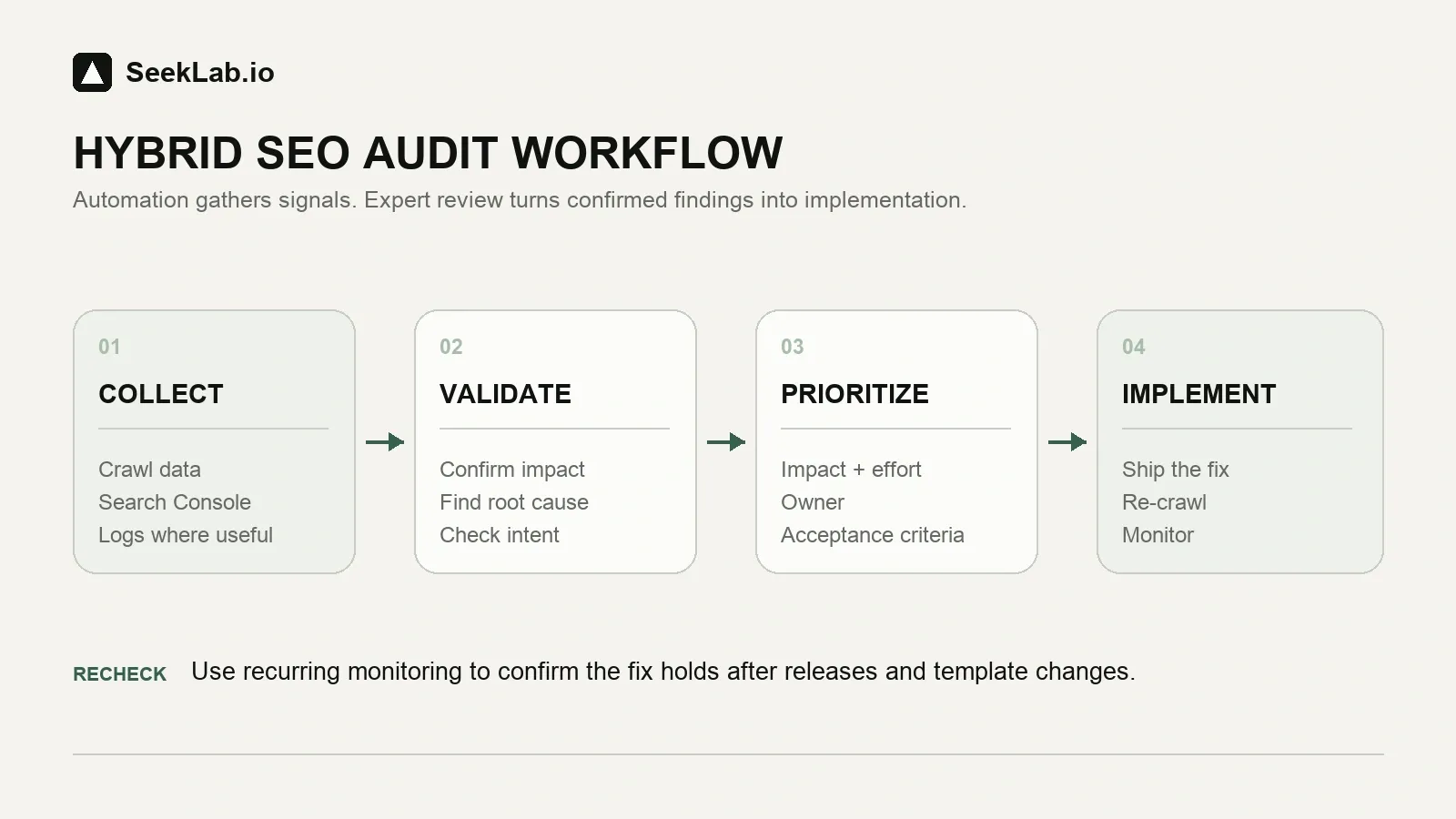
The most reliable workflow combines automated evidence with human validation:
- Collect: crawl data, Search Console evidence and logs where useful.
- Validate: confirm the issue, determine its scope and identify the root cause.
- Prioritize: rank the finding by impact and effort, assign an owner and define acceptance criteria.
- Implement and recheck: ship the change, re-crawl and monitor after release.
SeekLab combines automated diagnostic data with human review, prioritization, content and technical analysis, and implementation guidance. For a deeper review of search structure and AI readiness, see the Search & AI Audit. For ongoing technical, content and visibility work, review SeekLab’s SEO + GEO services.
Frequently Asked Questions
Can an automated SEO audit replace an expert review?
Not in every situation. Automated audits are strong at repeatable detection, inventories and monitoring. Expert review is more useful when findings need validation, root-cause analysis, prioritization or interpretation against search intent and business context.
Why can traffic decline while a site health score remains high?
A health score reflects the checks and weighting used by that product. It may not capture every ranking change, intent mismatch, off-crawl URL, rendering state or competitive shift. Treat the score as one signal and investigate changes with Search Console, analytics, SERP evidence and targeted technical tests.
How often should automated and expert audits run?
Run automated checks on a recurring schedule and after deployments, template changes or migrations. Use expert review around major changes, international expansion, persistent visibility decline or when automated reports do not explain the problem. Complex, frequently changing sites may justify more regular expert review.
What should a good SEO audit deliver?
A useful audit should provide confirmed evidence, affected URLs, root-cause hypotheses, priority, effort, an implementation owner, acceptance criteria and a recheck method. A long list of warnings without those elements is difficult to act on.
Start with SeekLab’s free automated audit for a quick baseline. If the findings need deeper validation, prioritization or Search and AI analysis, review the Search & AI Audit and the broader SEO + GEO service.