Best AI Visibility Checkers in 2026: Which Tools Actually Track ChatGPT and Perplexity Citations
Expert reviewed

The best AI visibility checkers in 2026 are Otterly.ai for focused citation tracking, AIclicks for multi-platform breadth, Semrush for teams already in the SEO suite, and Search Atlas for integrated SEO workflows. Profound is the strongest enterprise option but requires direct pricing verification.
Why this matters right now: AI Overviews now appear in 48% of all Google searches — up 58% from last year. AI Mode has a 93% zero-click rate, meaning nearly all AI Mode searches end without a single click to an external website. But brands cited inside AI Overviews see 91% more paid clicks than brands that don't appear at all. The gap between being cited and being invisible has never been larger — or more measurable.
If you are searching for an AI visibility checker tool 2026, the real question is not which dashboard gives the highest visibility score. The question is whether the tool can show where your brand appears in AI-generated answers, whether it is merely mentioned or actually cited with a source URL, which prompts triggered that result, and how the pattern changes across ChatGPT, Perplexity, Google AI Overviews, and competitors.
This article compares the main AI search monitoring options in 2026: Otterly.ai, AIclicks, Search Atlas, Profound, Semrush, BrandMentions, SeekLab Hot Topics, and several other tools worth checking. The criteria are practical: ChatGPT citation tracking, Perplexity source tracking, Google AI Overview or AI Mode monitoring, prompt-level evidence, competitor benchmarking, geographic and language support, reporting quality, pricing transparency, and usefulness for SEO execution.
If a checker shows your website is missing from AI answers, the next step is not simply "publish more content." You need to audit crawlability, indexing, rendering, schema, internal links, content structure, multilingual architecture, and citation readiness.
What an AI visibility checker tool 2026 should actually measure
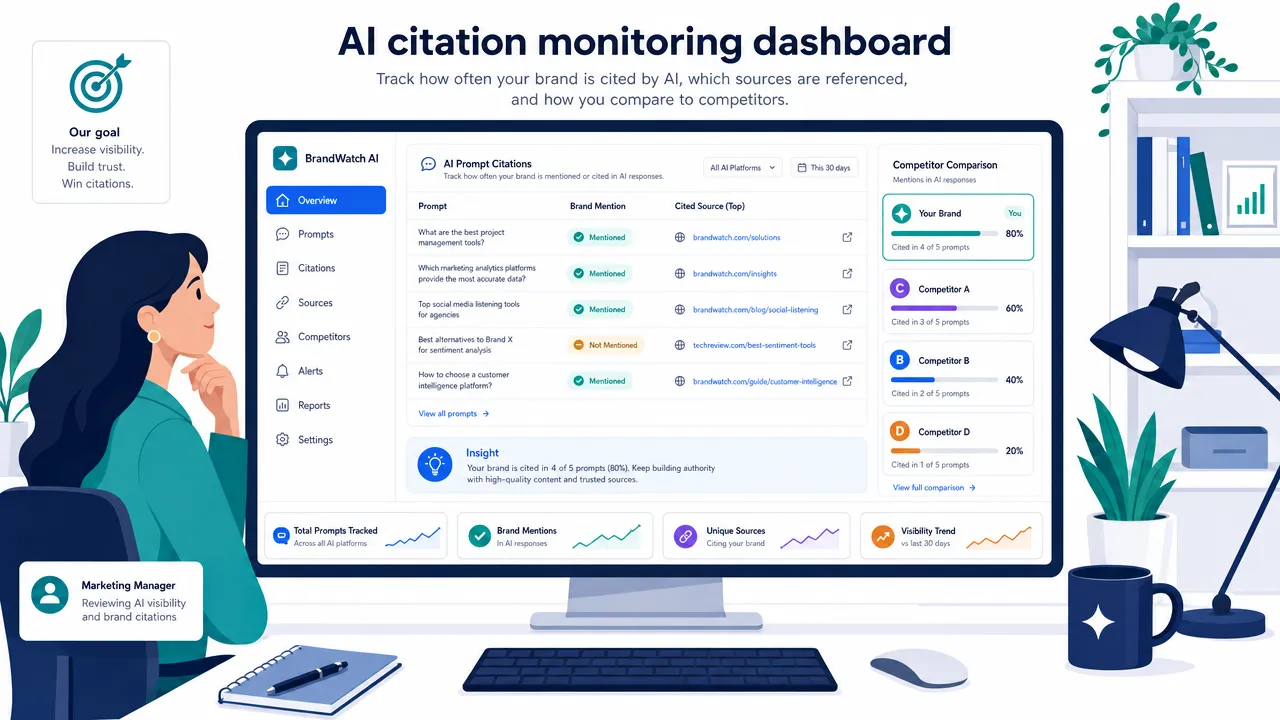
An AI visibility checker tool 2026 should do more than tell you that your brand has a score of 62 or appears in 18 percent of answers. Scores can be useful for trend reporting, but they are not the evidence a marketing manager needs when asking, "Did ChatGPT cite our website for this buyer question?" or "Why does Perplexity cite a competitor's comparison page instead of our product page?"
The first distinction is brand mention vs citation. A brand mention means the answer names your company, product, or domain. A citation means the answer includes a linked source, source panel, or cited URL connected to your website. OpenAI says ChatGPT Search can include inline citations and a Sources panel, which makes citation tracking a concrete thing to monitor rather than a vague visibility claim. You can read the official explanation in OpenAI's ChatGPT Search help documentation.
The second distinction is answer inclusion vs referral traffic. Your brand may appear in a generated answer without receiving a click. A page may be cited but still receive little traffic. That matters for reporting because AI citation tracking is not the same as analytics attribution. It is a visibility and source-inclusion signal, not proof of lead generation.
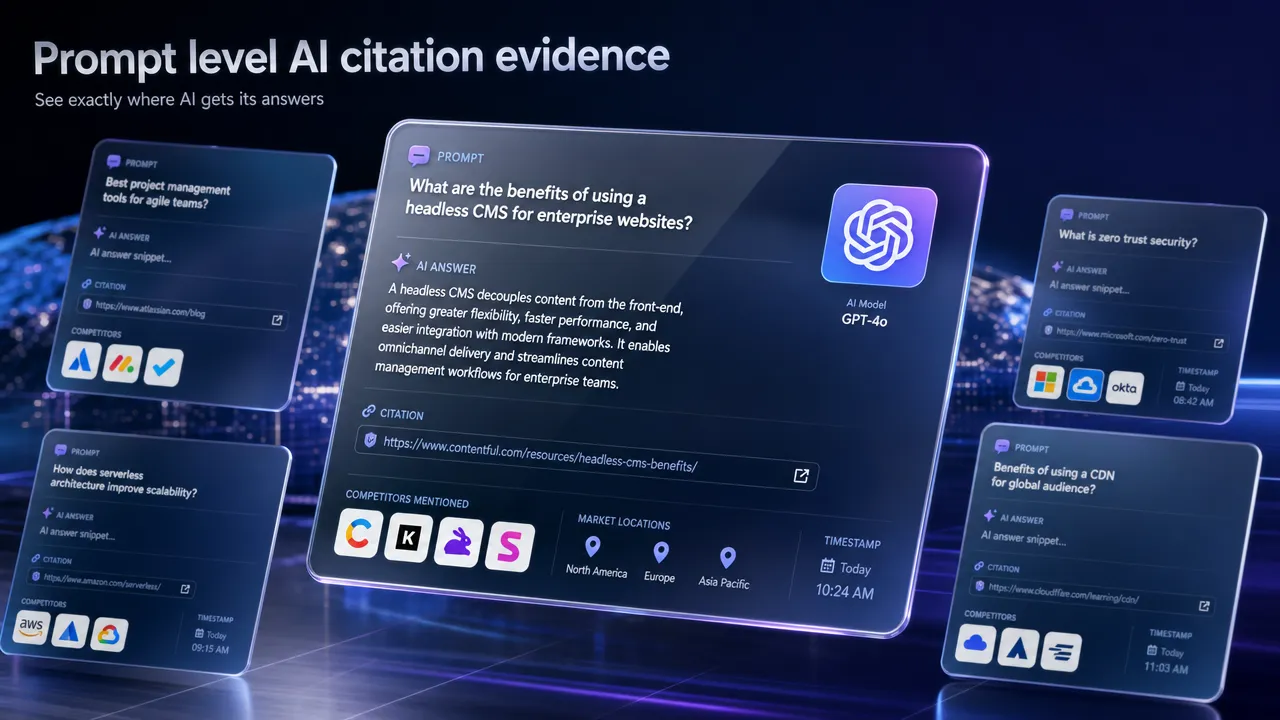
The third distinction is prompt-level tracking. A useful checker should store the prompt, answer text, cited sources, platform, location, language, timestamp, and competitor presence. Without that evidence, the report becomes a screenshot exercise. Screenshots are weak because the same prompt can produce different results depending on wording, model behavior, retrieval timing, and location.
Google's documentation also matters here. Google says pages must be indexed and eligible for snippets to appear as supporting links in AI Overviews or AI Mode. That connects AI search visibility back to classic SEO fundamentals such as crawlability, indexability, content clarity, and structured data. See Google's guidance on AI features and your website and its broader AI optimization guidance.
For independent websites, exporter websites, and multilingual company sites, this is where many problems show up. The site may have product pages, but the content is thin. The English page may exist, but the key specifications are rendered through JavaScript. The blog may target keywords, but the article structure does not answer buyer questions clearly enough for search engines or AI systems to interpret. Monitoring exposes the gap; it does not repair the site.

Best AI visibility checker tool 2026 comparison table
The table below summarizes the main tools based on the research report and public positioning reviewed. Competitor tools are mentioned for comparison, but links are intentionally not included because this article only links to SeekLab.io and authoritative documentation sources.
| Tool | ChatGPT tracking | Perplexity tracking | Google AI Overviews or AI Mode | Citation or source URL reporting | Prompt tracking | Best fit | Main limitation to verify |
|---|---|---|---|---|---|---|---|
| Otterly.ai | Yes, publicly positioned | Yes, publicly positioned | Yes, publicly positioned | Yes | Yes, plan-dependent details should be checked | Small teams, agencies, SEO teams needing focused monitoring | Prompt volume, refresh frequency, locations, and exports |
| AIclicks | Yes, publicly positioned | Yes, publicly positioned | Yes, publicly positioned | Yes | Yes | Teams wanting broad AI search platform coverage | "10+ platforms" and plan limits should be tested in trial |
| Search Atlas | Yes, publicly positioned | Yes, publicly positioned | Partial, based on public guidance | Yes | Yes or partial | SEO teams wanting AI visibility inside a broader platform | Depth of AI monitoring vs dedicated tools |
| Profound | Likely, based on enterprise positioning | Likely, based on enterprise positioning | Likely | Likely | Likely | Enterprise brands and agencies | Pricing, platform coverage, and plan details require direct verification |
| Semrush | Yes, publicly positioned | Mentioned in some official materials | Yes | Yes | Yes | Existing Semrush users and SEO teams | Platform coverage may vary by product and plan |
| BrandMentions | Not publicly confirmed | Not publicly confirmed | Not publicly confirmed | Unclear for AI citations | Not confirmed for AI prompts | PR, social listening, reputation monitoring | Strong for mentions, not clearly confirmed as ChatGPT or Perplexity citation tracking |
A practical buyer should not stop at "yes" or "no." Ask vendors to show one real prompt, the generated answer, the cited URL, the timestamp, the platform name, the tested location, and competitor overlap. If they cannot show that evidence, the tool may still be useful for broad monitoring, but it is weaker for citation reporting.
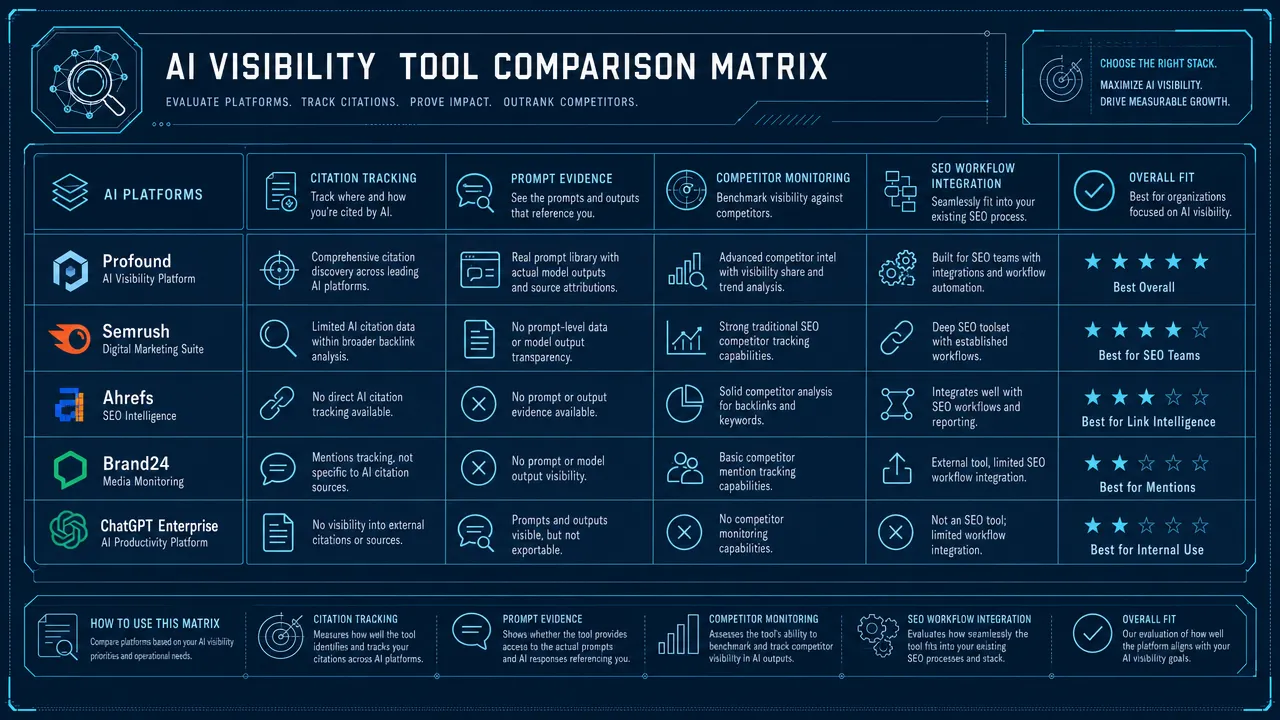
A simple way to evaluate the category is to separate tools into four groups. Dedicated monitors focus on prompt-level visibility and citations. SEO suites add AI visibility reporting to existing SEO workflows. Brand monitoring platforms track broader web and social mentions. Execution partners help diagnose why the site is not visible or citation-ready in the first place.
| Category | Typical tools | Use case | What to watch |
|---|---|---|---|
| Dedicated AI search monitors | Otterly.ai, AIclicks, Profound | Track prompts, mentions, citations, competitors | Verify exact platform coverage and source URL granularity |
| SEO suites with AI modules | Semrush, Search Atlas | Combine AI visibility reporting with keyword, audit, and SEO workflows | Confirm whether AI tracking is deep enough for your prompts and markets |
| Brand monitoring platforms | BrandMentions | Monitor web, social, media, sentiment, reputation signals | Do not assume ChatGPT or Perplexity citation tracking unless confirmed |
| SEO execution partners | SeekLab.io | Diagnose and improve technical, content, and structural readiness | Use after measurement shows gaps that need action |
For many B2B and cross-border websites, the best setup is not one tool alone. A monitoring platform can show that Perplexity cites third-party listicles for your category. A technical and content audit can then reveal that your official product pages do not explain use cases clearly, lack comparison-ready content, have weak internal links, or are hard to render. Those are different jobs.
How to choose an AI visibility checker tool 2026 for ChatGPT and Perplexity citations
The strongest AI visibility checker tool 2026 for your team depends on the evidence you need. If the goal is executive reporting, a clean score and competitor chart may be enough. If the goal is SEO action, you need source URLs, prompt logs, cited pages, and a way to connect visibility gaps to site improvements.
Start with ChatGPT citation tracking. Make sure the vendor distinguishes ChatGPT Search or browsing-enabled results from non-browsing model responses. OpenAI says ChatGPT can search the web when useful and can provide answers with links to relevant web sources. That means the tool should clarify what ChatGPT experience it monitors, not simply say "ChatGPT tracking."
Next, check Perplexity citation tracking. Perplexity is citation-forward, so a serious tool should show whether your domain or exact URL appears in the answer sources for a selected prompt. Perplexity's own documentation discusses citation extraction and validation workflows, which supports the idea that source-level evidence can be monitored. See Perplexity's citation documentation.
Then check Google AI Overview and AI Mode coverage. Google AI Overviews are not the same as a normal search ranking. Google describes them as AI-generated snapshots with links to dig deeper and also warns that they can make mistakes. You can review Google's explanation in its AI Overviews help page. For website owners, the important detail is that supporting links still depend on eligibility conditions such as indexing and snippet eligibility.
Use this vendor checklist before buying:
| Evaluation question | Why it matters |
|---|---|
| Does the tool track citations or only brand mentions? | Mentions are useful, but source URLs are stronger evidence. |
| Does it store exact prompts and responses? | Without prompt logs, you cannot repeat or audit the result. |
| Does it report page-level source URLs? | Domain-level reporting may hide which page is actually being cited. |
| Does it track competitors for the same prompt? | Competitive overlap shows whether the issue is category authority, content quality, or brand recognition. |
| Does it support your target country and language? | International sites need market-specific checks, not one global snapshot. |
| Can you export raw evidence? | SEO teams often need data for monthly reports, audits, and stakeholder reviews. |
| Does it connect results to SEO actions? | Measurement alone does not improve crawlability, content structure, or conversions. |
A common mistake is choosing the tool with the most polished dashboard while ignoring prompt design. Poor prompts produce poor insight. For example, an exporter website should not only test its brand name. It should test buyer-style prompts such as product comparisons, supplier selection questions, compliance questions, category alternatives, and use-case-specific searches in target markets.
Reviews of major AI visibility checker tool 2026 options
Below is a practical review of each major option. This is not a lab benchmark, and it does not claim to test private vendor data. It summarizes the public positioning and the buying implications that matter for marketing managers, SEO teams, and independent website operators.
Otterly.ai
Otterly.ai is one of the clearest dedicated options for AI search monitoring. Its public positioning focuses on tracking brand mentions, website citations, and visibility across ChatGPT, Perplexity, Google AI Overviews, Google AI Mode, Gemini, and Microsoft Copilot.
The practical strength is category focus. If your immediate question is "Are we cited in ChatGPT and Perplexity for these prompts?", Otterly.ai appears built around that workflow. It is likely a strong fit for smaller teams, agencies, and SEO operators who want AI search monitoring without moving their entire SEO stack.
The buying caution is plan detail. Ask about prompt limits, refresh frequency, location controls, historical data, export options, and whether source URL reporting is page-level or domain-level. A low monthly starting price can be attractive, but the usable cost depends on how many brands, markets, and prompt sets you need.
AIclicks
AIclicks publicly positions itself around AI search visibility tracking, citation source identification, prompt tracking, competitor benchmarking, geo audits, and recommendations. Its pricing is more transparent than some enterprise-style vendors, with public tiers listed in the research report starting at $59 per month.
The practical strength is breadth. AIclicks may appeal to teams that want to monitor multiple AI answer environments and combine prompt-level visibility with source and competitor analysis. For brands operating in multiple markets, geo-audit language is especially relevant.
The buying caution is verification. Claims around broad platform coverage should be tested during trial. Ask for a prompt-level export covering ChatGPT, Perplexity, Google AI features, location, timestamp, answer text, source URLs, and competitor presence. If your team works across English, Spanish, Arabic, Chinese, or other markets, confirm language support before committing.
Search Atlas
Search Atlas is more of an integrated SEO platform with LLM visibility capabilities than a narrow standalone monitor. Public materials describe visibility inside AI-generated answers, sentiment, share of voice, competitor benchmarks, citation sources, and dashboards for topics and queries.
The practical strength is workflow integration. If your team already wants rank tracking, site auditing, content planning, and AI visibility in one environment, Search Atlas may be easier to operationalize than a dedicated checker that sits outside the SEO process.
The buying caution is depth. Integrated platforms can be efficient, but you should still compare their AI visibility module against dedicated monitors for your actual prompts, regions, and reporting needs. A dashboard that looks useful for brand-level reporting may not provide enough evidence for page-level SEO decisions.
Profound
Profound appears positioned for enterprise AI answer visibility, agent analytics, and answer-engine intelligence. It is relevant for larger teams that need deeper reporting, stakeholder-ready analysis, and possibly broader platform coverage.
The practical strength is enterprise orientation. Teams with multiple brands, complex reporting needs, or agency-style client management may find this type of platform attractive.
The buying caution is transparency. Public pricing and plan limits are less clear than with some alternatives, so buyers should request a demo and ask direct questions about ChatGPT citation tracking, Perplexity source links, Google AI features, supported markets, export access, and historical trend data.
Semrush
Semrush is one of the strongest options for teams already using a broad SEO suite. Its AI Visibility Toolkit is publicly described as helping brands understand how they appear in AI-generated answers, with features such as prompt tracking, brand mentions, cited sources, competitor benchmarking, and AI search health.
The practical strength is connection to SEO operations. A team already using Semrush for keyword research, site audits, and competitive analysis may prefer to add AI visibility reporting inside the same workflow rather than manage another tool.
The buying caution is platform-specific coverage. Semrush materials mention ChatGPT, Gemini, Google AI Mode, Google AI Overviews, and Perplexity across different pages and contexts. Before buying, confirm exactly which platforms are included in your plan and whether Perplexity tracking is available at the level you need.
BrandMentions
BrandMentions is best understood as a broader brand monitoring and social listening platform. Public materials describe web, social, news, forum monitoring, alerts, sentiment analysis, and AI-powered context or mention analysis.
The practical strength is reputation monitoring. If your team cares about media mentions, social sentiment, and broader brand visibility outside AI answer engines, BrandMentions may still be useful.
The buying caution is category fit. Public sources reviewed do not clearly confirm native ChatGPT citation tracking, Perplexity citation tracking, or Google AI Overview source tracking. If you need AI citation evidence, ask for a live demonstration before treating it as an AI citation tracker.
Other tools worth checking
Peec AI, Scrunch AI, LLM Pulse, SE Ranking, Ahrefs Brand Radar, and similar products appear in AI search tracking discussions and tool roundups. They may be worth evaluating, especially if your team has specific platform, enterprise, or reporting requirements.
The same procurement rule applies: do not buy based on a category label. Ask for prompt-level evidence, source URL reporting, competitor overlap, location and language controls, trend history, and export options.
Limits of an AI visibility checker tool 2026 and what to do after measurement
No AI visibility checker tool 2026 can fully track every possible AI answer. AI outputs vary by prompt wording, location, account context, model version, retrieval behavior, browsing availability, and time. Google explicitly notes that AI Overviews can make mistakes. OpenAI explains that ChatGPT may search the web automatically when a prompt benefits from current information. These systems are not fixed SERPs.
This is why one-off screenshots are weak evidence. A screenshot can show that your brand appeared once, but it cannot prove consistent visibility. A stronger report tracks the same prompt set over time, stores source URLs, logs timestamps, compares competitors, and separates mentions from citations.
Visibility scores also need caution. Different vendors can use different prompts, weighting models, platforms, locations, and scoring formulas. A score from one tool is not directly comparable to a score from another. Treat the score as a directional indicator, not a market-share number.
Most importantly, citations do not guarantee clicks or inquiries. A cited page may attract traffic, but it may not. A buyer may read the AI answer and never click. A visitor may click and still not convert if the landing page lacks credible detail, inquiry paths, comparison information, or localized content. This is a familiar SEO problem with a new measurement layer.
For website owners, the more useful question is: "If tools show that we are not cited, what is blocking us?"
Start with crawlability, indexability, and rendering. A modern website may look polished in a browser but hide important product copy behind scripts, tabs, filters, or client-side rendering issues. If search engines and AI retrieval systems cannot reliably access the content, the site is unlikely to become a strong source. SeekLab.io covers these issues in its work on JavaScript SEO and indexing solutions.
Then review content structure. AI answer systems tend to work better with pages that explain entities, use cases, comparisons, specifications, audience fit, and constraints clearly. A product page that only lists marketing slogans is weaker than a page that explains what the product is, who it is for, how it compares, what problems it solves, and what evidence supports those claims.
Next, check schema and entity clarity. Schema does not guarantee citations, but it can help machines understand page type, organization details, products, articles, FAQs, breadcrumbs, and other structured relationships. SeekLab.io's free SEO and AI readiness audit includes checks around structured data, crawlability, robots.txt, sitemap.xml, internal link depth, hreflang, and AI search friendliness.
Internal links also matter. Many independent websites publish useful articles but fail to connect them to product pages, category pages, and conversion paths. A strong topic cluster should help both users and search systems understand which pages are authoritative and how supporting content relates to core commercial pages.
International websites need another layer of care. Hreflang mistakes, duplicate regional pages, inconsistent translations, and weak localized content can make it harder for search engines and AI systems to identify the right page for the right market. This is especially relevant for companies selling across the United States, Europe, the Asia-Pacific region, and the Middle East.
Before publishing another batch of articles, it is often smarter to run a structured audit. SeekLab.io's full-site SEO audit checklist explains how crawlability, Core Web Vitals, indexability, internal links, content quality, schema, and international SEO fit together. For content teams adapting to AI search behavior, SeekLab.io also has a guide on adapting content for AI search.
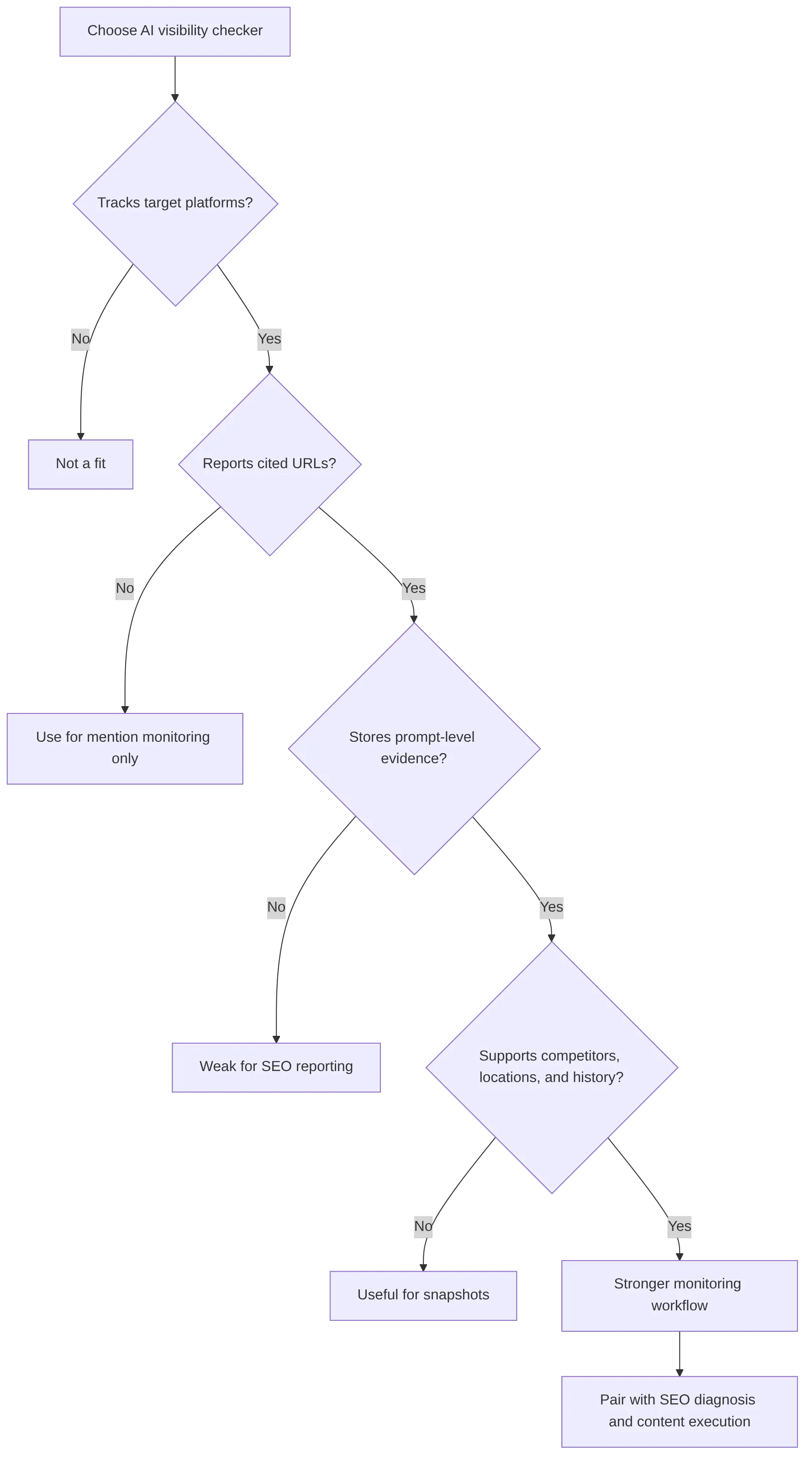
The workflow below shows the practical sequence. Do not treat monitoring as the final step. Treat it as the diagnostic trigger.

Where SeekLab.io fits after using an AI visibility checker tool 2026
SeekLab.io should not be treated as a narrow checker competing feature-by-feature with Otterly.ai, AIclicks, Search Atlas, Profound, or Semrush. Its role is different. Use monitoring tools to measure whether you are visible, mentioned, cited, or ignored. Use SeekLab.io to understand why that gap exists and what should be fixed first.
This distinction matters because many official company websites do not fail because they lack another dashboard. They fail because the site is difficult to crawl, important content is not indexable, JavaScript blocks key information, schema is missing or inconsistent, internal links do not support topical authority, multilingual pages are poorly structured, or content does not match real buyer questions.
SeekLab.io helps brands build search visibility and AI-era discoverability through high-quality content production and technical optimization. The work is not limited to technical issue detection. It also includes topic selection, content planning, page structure, internal linking, semantic clarity, multilingual architecture, and conversion-focused SEO recommendations.
The practical value is prioritization. SeekLab.io does not aim to fix everything for the sake of a checklist. It identifies what truly affects growth and what can be deprioritized. For a B2B exporter, that might mean fixing English product category pages before writing another generic blog post. For a multilingual SaaS site, it might mean correcting hreflang and internal linking before expanding into new content clusters. For a company website with traffic but few inquiries, it might mean improving comparison content, proof points, and conversion paths.
SeekLab.io's services are especially relevant after a checker reveals patterns such as:
| Visibility finding | Likely SEO or content issue | Practical next step |
|---|---|---|
| ChatGPT mentions the brand but does not cite the official site | Weak source pages, unclear entity signals, or stronger third-party pages | Improve authoritative company pages and supporting content |
| Perplexity cites competitors for category prompts | Competitors have clearer comparison or educational content | Build better topic clusters and comparison-ready pages |
| Google AI Overviews cite third-party blogs instead of product pages | Product pages may be thin, poorly structured, or not snippet-ready | Improve page structure, schema, and answer clarity |
| International prompts do not surface the right regional page | Hreflang, translation, or regional architecture problems | Audit multilingual SEO structure |
| AI answers misunderstand the product or service | Content lacks concrete definitions, use cases, and entity clarity | Rewrite core pages with clearer buyer-facing explanations |
| Traffic grows but inquiries do not | Content attracts attention but does not support buying decisions | Align SEO content with conversion paths and lead quality |
SeekLab.io also supports high-quality blog creation tailored to industry scenarios. That includes structured page layouts designed to match search intent, images, tables, internal links, headings, meta tags, keywords, JSON-LD, and monthly performance review. The goal is not traffic for its own sake. The goal is visibility that supports credibility, inquiry generation, and business growth.
For companies in the Asia-Pacific region, the United States, Europe, and the Middle East, international execution often decides whether search visibility turns into real demand. SeekLab.io has teams and legal entities in Singapore and Shanghai, with a business development team based in Dubai, which supports cross-market collaboration for brands expanding across regions.
If your AI visibility checker shows citation gaps, the next step is to make the website easier for search engines, AI systems, and real buyers to understand. You can get a free audit report to identify technical, content, and structural issues before spending more budget on content that may be heading in the wrong direction.
FAQ
What is an AI visibility checker tool?
An AI visibility checker tool monitors whether your brand, website, products, or competitors appear in AI-generated answers across platforms such as ChatGPT, Perplexity, Google AI Overviews, Gemini, Copilot, and similar systems. The best tools distinguish brand mentions from source citations and store prompt-level evidence.
Can tools track ChatGPT citations?
Yes, some tools publicly position themselves around ChatGPT citation or ChatGPT Search monitoring. Buyers should verify whether the tool tracks source URLs, prompts, timestamps, and browsing-enabled results rather than generic model responses.
Can tools track Perplexity citations?
Yes, some tools claim Perplexity citation monitoring. A serious setup should show whether your domain or exact URL appears in Perplexity's sources for a selected prompt and whether that changes over time.
Is a brand mention the same as a citation?
No. A mention means the AI answer names the brand. A citation means the answer includes or attributes a source URL. For SEO and reporting, citation evidence is usually stronger than mention-only visibility.
Do AI visibility tools track Google AI Overviews?
Some do. Otterly.ai, AIclicks, Semrush, and other platforms publicly reference Google AI Overviews or AI Mode tracking. Always confirm whether the tool tracks the specific Google AI feature and market you care about.
Are AI visibility scores accurate?
They are useful directional indicators, not absolute truth. Scores depend on each vendor's prompt set, platform coverage, weighting method, location settings, and data refresh cycle.
Does BrandMentions track ChatGPT or Perplexity citations?
Public sources reviewed confirm BrandMentions as a broader brand monitoring and sentiment platform. They do not clearly confirm native ChatGPT or Perplexity citation tracking, so buyers should request a live demonstration before using it for that purpose.
What should I do if my website is not cited by AI answers?
Audit crawlability, indexability, rendering, schema, content structure, internal links, topic authority, and multilingual architecture. Then improve the pages that should be authoritative sources for your target prompts.
Is AI citation tracking enough for SEO success?
No. It is a measurement layer. SEO success still depends on technical accessibility, useful content, clear site architecture, authority signals, conversion paths, and ongoing performance review.
Which tool is best for small teams?
Otterly.ai and AIclicks appear accessible based on focused positioning and public pricing details. Small teams should still verify prompt limits, locations, exports, and platform coverage before choosing.
Use an AI visibility checker tool 2026 to measure the gap. Use SeekLab.io to diagnose and improve the website conditions behind that gap. If your brand is being missed, misrepresented, or mentioned without being cited, contact us and get a practical audit before investing in another round of content.