Entity SEO & Topical Authority: B2B Guide 2026
Expert reviewed

Why topical authority is the winning SEO strategy for B2B in 2026
B2B search in 2026 is less about whether one page repeats a phrase and more about whether your domain consistently proves expertise across an entire subject area. Multiple industry guides describe this shift as moving from page-level optimization to domain-level topic coverage and structure, where search engines and answer engines ask: "Which site owns this topic and can be trusted as an entity?" (see explanations from Search Engine Land on entities and topical authority overviews from Semrush and Moz).
For B2B sites, especially exporters and international trade companies, this matters because buyers search with long, specific, multilingual queries. If your content is thin, poorly structured, or technically hard to crawl, you may get sporadic traffic but still fail to earn qualified inquiries.
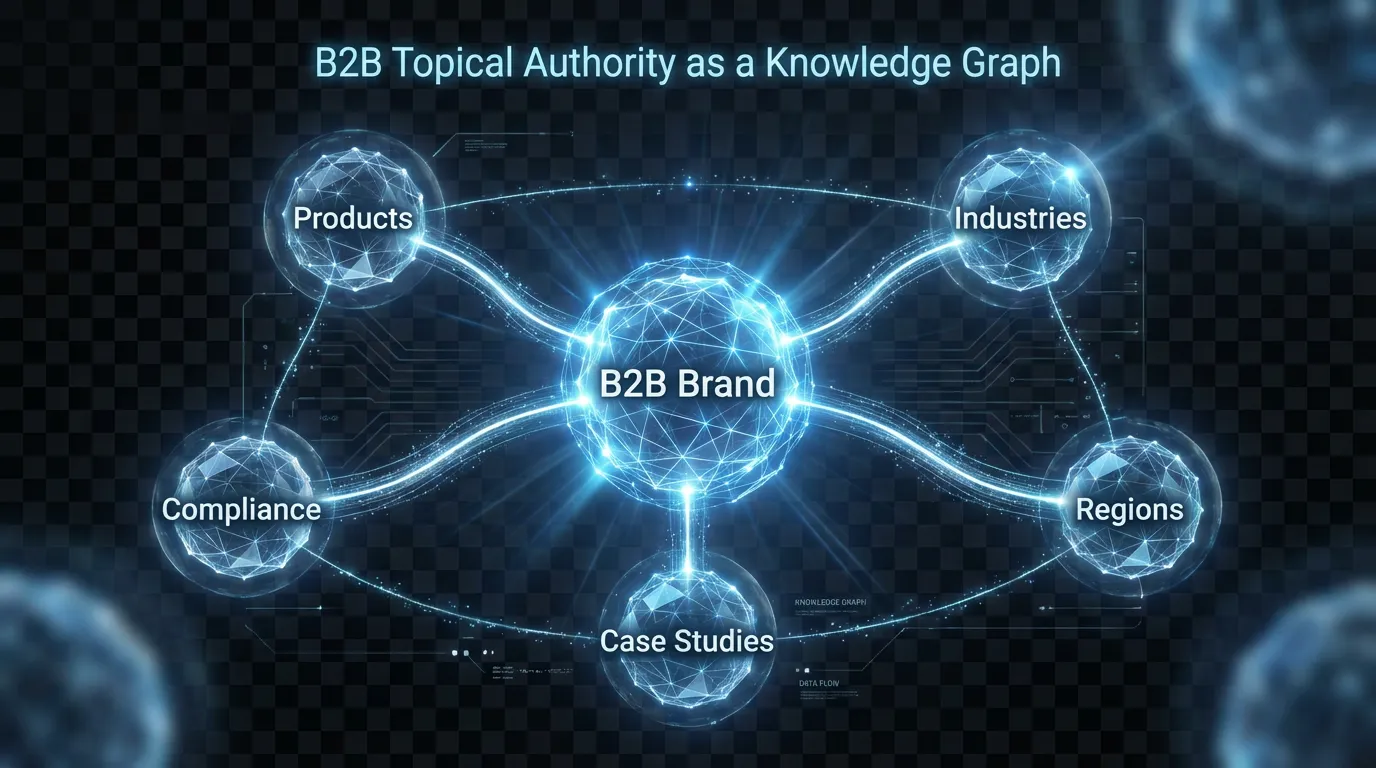
The 3-layer model: entity SEO, semantic SEO, and topic cluster SEO (how they fit together)
Think of modern authority-building as three layers that reinforce each other:
- Entity SEO: Define and reinforce the things your business represents (your company, products, services, locations, standards you work with) so search systems can connect them confidently in knowledge graphs. This is strongly tied to structured data and consistent naming (overview: Search Engine Land entity guide, plus Google structured data documentation at Google Search Central).
- Semantic SEO: Write and structure content around meaning and intent, not keyword repetition. This includes covering related concepts, answering common questions clearly, and using extractable formats like lists and tables (foundation: Search Engine Land semantic SEO guide).
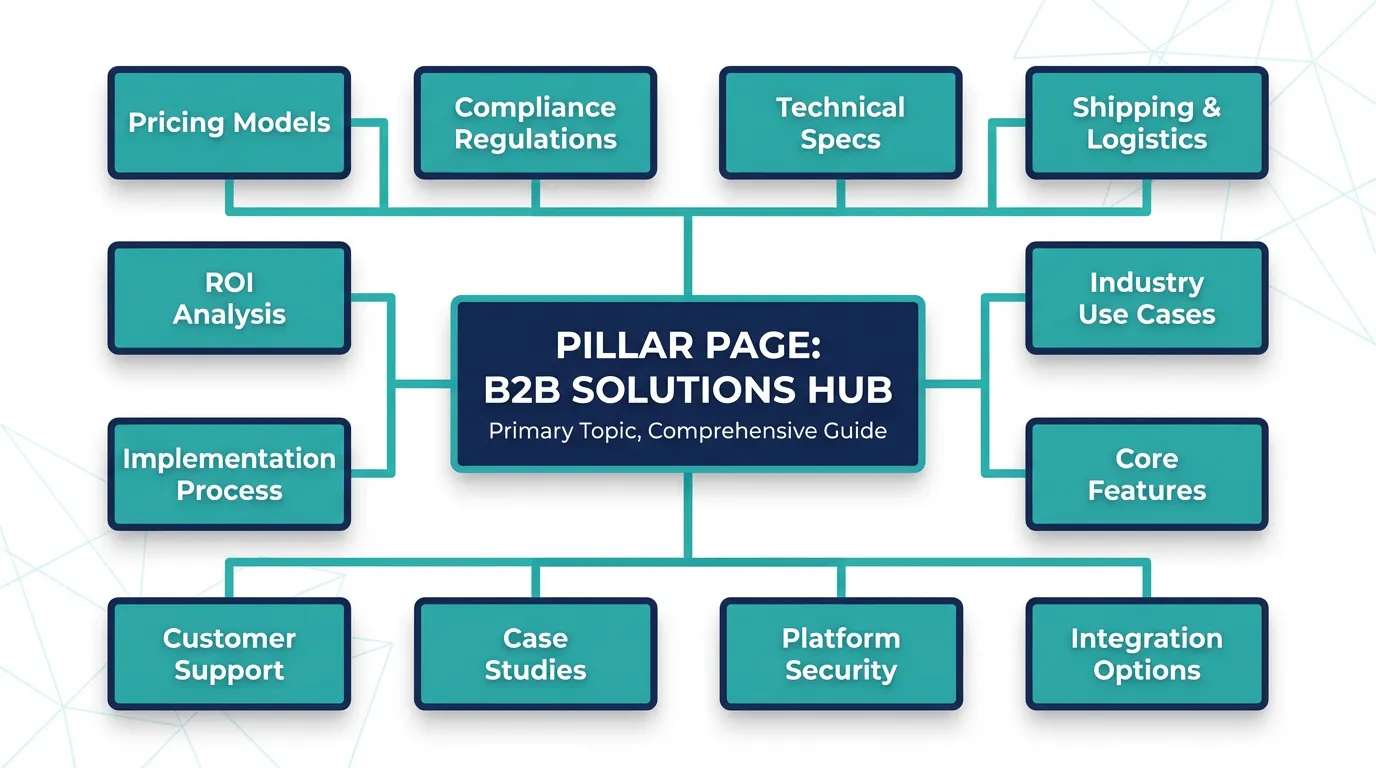
- Topic cluster SEO: Implement semantic SEO on your site with pillar pages and clusters, connected by intentional internal linking. This is one of the clearest on-site patterns for building topical authority (cluster planning discussed in topical authority guides like Semrush and Minuttia).
A practical way to remember the relationship:
- Topic cluster SEO is the architecture.
- Semantic SEO is the writing and on-page structure.
- Entity SEO is the machine-readable identity layer that helps search engines attribute your expertise to the right organization and offerings.
How to build topical authority: a step-by-step roadmap for B2B teams
This is the execution sequence that tends to work best for independent company sites and exporter websites, because it prevents wasted content and prioritizes what actually drives growth.
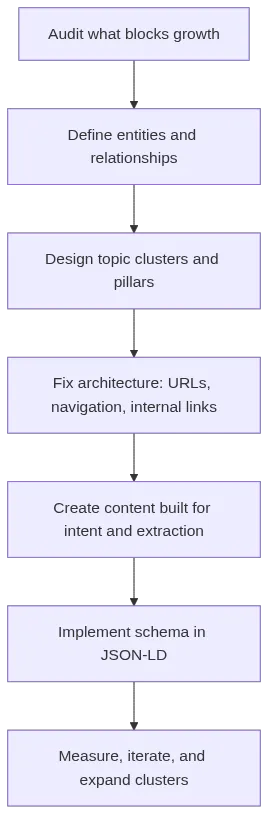
1) Start with an audit, not a content calendar
If Google cannot reliably crawl, render, and index your important pages, publishing more content can be like adding books to a library that has no catalog.
Your first pass should verify (at minimum):
- crawlability and indexing paths (robots.txt and sitemap.xml hygiene),
- internal linking gaps and orphan pages,
- Core Web Vitals and performance bottlenecks (reference: web.dev on Core Web Vitals),
- JavaScript rendering risks (especially if key content is client-rendered),
- multilingual indexing issues and hreflang correctness (see Google guidance: localized versions).
SeekLab.io's approach here is intentionally not "fix everything." The point is to identify what truly impacts growth, what can be deprioritized, and what you should not waste months producing content on.
2) Build an entity inventory (simple, but powerful)
Before you outline pillars, list the entities your business needs to be associated with.
| Entity type | Examples (B2B/exporter) | What to standardize | Where it should appear |
|---|---|---|---|
| Organization | Your company | exact brand name, description, locations (APAC, US, Europe) | About, footer, contact, schema |
| Product lines | SKU families, flagship products | names, attributes, identifiers | product pages, Product schema |
| Services | OEM, customization, logistics support | scope, deliverables, regions | service pages, Service schema |
| Industries | automotive, industrial components | who it is for, constraints | pillar pages, case studies |
| Standards/concepts | Incoterms, compliance topics | definitions, relationships | guides, FAQs, glossary |
This becomes the "source of truth" that prevents inconsistent naming and weak machine understanding.
3) Design pillars and clusters around buyer problems (not just volume)
For B2B, the highest-converting content often maps to commercial questions, constraints, and evaluation criteria.
A realistic cluster example (one pillar, 10 to 20 clusters):
- Pillar: "Export compliance and documentation"
- Clusters: incoterms overview, document checklists, region-specific requirements, common customs delays, packaging and labeling, insurance basics, etc.
The goal is breadth and depth, interlinked so search engines can infer comprehensive coverage (topical authority definitions: Wix topical authority primer, Semrush guide).
International SEO: where topical authority often breaks (and how to prevent it)
If you operate across Singapore, Shanghai, Dubai, and broader APAC, US, and European markets, your content strategy must be built on international SEO fundamentals. Otherwise, authority gets split across duplicates or mis-targeted pages.
URL and language structure
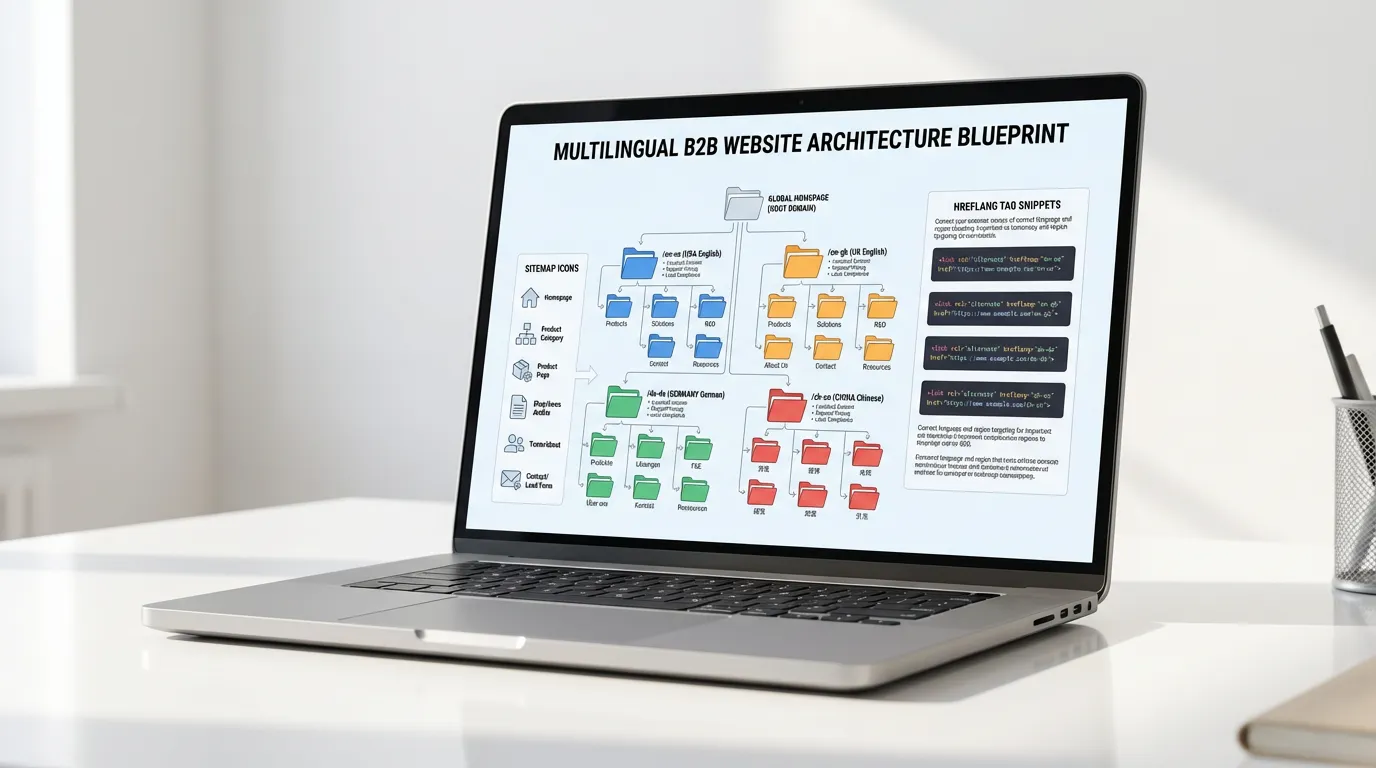
For many B2B sites, language and region subdirectories are the cleanest to maintain (example patterns are supported in Google documentation: multi-regional and multilingual sites).
You want consistency like:
/en-us/for US-focused English/en-gb/for UK-focused English/de-de/for Germany/zh-cn/for Simplified Chinese
hreflang SEO: treat it as a trust signal
hreflang tells Google which equivalent page to show in each locale. The basics (and common errors to avoid) are documented by Google in its hreflang guidance.
Operationally, what breaks most often:
- hreflang pointing to non-equivalent pages,
- missing bidirectional references,
- mixing language and region codes incorrectly,
- "translated" pages that are actually different offers (which should not be treated as equivalents).
Performance is not optional for authority
Exporters often have image-heavy catalogs. If product and content pages are slow or unstable, engagement suffers, and authority-building becomes harder. Core Web Vitals are a practical baseline for this work (reference: web.dev vitals).
Measurement, pitfalls, and a practical B2B scorecard
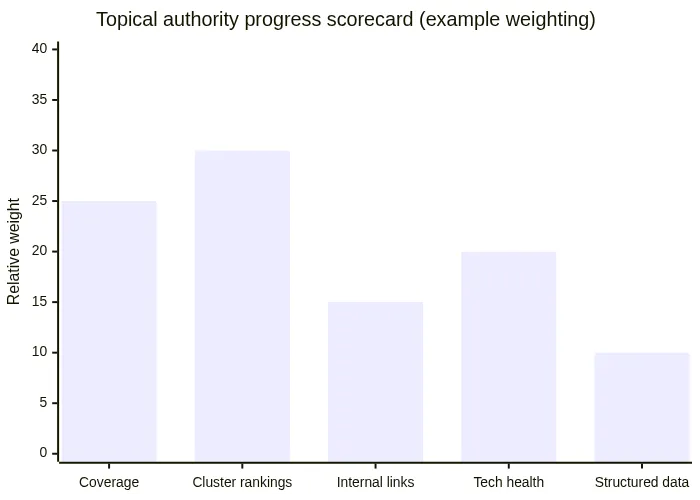
Topical authority is not a single metric. It is a pattern of signals across coverage, rankings, internal structure, technical health, and (increasingly) how well content is structured for answer extraction (discussed in AI search-oriented topical authority resources like topical authority measurement discussions such as Growth Memo).
Common pitfalls to avoid
Based on widely-cited topical authority and structured data guidance:
- Publishing more content without a cluster plan can dilute relevance and create overlap (topic planning caution: Minuttia).
- Adding structured data that does not match visible page content can reduce trust in markup (structured data policies: Google Search Central).
- Ignoring crawlability, JavaScript rendering, or multilingual equivalence means pillar and cluster pages may never consolidate authority.
A pragmatic 90-day plan (what to do first)
| Week | Focus | Output you can verify |
|---|---|---|
| 1 to 2 | Full-site crawling, indexing review, internal linking map | prioritized issue list, quick wins, what to deprioritize |
| 3 to 4 | Entity inventory + topic map | pillar candidates, cluster list, localization plan |
| 5 to 8 | Fix architecture and technical blockers | improved crawl paths, sitemap and robots validation, hreflang corrections |
| 9 to 12 | Publish one pillar + 3 to 6 clusters + schema baseline | internal link loops live, Organization and Article schema validated |
How SeekLab.io supports B2B teams (without overpromising)
SeekLab.io is built for marketing and operations managers, plus independent developers, who want SEO that is measurable and tied to business outcomes, not vague activity.
What you get in practice:
- comprehensive website SEO audits (crawling, indexing, rendering, JavaScript compatibility),
- Core Web Vitals and performance diagnostics,
- internal link equity and semantic structure analysis,
- schema compliance and enhancement aligned with Google documentation,
- content topic selection based on intent and real business scenarios,
- clear action plans and technical guidance, with monthly performance reviews.
If you want to build topical authority with an entity-led strategy and avoid heading in the wrong direction, start with a diagnostic baseline.
Get a free audit report, contact us, and leave your website domain.