SEO Audit Checklist 2026: A Step-by-Step Website Audit Guide
Expert reviewed

An SEO audit checklist for 2026 should help you review crawlability, indexation, Core Web Vitals, internal linking, content quality, schema, and analytics. This step-by-step guide shows how to audit any website properly and prioritize the fixes that matter most.
Whether you run a B2B site, SaaS website, ecommerce store, or multilingual company site, this checklist helps you identify what to fix first and what to deprioritize.
Use the quick checklist below if you want a fast review, then work through the full 10-step audit.
| Area | What to Check | Status |
|---|---|---|
| Crawlability | Important pages are crawlable and not blocked in robots.txt | ☐ |
| Indexation | Key pages are indexed and canonicalized correctly | ☐ |
| Core Web Vitals | LCP, INP, CLS are acceptable on core templates | ☐ |
| Internal Links | No orphan pages, key pages within 3 clicks | ☐ |
| On-Page SEO | Unique title, H1, meta description, headings | ☐ |
| Content Quality | Matches search intent and adds original value | ☐ |
| Schema | Article, Organization, FAQ, Breadcrumb as needed | ☐ |
| JavaScript SEO | Important content renders in HTML | ☐ |
| International SEO | hreflang and language targeting are valid | ☐ |
| Analytics | GA4 and GSC track organic performance correctly | ☐ |
What an SEO Audit Really Is in 2026
An SEO audit in 2026 is a structured, data-driven review of your entire website across:
- Technical SEO (crawlability, indexation, Core Web Vitals, JavaScript)
- Content and on-page optimization
- Information architecture and internal linking
- Schema and entities
- Off-page authority
- International and multi-language setup
- Reporting, KPIs, and decision-making
Three closely related concepts:
- SEO audit: The full diagnostic process across all dimensions.
- SEO audit checklist: The step-by-step list of what to review so nothing critical is missed.
- SEO audit report: The documented outcome of the audit, including findings, priorities, and next steps.
For SeekLab.io, the SEO audit is not a random to-do list. It is a strategic decision tool that helps you:
- Understand which issues actually block qualified traffic and leads.
- Decide what to fix now, what to schedule, and what to ignore.
- Align technical, content, and international SEO work with business goals.
SeekLab.io's audits are built for teams across the Asia-Pacific region, the US, and Europe, with specialists in Singapore, Shanghai, and a business development team in Dubai. The focus is simple:
- We do not try to fix everything.
- We identify what truly impacts growth and what can be deprioritized.
- We provide clear, actionable solutions and technical guidance—not just diagnostics.
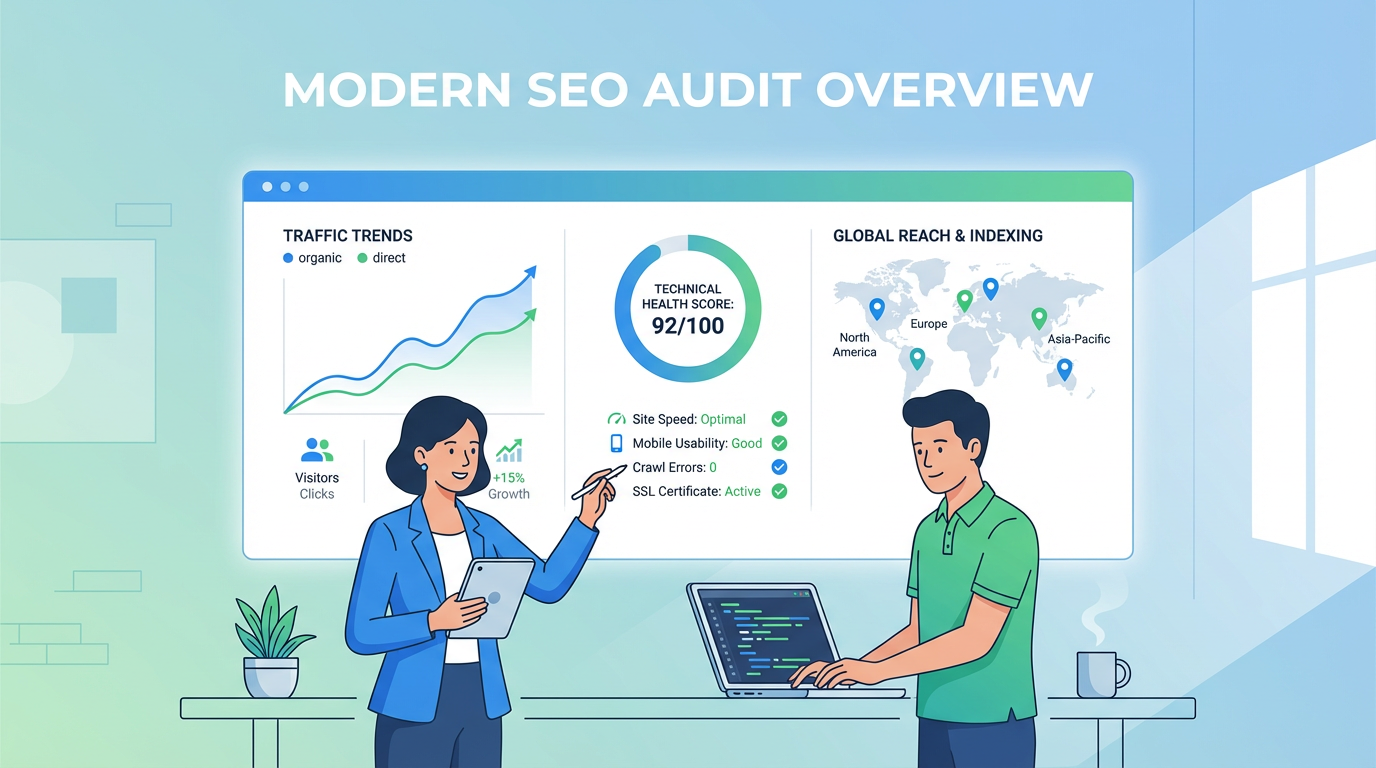
If you prefer expert eyes on your site, you can leave your website domain for a free initial SEO health check from SeekLab.io and see your top issues summarized in a concise SEO audit report.
SEO Audit Checklist 2026: 10 Steps to Audit Your Website
Use this SEO audit checklist as your roadmap. You can work through it internally, or use it to evaluate how thorough an external audit really is.
Phase 1 – Discovery & Goal Setting
What to clarify
- Primary products/services and target segments.
- Priority markets (for example, US, Singapore, Germany, UAE).
- Primary conversion actions (leads, demo requests, RFQs, downloads).
Why it matters
Without clear business goals, the audit easily becomes a technical exercise that does not move revenue. Every recommendation should map back to specific markets and conversions.
Phase 2 – Site Crawling & Indexability
What to check
- Run a full-site crawl to find:
- Broken links, redirect chains, soft 404s.
- Duplicate titles and meta descriptions.
- Parameter-heavy or duplicate URLs.
- Compare crawl results with indexed pages in Google Search Console.
- Review robots.txt and XML sitemaps to ensure:
- Important sections are crawlable.
- Sitemaps contain only canonical, 200-status URLs.
Why it matters
If critical pages cannot be crawled or indexed, no amount of content or link building will help. SeekLab.io places this at the top of every SEO audit checklist and includes detailed sitemap.xml and robots.txt validation.
Phase 3 – Technical Performance & Core Web Vitals
What to check
- Core Web Vitals (Largest Contentful Paint, Interaction to Next Paint, Cumulative Layout Shift) for key templates:
- Home
- Category/collection
- Product/service
- Blog/article
- Mobile friendliness and responsive layout on different devices.
- Server performance:
- Time to first byte in target regions.
- HTTPS coverage and mixed-content issues.
Why it matters
Slow, unstable pages hurt both rankings and conversion rates. SeekLab.io provides in-depth Core Web Vitals diagnostics and a clear, developer-ready list of actions (image optimization, script deferral, caching improvements) prioritized by impact.
Phase 4 – Site Architecture & Internal Linking
What to check
- URL structure:
- Short, descriptive slugs.
- Consistent patterns for languages/regions (for example, /en/, /de/).
- Avoid unnecessarily deep nesting.
- Internal linking:
- Click depth to key pages (should be within three clicks from the homepage).
- Orphan pages with no internal links.
- Contextual internal links to important service, product, and contact pages.
Why it matters
Strong site architecture and internal linking concentrate link equity on the pages that generate leads, rather than scattering it across low-value URLs. SeekLab.io audits internal link equity and semantic structure to make sure search engines and users are guided to your most important content.
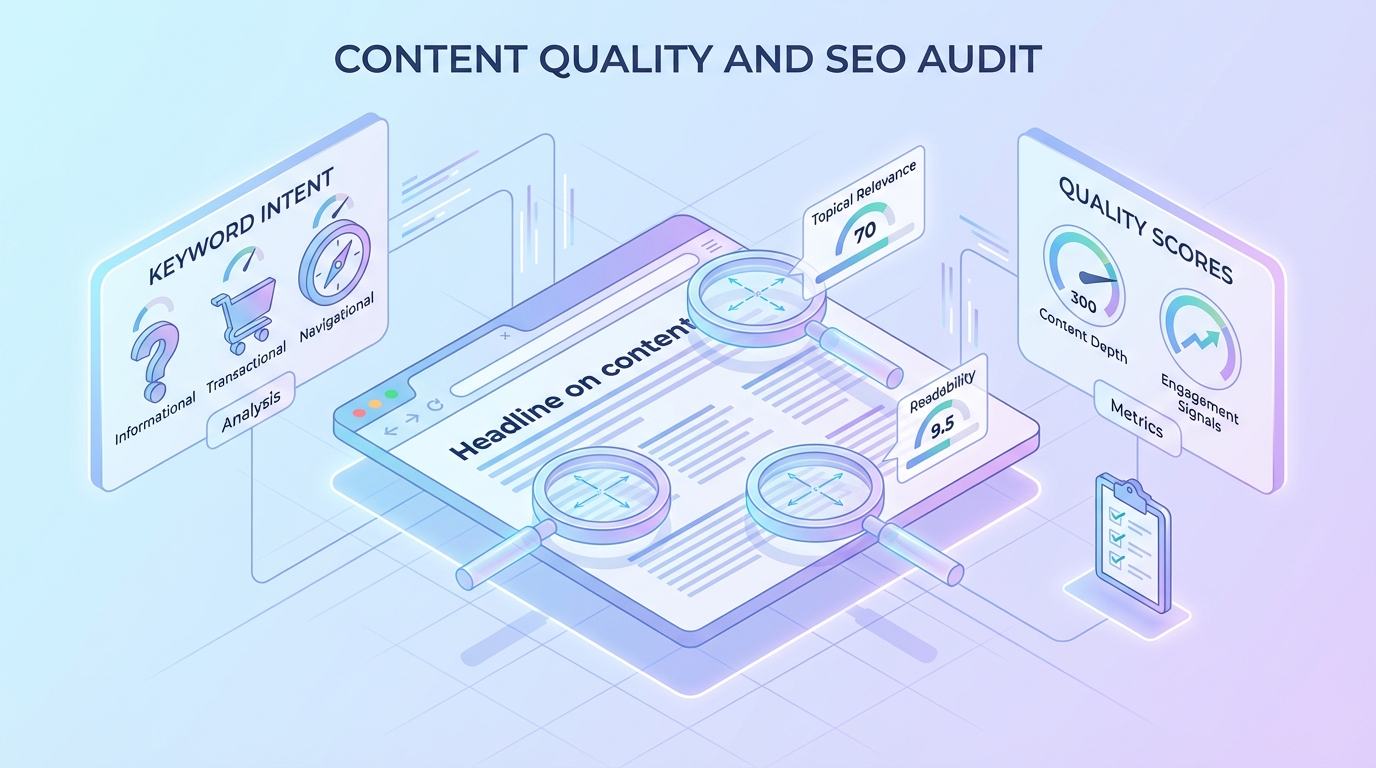
Phase 5 – On-Page SEO & Content Quality
What to check
- Titles, meta descriptions, and headings:
- No missing or duplicate titles.
- Clear, non-spammy use of target keywords.
- Logical H1–H3 structure that reflects user intent.
- Content depth and originality:
- Does each page fully answer the searcher's question?
- Does it use real industry scenarios, data, or examples?
- Does it avoid the repetitive, "machine-like" tone common in low-quality AI content?
- Content cannibalization:
- Multiple weak pages targeting the same topic.
- Image usage:
- Helpful, on-brand visuals, not just stock photos.
- Optimized file sizes and descriptive alt text.
Why it matters
Many teams publish more and more content, yet leads stay flat because the content does not match search intent or feels generic. SeekLab.io specializes in turning audit findings into in-depth, industry-tuned articles with high-quality images that meet both EEAT and conversion goals.
Phase 6 – Schema Markup & Entities
What to check
- Current schema types (Organization, Article, Product, FAQ, Breadcrumb, LocalBusiness, etc.).
- Validation errors or warnings in structured data testing tools.
- Consistency of key entities (brand, products, locations) across pages and languages.
Why it matters
Schema helps search engines understand who you are, what you sell, and which content answers which questions. It is also essential for rich results and modern answer-style experiences. SeekLab.io includes schema data compliance and enhancement in every full audit.
Phase 7 – JavaScript SEO & Rendering
What to check
- Rendered HTML vs original HTML for JS-heavy pages:
- Is core content visible in the rendered version?
- Are key internal links exposed early in the DOM?
- Whether critical content is blocked by scripts or late-loading components.
Why it matters
If your site relies on modern JavaScript frameworks, it is easy to ship pages that look fine to users but are invisible or incomplete to search engines. SeekLab.io performs indexing, crawling, rendering, and JavaScript compatibility checks and provides concrete implementation suggestions.
Phase 8 – International SEO & Hreflang
What to check
- Language and region architecture:
- Clear URL patterns for each language/market.
- Locally relevant content rather than simple machine translations.
- Hreflang implementation:
- Correct language-region codes.
- Reciprocal references between language variants.
- Alignment with sitemaps.
Why it matters
For exporters and international brands, incorrect hreflang can send the wrong language version into critical markets, or cause duplicate content issues. SeekLab.io specializes in multilingual site architecture and SEO for exporters, explicitly connecting these fixes to better overseas inquiries.
Phase 9 – Off-Page SEO & Authority
What to check
- Backlink profile:
- Number and quality of referring domains.
- Topical relevance and anchor text distribution.
- Potentially toxic or spammy links.
- Brand mentions:
- Unlinked mentions that could be turned into relationships or links.
Why it matters
Even with perfect technical and content work, you still need authority in your niche. A modern audit highlights where digital PR, partnerships, or content assets can earn the right kind of attention.
Phase 10 – Analytics, KPIs & Reporting
What to check
- Baseline KPIs:
- Non-branded organic traffic.
- Organic leads, RFQs, demo requests by market.
- Performance of key landing pages.
- Tracking and attribution:
- Correct GA4 event setup for core actions.
- Search Console filters by country and query group.
- Prioritization:
- Group issues into P1 (must-fix), P2 (high impact), P3 (nice-to-have).
Why it matters
Without clear measurement and prioritization, even the best SEO audit report becomes shelfware. SeekLab.io always connects findings to business KPIs and sets a realistic sequence of changes, with monthly data review and performance reports.
A simple summary table you can adapt for your own audit:
| Phase | Main Focus | Primary Outcome |
|---|---|---|
| 1 | Goals & markets | SEO aligned with real business targets |
| 2 | Crawl & indexability | All critical pages discoverable |
| 3 | Core Web Vitals & performance | Faster, more stable user experience |
| 4 | Architecture & internal linking | Authority focused on high-value URLs |
| 5 | On-page SEO & content quality | Pages that actually answer and convert |
| 6 | Schema & entities | Clear machine-readable understanding of your site |
| 7 | JavaScript SEO | JS-driven pages fully visible to search engines |
| 8 | International SEO & hreflang | Correct language/market targeting |
| 9 | Off-page authority | Stronger, cleaner backlink profile |
| 10 | KPIs, reporting & roadmap | Action plan for next 30/90/180 days |
To visualize where most impact usually comes from:
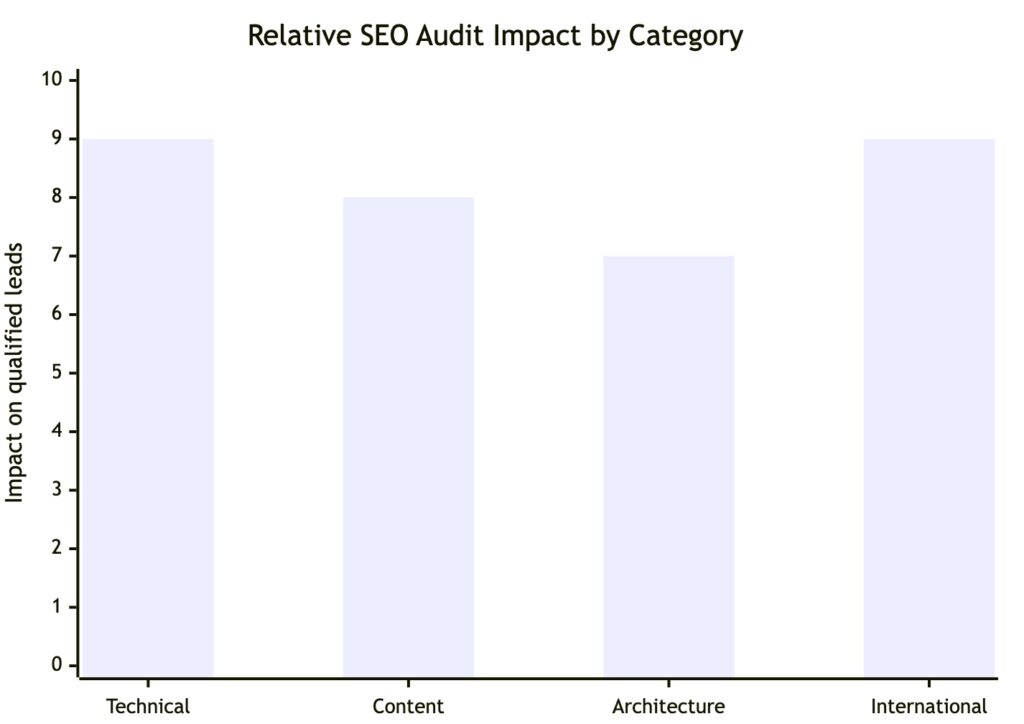
Use this chart to focus your limited resources where they matter most.
If you are short on time, you can share your domain with SeekLab.io and receive a free high-level SEO audit report highlighting the top 5 issues blocking growth.
Turning Your SEO Audit Report into a 90-Day Roadmap
A strong SEO audit report should be understandable for executives, marketers, and developers at the same time.
Key sections to look for
- Executive summary with top 5–10 issues and expected impact on leads.
- Baseline KPIs (by country, page type, and branded vs non-branded queries).
- Detailed technical findings with:
- Affected URLs
- Severity
- Suggested fixes
- Content and on-page recommendations:
- Which pages to rewrite, consolidate, or expand.
- New content opportunities directly tied to search intent.
- International SEO and hreflang status for each market.
- Clear 30/90/180-day plan.
A simple prioritization framework:
| Priority | Description | Examples |
|---|---|---|
| P1 | Must-fix immediately | Indexation errors on key pages, broken hreflang, major Core Web Vitals issues |
| P2 | High-value, scheduled improvements | Content consolidation, schema rollout, internal link upgrades |
| P3 | Nice-to-have / experimental | Minor template refinements, long-tail content ideas |
SeekLab.io’s philosophy is to keep your roadmap focused. Low-impact issues go into a backlog so your teams are not overwhelmed. In addition:
- If the minimum expected results are not achieved, there is no charge.
- Some simple technical issues can be fixed for clients free of charge during the audit phase.
- Monthly reviews help you track how resolved issues translate into visibility and inquiries.
From Audit to Content Strategy and International Growth
An SEO audit should not stop at "what’s broken". It should guide what to create next.
How to use the audit to drive content strategy
- Choose the right topics, not just keywords
- Use query and landing-page data to identify:
- High-intent topics (for example, "B2B manufacturer in [country]", "exporter shipping terms").
- Countries where you get impressions but few inquiries.
- Plan topic clusters around your real services and export scenarios.
- Use query and landing-page data to identify:
- Create SEO content briefs before writingFor each priority topic, define:
- Target queries and intent.Core questions to answer (from SERP and customer inquiries).Required visuals (process diagrams, tables, international workflows).Internal links to relevant country, product, and contact pages.Basic JSON-LD schema requirements (Article, FAQ, Product, etc.).
- Align international content with real markets
- Localize examples, pricing models, and shipping or compliance details.
- Adjust CTAs for each region (for example, local phone numbers or regional sales teams).
- Make sure hreflang and internal linking support your priority markets.
- Balance rankings with conversionEvery new article or landing page should:
- Match clear search intent.
- Lead users naturally toward a next step:
- "Request a quote"
- "Talk to our team"
- "Download a detailed specification"
SeekLab.io focuses on both sides—traffic growth and lead generation—so that your audit-driven content plan translates into measurable business results.
SEO Audit FAQs for 2026
1. What is an SEO audit?
It is a systematic review of your website’s technical setup, content, authority, and international configuration to identify issues and opportunities that impact organic visibility and leads.
2. Why is an SEO audit important?
It reveals hidden problems—like slow templates, indexing gaps, weak content, or incorrect hreflang—that block the right customers from finding and contacting you.
3. How often should I run an SEO audit?
Most sites benefit from a light check each quarter and a comprehensive review at least once a year. Always perform an audit after major redesigns, migrations, or international expansions.
4. Can I do an SEO audit myself?
You can cover the basics using tools such as search analytics, speed tests, and crawlers. However, complex technical issues, JavaScript SEO, and international SEO usually require specialist experience and structured guidance.
5. What should be included in an SEO audit checklist?
At minimum: crawlability and indexation, Core Web Vitals and performance, on-page elements, content quality and cannibalization, information architecture and internal linking, schema, JavaScript rendering, international setup, off-page authority, and reporting.
6. What makes a good SEO audit report?
A good SEO audit report is clear, prioritized, and actionable. Executives should understand the business impact in a few pages, while developers and marketers receive concrete, technically accurate tasks and a realistic timeline.
7. How do I get started if I’m overwhelmed?
Begin with discovery and baseline data, then quickly move to crawlability and Core Web Vitals for your main templates. If you want a guided starting point, you can contact SeekLab.io, leave your website domain, and receive a free high-level SEO audit report with your most important next steps.