The Product Page Structure AI Shopping Assistants Actually Read
Expert reviewed

A strong product page structure for AI shopping assistants does not depend on a hidden markup trick. It depends on one clear, crawlable product record that explains the exact item, selected variant, price, availability, specifications, delivery terms, and return conditions without forcing a system or buyer to guess.
This case-study-style breakdown examines a practical ecommerce product-page template through the lens of machine readability and buyer decision-making. You will see what belongs in visible HTML, structured data, feeds, internal links, and technical delivery, plus the failure patterns that should be fixed before a team spends time expanding product descriptions.
The central rule is simple: keep the same product facts aligned across the page, JSON-LD, product feed, and merchant settings. If the page says a fragrance-free 30 ml serum is in stock for $34, but the schema or feed identifies a different variant, the problem is not a lack of content. It is conflicting product data.
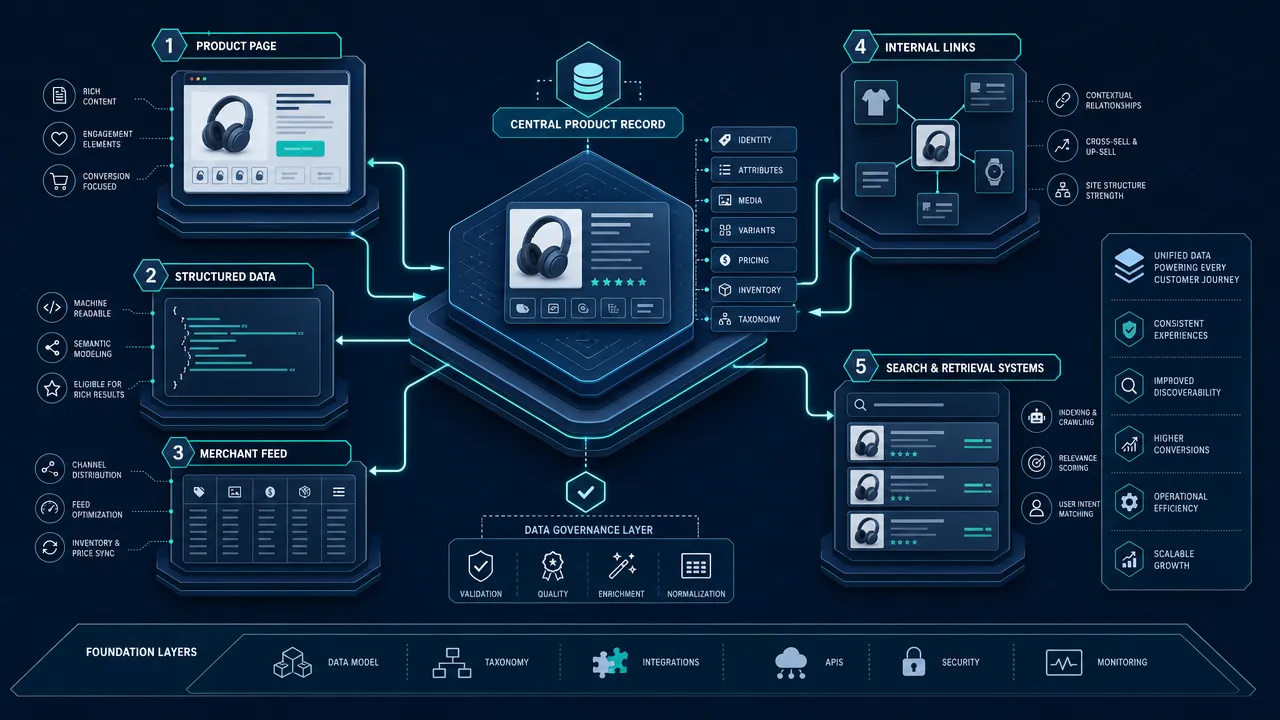
Product page structure for AI shopping assistants starts with a single source of truth
AI shopping assistants use proprietary retrieval and recommendation methods, so no public specification can guarantee compatibility with every shopping experience. What is documented is how search engines and merchant systems discover, crawl, render, and interpret ecommerce information. That documented foundation is where independent stores should invest.
A useful working model is that a shopping interface may retrieve information from crawled product pages, search indexes, structured data, merchant feeds, or platform records. The exact mix differs by platform. The practical requirement does not: each purchasable product or variant needs an unambiguous record.
For an apparel store, "Linen Shirt" is not enough. A usable product record distinguishes the brand, cut, fabric composition, color, regional size, selected size, current price, stock status, and delivery market. For electronics, it should distinguish the exact model number, plug type, compatible devices, included accessories, warranty, and regional availability.
| Product fact | What a buyer needs | What a system needs |
|---|---|---|
| Product identity | What is this exact item? | Name, brand, model, SKU, GTIN, or MPN |
| Variant state | Which size, color, capacity, or bundle is selected? | Variant-level identifier, image, price, and availability |
| Offer data | What does it cost and can I buy it? | Price, currency, stock, seller, sale dates |
| Product evidence | Will it meet my requirements? | Specifications, materials, compatibility, dimensions, package contents |
| Purchase risk | What happens after checkout? | Shipping, returns, warranty, and support terms |
| Technical access | Can the page be found and processed? | Crawlable links, canonical URL, rendered HTML, accessible resources |
Google's ecommerce SEO guidance supports this layered approach. It addresses product data, site navigation, URL management, and technical delivery rather than treating schema as a stand-alone solution.
The operational lesson is to identify the product-data owner. On many stores, merchandising controls page copy, developers control JSON-LD, and operations controls feeds. That separation creates drift after a price change, inventory update, or new variant launch. A source of truth in a PIM, ERP, CMS, or commerce platform reduces that risk, but only if each output is tested.
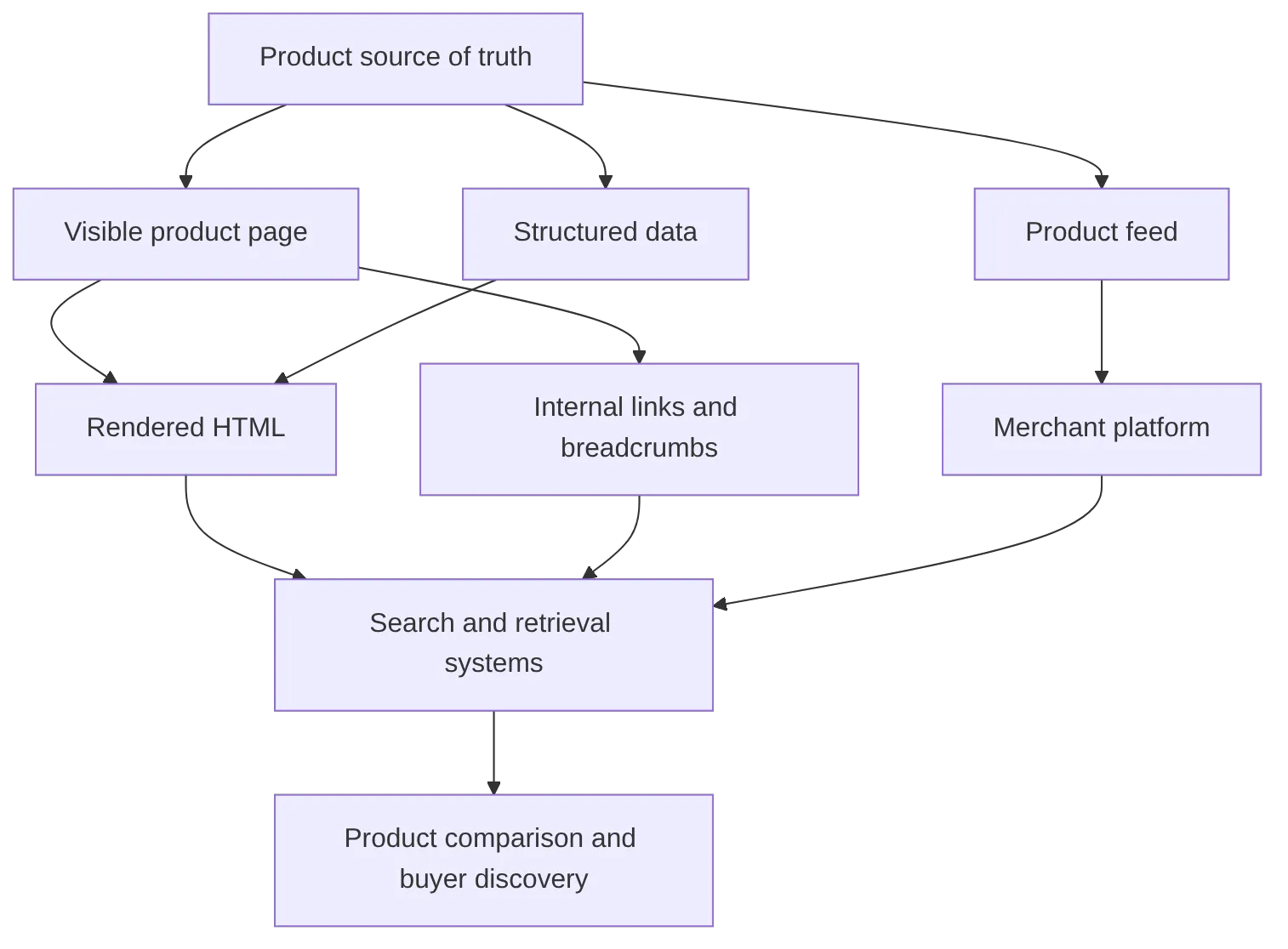
This is why structured product content should be governed as a system. A polished product description cannot compensate for a page that is blocked from crawling, rendered incompletely, or inconsistent with the feed.
Product page structure for AI shopping assistants must make identity and offers explicit
The first section of a product page should establish what the item is and what a buyer can purchase now. This is where generic catalog templates often fail.
A product title such as "Hydrating Serum" leaves important questions unanswered. "Brand X Hydrating Serum, 30 ml, Fragrance-Free" gives a clearer product type, brand, size, and differentiating attribute. The same principle applies to a B2B component page: "Stainless Steel Ball Valve, 2 Inch, 316 Grade, NPT Thread" is more useful than "Industrial Valve."
Use the fields supported by Schema.org Product and Schema.org Offer where they reflect real page content. Relevant product identifiers include SKU, GTIN, MPN, model number, and brand. Relevant offer facts include price, currency, availability, condition, seller, and sale validity where applicable.
A practical above-the-fold pattern looks like this:
| Page section | Include | Common failure |
|---|---|---|
| Product identity | Product name, brand, model, selected variant, SKU where useful | Generic product title with no differentiating attributes |
| Offer block | Current price, currency, availability, selected option | Showing "from $49" while the selected option costs $79 |
| Variant selector | Clear color, size, material, or configuration choices | Visual swatches that do not state the selected option in text |
| Trust summary | Delivery, returns, warranty, support route | Hiding decision-critical policy details until checkout |
| Primary evidence | Main image, key benefit summary, essential product facts | Making buyers scroll through promotional copy before finding specifications |
For product page optimization, the selected variant is especially important. A parent product can have several colors, sizes, capacities, or bundles, but a shopper is considering one actual offer. The selected option should update the visible price, stock state, image, SKU, and, where relevant, the structured data and feed entry.
Google's guidance on product variant structured data reflects this distinction between a product family and a purchasable variant. The implementation method depends on the ecommerce stack, but the commercial logic is consistent: do not present one vague offer for many materially different options.
Consider these two approaches:
| Weak variant presentation | Better variant presentation |
|---|---|
| "Available in multiple colors" | "Selected: Forest Green, 500 ml, in stock" |
| "From $49" | "Forest Green, 500 ml: $59, available now" |
| One universal product image | Variant-specific hero image and labeled gallery |
| Parent SKU only | Variant SKU, GTIN, or MPN where available |
| Stock appears after a script event | Stock state is present in tested rendered HTML |
The better version does more than support shopping assistant compatibility. It reduces mistaken orders, customer-service tickets, and returns caused by unclear options.
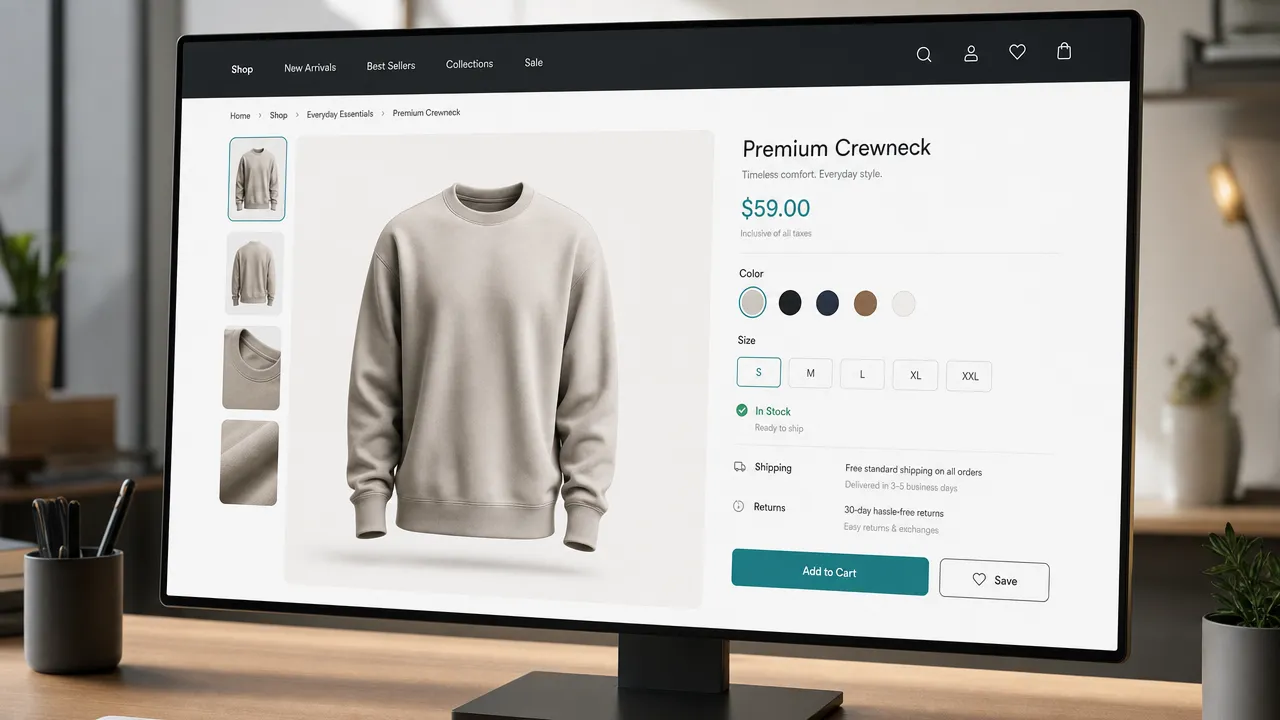
Product page structure for AI shopping assistants needs visible comparison content
Schema helps label facts, but visible content remains essential. Google's structured data guidelines state that markup should represent content available to users. Marking up a shipping promise, review rating, or product claim that is absent from the page is not a shortcut. It creates conflicting evidence.
The most useful AI-readable product pages make comparison facts easy to find in normal HTML. That usually means a concise summary near the purchase action and a deeper specification section lower on the page.
For a skincare product, comparison content could include skin type, active ingredients, fragrance status, volume, use frequency, refill status, and product exclusions. For a technical product, it may include voltage, dimensions, certification, compatibility, operating conditions, installation requirements, and package contents.
Use a labeled table when the product has measurable or comparable attributes:
| Specification | Example value | Why it matters |
|---|---|---|
| Material | 316 stainless steel | Helps buyers assess durability and suitability |
| Dimensions | 120 mm x 65 mm x 40 mm | Prevents fitment and installation uncertainty |
| Compatibility | Fits Model A, B, and C only | Reduces incorrect purchases |
| Included in box | Device, cable, mounting kit | Clarifies the actual offer |
| Warranty | Two-year limited warranty | Addresses post-purchase risk |
| Return window | 30 days, unopened items excluded | Makes purchase conditions visible |
This content should not be buried only in product images, downloadable PDFs, tab interfaces that require a click to load, or checkout flows. Supporting documents are valuable, but the core decision facts should be present on the product page itself.
Media also needs context. A gallery can show texture, scale, packaging, fit, or installation, but an image cannot reliably replace a written specification. Use descriptive alt text for informative images, and add nearby captions where the image demonstrates a technical detail, compatibility scenario, or specific variant.
The same applies to trust information. A concise shipping, returns, and warranty summary close to the purchase action gives buyers a realistic view of the total offer. Full policy pages should remain available for legal detail, but a product page should not make a buyer hunt through a footer to learn whether returns are possible.
For related implementation ideas, see SeekLab.io's guidance on advanced product page SEO, particularly where content quality, visual evidence, and conversion support need to work together.
Product page structure for AI shopping assistants depends on schema, links, and rendering
A reliable product page structure has three supporting technical layers: semantic HTML, structured data, and crawlable site architecture. Each has a different job.
Semantic HTML helps define page hierarchy. A page should have one clear H1, logical section headings, real lists for features, properly labeled specification tables, and accessible controls. This makes the page easier to scan for people and easier to interpret for systems processing the rendered content.
Structured data provides explicit labels for product and offer facts. Google documents Product structured data, merchant listing markup, reviews, and related ecommerce features. JSON-LD can support eligibility for supported search features, but it does not guarantee product recommendation, rankings, citations, or inclusion in every AI shopping interface.
Use schema to reinforce visible facts, not invent them. Common checks include:
- Product name, brand, SKU, GTIN, MPN, and image match the visible page.
- Price and currency match the selected offer.
- Availability reflects the actual selected variant.
- Review markup refers to genuine, visible product-specific reviews.
- Shipping and returns information matches merchant and policy data.
- Product and Offer data are not accidentally attached to a category page or unrelated bundle.
Feeds add another layer where a merchant platform uses them. Product titles, identifiers, availability, price, images, and variant attributes should align with the landing page. A feed that updates hourly while the website caches stock for a day will eventually create a mismatch.
Finally, make the page discoverable. Google recommends ordinary <a href> links and descriptive anchor text in its link best practices. Product pages should be reachable through category pages, breadcrumbs, relevant buying guides, and selected related-product modules.
A sound internal-link path could look like this:
Category page
  -> Subcategory page
  -> Product page
  -> Size guide or compatibility guide
  -> Delivery and returns policy
  -> Related products or comparison guide
Avoid script-only navigation, generic "Learn more" links for critical resources, and related-product blocks driven only by excess inventory. A link to "View the full size guide" or "Compare compatible mounting options" gives a clearer destination signal and helps a buyer continue their research.
For larger catalogs, ecommerce site architecture becomes decisive. Faceted filters, sort parameters, color URLs, and currency parameters can create many duplicate URLs if canonical rules and indexation strategy are not planned.
JavaScript is not automatically a problem, but it adds verification work. Google can process rendered JavaScript content, as explained in its JavaScript SEO documentation. The important question is whether a crawler can reliably access the key product facts, links, canonical tag, and schema after rendering.
Test the product-page template, not just one favorable example. Check source HTML, rendered HTML, Rich Results Test output, canonical tags, and feed landing-page data after releases. SeekLab.io's JavaScript rendering and indexing checks are particularly relevant when critical price, stock, or variant content loads client-side.
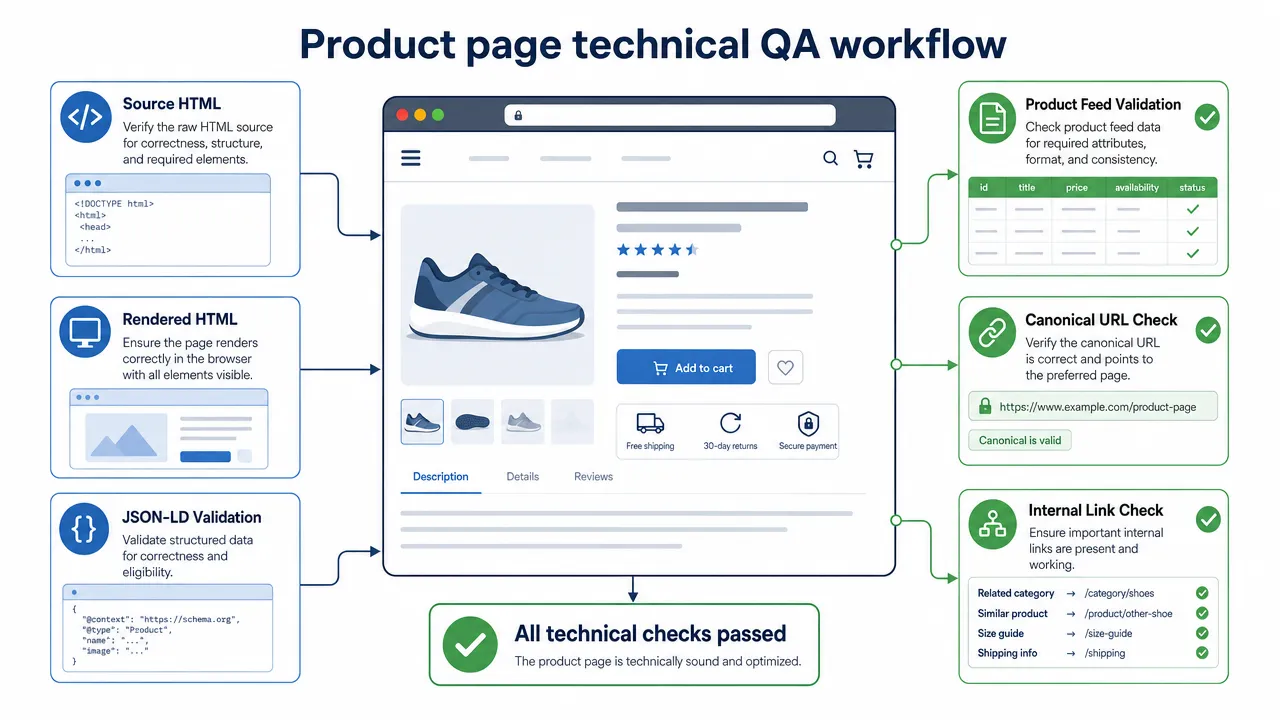
Product page structure for AI shopping assistants should handle international offers carefully
International ecommerce introduces a problem that simple product templates often ignore: one product may not be the same offer in every market.
A US shopper may see a dollar price, domestic delivery timing, and a 30-day return option. A buyer in Europe may need a different currency, tax presentation, delivery term, plug type, sizing convention, compliance statement, or return process. If one URL changes its content by IP address alone, search systems may not reliably see every version.
Google recommends communicating language and regional variations through distinct URLs and appropriate hreflang relationships. Its guidance on localized versions also warns against relying solely on locale-adaptive content.
For cross-border brands, audit these fields market by market:
| Field | What to verify |
|---|---|
| URL | Each genuine market or language version has a stable, crawlable URL |
| Language | Product copy, navigation, and support content match the target locale |
| Currency | Visible price, structured data, and feed use the correct currency |
| Availability | Stock and purchase eligibility reflect that destination market |
| Delivery | Timing, cost, and restrictions match local fulfillment reality |
| Returns | Policy summary and full terms reflect regional conditions |
| Product configuration | Plug type, sizing, compliance, ingredients, or labels are accurate |
| Hreflang | Links connect equivalent canonical and indexable versions |
This is not only an international SEO concern. It prevents the buyer from discovering a product that cannot actually be purchased in their market.
For teams managing multilingual catalogs, multilingual product-page architecture should be reviewed alongside feed rules, inventory logic, and local policy ownership. Translation alone does not solve market-level offer clarity.
Product page structure for AI shopping assistants needs a priority-based audit
Not every issue deserves equal effort. A specification table is useful, but it should not be the first task if product pages are orphaned, stock data is wrong, or essential content fails to render.
Use this order to prioritize ecommerce product page SEO work:
| Priority | Fix first | Why it takes precedence |
|---|---|---|
| P1 | Crawlability, indexability, rendered HTML, canonicals, crawlable links | No product information can help if the page is inaccessible or duplicated |
| P1 | Product identity, variant data, price, currency, stock, feed alignment | Contradictory offers create the most serious interpretation and buyer problems |
| P2 | Specifications, compatibility, package contents, usage details | These make products easier to compare without guessing |
| P2 | Product and Offer JSON-LD validation | Supports clearer machine-readable labeling when it matches visible facts |
| P2 | Shipping and returns summaries | Reduces buyer risk and supports offer clarity |
| P3 | Better media, comparison modules, guides, product Q&A | Improves decision support after the fundamentals are stable |
| P4 | Automated checks across markets, catalogs, and variants | Becomes essential as complexity and catalog size increase |
A useful audit question is: "Can a buyer and a retrieval system identify the exact purchasable item, understand the current offer, compare it against constraints, and reach supporting information without guessing?"
If the answer is no, do not start by adding generic FAQs or rewriting every description. Fix the information gap behind the question.
SeekLab.io helps brands improve search visibility and AI-era discoverability by diagnosing the issues that actually limit growth across content, technical SEO, page architecture, internal linking, rendering, schema, and international site structure. The goal is not to generate a long list of tasks. It is to identify what should be fixed now, what can wait, and what will not materially improve performance.
FAQ: product page structure for AI shopping assistants
What's the single most important fix for AI shopping assistant visibility?
Consistency between the visible page, the structured data, and the product feed. A page can have great copy and still fail if the price, variant, or stock state shown to a shopper doesn't match what's in the schema or feed. Fix the data alignment before investing in more content.
Does adding Product schema guarantee my products get recommended?
No. Schema labels facts that already exist on the page; it doesn't invent them and doesn't guarantee inclusion in any specific AI shopping interface. If the visible content is thin or the feed is out of sync, schema can't compensate.
Do I need to rewrite every product description to fix this?
Usually not first. Start with access and data integrity: is the page crawlable, indexable, and rendering correctly, and do the price/variant/stock facts match across the page, schema, and feed? Content depth matters, but it's a P2 fix behind those fundamentals.
How should I handle products sold in multiple countries?
Each real market or language version needs its own stable, crawlable URL with correct hreflang relationships, not one URL that silently swaps currency or delivery terms based on IP address. Search systems may not reliably see every version if the differences aren't expressed as distinct, linked URLs.
What's the fastest way to check if my product pages have this problem?
Compare the source HTML, the rendered HTML, the JSON-LD, and the feed entry for a handful of real product pages, especially ones with multiple variants. If any of those four disagree on price, stock, or which variant is selected, that's the gap to close first.
Get a free audit report to identify whether product-data conflicts, JavaScript rendering, duplicate URLs, weak internal links, or thin product information are limiting your catalog. You can also contact SeekLab.io for a practical remediation plan built around your site, catalog, and target markets.