Uber drivers are demanding dignity from AI systems
Expert reviewed

The gig economy revolt points to a broader problem with algorithmic management: when systems optimize for margin and throughput without giving workers any real visibility, appeal path, or bargaining power, conflict becomes predictable. In this article, you will get a practical breakdown of what the February 2026 Uber driver strikes actually signaled, how labor AI and human-AI coordination are shaping platform work, and what independent brands can learn before they repeat the same mistakes in their own automation and SEO operations.
More specifically, this piece covers five things: what happened in the 2026 strike wave, why the phrase gig economy revolt matters beyond slogans, where algorithmic management breaks down in real work settings, how economic dignity should reshape human-AI coordination, and what website owners can do now to build fairer, more legible systems. If your team depends on opaque platforms for traffic, leads, or labor, the warning is closer to home than it looks.
1. Why the gig economy revolt became a serious signal about algorithmic management
In February 2026, Uber-related protests, app log-offs, and strike actions across markets such as India and the UK were widely discussed as a gig economy revolt. The headline demand that spread across online worker communities was a symbolic one: a $30 minimum fare. That number was not a formal global settlement point. It functioned more as a line in the sand against opaque algorithmic management and shrinking take-home pay.
The strongest evidence in the research report is not that one single synchronized global strike happened in a formal sense, but that workers in multiple markets were reacting to the same pattern. Pay felt harder to predict. Platform rules seemed to change without negotiation. Ratings and deactivation risk remained persistent threats. Reddit discussions amplified this into a shared narrative of economic dignity, even when local demands differed.
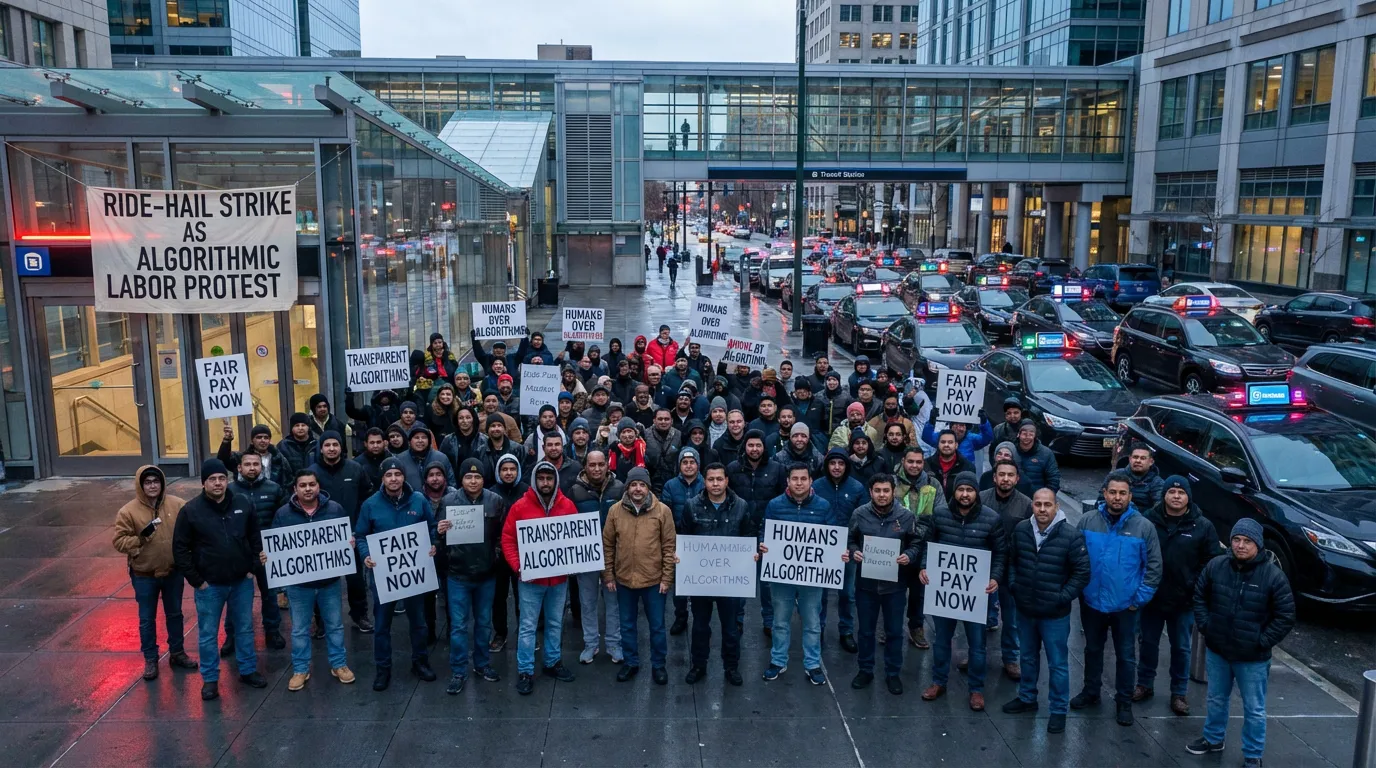
What made this gig economy revolt significant was not just the labor action itself. It was the public framing. Drivers were not only saying "pay us more." They were saying the system managing their livelihood had become unanswerable. That is a different kind of complaint. Once workers start treating the algorithm as the real manager, the conversation shifts from pricing policy to governance.
For marketers and operators, that distinction matters. If your website depends on ranking systems, recommendation engines, or automated internal workflows, you already live with a softer version of the same power imbalance. You may not call it labor AI, but you are still dealing with a system that affects visibility, revenue, and recourse.
Quick view of the 2026 gig economy revolt
| Element | What the research report supports | Practical meaning |
|---|---|---|
| Main trigger | Pay pressure and opaque fare logic | Workers no longer trusted the optimization model |
| Core complaint | Algorithmic management without visibility | The system acted like a boss without accountability |
| Symbolic demand | $30 minimum fare | A benchmark for economic dignity, not just a wage number |
| Worker fear | Ratings, surveillance, deactivation | High dependence with weak appeal rights |
| Wider implication | Labor AI governs livelihoods | AI design is now a business governance issue |
2. How the gig economy revolt exposed the real costs of labor AI
The term labor AI fits here because these systems do much more than automate dispatch. They allocate work, shape earnings, assess performance, and sometimes trigger discipline. In practice, that means software is performing core management functions.
On ride-hail platforms, this usually includes trip matching, dynamic pricing, performance scoring, fraud detection, and deactivation logic. From the company side, that looks efficient. From the worker side, it often feels like being managed by a system that reveals outcomes but hides reasoning. That is exactly why the gig economy revolt gathered force: the efficiency gains were visible to the platform, while the uncertainty was pushed onto the worker.
A driver can feel this in very ordinary ways. One week, certain trips seem worth taking. The next week, after a pricing tweak no one clearly explains, the same hours produce noticeably worse income. The app still speaks in neutral product language, but the economic effect is managerial. That is where algorithmic management stops sounding abstract.
The research report also highlights a second cost: workers absorb experimentation risk. If a platform changes fare formulas, weighting systems, or dispatch priorities, the downside lands on the people doing the work. This is one reason economic dignity belongs in AI system design. Without it, "optimization" becomes a polite label for shifting volatility downward.
Here is a simple way to understand the trade-off:
| Labor AI function | Benefit to platform | Cost to worker if poorly governed |
|---|---|---|
| Dispatch matching | Faster coordination at scale | Less control over work quality and trip value |
| Dynamic pricing | Margin optimization and supply balancing | Income volatility and distrust |
| Ratings systems | Standardized quality control | Constant psychological pressure |
| Fraud detection | Faster risk filtering | False positives with weak appeals |
| Automated deactivation | Operational speed | Sudden loss of livelihood |
This is where many business readers miss the point. The problem is not that automation exists. The problem is that algorithmic management often centralizes decision power while minimizing explanation. That is not just a labor issue. It is a design issue.
3. What the gig economy revolt teaches about human-AI coordination and economic dignity
The most useful frame is human-AI coordination. Not all AI systems need to play the same role. Some should advise. Some should summarize. Very few should become the manager-of-record for decisions that directly affect income, opportunity, or exclusion.
The gig economy revolt showed what happens when that boundary is ignored. Uber-style platform logic largely places AI in the role of manager, gatekeeper, and evaluator at the same time. That compresses human judgment instead of supporting it. Workers are left interacting with outcomes rather than with decision-makers.
A better model of human-AI coordination separates these roles. AI can process patterns, flag anomalies, and recommend actions. Humans should retain authority where livelihood, penalties, or contested edge cases are involved. If that sounds expensive, consider the alternative: low trust, public backlash, and long-term governance pressure.
Economic dignity is the missing design constraint in many AI deployments. It is not limited to wages. In this context, it means predictable treatment, meaningful recourse, transparent expectations, and enough agency to avoid feeling disposable. Workers can tolerate hard conditions longer than executives expect, but they usually revolt when the system becomes both extractive and unreadable.

A practical comparison helps:
| Human-AI coordination model | How it works | Risk level |
|---|---|---|
| AI as advisor | AI suggests, human decides | Lower |
| AI as gatekeeper | AI filters what humans see | Medium |
| AI as manager-of-record | AI allocates, evaluates, penalizes | High |
| Hybrid with appeals and audit | AI assists, humans review critical outcomes | Better long-term model |
For businesses outside ride-hailing, this still applies. If your company uses AI for lead scoring, partner ranking, editorial prioritization, or contractor evaluation, ask one blunt question: can the affected person understand and challenge the decision? If the answer is no, you may be building a smaller internal version of the same problem.
4. How the gig economy revolt should change SEO and website strategy
The most interesting lesson for SeekLab.io readers is not ideological. It is operational. Platforms that control work and platforms that control visibility are starting to look structurally similar. In both cases, people depend on opaque systems they cannot fully inspect.
An independent website owner experiences this differently than a driver, but the pattern is familiar. One algorithm update changes what gets surfaced. A citation disappears from AI-generated answers. A previously stable page stops attracting qualified traffic. There is little direct recourse, so teams are forced into diagnosis, reverse-engineering, and adaptation.
That is why the right SEO response is not blind output. It is clarity. SeekLab.io helps brands build search visibility and AI-era discoverability through high-quality content production and technical optimization. The value is not just in publishing more pages. It is in making websites easier for search engines, AI systems, and real users to understand through better structure, clearer information architecture, stronger internal linking, and better technical readiness.
This is also why a structured SEO audit checklist for 2026 matters more than generic advice. When a site loses visibility, the expensive mistake is trying to fix everything. The smarter move is to identify which issues actually block growth, what can wait, and what should be deprioritized.
The same goes for internal architecture. If your content is scattered, key pages are buried, or authority does not flow toward commercial pages, you create unnecessary dependence on external algorithms to "figure it out." SeekLab.io's perspective on internal linking SEO best practices for 2026 is useful here because it treats internal links as a business lever, not just site plumbing.
Practical SEO lessons from the gig economy revolt
| Gig economy problem | Website equivalent | Better response |
|---|---|---|
| Opaque dispatch rules | Opaque ranking and citation shifts | Improve technical clarity and entity structure |
| No meaningful appeal path | Limited feedback after ranking drops | Build stronger diagnostic capability |
| Pay volatility | Traffic volatility | Diversify channels and strengthen core pages |
| Worker treated as variable | Site treated as disposable content source | Publish evidence-rich, high-trust content |
| Hidden objective function | Hidden ranking priorities | Align content with intent, structure, and trust signals |
For teams trying to adapt content for AI-mediated discovery, From SEO To GEO: Adapting Content For AI Search is especially relevant. It reinforces a point this gig economy revolt makes very clear: if you are legible to the system, you have more agency than if you are merely present inside it.
5. How to respond to the gig economy revolt without building your own micro-version of it
The easiest mistake is to treat this story as something that only belongs to Uber. Many companies now use algorithmic management in quieter ways: automated lead assignment, black-box scoring of contributors, AI-assisted editorial filtering, or partner routing systems that nobody can really explain.
That becomes dangerous when efficiency is the only active goal. A content team, for example, may start over-trusting automation that ranks topics or writers without documenting why. A sales operation may quietly route better leads toward certain markets because a model predicts higher close rates, while other teams see only the outcome. In both cases, human-AI coordination becomes distorted.
A better response starts with a short operating checklist:
- Define what the system is optimizing.
- Add explicit fairness constraints, not just performance targets.
- Make critical scoring logic understandable at a practical level.
- Create a human review path for consequential decisions.
- Measure who benefits and who consistently loses.
These are not abstract governance ideals. They are practical safeguards against bad operational drift.
For brands that depend on organic visibility, the same discipline should shape content and technical work. SeekLab.io focuses on diagnosing what truly impacts growth rather than flooding clients with low-priority fixes. That matters because most teams do not need more dashboards. They need better judgment. Before writing content or fixing technical issues, the strategic direction has to be right.
That is also why trend selection matters. A topic like the gig economy revolt is commercially useful when it is handled with depth, credible sources, and a clear angle. It intersects labor AI, algorithmic management, human-AI coordination, and economic dignity in a way that aligns with current search behavior and broader AI governance concerns. It is not just topical. It is structurally revealing.
If your team wants to strengthen site readiness before opaque systems become a bigger constraint, SeekLab.io can help with technical diagnosis, content direction, and implementation guidance. You can contact us or get a free audit report to identify the small number of issues most likely to affect visibility, credibility, and conversion.
The real lesson of the gig economy revolt is simple. AI systems do not stay "just tools" once they start deciding who gets work, attention, or opportunity. At that point, they become participants in an economic relationship. If the design excludes fairness, agency, and explanation, revolt is not a surprise. It is delayed feedback.