ChatGPT vs Google AI Overviews vs Perplexity: How Brand Visibility Differs
Expert reviewed

ChatGPT, Google AI Overviews, and Perplexity create different opportunities for brand visibility in AI search because their retrieval methods, answer formats, and publisher controls differ. ChatGPT search must be separated from conversations without live retrieval. Google AI Overviews depend on Google Search eligibility. Perplexity offers search and research experiences that should be measured separately.
A useful comparison separates four outcomes: being mentioned, being recommended, receiving a citation, and generating a qualified inquiry. An industrial supplier could be recommended through a trade publication without receiving a link to its own website. Its technical documentation could also be cited without the supplier being recommended.
The practical response is to check access to buyer-critical pages, improve the information buyers need to evaluate your business, and test matched queries on each platform. Measure mentions and citations separately from visits and inquiries. More appearances are not automatically better commercial results.
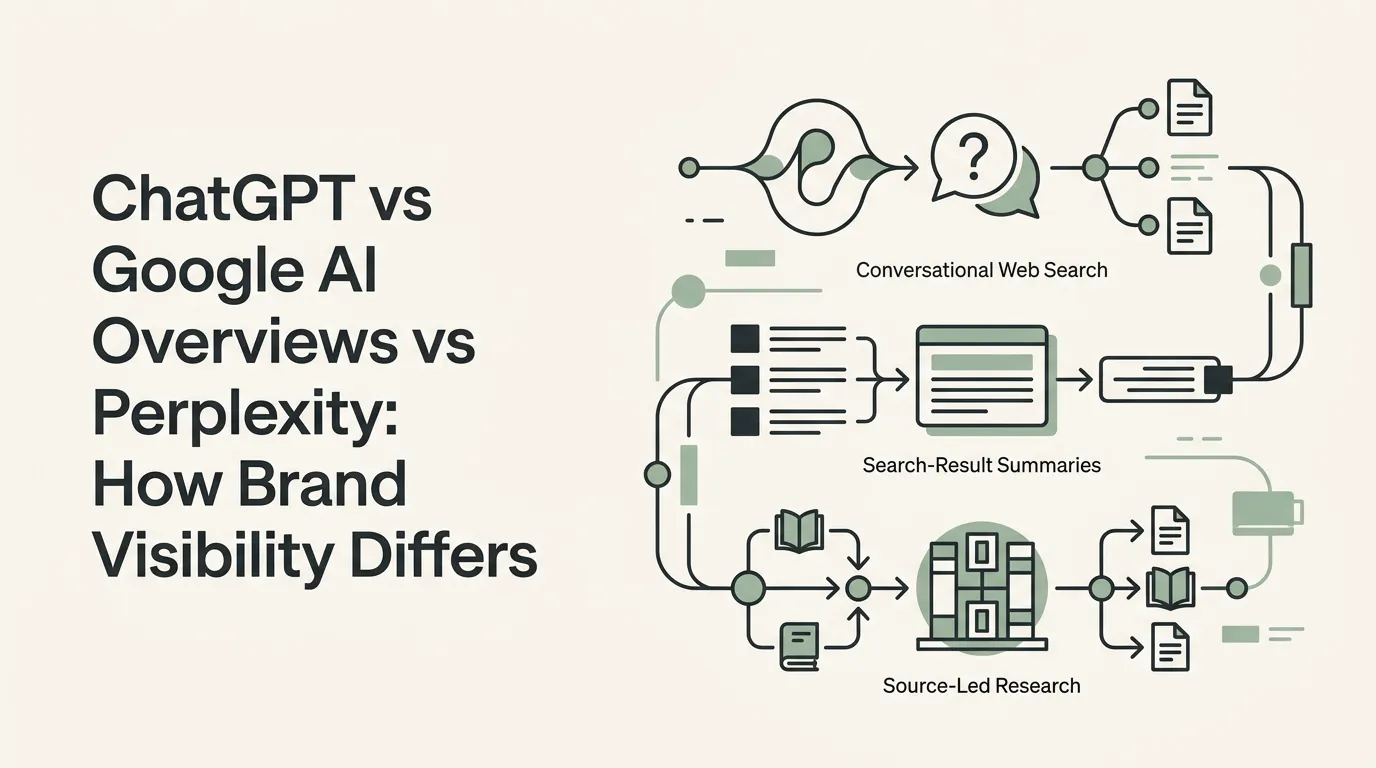
How retrieval differences shape brand visibility in AI search
A brand's appearance on one platform does not mean it will appear on another. Even within the same platform, changing the search mode, language, conversation history or query wording can change the answer and its sources.
The clearest documented distinction concerns eligibility. Google explicitly connects supporting-link eligibility to its Search index and snippet requirements. OpenAI and Perplexity document search-specific crawlers and distinguish their roles from other forms of access. None publishes a complete formula for brand recommendations or citation selection.
| Comparison point | ChatGPT search | Google AI Overviews | Perplexity |
|---|---|---|---|
| Relevant experience | Search-enabled answers, separate from conversations without retrieval | AI Overviews within Google Search, separate from AI Mode | Search, Pro Search and Research experiences |
| Documented discovery relationship | OAI-SearchBot and search providers | Google indexing and snippet eligibility | PerplexityBot and search infrastructure |
| Main publisher check | Search-crawler access and network restrictions | Indexing, snippets, Googlebot access and Search controls | Search-crawler access and network restrictions |
| Source presentation | Citations and a Sources interface | Supporting links associated with the generated answer | Source-supported answers and source links |
| Common measurement mistake | Treating model recall as current search evidence | Treating no Overview as an Overview that omitted the brand | Pooling fast Search and deeper Research observations |
| What access does not guarantee | A mention, recommendation or citation | An Overview, supporting link or recommendation | A mention, recommendation or citation |
These distinctions follow OpenAI's crawler documentation, Google's publisher guidance, and Perplexity's crawler documentation. They describe access and product behavior, not a performance ranking.
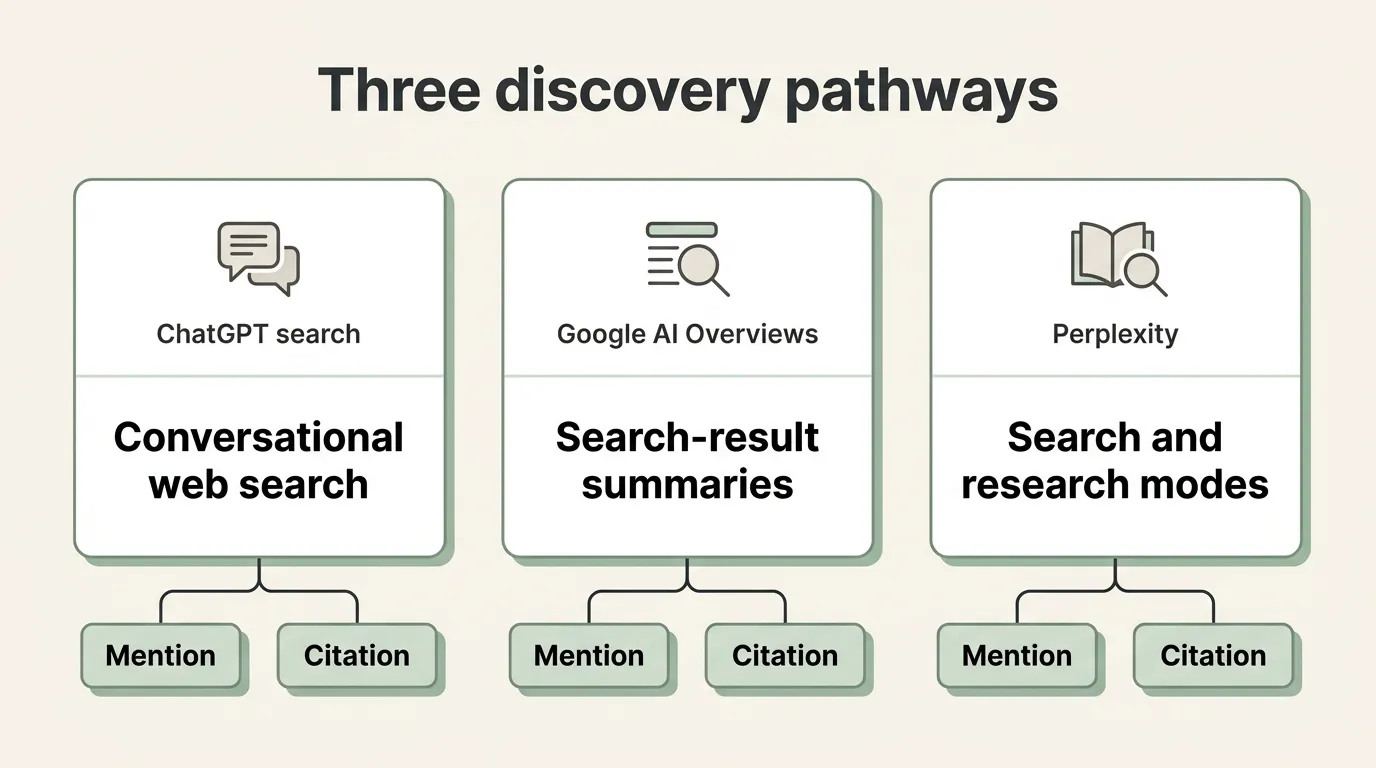
Separate recognition from business outcomes
Use explicit definitions before discussing which platform performs better.
| Outcome | What counts | What it does not prove |
|---|---|---|
| Brand mention | The answer body names the brand | The brand is recommended |
| Brand recommendation | The answer affirmatively proposes the brand for the stated need | The recommendation is accurate or produces a visit |
| Owned-domain citation | An attributed source points to a brand-controlled website | The visitor clicked |
| Third-party corroboration | A cited independent page actually discusses the brand | The brand received the referral |
| Referral visit | Analytics records an attributable website session | The visitor has a suitable requirement |
| Qualified inquiry | An inquiry meets agreed business-fit criteria | Every earlier influence was captured |
Consider two supplier results. One answer names a manufacturer but links to an independent industry article. Another cites the manufacturer's compatibility table without recommending its products. The first supports recognition; the second demonstrates source use. Neither establishes lead generation.
This distinction changes budget decisions. A business with recognition but few owned links may need stronger evidence pages. A business already receiving relevant visits may need clearer qualification information and a better inquiry journey rather than more exposure. For a deeper explanation, see AI citations vs brand mentions.
ChatGPT brand visibility depends on whether search was used
ChatGPT brand visibility should be evaluated first by interaction type. A response generated without live retrieval is not evidence that the system currently found, fetched or evaluated your website.
That matters for changing facts. Product availability, certifications, delivery markets and service scope can become outdated. A fluent answer about a company does not prove that its latest information was consulted.
Search access and training access are different decisions
OpenAI documents three distinct agent roles:
- OAI-SearchBot: supports surfacing websites in ChatGPT search.
- GPTBot: concerns potential foundation-model training use.
- ChatGPT-User: supports user-initiated visits and is not the crawler used to determine search inclusion.
According to OpenAI, opting out of OAI-SearchBot prevents a site's content from appearing in ChatGPT search answers, although navigational links may still appear. Allowing search access is therefore an eligibility decision, not a guarantee of selection.
Review robots.txt alongside CDN and firewall settings. A permissive robots file cannot resolve a network rule that returns an access error. Conversely, a successful bot request proves access, not citation. SeekLab.io's guide to selective crawler permissions covers the implementation details.
Inspect the answer, not just its source panel
OpenAI's search help documentation explains that search responses can include citations. The Sources interface may also contain other relevant links. A listed URL should not automatically be counted as evidence supporting a particular statement.
For an important answer, record whether search was used, whether the brand was mentioned or recommended, which passage is attributed to which source, and whether the destination belongs to the brand or another publisher. Check factual accuracy as well as presence: a recommendation based on an unsupported certification or unavailable delivery market can attract unsuitable inquiries.
Referral attribution captures only part of the effect
OpenAI's publisher FAQ documents the utm_source=chatgpt.com parameter on ChatGPT referral URLs. Preserving it can help identify visits and connect them to inquiry events.
It cannot measure unclicked mentions or someone who later searches for the company and visits through another channel. Report identifiable referrals as observed traffic, not the total influence of ChatGPT.
Google AI Overviews visibility starts with Search eligibility
Google AI Overviews have a documented technical starting point: a supporting page must be indexed and eligible to appear in Google Search with a snippet.
Google's guidance for website owners says there are no additional special technical requirements and no special schema or machine-readable file is required. Basic eligibility checks are therefore more useful than speculative formatting changes:
- Is the intended page indexed?
- Does its canonical point to the correct destination?
- Are essential content and resources accessible?
- Do snippet settings permit the intended use?
- Do relevant Search controls exclude the site from covered generative features?
Google-Extended serves a separate purpose and does not control inclusion or ranking in Google Search. Review Googlebot and Search-specific settings rather than treating all Google access controls as interchangeable.
Organic rankings and supporting links are related, not identical
Google says its generated search experiences may use query fan-out, running related searches across subtopics. A page can therefore be relevant to a supporting question without ranking prominently for the exact wording the user entered.
An Ahrefs analysis published in March 2026 examined 863,000 keyword result pages and 4 million AI Overview URLs. Its blue-link organic-position breakdown was 37.1% in the top 10, 26.2% in positions 11–100, and 36.7% outside the top 100.
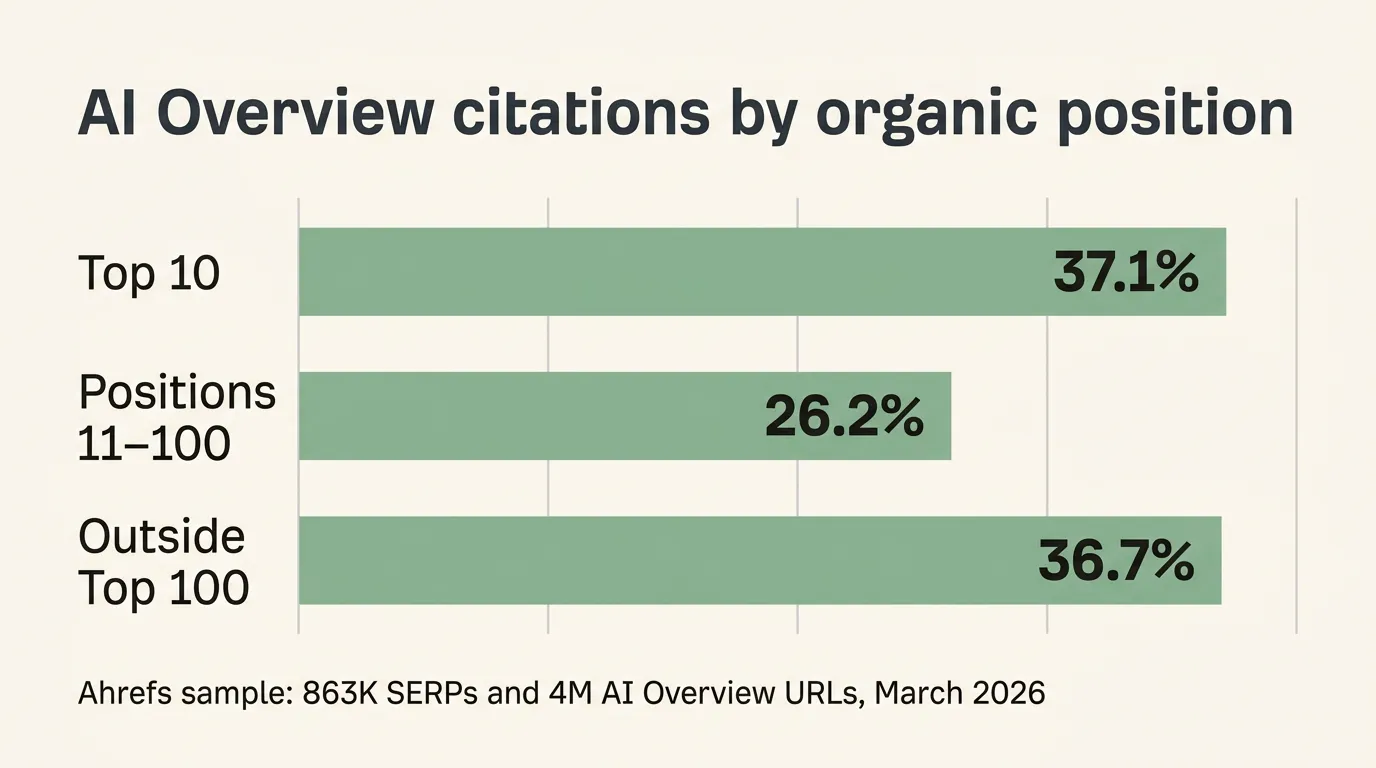
This is one Ahrefs sample, not a universal benchmark. It compares rankings for the original query and does not reconstruct every fan-out search. The useful conclusion is narrower: ranking and citation are different outcomes. Traditional SEO remains relevant, but a ranking improvement cannot be reported as proof of an AI Overview citation.
An Overview can appear without creating a visit
Pew Research Center's July 2025 study examined March 2025 browsing from 900 U.S. adults. Source links inside AI summaries were clicked in approximately 1% of visits to pages containing a summary. It is a historical observational study, but it supports keeping citations separate from visits.
Google now documents generative AI performance reports in Search Console. Use the available property dimensions and definitions rather than assuming every impression represents a recommendation or an AI Overview-only exposure.
Perplexity brand mentions vary by search and research mode
Perplexity brand mentions should be evaluated within the exact experience used. Its documentation distinguishes Search, Pro Search and Research, while some pages use the label Deep Research.
A short answer and an extended research report are not equivalent tests. They may retrieve and expose different sources. A longer report does not automatically make a brand more likely to be recommended.
Check crawler access without assuming preferential treatment
Perplexity's official documentation identifies PerplexityBot as a crawler used to surface and link websites in search and distinguishes it from Perplexity-User, which handles user-triggered fetching.
Where discovery is desired, review crawler access and network rules. The business implication is similar to ChatGPT but requires provider-specific checks: successful access enables discovery but says nothing about whether a page will be cited or a brand recommended.
Give buyers verifiable information
Useful assets for specialist businesses include:
- HTML specification tables with units and application limits;
- product-selection explanations tied to actual use cases;
- comparisons using disclosed criteria rather than unsupported superiority claims;
- documentation that identifies authorship, evidence and revision dates where relevant;
- accurate independent coverage that corroborates company claims.
A supplier page stating “suitable for demanding environments” gives little information to compare. A page explaining operating limits, compatible materials, testing conditions and exceptions gives a buyer something verifiable.
When reviewing a Perplexity answer, check whether the cited source supports the adjacent claim. A source list is not an endorsement list, and a citation to your documentation is not automatically a supplier recommendation.
How to monitor brand presence without misleading scores
Use a stable query set and matched intent across ChatGPT search, Google AI Overviews and Perplexity. Keep branded and non-branded queries separate, and record country, language, platform, mode, date and conversation conditions. Repeat observations rather than treating one response as a benchmark; the citation lag guide explains why timing deserves its own record.
For Google, distinguish three states: an AI Overview appeared and mentioned the brand; an Overview appeared but omitted it; or no Overview appeared. A timeout or unavailable mode is missing data, not brand absence.
| Field | What to record |
|---|---|
| Query | Exact wording, intent, and branded or non-branded status |
| Environment | Country, language, account state and conversation context |
| Product | Platform, exact mode and model label when visible |
| Timing | Timestamp and repetition number |
| Answer | Mention, recommendation, accuracy and ambiguity |
| Sources | Destination, owned or third-party status and supported claim |
| Evidence | Saved answer and screenshot or export reference |
| Exceptions | Failures, incomplete sources or protocol changes |
Track mention, recommendation and owned-domain citation rates separately, using valid observations as the denominator. For Google, also report Overview appearance rate and brand inclusion conditional on an Overview appearing. Show raw counts beside percentages so a small panel does not look more representative than it is.
Define qualified inquiries with sales or operations before reporting them. Relevant requirements, serviceable markets and credible contact details are more useful than counting every form submission.
What to prioritize across all three platforms
Start with the constraint affecting commercially important pages.
- Access: check robots.txt, CDN rules, rendering and indexing before rewriting content that systems cannot reliably retrieve. SeekLab.io's JavaScript indexing guide covers common rendering failures.
- Buyer-critical information: publish clear specifications, evidence, limitations, delivery details and comparison criteria in accessible HTML.
- Internal structure: connect educational content to the relevant product or service pages with descriptive links. See the guide to internal linking for SEO.
- International accuracy: keep company names, capabilities, availability and localized URLs consistent across markets and languages.
- Implementation priority: fix issues that affect discovery, evaluation or qualified inquiries before chasing perfect audit scores or speculative AI-search files.
A technical SEO audit can reveal access, rendering and internal-structure problems. It should lead to prioritized implementation, not another generic issue list.
Turn platform differences into an international SEO and GEO plan
SeekLab.io is an international SEO and GEO partner helping companies improve technical accessibility, content quality, internal structure, market-level consistency and visibility across search and AI-assisted discovery.
The first step is to identify the constraint on the pages that matter commercially. Explore SeekLab.io's SEO and GEO services for a deeper engagement, or run the free technical SEO audit for an initial technical baseline.