AI Citations vs Brand Mentions: Why Being Cited Isn’t the Same as Being Recommended
Expert reviewed

An AI citation shows that a page or source was used or surfaced as supporting evidence; an AI brand mention shows that the company or product name appeared in the answer; and recommendation-style inclusion shows that the brand was presented as an option for a particular need. These outcomes can overlap, but none automatically proves the others.
That distinction matters because “AI visibility” is often reported as though it were one metric. A website may earn citations for a strong technical guide while its brand remains absent from the generated answer. A brand may also appear in a comparison because third-party sources discuss it even when its own website is not cited.
The right response depends on the visibility state. Citation performance is mainly page- and source-level evidence. Brand mentions are entity-level exposure. Recommendation-style inclusion is query- and category-level visibility. Measuring them separately makes it easier to see what is actually working and what still needs attention.
AI Citations and Brand Mentions Are Different Visibility Signals
A citation answers, “Which source supports this part of the response?” A brand mention answers, “Which company or product appears in the response?” A recommendation-style inclusion answers, “Which options did the system present for the user’s stated need?”
These signals can occur together, but they are not interchangeable:
- A technical article can support an explanation without the publisher being named in the answer.
- A brand can be named because a comparison page, directory, review, media article or community discussion describes it.
- A brand can be mentioned neutrally or critically without being recommended.
- A brand can appear in a shortlist without being ranked first or presented as universally suitable.
This is why a single “AI visibility score” can hide the most useful diagnostic information.
What Is an AI Citation?
An AI citation is a visible source attribution connected to an AI-generated answer. Depending on the platform, it may appear as an inline link, a source card, a supporting link or an entry in a sources panel.
The exact interface matters. ChatGPT search may show inline citations and a Sources view that can also contain other relevant links. Google says AI Overviews and AI Mode surface supporting links, while Gemini Apps may show sources and related content within or below a response. Not every response on every platform includes the same source display.
For measurement, record the linked destination rather than assuming that any visible domain label supports every statement in the answer. Also distinguish:
- an owned-domain citation, where the brand’s own website is linked;
- a third-party citation, where another publisher is linked; and
- a cited page, which is the unique URL receiving source visibility.
A citation proves only that a source was visibly associated with the response in that captured output. It does not prove endorsement, recommendation, brand recognition or a resulting visit.
What Is an AI Brand Mention?
An AI brand mention occurs when the generated answer names a company, product or service. The mention may be descriptive, comparative, positive, negative or purely contextual.
For example, “Supplier A offers multilingual support” is a mention. It is not necessarily a recommendation. The answer names the supplier and describes a capability, but it does not tell the reader to choose that supplier.
A mention can be supported by the brand’s own website, by third-party sources, by a combination of sources or by information that is not visibly attributed in the interface. That is why mention tracking should capture the exact wording and visible sources rather than inferring where the name came from.
What Is Recommendation-Style Inclusion?
Recommendation-style inclusion occurs when a brand is presented as a relevant option in an answer to a category, comparison or selection question. Typical prompts include “best X for Y,” “alternatives to X,” “which provider offers Y?” or “what should I compare before choosing X?”
This does not mean the AI system has independently certified the “best” brand. The output may be a generated synthesis of available web information, the user’s wording, the system’s retrieval results and the context of that session.
The most defensible way to record recommendation-style inclusion is to preserve the qualifying language. “Consider Supplier A if multilingual implementation is essential” is different from “Supplier A is one company in this category.” A shortlist is also different from an explicit preference.
Citation vs Mention vs Recommendation
| Visibility outcome | What appears | Typical query | Main observable evidence | What it does not prove |
|---|---|---|---|---|
| Source citation | A linked page, source card or supporting link | “What is canonicalization?” | A visible source destination | That the publisher is recommended |
| Brand mention | A company or product name in the answer | “Which companies offer multilingual SEO?” | The exact brand wording | That the mention is positive or sourced from the brand’s site |
| Recommendation-style inclusion | The brand appears as an option for a stated need | “What are the best technical SEO agencies for international sites?” | The recommendation or shortlist language | Universal suitability or independent certification |
| Owned-domain citation | The brand’s own page is linked | Informational or commercial | A URL on the owned domain | That the brand name appears in the answer |
| Third-party visibility | Another source names, compares or describes the brand | Category, review or comparison | The third-party page and generated wording | That the brand controls the description |
How Can a Page Be Cited Without the Brand Being Mentioned?
A page can be useful as evidence even when the publisher’s identity is not central to the answer. Common possible explanations include:
- The page answers an informational question, while the generated response focuses on the fact or method rather than the source owner.
- A specific passage is useful, but the brand name is outside the extracted context.
- The content is relevant to informational intent but does not establish that the company belongs in a commercial category or shortlist.
- The page’s authorship, publisher or relationship to a service is unclear.
- The brand has limited third-party recognition for the category being discussed.
These are diagnostic possibilities, not guaranteed causes. A source citation can still be valuable: it may create source exposure, support referral traffic and show that a page is useful for a tracked question. It simply should not be counted as a brand-in-answer mention unless the brand is actually named.
Consider a SeekLab.io-style example. A technical guide may be linked because it clearly explains canonicalization. If the generated answer uses the explanation but never names SeekLab.io, the result is an owned-domain citation without a prose brand mention. It does not automatically make SeekLab.io an option in an answer about technical SEO agencies.
How Can a Brand Be Mentioned Without Its Own Site Being Cited?
A generated answer can name a brand while citing other websites. The visible evidence may come from:
- editorial comparisons and “best X” listicles;
- independent reviews;
- directories and association profiles;
- news or trade publications;
- relevant community discussions;
- partner, customer or integration pages; or
- other authoritative pages that describe the brand in context.
In that state, the brand has entity or category visibility, but the owned domain has not received source visibility in the captured answer. This can be commercially useful, especially for discovery queries, but it also creates a dependency: the description may be incomplete, outdated or framed by someone else.
Teams should inspect which third-party pages recur, what claims they make and whether those claims match the current offer. The goal is not to manufacture mentions. It is to understand the wider information environment in which the brand is being categorized.
Why Third-Party Content Matters for Brand Mentions
Owned content explains the brand from the inside. Third-party content places the brand in a category, comparison or market context.
Comparison and listicle pages can be especially relevant category-discovery surfaces because they explicitly associate multiple brands with a use case or evaluation question. A page comparing technical SEO agencies, for example, gives a generated system material for identifying possible providers. That is a different job from a guide explaining how canonical tags work.
Other useful third-party contexts may include reviews, directories, media coverage, expert commentary, community discussions and partner ecosystems. None guarantees inclusion in an AI answer, and paid inclusion does not guarantee meaningful visibility. Quality, relevance, accuracy and the query still matter.
The practical lesson is that brand-level visibility depends on more than publishing additional articles on the owned domain. It can also require accurate category relationships across the wider web.
Owned Content and External Signals Serve Different Jobs
| Evidence layer | Typical assets | Primary job |
|---|---|---|
| Owned informational content | Definitions, guides, original research, case studies | Explain topics and provide source-worthy evidence |
| Owned commercial content | Service, product, comparison and use-case pages | Explain what the brand offers and for whom |
| Entity clarity | About pages, consistent naming, authorship, organization data | Make brand, product and publisher relationships clearer |
| Third-party category context | Listicles, reviews, directories, media and partner pages | Place the brand within a category or evaluation set |
| Market evidence | Customer examples, documented results, expert references | Support specific claims with verifiable context |
These layers can reinforce one another, but no single layer controls recommendation-style answers. A brand still needs an offer that fits the user’s question, accurate evidence and a website that can be accessed and interpreted.
Citation Intent and Category Intent Need Different Evidence
The difference becomes clearest when two prompts have different jobs.
“What is canonicalization?” is an informational query. It needs a clear definition and reliable explanatory evidence. A strong technical article can satisfy that need and earn a citation.
“What are the best technical SEO agencies for international websites?” is a category and selection query. It requires the system to identify organizations, compare relevant capabilities and present possible options. A canonicalization guide alone does not establish that its publisher belongs in that shortlist.
| Query type | User need | Evidence likely to be useful | Main visibility outcome to track |
|---|---|---|---|
| Informational | Understand a fact, process or concept | Clear explanations, original evidence, documentation | Citations and cited pages |
| Diagnostic | Understand why something is not working | Troubleshooting steps, checks, technical evidence | Citations and relevant brand mentions |
| Category discovery | Identify available providers or products | Category pages, comparisons, directories, market references | Brand mentions and shortlist inclusion |
| Recommendation | Choose an option for stated criteria | Verified capabilities, use cases, reviews, comparisons | Recommendation-style inclusion and caveats |
This is why success as an informational source does not automatically create visibility for commercial or recommendation queries. The query intent changes the evidence required.
Use a 2×2 Matrix Instead of One Visibility Score
The simplest useful framework compares two observable questions: was the brand’s own domain cited, and was the brand named in the answer?
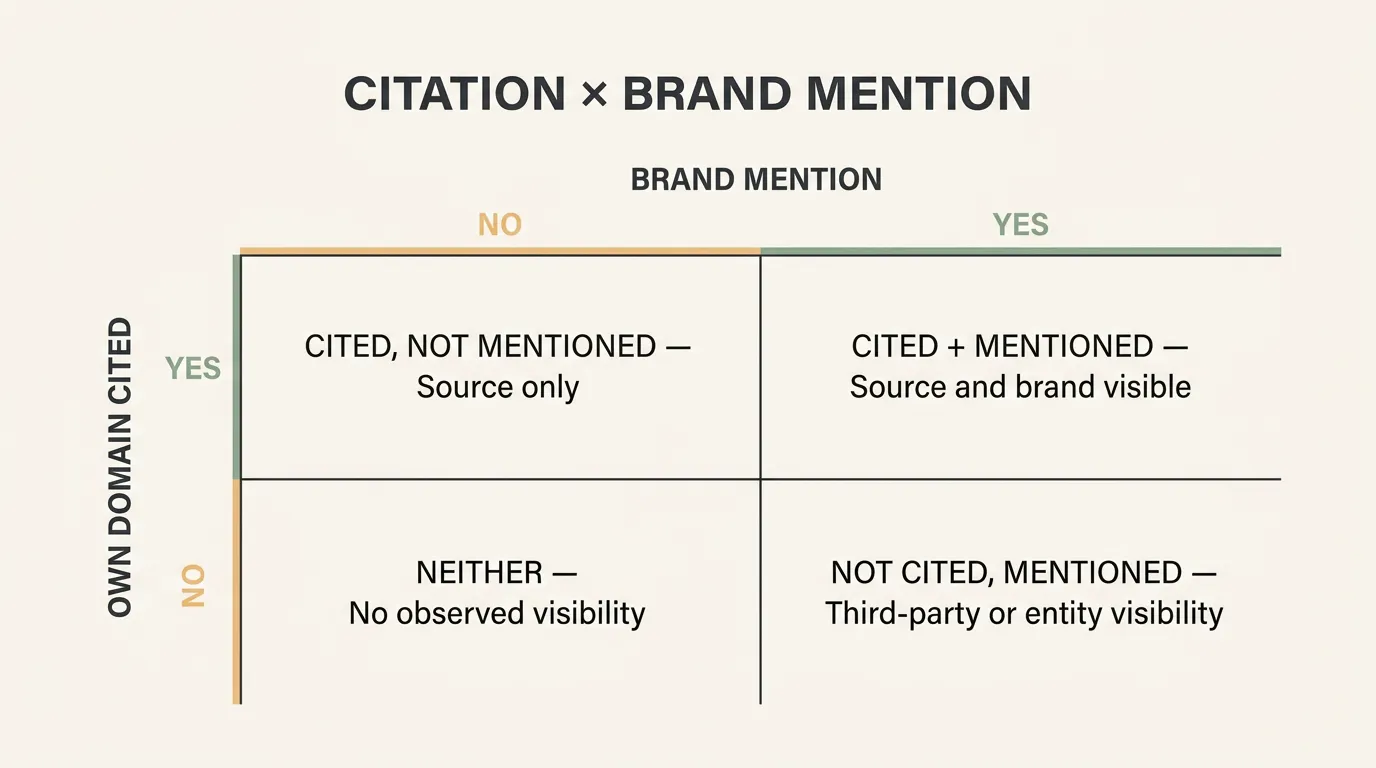
The four states are:
- Cited and mentioned: the owned domain receives source visibility and the brand appears in the answer.
- Cited, not mentioned: the owned page is used or surfaced as a source, but the brand is absent from the answer text.
- Not cited, mentioned: the brand appears, but the owned website is not linked. Third-party or broader entity visibility may be contributing.
- Neither: the captured answer shows no owned-domain citation and no brand mention.
Recommendation-style inclusion should be tracked as a separate layer because a mention can be neutral, cautionary or descriptive.
How to Measure AI Visibility Correctly
Different tools define “citation,” “mention,” “cited page” and “visibility score” differently. Do not compare totals across tools until the definitions and denominators are clear.
For a fixed query set, track separately:
- cited pages;
- citation occurrences;
- owned-domain citations;
- brand mentions in answer text;
- recommendation-style inclusion;
- third-party sources that mention the brand;
- the queries and intent types producing each outcome;
- the platform, market, language and capture date; and
- any material caveat or negative framing.
Preserve the output where possible. AI answers can vary by model, interface, location, time and session context. OpenAI notes that ChatGPT search may use location and, when enabled, relevant saved memories when rewriting a search. Google also states that AI Overviews and AI Mode can use different models and techniques, so their responses and links may vary.
The Google guidance for AI features adds another measurement constraint: AI feature traffic is included within Search Console’s Web search type rather than reported as a clean, separate AI Overview or AI Mode segment. A citation observation and a traffic report therefore measure different things.
SeekLab.io’s GEO case study is useful context for why cited pages and citation activity should be recorded explicitly, but one project’s totals should not be treated as a universal benchmark.
What to Do in Each Visibility State
Cited but not mentioned
First confirm that the query should contain a brand at all. A definition does not need to become an advertisement.
If the query has genuine commercial relevance, strengthen entity clarity and connect the cited content naturally to the brand’s relevant expertise, service or product context. Review the About page, consistent naming, authorship, internal links and category-level third-party coverage. Do not insert the brand into every paragraph merely to force a mention.
Mentioned but the owned domain is not cited
Identify which third-party pages are creating or reinforcing the visibility. Check whether the description is accurate and current. Strengthen owned category, service or product resources so there is a useful first-party destination, and publish original evidence where the brand can genuinely support the answer.
Neither cited nor mentioned
Check the full chain: crawl access, indexability, content quality, query fit, entity clarity, authority and third-party category presence. A focused technical SEO audit can help identify eligibility and site-foundation problems, but technical access alone does not guarantee citations or mentions.
Both cited and mentioned
Record which queries, pages and sources produce the result. Keep the underlying pages accurate, maintain important third-party references and expand only into adjacent questions where the brand has relevant evidence. Then check whether the mention is neutral, cautionary or recommendation-oriented.
What These Signals Do Not Prove
- A citation does not prove endorsement.
- A mention does not prove preference or positive sentiment.
- Recommendation-style inclusion does not prove that the system independently identified the objectively “best” brand.
- One prompt or one captured answer does not represent overall visibility.
- A supporting link does not prove that every claim in the answer came from that page.
- Correlation between stronger external coverage and more mentions does not by itself establish causation.
- Platform behavior and source interfaces can change.
These limits are why the output, query, date, platform and visible evidence should remain available for review.
Citation Type Is Not Citation Lag
Citation lag concerns timing: a page is published, crawled or indexed, and only later may be selected as a visible source.
Citation versus brand mention concerns visibility type: a source is selected, and the brand may or may not be named.
A page can experience citation lag before it is first cited. Once cited, it can still sit in either the “cited and mentioned” or “cited, not mentioned” state. These are separate diagnostic questions.
Build Source-Level and Brand-Level Visibility Together
Effective SEO and GEO work should make two things easier to assess: whether useful pages can become visible sources, and whether the brand is accurately represented for commercially relevant questions.
SeekLab.io reviews these outcomes across technical readiness, content structure, entity clarity, internal linking, query tracking, citation analysis, brand mentions and third-party category visibility. The goal is not to promise a citation or recommendation. It is to identify which part of the visibility system is weak and prioritize work that has a defensible connection to growth.
Explore SeekLab.io’s SEO and GEO services to evaluate source-level visibility, brand-level visibility and the technical and content foundations behind both. For a narrower look at monitoring and optimization, see the AI Visibility solution.
FAQ
What Is an AI Citation?
An AI citation is a visible link, source card or source attribution associated with an AI-generated answer. It identifies a page or publisher connected to the response, but it does not automatically mean the publisher or brand is recommended.
What Is an AI Brand Mention?
An AI brand mention occurs when the generated answer names a company, product or service. The mention may be neutral, positive, negative, comparative or recommendation-oriented, and it may occur without a link to the brand’s website.
Is Being Cited by ChatGPT the Same as Being Mentioned?
No. ChatGPT can cite a page without naming its publisher in the answer, and it can name a brand while citing a third-party source. Track the visible source destination and the brand wording as separate fields.
Can a Brand Be Mentioned Without Its Website Being Cited?
Yes. The answer may rely on or display third-party sources such as comparison pages, reviews, directories, media coverage or community discussions. The brand receives mention visibility, while its owned domain does not receive a visible citation in that answer.
Why Is My Website Cited but My Brand Not Mentioned?
The page may answer an informational question where the brand is not central, or its passage may be useful without establishing category relevance. Other possibilities include weak entity clarity or limited third-party recognition. These are diagnostic possibilities, not guaranteed causes.
Do AI Citations Improve Brand Visibility?
They can create source exposure and may support discovery, but a citation does not guarantee that the brand is named, remembered, recommended or visited. Measure citations and brand mentions separately.
How Do You Measure Brand Visibility in AI Search?
Use a fixed query set and record brand mentions, recommendation-style inclusion, owned-domain citations, third-party sources, platform, market, language and date. Keep the captured wording so neutral, positive, negative and conditional mentions are not collapsed into one count.
What Is the Difference Between AI Visibility and AI Citations?
AI visibility is the broader category. It can include citations, cited pages, brand mentions, recommendation-style inclusion and third-party visibility. AI citations are one source-level component within that broader measurement framework.