The Citation Lag Problem: How Long It Actually Takes to Get Cited by AI
Expert reviewed

AI citation lag usually lasts from a few days to several weeks, but a new page can take months or never be cited if it is hard to crawl, weakly structured, poorly trusted, or not useful for the exact AI-generated answer. For an updated page on a strong, frequently crawled website, the fastest visible AI citations may appear within hours or days when the AI system uses live web retrieval. For a new page on an average independent website, the practical planning range is often 2 to 8 weeks, with the first 90 days giving the clearest diagnostic window.
The key distinction is simple: content indexing lag and AI citation lag are not the same. A page can be crawled and indexed by Google before any AI answer system selects it as a cited source. AI citations require extra conditions: the page must be retrievable, relevant to the query, trustworthy enough to support the answer, easy to extract, and suitable for the answer format. Google describes Search as separate crawling, indexing, and serving stages in How Search Works, while its AI features guidance makes clear that AI-generated summaries are a distinct search experience with source links for further exploration.
For website operators, the practical issue is not just how long it takes to get cited by AI. The better question is where the delay is happening: discovery, crawling, rendering, indexing, ranking, retrieval, source selection, or conversion after the citation. Many independent websites publish new blogs, wait for AI search visibility, and then misread silence as a content problem when the real blocker is a canonical tag, JavaScript rendering, a weak internal link path, or a page that answers a topic too vaguely to be used as evidence.
Why AI citation lag takes longer than normal indexing lag
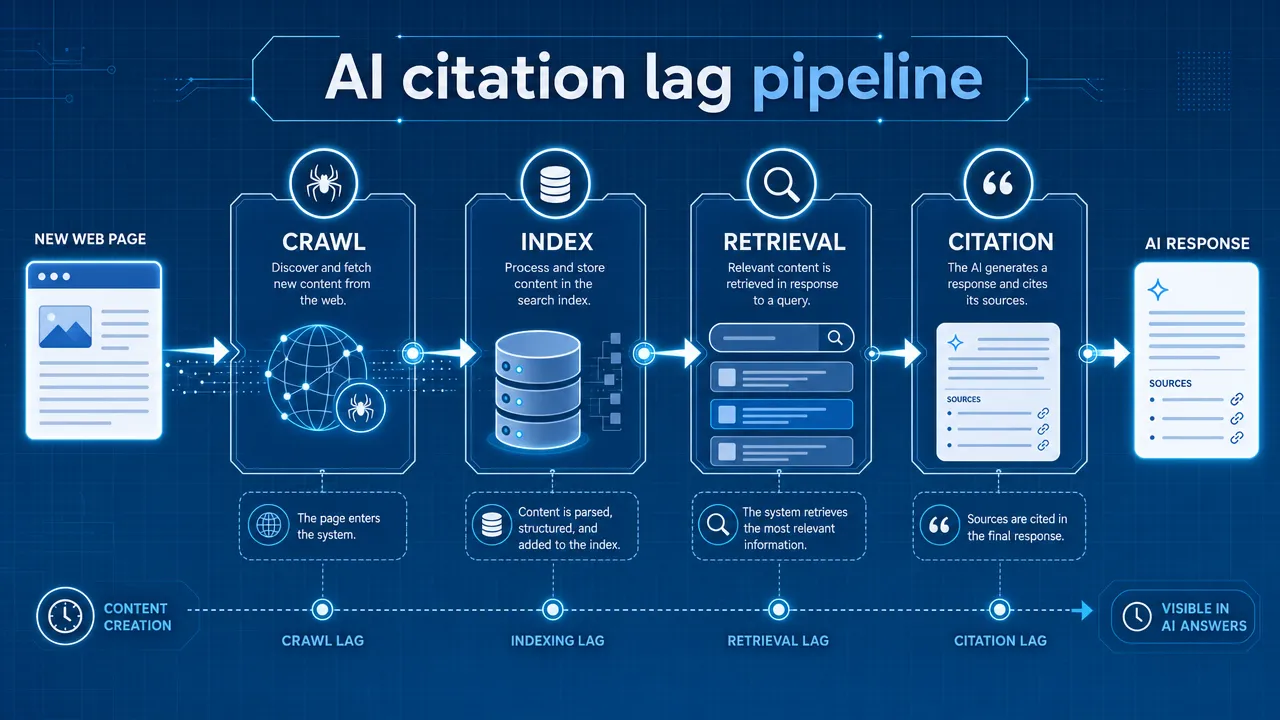
AI citation lag takes longer because citation is not the first technical milestone. It is one of the last. Publishing creates a URL, but AI systems generally need that URL to become discoverable, crawlable, understandable, and credible before it can appear as a visible source.
Google indexing asks a narrower question: can the search engine discover, process, and store the page? AI citation asks a more selective question: should this page be shown as supporting evidence inside a generated answer for this exact query? That is why an indexed page may still be invisible in Google AI Overviews, ChatGPT Search, Perplexity-style answer results, Gemini grounding outputs, or Copilot-style answers.
A typical citation path looks like this:
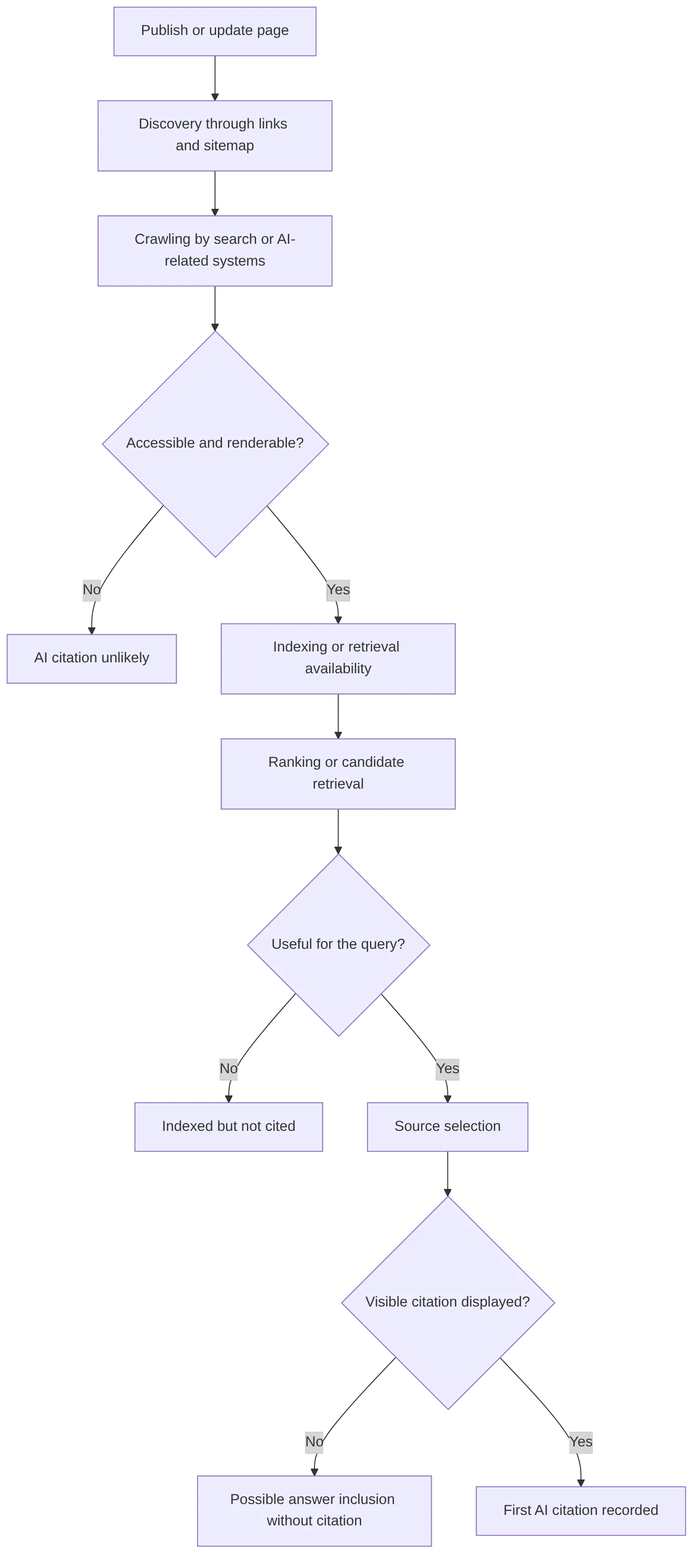
The most common mistake is treating the final box as if it should happen immediately after publication. It usually does not. Even with retrieval-based systems, LLM citation timing depends on whether the product triggers web search, which index or retrieval layer it uses, and whether the page is selected over competing sources. OpenAI says ChatGPT Search provides timely answers with links to relevant web sources in its ChatGPT Search announcement, and Gemini grounding connects models to Google Search and returns citation metadata according to Gemini API grounding documentation. Neither source promises that a newly published page will be cited on a fixed schedule.
For a B2B independent website, this creates a practical operational problem. A marketing manager may publish a detailed product guide, see it indexed after a week, and still get no AI citations for a month. That does not automatically mean the content failed. It may mean the page has not earned enough retrieval confidence, the query set is too broad, or the answer passage is buried below generic copy.
| Stage | What it proves | What it does not prove |
|---|---|---|
| Crawled | A crawler reached the URL | The page is indexed or useful |
| Indexed | The page is stored in a search index | The page will rank or be cited |
| Ranking | The page appears for some queries | The page will be selected by AI systems |
| Retrieved | The page may be considered for an answer | It will be visibly cited |
| Cited | The URL appears as a source | It will generate qualified inquiries |
This is why SeekLab.io treats citation delay as a cross-functional SEO issue, not just a writing issue. A page needs technical readiness, content clarity, entity consistency, internal links, and a conversion path. Fixing only the text while ignoring crawlability or page architecture often leaves the real bottleneck untouched.
AI citation lag timelines by website scenario
AI citation lag has no universal SLA. The realistic timeline depends on the website's crawl frequency, authority, internal linking, content quality, and the AI platform being tested. A strong updated page can be cited quickly. A new page on a weak or poorly structured website may wait months or never appear.
The most useful way to plan is by scenario:
| Website or page scenario | Likely citation delay | Practical interpretation |
|---|---|---|
| Updated page on a strong, frequently crawled site | Hours to several days | The page already has trust, internal links, and index history. Fresh changes may be picked up quickly. |
| New page on a strong site with clear internal links and sitemap inclusion | Several days to 2-4 weeks | Discovery and indexing may happen quickly, but source selection still depends on query fit. |
| New page on an average independent website | 2-8 weeks | This is the range where crawl, index, ranking, and AI answer testing should be tracked carefully. |
| New page on a weak or rarely crawled site | Several weeks to months | Low crawl frequency and weak authority can delay every downstream step. |
| Page with noindex, robots blocks, canonical conflicts, or rendering problems | No citation or very long delay | The page may never become a valid citation candidate. |
| Multilingual page with weak hreflang or wrong canonicals | Unstable delay | The wrong language version may rank or be cited, or the page may be ignored. |
These numbers are reasoned operating ranges, not platform guarantees. They are based on documented mechanics from search and retrieval systems rather than a public citation-timing promise. Google explains the crawl-index-serve model in How Search Works, and its crawling and indexing documentation confirms that crawlability, sitemaps, robots rules, canonicals, and page accessibility affect whether content can enter search systems at all.
The "blocked page" bar should be read carefully. It does not mean a blocked page will eventually be cited after 120 days. It means the delay can become indefinite. If a page is noindexed, canonicalized to another URL, hidden behind client-side rendering, or disconnected from crawlable internal links, waiting longer is not a strategy.
A more realistic 90-day operating model looks like this:
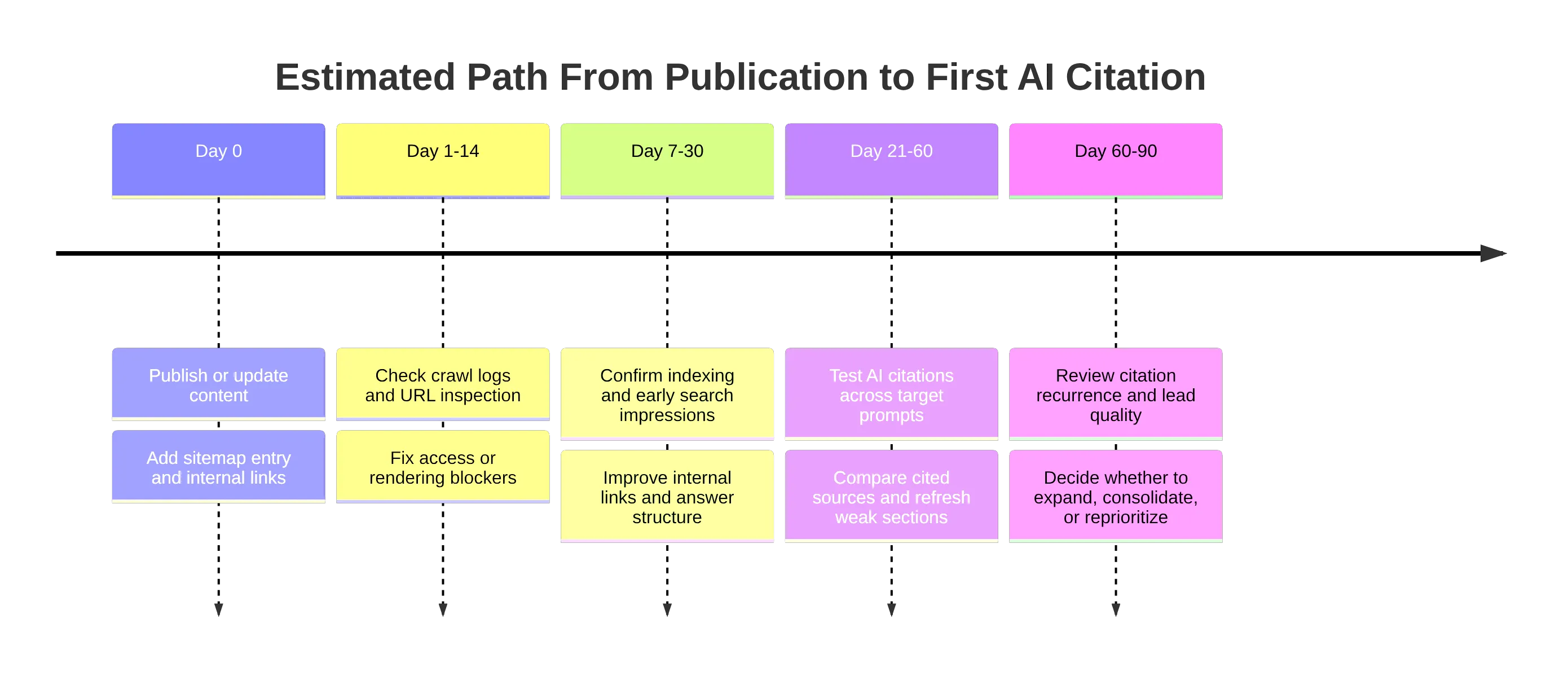
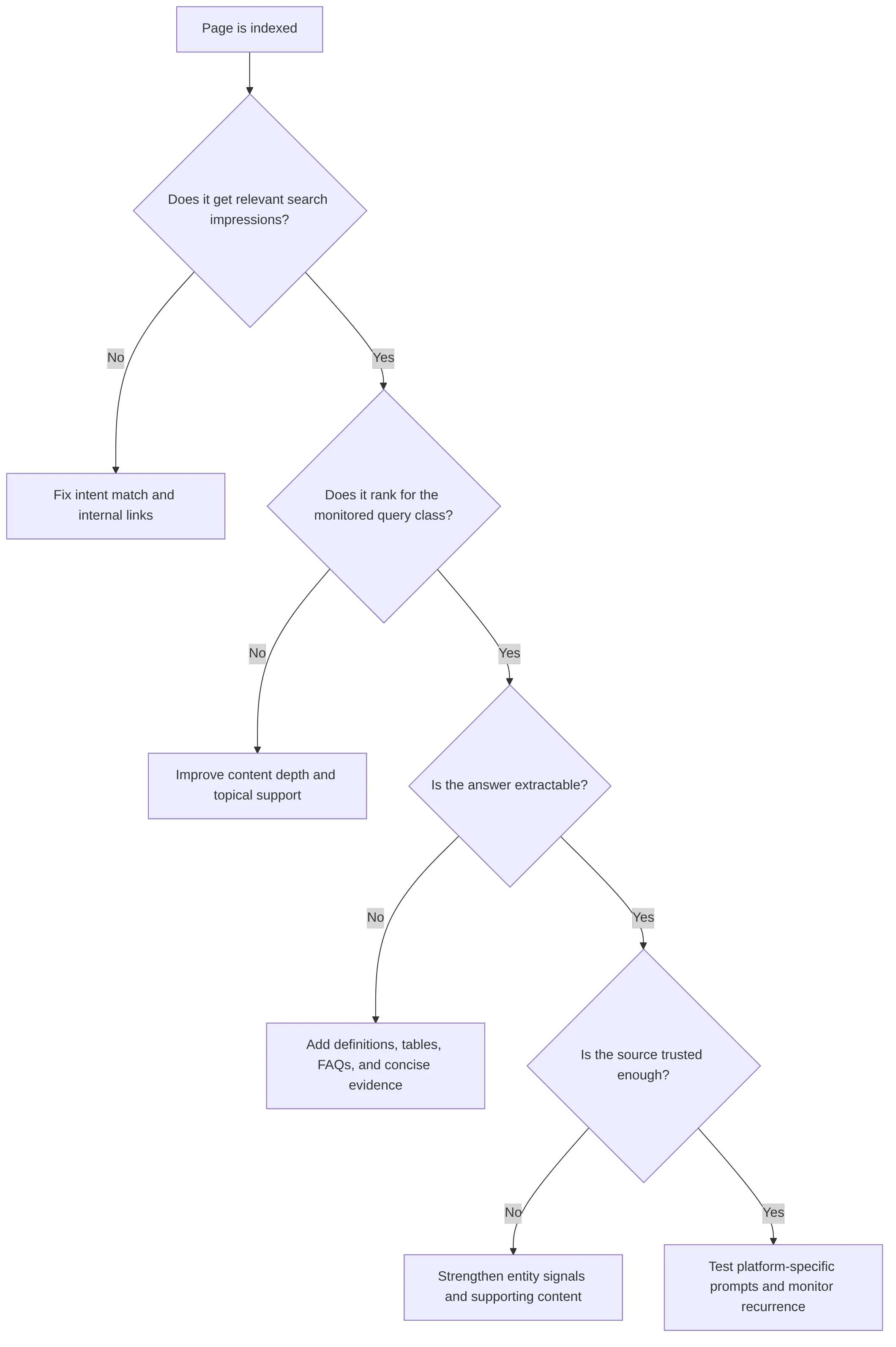
For independent company websites, the 90-day window matters because it separates normal citation delay from deeper structural problems. If a page has not been crawled within two weeks, start with technical discovery. If it is indexed but has no impressions after a month, look at intent match and internal links. If it ranks but is not cited after repeated AI answer testing, inspect extractability, authority, and the type of query being monitored.
This is where many SEO projects lose time. Teams keep publishing new posts because the first batch did not produce visible AI citations. In practice, the better move is often to diagnose whether the first batch was even eligible to be cited. SeekLab.io's approach starts with the strategic decision before production: choose topics that match real user intent, then build pages that search engines, AI systems, and users can understand.
Why AI citation lag happens even after a page is indexed
AI citation lag often continues after indexing because AI systems do not cite pages simply because they exist in a search index. They select sources that help answer a specific prompt. A page may be technically available but still lose to clearer, more authoritative, or more extractable pages.
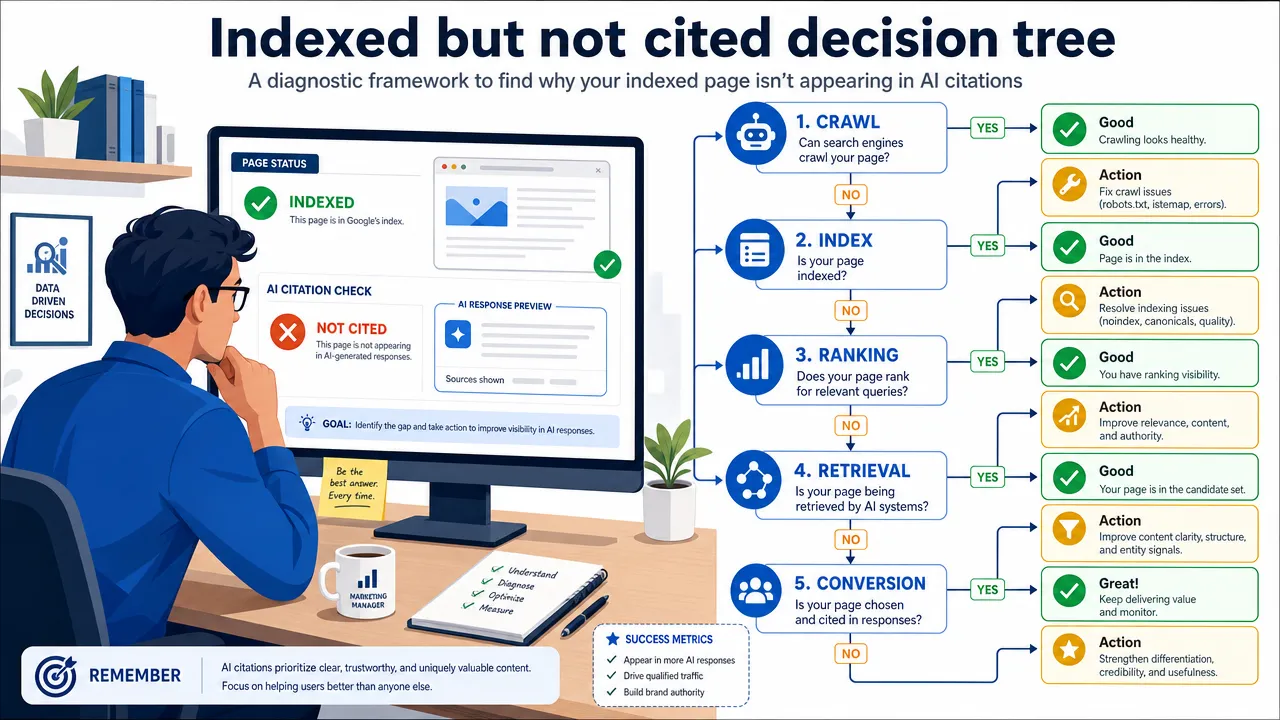
The most common "indexed but not cited" cases are easy to recognize during an audit:
| Symptom | Likely cause | What to check first |
|---|---|---|
| Indexed but no impressions | Weak search intent match or poor internal linking | Google Search Console queries and crawl depth |
| Ranking for irrelevant terms | Topic is too broad or page structure is unclear | Headings, title tag, intro, internal anchors |
| Ranking but no AI citations | Page lacks concise evidence blocks | Definitions, tables, FAQs, summary passages |
| Cited once but not again | Query fit is unstable or source competition changed | Prompt set, platform, date, screenshots |
| Cited but no inquiries | Informational traffic has no conversion path | CTA placement, internal links, lead form friction |
| Wrong language page appears | Hreflang or canonical setup is weak | Locale URLs, canonicals, language-specific links |
A page that wants AI citations needs extractable passages. That means a direct answer near the relevant heading, clear definitions, comparison tables, original observations, and entity names that do not change from one section to another. A vague article that says "solutions improve efficiency" across 2,000 words gives an AI answer system little worth citing. A page that states a specific framework, shows a table, and distinguishes confirmed facts from estimates is easier to reuse as evidence.
Technical issues are just as common. JavaScript-heavy websites often show the important content to users but make crawlers work harder to extract it. Google's JavaScript SEO documentation explains how rendering affects what Google can process. If the main answer block, internal links, canonical tag, or structured data depend on delayed client-side rendering, the page may be slower to index and weaker as a citation candidate.
SeekLab.io has covered this problem in more detail in its guide to technical JavaScript SEO and indexing solutions. The practical point is direct: if the content that makes the page citation-worthy is not reliably present in rendered HTML, publishing more pages may multiply the problem rather than solve it.
Internal linking is another quiet source of citation delay. A new article buried six clicks deep, absent from topic hubs, and missing descriptive anchors sends a weak importance signal. AI systems using search-grounded retrieval are more likely to encounter pages that search systems can understand within a clear site architecture. A strong internal link path from relevant service pages, product category pages, and supporting articles helps both discovery and semantic clarity.
Content strategy also affects LLM citation timing before a page is even written. If a team chooses topics because they have high search volume but weak business relevance, the page may attract informational visits without qualified leads. If a team chooses topics that AI systems can answer from common web knowledge, citation competition becomes harder. SeekLab.io's keyword research service focuses on intent, long-tail terms, contextual scenarios, and content direction so teams do not spend months producing pages that were unlikely to support growth from the beginning.
A useful diagnostic rule is this: if a page is indexed but not cited, do not rewrite it blindly. First identify which gate it is failing.
After this diagnostic stage, the right next action is usually clearer. If your team cannot tell whether the bottleneck is technical, structural, or content-related, SeekLab.io can help with a structured review. Get a free audit report to identify what actually affects growth and what can be deprioritized.
How AI citation lag differs across platforms
AI citation lag differs by platform because each product uses different retrieval triggers, indexes, grounding methods, and citation displays. The same page may be cited in one AI answer system and ignored in another during the same week.
Google AI Overviews are tied to Google Search systems, but they are not just a copy of the top organic results. Google describes AI features as generated experiences that help users understand topics and explore source links in its AI features documentation. This means classic SEO visibility can support citation probability, but it does not guarantee it.
ChatGPT Search has a different behavior pattern. OpenAI states that ChatGPT Search provides fast, timely answers with links to relevant web sources, and its ChatGPT Search help page explains user-facing search and source behavior. However, not every ChatGPT response uses live search. If the answer is generated from model knowledge without web retrieval, a newly published page may have no chance of appearing as a citation in that interaction.
Gemini grounding is more explicit in developer contexts. The Gemini grounding documentation describes how grounding connects Gemini models with Google Search and returns source metadata. This reinforces the practical point for website operators: pages that are weak in search discovery and content clarity are less likely to perform well in search-grounded AI experiences.
IndexNow can help with discovery for participating search engines by notifying them when URLs are added, updated, or deleted. The IndexNow protocol is useful for URL change notification, but it is not a ranking or citation guarantee. Treat it as a faster doorbell, not a promise that someone will invite the page into every AI answer.
| Platform | Freshness pathway | Citation implication | What website teams should do |
|---|---|---|---|
| Google AI Overviews | Google Search systems and query-dependent AI features | Indexed and useful pages may be linked, but timing is not guaranteed | Strengthen Search fundamentals, answer clarity, and topical authority |
| ChatGPT Search | Web search when search is triggered | Source links can appear for timely answers | Make pages accessible, structured, and useful for web retrieval |
| Gemini grounding | Google Search grounding in supported contexts | Citation metadata can be returned when grounding is used | Improve Google indexability and entity clarity |
| Copilot or Bing-connected experiences | Bing index and web grounding signals | Citation behavior can differ from Google | Verify Bing Webmaster Tools and consider IndexNow |
| Perplexity-style answer search | Real-time source retrieval and answer synthesis | Clear, current, source-worthy pages have an advantage | Use concise evidence, tables, and direct answers |
The platform differences matter most in measurement. Checking one prompt in one product once a month is too thin. AI citations vary by location, session, wording, language, and time. A better monitoring sheet records the prompt, platform, date, location, visible citations, whether the brand was mentioned without a link, and whether any traffic or inquiries followed.
For multilingual and cross-border websites, platform differences become sharper. A product page for the United States, a distributor page for Europe, and a localized service page for Asia-Pacific may not share the same citation path. Google's international and multilingual site guidance warns that multilingual sites need clear localized URLs and signals. In practice, wrong canonicals, weak hreflang, and direct translations often cause longer citation delay or wrong-language citation.
SeekLab.io's guide to multilingual SEO strategy is relevant here because international websites need more than translated articles. They need localized keyword research, clean URL structures, market-specific internal links, and consistent entity signals. For exporters, manufacturers, and official company websites, this often decides whether a page becomes discoverable in the right market at all.
A 90-day AI citation lag tracking framework
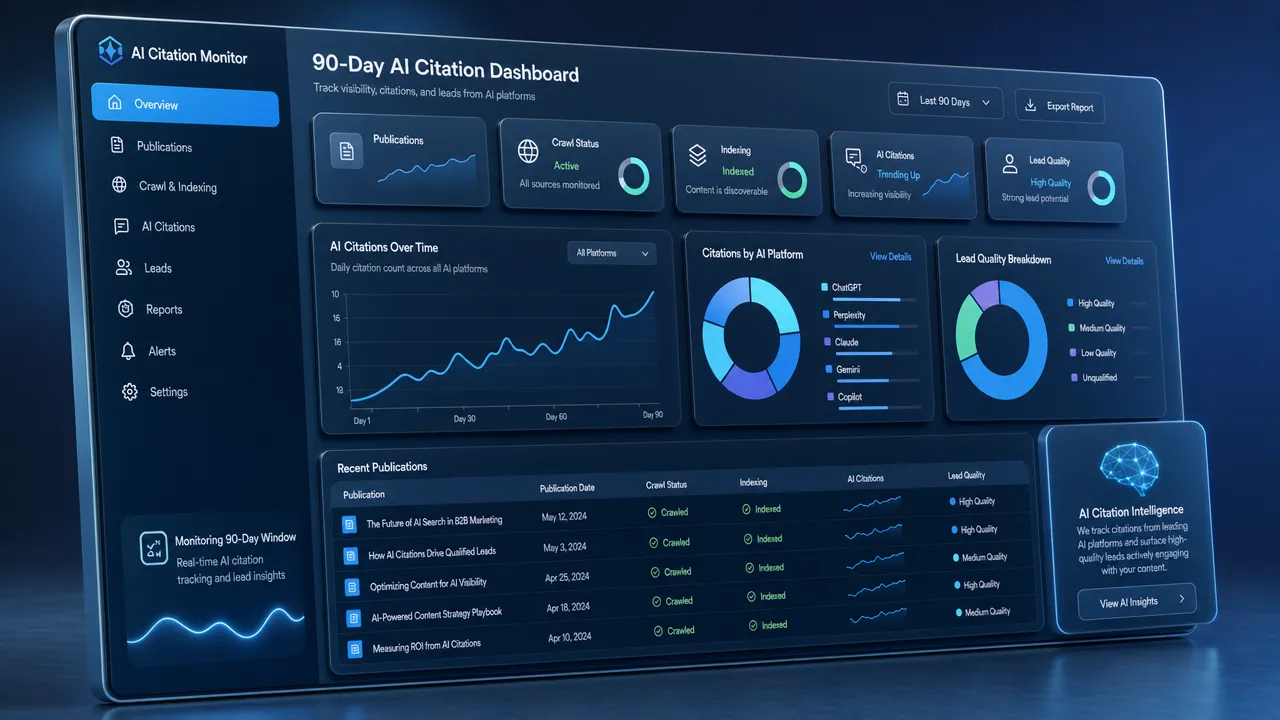
AI citation lag should be tracked as a sequence of timestamps, not as a single waiting period. Without intermediate milestones, teams guess. With milestones, the problem becomes diagnosable.
A practical tracking sheet should include these fields:
| Metric | Why it matters | Recommended check |
|---|---|---|
| Publication or update date | Sets the starting point | CMS and deployment log |
| First crawl date | Separates discovery delay from later problems | Server logs and URL inspection |
| First indexation date | Confirms search availability | Google Search Console and Bing Webmaster Tools |
| First relevant impression | Shows early query eligibility | Search Console query data |
| First ranking signal | Indicates retrieval potential | Rank tracking or Search Console |
| First AI answer mention | Shows answer-level inclusion even without citation | Manual prompt checks and screenshots |
| First visible AI citation | Measures the main AI citation lag endpoint | Platform screenshots and logs |
| Citation recurrence | Separates one-off citation from stable visibility | Weekly prompt retesting |
| Conversion signal | Connects visibility to business outcome | GA4, CRM, form submissions, call tracking |
The first two weeks should focus on access and discovery. Check whether the URL returns a 200 status, appears in the XML sitemap, has crawlable internal links, is not blocked by robots.txt, and does not carry an accidental noindex. If the page relies on JavaScript, compare the source HTML with the rendered page. The goal is to avoid spending month two rewriting content that crawlers could not properly process in month one.
Weeks three to six should focus on query fit and extractability. Review whether the page receives relevant impressions, whether the headings match real search questions, and whether the page contains short passages that could be cited. Add tables, definitions, and structured explanations where they genuinely improve clarity. Do not add schema as decoration. Google's structured data introduction is clear that structured data should describe visible page content, not replace it.
Weeks seven to twelve should focus on recurrence and commercial value. A single AI citation screenshot is useful evidence, but it does not prove stable AI search visibility. Track repeated prompts, compare citation frequency, and review whether the cited page sends users toward relevant service pages, product pages, contact forms, or audit requests. Citation without conversion is a partial win at best.
A simple 90-day workflow looks like this:

The framework also helps decide what to deprioritize. If a page is not indexed, do not spend the week debating CTA wording. If a page ranks but lacks citations, do not obsess over sitemap resubmission. If a page is cited but produces no inquiries, do not celebrate citation count without looking at conversion paths, trust proof, and buyer intent.
This is the type of operating discipline SeekLab.io applies in SEO audits and content programs. The aim is not to fix everything. The aim is to identify what truly affects growth, what can wait, and what should not be done at all because it sends the website in the wrong direction.
How to reduce AI citation lag without chasing shortcuts
Reducing AI citation lag starts with making the page eligible, then making it useful enough to cite. There is no special tag that forces AI citations. The reliable work is less glamorous: clean crawl paths, indexable pages, strong internal links, clear content structure, accurate entity signals, and content that answers specific user questions better than generic alternatives.
Use this checklist before publishing or refreshing a citation-focused page:
| Area | What to verify | Why it reduces citation delay |
|---|---|---|
| Crawlability | The URL is internally linked, in the sitemap, and not blocked | AI systems depending on search retrieval need discoverable pages |
| Indexability | Canonical, noindex, robots, and status codes are correct | Non-indexable pages are unlikely citation candidates |
| Rendering | Main content, links, and schema are available in rendered HTML | JavaScript failures can delay or distort understanding |
| Internal linking | Related hubs and service pages link to the content | Search systems understand importance and topic relationships |
| Answer structure | Direct answers appear near relevant headings | AI systems can extract concise evidence more easily |
| Evidence quality | Tables, definitions, examples, and dated claims are present | The page becomes more source-worthy |
| Entity clarity | Brand, service, author, region, and product names are consistent | AI systems can associate the page with the right topic |
| Multilingual setup | Hreflang, canonicals, and localized URLs are clean | Regional citation paths become less confusing |
| Conversion path | CTA, contact route, and internal links match the intent | Visibility has a route to inquiries |
For content teams, the biggest improvement often comes from replacing broad paragraphs with usable evidence blocks. For example, a weak section says: "AI search is changing how users find information, so brands need better content." A citation-ready section says: "AI citation lag is the delay between publishing a page and the first visible source link to that page in an AI-generated answer. It is usually longer than indexing lag because the page must also be retrieved, selected, and displayed as evidence." The second version is easier to quote, verify, and cite.
For developers, the priority is to remove hidden blockers. Check robots.txt, canonical tags, sitemap quality, rendered HTML, crawl depth, and page performance. Google's crawling and indexing documentation is still the foundation. AI-era discoverability does not cancel technical SEO; it makes sloppy technical execution more expensive because one broken template can suppress hundreds of otherwise useful pages.
For international websites, do not translate every article and hope AI citations follow. Prioritize markets where the topic has real demand, localize the intent, and build language-specific internal links. A page targeting Singapore, Europe, and the United States may need different examples, terms, product pathways, and schema details. SeekLab.io is especially relevant for brands operating across Asia-Pacific, the United States, and Europe, with teams and legal entities in Singapore and Shanghai and business development support in Dubai.
For commercial teams, the final question is not "Did we get cited?" It is "Did the citation support qualified discovery and conversion?" A cited educational article should lead readers to a relevant audit, consultation, product category, or service explanation. SeekLab.io helps brands build search visibility and AI-era discoverability through high-quality content production and technical optimization, but the work remains tied to business outcomes: better information clarity, stronger page architecture, useful internal links, credible content assets, and higher conversion potential.
If your page is still not cited after 60 to 90 days, use the delay as evidence rather than frustration. Identify whether the issue is technical eligibility, weak query fit, poor extractability, lack of authority, multilingual confusion, or conversion mismatch. Then fix the highest-impact bottleneck first.
SeekLab.io supports this process with full-site crawling, structured SEO audits, Core Web Vitals diagnostics, indexing and JavaScript compatibility checks, internal link and semantic structure analysis, schema review, AI search friendliness and citation readiness evaluation, sitemap.xml and robots.txt validation, topic selection, high-quality blog creation, and monthly performance reporting. Some simple technical issues can be resolved for clients free of charge, and customized content can be provided based on business needs.
Contact us if you need a practical review of why your indexed pages are not earning AI citations, which fixes matter most, and which tasks can be deprioritized before your team spends another quarter publishing in the wrong direction.