AI Startup SEO Roadmap: How to Build Search Visibility from Zero
Expert reviewed

An AI startup SEO roadmap should make the company and its products discoverable, understandable, verifiable, and convertible before the team scales blog publishing.
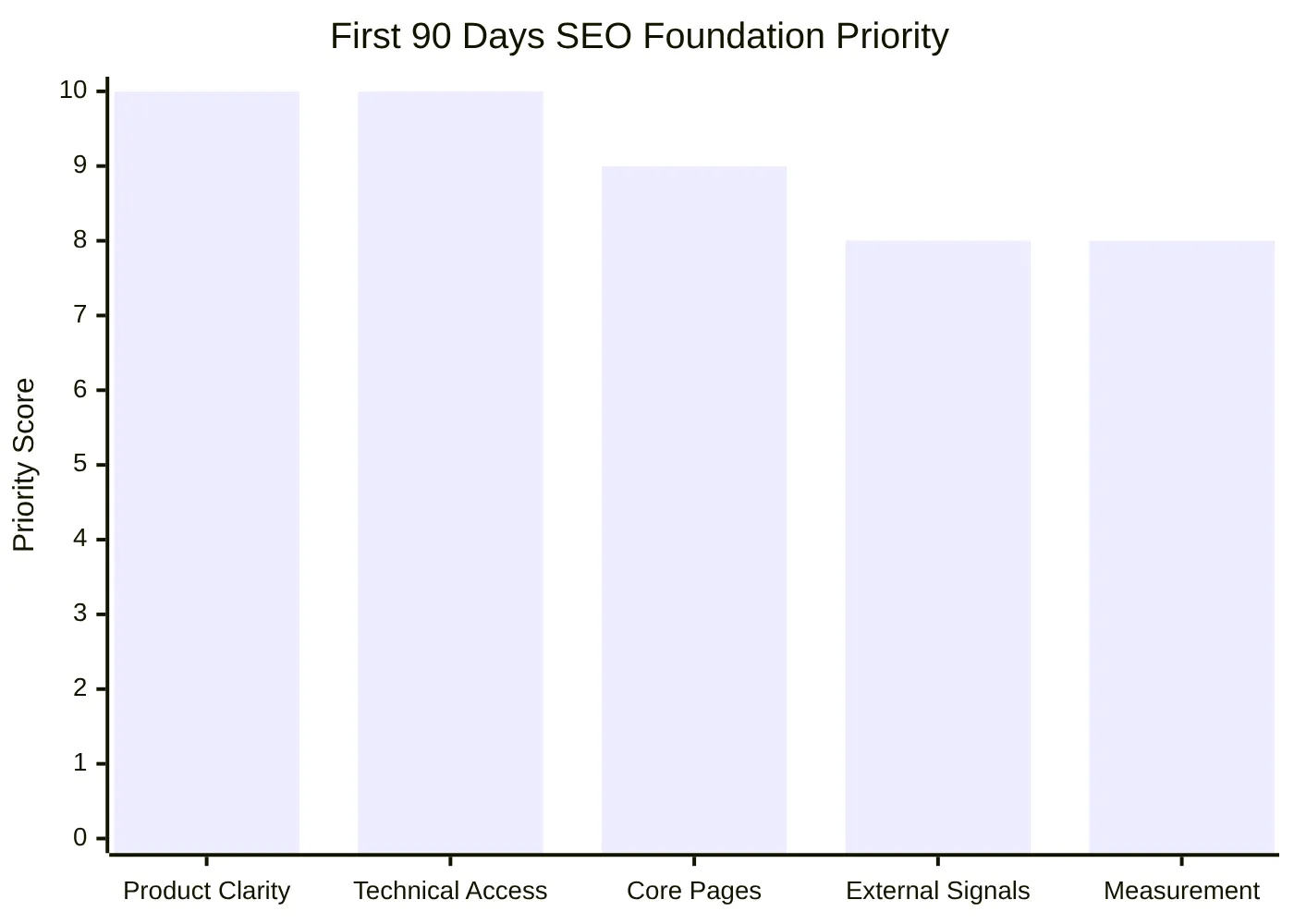
Early-stage AI companies should treat the first 3 months as visibility infrastructure work. The required sequence is product clarity, technical access, structured pages, external evidence, and measurement. Blog volume comes after these dependencies are stable.
For international expansion, the SEO roadmap for AI startups must also include GEO. GEO strategy for AI startups means building consistent external evidence across search engines, AI answer systems, directories, communities, creators, documentation, and third-party sources. It is not limited to rewriting website copy.
AI startup SEO roadmap for the first 3 months
Use the first 90 days to build a search-ready operating system. Do not begin with random posts about generic AI topics. Start with the pages and signals that explain what the product is, who it serves, how it works, and what the user should do next.
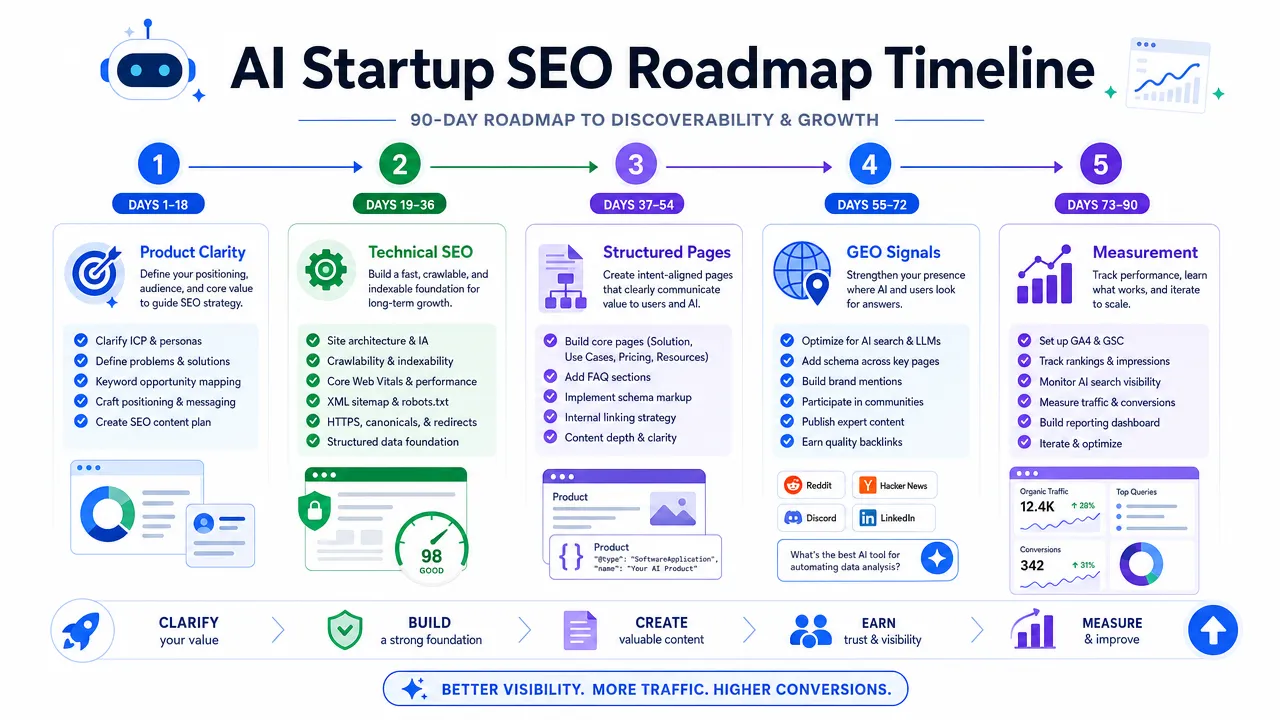
Use this order for the first 3 months:
| Month | Main objective | Required work | Output |
|---|---|---|---|
| Month 1 | Make the product understandable and indexable | Brand map, product map, technical audit, GSC, Bing Webmaster Tools, GA4, sitemap, robots.txt, canonicals, rendering checks | Search foundation report and technical fix backlog |
| Month 2 | Build structured product-led pages | Homepage, product pages, feature pages, use cases, FAQ, docs, metadata, schema, internal links, CTAs | Core page system and free external signal tracker |
| Month 3 | Expand into validation and high-intent content | Comparison pages, category pages, launch updates, creator outreach, directory review, paid validation if appropriate | Performance review and next-quarter SEO/GEO plan |
Use this dependency chart before assigning writing tasks:
Month 1 should answer these questions:
- What is the parent brand?
- What products does the company offer?
- Which products have separate domains, app subdomains, or documentation sites?
- Which pages should rank?
- Which pages should convert?
- Which pages should support citations, summaries, reviews, or external mentions?
- Which markets and languages matter first?
- Which product pages need to be preserved from acquired products?
Create a product clarity map before publishing new content.
| Element | Required decision | Risk if skipped |
|---|---|---|
| Parent brand | Define company name, product suite, and trust proof | Search engines and users may not understand ownership |
| Product brands | Define each product and its category | Product pages compete or look unrelated |
| User segments | Define buyer, user, and technical evaluator | Use-case pages become generic |
| Conversion paths | Define signup, demo, trial, docs, API key, or pricing path | Organic traffic does not produce business action |
| Domains | Define marketing site, app, docs, checkout, and acquired domains | Tracking and indexing become fragmented |
| International structure | Define language, market, and URL handling | Global pages compete or duplicate each other |
For a multi-product AI SaaS portfolio, create a product suite page. Link from the homepage to the suite page, from the suite page to each product page, and from each product page to feature, use-case, pricing, documentation, and conversion pages.
If the company has acquired products, do not redirect every acquired domain to the parent homepage. Audit traffic, rankings, backlinks, indexed pages, brand searches, content assets, technical dependencies, and risk profile first. Preserve or migrate high-value URLs to the closest equivalent page.
Use a website audit before expansion. The audit should check broken links, crawlability, robots.txt, sitemap validation, indexability, canonical tags, hreflang, performance, schema issues, and internal link depth.
AI startup SEO roadmap for technical access and measurement
Technical SEO is a first-month requirement. Search engines must be able to discover, crawl, render, index, and measure the site before content expansion has value.
Google's documentation on crawling and indexing should be the baseline reference. Google's SEO Starter Guide also reinforces clear site structure, useful pages, descriptive titles, and internal links.
Complete these tasks in Month 1:
- Verify Google Search Console.
- Verify Bing Webmaster Tools.
- Submit sitemap.xml.
- Review robots.txt.
- Check noindex tags.
- Check canonical tags.
- Test JavaScript rendering.
- Review redirects and status codes.
- Measure Core Web Vitals.
- Configure GA4 events and conversions.
- Configure cross-domain tracking when the marketing site, app, docs, checkout, or acquired domains are separate.
- Build a technical fix backlog with owners and deadlines.
Use Google's JavaScript SEO guidance when the site uses modern frameworks. Critical product copy, navigation links, pricing links, and CTA links should be visible after rendering. Important content should not depend on fragile client-side behavior.
Use Google's Core Web Vitals documentation to evaluate page templates. Prioritize homepage, product pages, pricing pages, docs pages, and high-intent use-case pages.
Use Bing Webmaster Tools for Bing indexing and diagnostics. Do not treat Bing as optional during international expansion. Bing also supports discovery across Microsoft search surfaces.
Use GA4 configuration guidance to define conversion events. Track signups, demo requests, pricing clicks, API key creation, documentation visits, trial starts, and contact form submissions.
Use GA4 cross-domain measurement when the user journey crosses domains or subdomains. Common AI startup paths include marketing site to app, product page to docs, docs to API signup, and homepage to checkout.
Technical checklist:
| Area | Required check | Correct result |
|---|---|---|
| robots.txt | Confirm important pages are crawlable | Homepage, product pages, docs, pricing, and resources are not blocked |
| sitemap.xml | Submit clean URL list | Only canonical, indexable URLs are included |
| Canonicals | Check duplicate and parameter URLs | Canonical tags point to preferred URLs |
| Indexability | Check noindex and blocked resources | Core pages are eligible for indexing |
| JavaScript rendering | Inspect rendered HTML and links | Main content and navigation are visible |
| Core Web Vitals | Review LCP, INP, and CLS by template | Key templates meet acceptable performance targets or have fixes assigned |
| Search Console | Review indexing, sitemap, URL inspection, and performance | Diagnostics are available before launch activity |
| Bing Webmaster Tools | Submit and monitor the site | Bing diagnostics are active |
| GA4 | Configure conversions | Organic and referral traffic can be tied to actions |
| Cross-domain tracking | Test sessions across domains | User journeys are not split incorrectly |
For teams that need an operational starting point, SeekLab's technical-first global visibility context explains why SEO and GEO work should be connected to crawlability, measurement, and revenue pathways.
AI startup SEO roadmap for structured pages, metadata, schema, and CTAs
Build the core page system before scaling blog content. The first content layer should include homepage, product pages, feature pages, use-case pages, pricing pages, FAQ pages, documentation pages, comparison pages, resource pages, and launch or update pages.
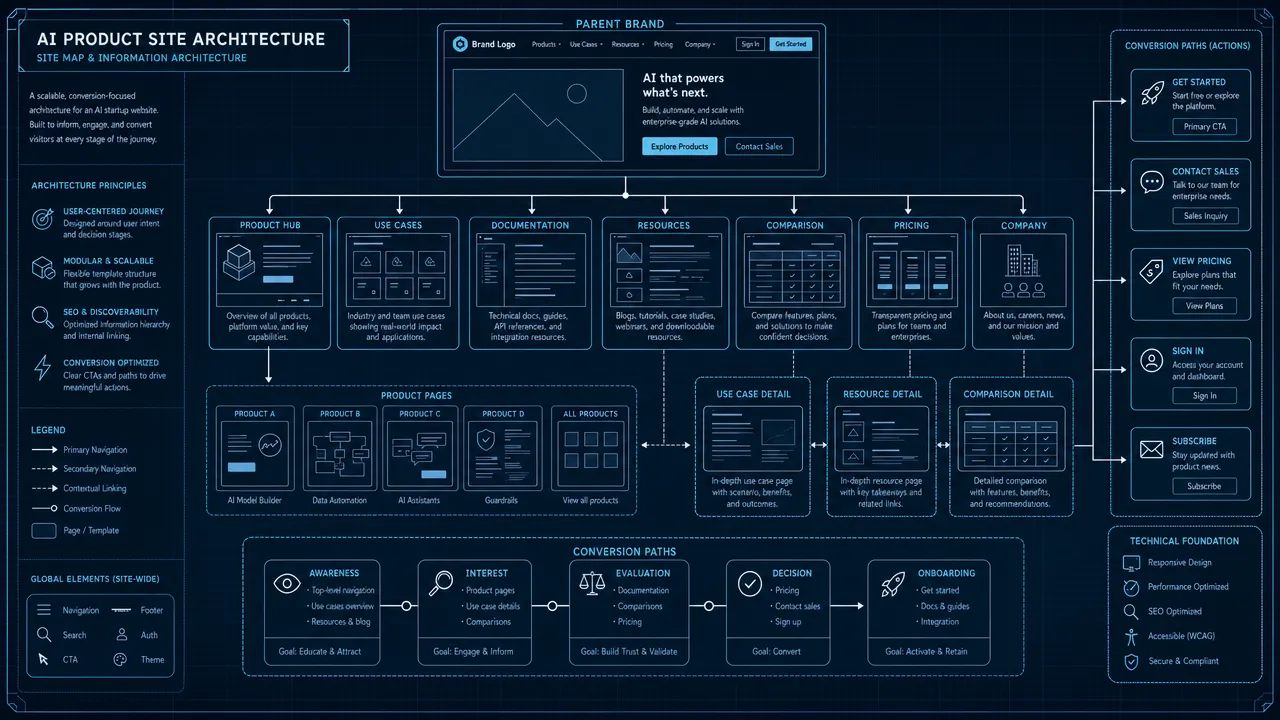
Each page must have one job. Do not ask a single page to explain the whole company, rank for every category term, compare every competitor, and convert every audience segment.
Use this page matrix:
| Page type | Function | Required elements | CTA |
|---|---|---|---|
| Homepage | Define the company and product category | Positioning, product summary, audience, trust proof, product links | Explore products, start free, book demo |
| Product page | Explain one product | Product description, features, use cases, proof, screenshots or video, FAQ | Try product, view pricing, book demo |
| Feature page | Explain one capability | Workflow, examples, related use cases, product link | Try feature, see use case |
| Use-case page | Match product to a task or role | User problem, workflow, product fit, examples, FAQ | Try workflow, request demo |
| Pricing page | Support purchase evaluation | Plans, limits, terms, FAQ, trust signals | Start plan, contact sales |
| FAQ page | Reduce objections | Real customer questions and concise answers | Start trial, contact support, read docs |
| Documentation | Support activation and trust | Setup steps, API examples, integrations, troubleshooting | Create account, get API key |
| Comparison page | Support evaluation | Workflow differences, audience fit, use cases, public pricing notes if verified | Compare plans, try product |
| Resource page | Support education and citation | Definitions, tables, examples, sources | Read related product page |
| Launch/update page | Explain product changes | What changed, who it helps, screenshots, release notes | Try update, join waitlist |
Metadata should describe the page clearly in search results. Avoid vague titles such as "AI Tools for Everyone." Use product category and audience.
Examples:
| Page | Title pattern | Description pattern |
|---|---|---|
| Homepage | BrandName - AI Video Platform for Marketing Teams | Create, localize, and test AI video campaigns from one workflow. |
| Product page | ProductName - AI Agent Builder for Customer Support | Build support agents with workflow controls, documentation access, and human handoff. |
| Use-case page | AI Video Ads for Ecommerce Brands | ProductName | Generate product videos, ad variations, and localized creatives for ecommerce campaigns. |
| Comparison page | ProductName vs Alternative: Workflow and Use Case Comparison | Compare workflows, audience fit, integrations, and setup requirements. |
Schema should add structured clarity. Use Google's structured data documentation and schema.org as implementation references.
Recommended schema types:
| Schema type | Use case |
|---|---|
| Organization | Parent company identity |
| WebSite | Site-level identity |
| SoftwareApplication | AI SaaS product pages |
| WebApplication | Browser-based AI tools |
| FAQPage | Genuine FAQ sections visible on the page |
| Article | Resource pages |
| BlogPosting | Blog posts |
| BreadcrumbList | Site hierarchy |
| ItemList | Product lists, comparison lists, resource lists |
Schema must match visible content. Do not add FAQPage schema to hidden or non-FAQ content. Do not use schema to claim reviews, ratings, or product attributes that are not present on the page.
Internal links should explain relationships. Use descriptive anchor text and connect pages in a deliberate pattern:
- Homepage to product hub.
- Product hub to product pages.
- Product pages to feature pages.
- Feature pages to use-case pages.
- Use-case pages to pricing, demo, or signup.
- Blog and resources to relevant product and use-case pages.
- Documentation to signup, API, integration, and support paths.
- Comparison pages to product pages and docs.
CTAs should match page intent. A documentation page should not rely only on "Book demo." It may need "Create API key," "Start integration," or "View SDK." A comparison page should offer "Compare plans" or "Try ProductName." A use-case page should offer "Try this workflow."
For related implementation context, use SeekLab's guide on adapting content from SEO to GEO. For a practical definition of GEO, use SeekLab's article on what GEO means in practice. For service-level planning, reference SeekLab's SEO and GEO service structure.
AI startup SEO roadmap for GEO signals and external validation
GEO strategy for AI startups should create a consistent external evidence layer. AI answer systems, search users, creators, buyers, and journalists do not evaluate only the official website. They also inspect third-party pages, community discussions, documentation, launch platforms, directories, social profiles, reviews, videos, and media mentions.

Use external signals to answer four questions:
- What is the product?
- Who uses it?
- What workflow does it support?
- Why should a buyer, creator, developer, or AI search system trust the description?
Google's AI features guidance still points site owners back to Search fundamentals. The practical requirement is clear: make useful, accessible, well-structured pages and support them with credible signals. The original GEO academic paper is useful for understanding generative engine optimization as a research concept, but implementation should remain grounded in verified search documentation and measurable external evidence.
Separate free and paid signals.
| Signal type | Examples | Use | Risk control |
|---|---|---|---|
| Free launch platforms | Product Hunt, BetaList | Establish a third-party product page and launch narrative | Prepare landing page, assets, tracking, and comments before launch |
| Free communities | Reddit, Hacker News, Indie Hackers, Discord | Collect feedback and create discussion history | Do not use aggressive self-promotion |
| Free developer evidence | GitHub, GitBook, Dev.to, documentation sites | Support technical trust and developer adoption | Keep docs accurate and maintained |
| Free social profiles | LinkedIn, X / Twitter | Keep product name, description, and URL consistent | Avoid inactive or conflicting profiles |
| Free publishing | Medium, Substack, company blog | Explain product thinking, launch story, and category context | Avoid thin reposting |
| Free AI directories | Relevant AI tool directories | Build early product definition and referral discovery | Filter low-quality or scraped directories |
| Paid directory listings | Featured directory placements | Accelerate exposure in relevant categories | Select only indexed directories with real audience fit |
| Paid newsletters | Niche AI, SaaS, developer, creator newsletters | Reach category-relevant users | Match audience to product use case |
| Paid YouTube reviews | Creator demos and workflow reviews | Provide visual proof and search discovery | Require disclosure where applicable |
| Paid blogger reviews | Niche review blogs | Add third-party explanation and comparison context | Avoid unsupported claims |
| Digital PR | Launch PR, funding news, original data | Build broader validation | Use only when the story is credible |
| Community sponsorships | Discord, newsletter, developer communities | Enter relevant communities with visibility | Sponsor communities where participation is real |
Paid external signals should not be treated as bulk link buying. The goal is credible third-party evidence, referral traffic, consistent product descriptions, and useful validation.
Use this quality filter before accepting any external placement:
| Criterion | Required standard |
|---|---|
| Relevance | The audience matches the product category or user segment |
| Credibility | The site or creator has real readers, viewers, or community trust |
| Indexability | The page can be crawled and discovered |
| Consistency | Product name, category, description, and URL match official pages |
| Referral potential | The placement can send qualified users |
| Longevity | The page or video is likely to remain available |
| Disclosure | Sponsored content follows platform and advertising rules |
The AI product SEO strategy should include external signals only after the landing pages and tracking are ready. Sending Product Hunt, newsletter, or creator traffic to an unclear page wastes the placement.
For free signals, prepare a product profile kit:
- Product name.
- One-sentence description.
- Product category.
- Primary user segment.
- Core use cases.
- Official homepage URL.
- Product page URL.
- Demo or signup URL.
- Documentation URL.
- Logo and screenshots.
- Founder or company profile.
- Short FAQ.
- Launch announcement copy.
For paid signals, prepare a review brief:
- What the product does.
- Who should use it.
- What workflow should be tested.
- What claims are supported.
- What should not be claimed.
- Required disclosure language.
- Correct product links.
- Measurement UTM plan.
Use Product Hunt and BetaList as launch-platform references. Use them only when the product page, onboarding, analytics, and support path are ready.
AI startup SEO roadmap checklist for content, comparisons, acquisitions, and measurement
Content scaling should begin after the product pages, technical access, schema, internal links, CTAs, and initial external signals are in place.
Start with product-led content:
| Content type | Purpose | Example for AI startups |
|---|---|---|
| Product pages | Define the product | AI video platform, AI agent builder, AI marketing automation tool |
| Feature pages | Capture capability intent | AI video localization, campaign automation, agent handoff, prompt library |
| Use-case pages | Match workflow intent | AI video ads for ecommerce, AI agents for support, AI creative variations for agencies |
| FAQ pages | Answer objections | Data handling, pricing limits, integrations, output rights, setup time |
| Documentation | Support activation | API setup, SDK guide, integration tutorial, troubleshooting |
| Launch/update pages | Create freshness and product proof | New model support, new workflow, new integration, new template set |
| Comparison pages | Support evaluation intent | Workflow comparison, category fit, migration notes |
| Resource pages | Support citation and education | Glossaries, frameworks, checklists, benchmark explanations |
Blog content can scale later. Select topics based on:
- Real search intent.
- Product use cases.
- Sales objections.
- Documentation gaps.
- Customer questions.
- Competitor content gaps.
- Community questions.
- GEO citation potential.
- Conversion pathway relevance.
Do not choose random high-volume keywords that do not match product positioning. A startup building AI agents for customer support should not publish broad "best AI image generators" content unless the product directly supports that use case.
Comparison pages can work when they support decisions. They should explain category differences, workflow differences, audience fit, integrations, setup requirements, pricing model differences where publicly verified, and migration considerations.
Do not write aggressive attack pages. Do not invent feature gaps. Do not publish automated competitor pages at scale. Use comparison content to help buyers decide.
Use this comparison page structure:
- Neutral summary.
- Best-fit table.
- Workflow comparison.
- Feature comparison.
- Use-case fit.
- Integration notes.
- Pricing or plan notes from verified public sources.
- Migration considerations.
- FAQ.
- CTA to product, trial, demo, or documentation.
Public competitor patterns can provide useful lessons without copying their strategy. Question-research tools show the value of narrow positioning, use-case pages, help content, documentation, pricing paths, and product-aligned resources. Early AI startups should adapt the structure, not the messaging.
Acquired products require a separate SEO process.
Audit each acquired product before redirects:
| Audit area | Check | Decision |
|---|---|---|
| Organic traffic | Top landing pages, countries, query types | Preserve or migrate valuable pages |
| Rankings | Branded and non-branded terms | Map ranking pages to equivalent URLs |
| Backlinks | Quality, anchors, referring domains | Preserve linked pages or redirect carefully |
| Indexed pages | Index count, duplicates, thin pages | Prune, canonicalize, or migrate selectively |
| Brand searches | Demand for acquired product name | Keep a dedicated product brand page if needed |
| Content assets | Docs, guides, templates, examples | Integrate valuable assets into docs or resource hub |
| Risk profile | Spam links, thin content, policy issues | Clean before migration |
| Technical setup | Canonicals, hreflang, redirects, app routes | Build and test URL mapping |
| Conversion paths | Signup, app, docs, pricing | Protect revenue and activation |
| Analytics | GSC, GA4, historical data | Keep benchmarks for migration monitoring |
Use selective 301 redirects. Map old URLs to the closest equivalent page. Do not send all acquired URLs to the parent homepage. Keep canonical strategy clear when content is duplicated or syndicated. Monitor Google Search Console and GA4 after migration.
Measurement should connect visibility to business action. Do not evaluate the first 3 months only by traffic.
Track these metrics:
| Category | Metrics |
|---|---|
| Technical readiness | Indexed pages, crawl errors, sitemap status, robots issues, canonical problems, Core Web Vitals |
| Search visibility | Branded impressions, non-branded impressions, query growth, page-level performance |
| External evidence | Directory listings, Product Hunt traffic, BetaList traffic, community mentions, creator reviews, newsletter referrals |
| Engagement | CTA clicks, pricing clicks, documentation visits, video/demo clicks |
| Conversion | Signups, demo requests, trial starts, API key creation, contact forms |
| Quality control | Duplicate pages, weak pages, declining pages, outdated docs, inconsistent descriptions |
Use this 90-day scoring model for internal review:
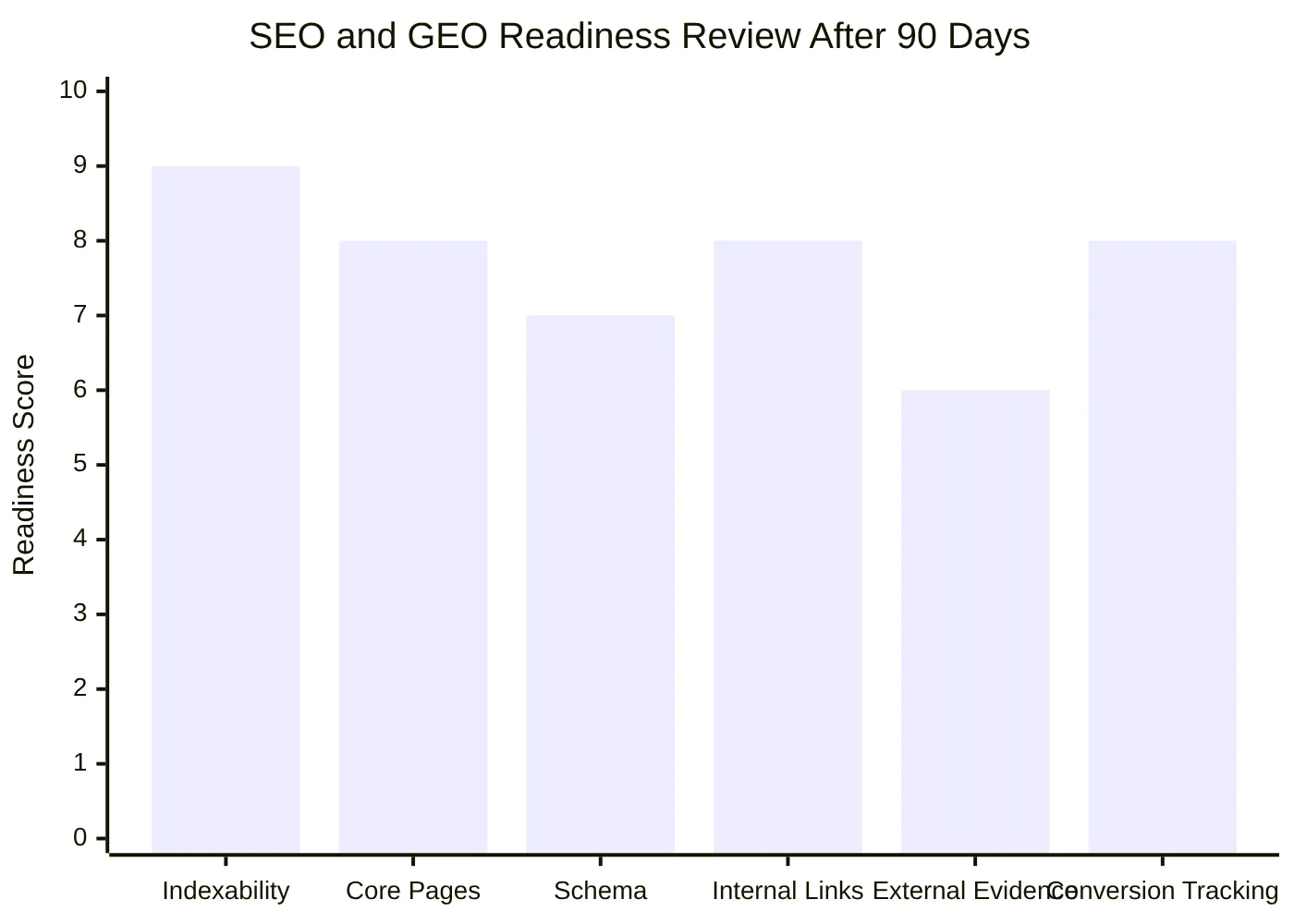
Use the scores to prioritize the next quarter. A low external evidence score requires directory, community, creator, and PR work. A low schema score requires template fixes. A low conversion tracking score requires analytics repair before additional campaigns.
Final operating checklist:
- Define parent brand, product brands, users, use cases, and conversion paths.
- Audit crawlability, robots.txt, sitemap.xml, canonicals, indexability, rendering, and Core Web Vitals.
- Verify Google Search Console and Bing Webmaster Tools.
- Configure GA4 conversions and cross-domain tracking.
- Build homepage, product pages, feature pages, use-case pages, pricing, FAQ, docs, and demo/contact pages.
- Add metadata, schema, breadcrumbs, internal links, and page-specific CTAs.
- Create consistent external profiles and launch assets.
- Build free external signals before paid validation.
- Use paid placements for credibility, audience fit, and referral traffic, not bulk links.
- Publish comparison pages only when they help buyers evaluate workflow fit.
- Audit acquired products before redirecting or migrating pages.
- Measure indexed pages, impressions, referral traffic, CTA clicks, signups, demo requests, and third-party mentions.
The first goal is operational clarity. Once the company and products are discoverable, understandable, verifiable, and measurable, content scaling becomes safer and more useful.