From Zero to 61 AI-Cited Pages in Six Months: A New Domain Case Study
Expert reviewed

A new domain reached 61 AI-cited pages in six months because the SEO work followed the right order: technical access first, topic direction second, structured content third, and measurement every month.
This new domain SEO case study is not a promise that every fresh website can repeat the same number. The 61 AI-cited pages figure is a measured case-study outcome. AI citations can change by platform, prompt wording, location, language, personalization, and timing, so the useful lesson is the operating sequence behind the result.
The practical pattern was clear: make the site crawlable and indexable, remove high-impact technical blockers, choose topics a new domain could realistically compete for, create pages with strong structure and useful evidence, connect content through internal links, add schema where it matched visible content, and review search and citation signals monthly. That combination created early search visibility for new domains without relying on low-quality content or manipulative tactics.
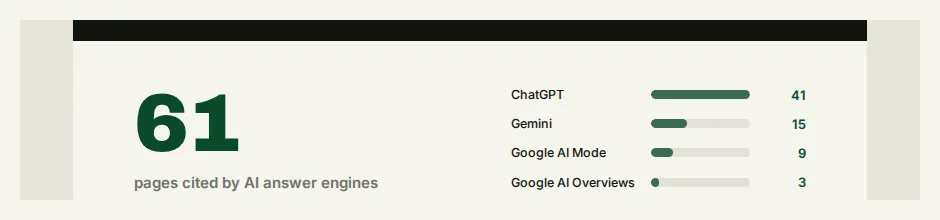
Citation breakdown by platform at the six-month mark: ChatGPT 41, Gemini 15, Google AI Mode 9, Google AI Overviews 3.
How the site moved from zero to 61 AI-cited pages
The case started with a new domain that had no meaningful search footprint. That means no established topical authority, no reliable crawl history, no mature internal link graph, and no historical performance data to lean on. For a new official company website, that is normal. It also means early SEO work has to be disciplined, because random publishing can create more noise than growth.
By the end of the six-month period, 61 pages were observed as cited in AI-generated answer experiences during tracked checks. This number should be treated as a discoverability signal, not a replacement for rankings, clicks, leads, or revenue.
| Case element | What was measured or handled | Source and interpretation |
|---|---|---|
| Starting point | New domain with no established search footprint | Measured in tracked checks |
| Result period | Six months | Measured in tracked checks |
| Headline outcome | 61 AI-cited pages | Measured in tracked checks |
| Main operating model | Audit, technical readiness, topic strategy, content production, internal linking, schema, monthly review | Based on case method and SeekLab.io service scope |
| Main caution | Citation count does not guarantee recurring visibility or clicks | Based on measurement limitations and platform volatility |
The strongest part of the result is not the number alone. The stronger signal is that the pages became understandable enough to be discovered, indexed, evaluated, and referenced in some AI-generated answer contexts. That usually does not happen from content volume alone.
Google's own guidance on generative AI features emphasizes that pages need to meet Search technical requirements and be eligible to appear with snippets. The practical implication is simple: a page that cannot be crawled, indexed, rendered, or previewed properly has a weak foundation for both traditional search and AI-era discovery. See Google's guidance on optimization for generative AI features in Search and AI features and website controls.
This is why SeekLab.io treats early growth as a sequence rather than a content race. The team focuses on what actually affects growth and what can be deprioritized. A new domain does not need every minor warning fixed before publishing, but it does need the right pages accessible, clear, fast enough, internally linked, and aligned with buyer intent.
For teams that want to check whether their own site has similar constraints, the SeekLab.io audit workflow is designed to review crawlability, indexing, on-page structure, technical foundations, international SEO, URL structure, resources, media, and advanced issues before content is scaled.
What 61 AI-cited pages means, and what it does not prove
An AI-cited page is a page observed as being referenced or cited in an AI-generated answer experience during a defined check. In this case, the result was 61 observed pages by the end of six months. A credible tracking sheet should record the platform, prompt, date, cited URL, market or language setting, and screenshot evidence where available.
This measurement is useful because it adds a discovery layer beyond classic ranking reports. A page may not rank in the top few blue links for a broad keyword, but it may still be referenced for a specific question if the content is structured, clear, and relevant enough. That matters for content marketing case study analysis because users increasingly encounter answers before they decide which site to visit.
It is also easy to misuse the metric. A cited page may not receive a click. A citation may appear for one prompt and disappear for a similar prompt. Search Console data and citation tracking do not come from the same measurement system. A serious website traffic growth case study should not treat AI citations as a vanity number or a guaranteed conversion channel.
| Measurement layer | What it tells you | What it does not tell you |
|---|---|---|
| Indexed pages | Search engines can include pages in search results | The pages will rank or be cited |
| Impressions | Pages are appearing for some queries | Users found the pages persuasive |
| Organic clicks | Users visited from search | The traffic was commercially useful |
| AI-cited pages | Pages were referenced in tracked AI-generated answers | Citations will repeat or produce leads |
| Audit requests and inquiries | Search may be supporting business outcomes | SEO alone caused every conversion |
Pew Research has observed that AI summaries can change click behavior and may cite multiple sources, but those observations are not a formula for earning citations. The safer reading is that source visibility is becoming more fragmented, so websites need pages that are easy for search engines, AI systems, and real users to understand. See Pew's research on how AI summaries affect search behavior.
SeekLab.io's internal approach to citation readiness is grounded in practical checks: crawl and index status, rendered content, information clarity, heading structure, source support, internal links, schema consistency, and content usefulness. For related reading on this measurement challenge, SeekLab.io has covered the timing problem in AI citation tracking and citation lag and the content structure side in core strategies for answer-source readiness.

The supporting metrics behind the citation count: keyword coverage, referring domains, and backlink growth from a standing start.
A responsible tracking method would include:
| Tracking field | Why it matters |
|---|---|
| Prompt wording | Small wording changes can change cited sources |
| Platform checked | Different systems may cite different pages |
| Date and time | Citations can appear and disappear |
| Country or language setting | International websites may behave differently by market |
| Cited URL | Confirms whether the page or another URL was referenced |
| Screenshot evidence | Makes the result auditable |
| Related query intent | Shows whether the citation supports a real buyer or research need |
The key warning for a new domain is simple: do not chase citations before the site is technically eligible and commercially coherent. A page that answers a question but leads nowhere useful may create visibility without inquiry value. A page that is technically blocked may never get a fair chance, no matter how well it is written.
The six-month execution sequence
The six-month SEO results came from removing constraints in order. Month 1 focused on access and measurement. Month 2 focused on technical readiness. Months 3 and 4 focused on topic selection and structured content. Month 5 focused on indexation and citation monitoring. Month 6 focused on performance review and conversion quality.
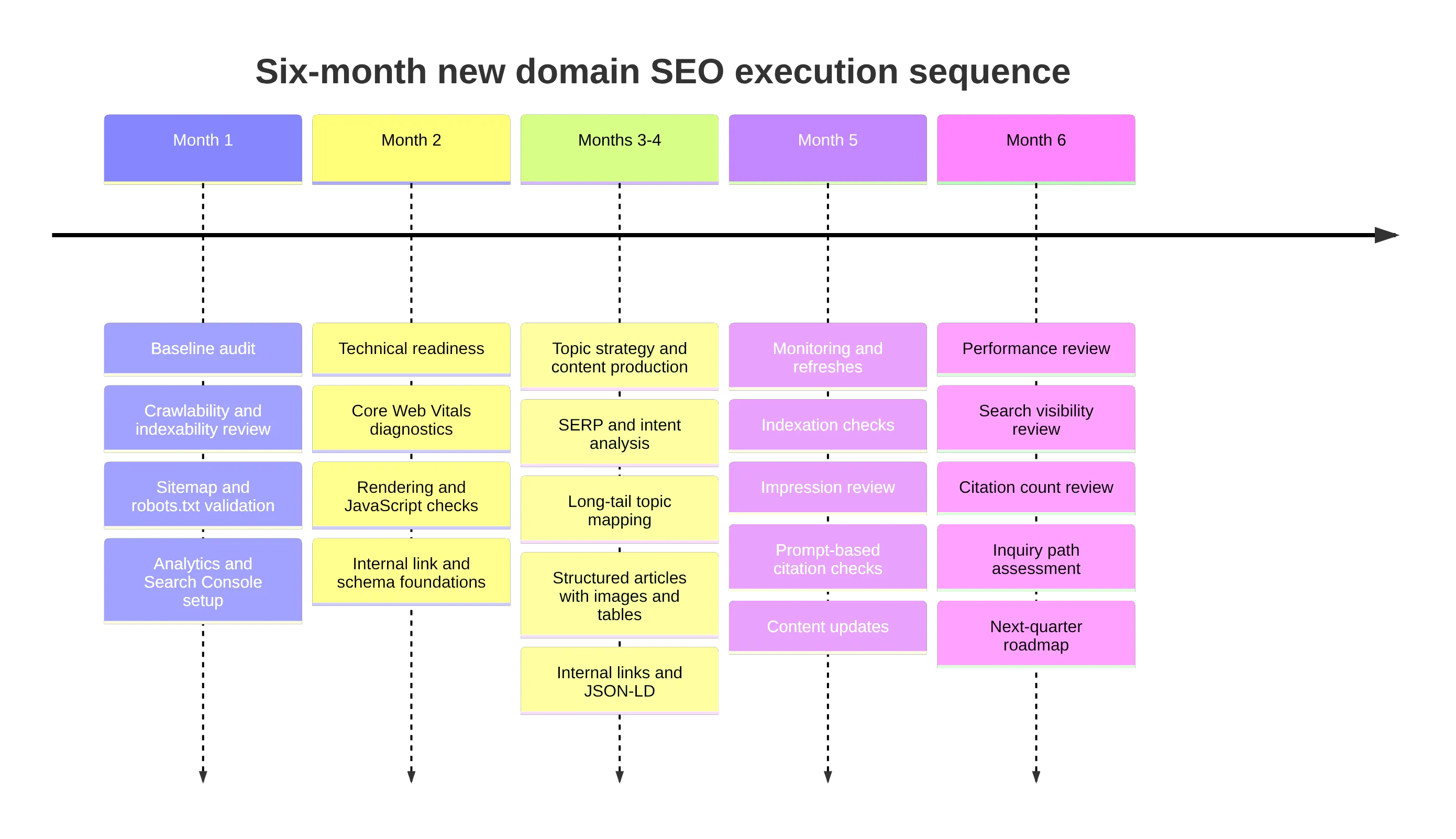
The first practical decision was to audit before scaling. New domains often have avoidable issues: pages in the sitemap that are not canonical, important links rendered in ways crawlers struggle with, thin templates, blocked resources, weak mobile performance, or service pages buried too deep in the site architecture.
Google explains Search through crawling, indexing, and serving. That sequence matters because a new website cannot skip the first two steps and expect stable performance later. Google's How Search works documentation is still the cleanest public explanation of why technical access comes before performance analysis.
SeekLab.io's audit process includes full-site crawling and structured analysis, Core Web Vitals and page performance diagnostics, indexing, crawling, rendering, JavaScript compatibility checks, internal link equity analysis, semantic structure review, schema compliance, sitemap.xml and robots.txt validation, website tech stack analysis, and readiness review for AI-era discoverability.
The technical work was not about fixing everything. That distinction matters. Many new websites waste their first months polishing low-impact details while leaving important commercial pages three or four clicks deep, missing from navigation, or dependent on unstable JavaScript rendering. SeekLab.io prioritizes what truly affects growth and deprioritizes issues that do not block crawling, indexing, understanding, or conversion.
| Month | Main constraint removed | Practical work |
|---|---|---|
| Month 1 | Search systems needed reliable access | Crawl audit, sitemap check, robots.txt review, baseline analytics setup |
| Month 2 | Templates needed technical readiness | Rendering checks, Core Web Vitals diagnostics, schema planning, internal link foundations |
| Months 3-4 | The site needed relevant topical depth | Topic clusters, content briefs, expert-style articles, images, tables, internal links |
| Month 5 | Pages needed measurement and refinement | Indexing checks, impression review, prompt-based citation checks, refresh decisions |
| Month 6 | Visibility needed business interpretation | Traffic quality review, service-page paths, inquiry signals, expansion decisions |
JavaScript deserved special attention because many independent websites and official company websites are built with modern front-end frameworks. That is not a problem by itself. The risk appears when key content, titles, canonical tags, links, or product and service information are not reliably available after rendering. Google's JavaScript SEO guidance supports the same practical concern.
SeekLab.io has also documented a more applied checklist for this issue in technical JavaScript SEO and indexing solutions, including rendered HTML checks, crawlable links, blocked JS or CSS resources, SPA traps, critical tag stability, and Core Web Vitals pressure points.

The shape that matters more than the number: little visible movement for three months, then a sharp break upward as the foundation compounded.
The content work started only after the foundation was usable. That prevented a common failure pattern: publishing 50 articles, waiting three months, and then discovering that half the pages were poorly linked, slow, duplicated, or not indexed. For a new domain, every published page should have a job. Some pages capture long-tail questions. Some support service understanding. Some build topical depth. Some move a reader toward an audit request or contact form.
This is where the content marketing case study angle becomes important. The team did not just "find keywords." Topic selection considered user intent, contextual scenarios, SERP formats, AI-generated answer structures, brand knowledge, industry knowledge, and commercial relevance. The better early targets were not broad generic phrases. They were specific questions and long-tail topics a new domain could credibly answer.
| Weak early content direction | Better new-domain direction |
|---|---|
| Broad, generic SEO topic with high competition | SEO strategy for new websites with specific technical and content constraints |
| Article written only for search volume | Page mapped to buyer questions, service relevance, and internal links |
| No visual support | Images, tables, process diagrams, and examples |
| Standalone blog post | Clustered page with links to related service and support content |
| No measurement plan | Indexation, impressions, rankings, citations, and inquiry paths reviewed monthly |
Google's guidance on creating helpful content supports the same direction: content should serve people first, show clear value, and avoid being made primarily to attract search traffic. In practical business terms, that means an article should help a skeptical operations manager understand what to do next, not just repeat definitions.
For structured data, the case followed a conservative rule: schema should describe what is actually visible on the page. Google's structured data introduction explains that structured data helps Google understand page content and can enable eligible enhancements, but it is not a shortcut for weak content.
Internal links were another controllable advantage. New domains usually cannot manufacture trust overnight, but they can build a clear architecture. Hub pages, related articles, breadcrumbs, descriptive anchors, and links from educational content to relevant service pages help users and crawlers understand which pages matter.
Why technical readiness and content quality had to work together
Technical SEO without useful content gives search systems a clean but thin site. Content without technical readiness gives users and crawlers assets that may be hard to discover, render, index, or trust. The result in this case came from combining both sides, then reviewing what actually moved.
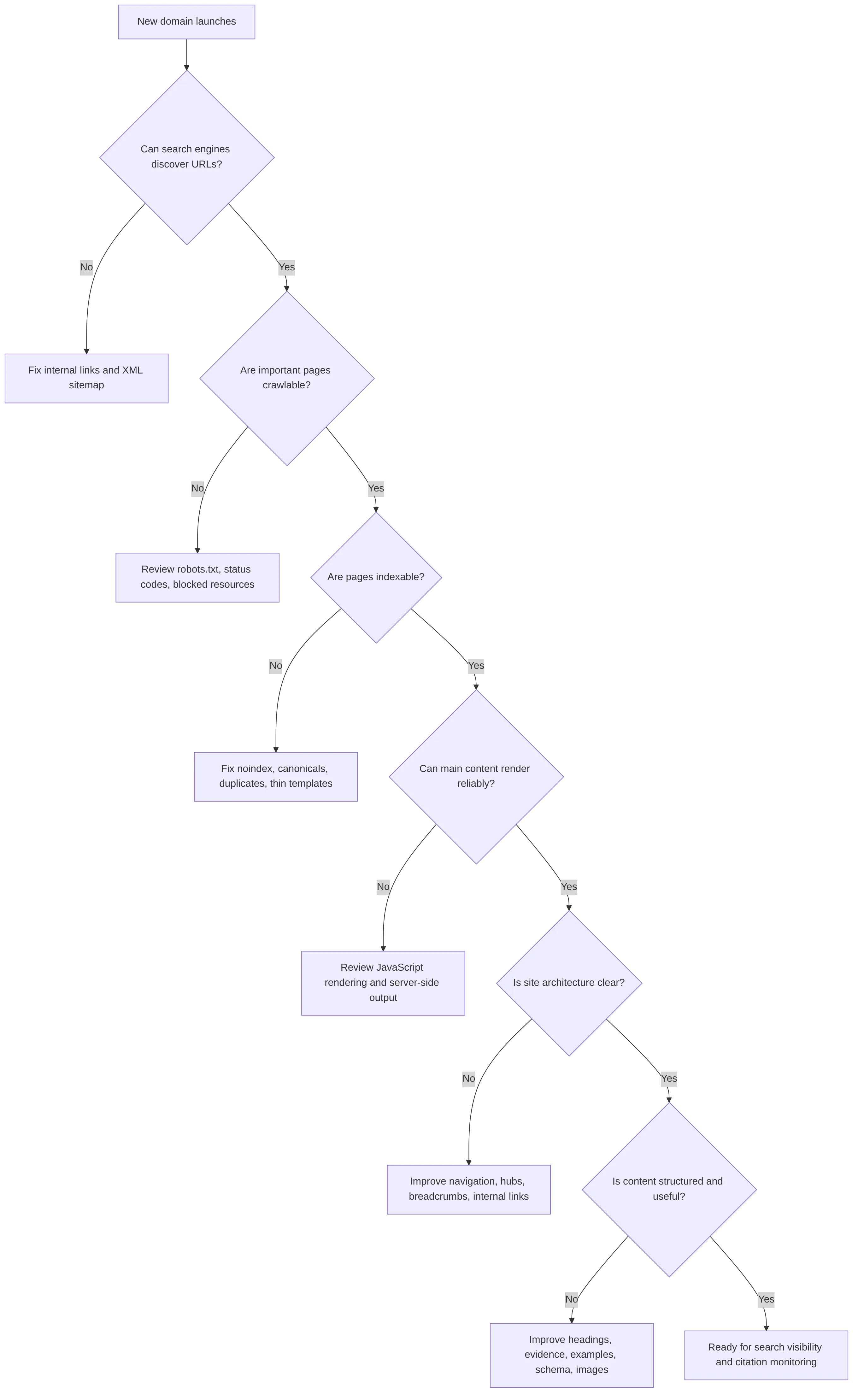
The audit phase looked beyond technical issue detection. That matters for real websites because technical health alone does not guarantee business growth. A page can be indexable and still fail because it answers the wrong question, attracts the wrong country, or gives no clear path to a service page.
For international and cross-border websites, the risk is even sharper. A multilingual site can lose months if hreflang is inconsistent, canonicals point to the wrong language version, translated pages ignore local intent, or internal links send users across regions without context. Google's localized versions guidance is especially relevant for teams serving the Asia-Pacific region, the United States, Europe, and Middle East business development routes.
SeekLab.io works across Asia-Pacific, the United States and Europe, which shapes how this kind of international website work is approached. The practical value is not just translation. It is helping search engines and users understand which page is meant for which market, language, and buying scenario.
The content pages were built to be easier to extract and evaluate. That meant answer-first sections, clear headings, tables, visual explanations, examples, source references, internal links, and JSON-LD where appropriate. It also meant avoiding generic, repetitive articles that sound polished but say nothing a buyer can act on.
| Page element | Why it helped |
|---|---|
| Clear answer near the top | Helps users and systems identify the page's purpose quickly |
| Descriptive headings | Makes the page easier to scan and parse |
| Tables | Turns comparisons and methods into extractable information |
| Original images or diagrams | Improves perceived professionalism and supports complex explanations |
| Internal links | Connects informational traffic to service and audit paths |
| Schema aligned with visible content | Improves machine understanding without overstating page content |
| Monthly updates | Keeps pages aligned with search behavior and performance data |
Core Web Vitals were treated as both a search and conversion issue. Google's page experience documentation discusses page experience signals, but the business impact is just as important. Slow mobile pages can reduce form completion, especially for international users on variable networks. A new domain cannot afford to lose its early visitors because the contact page loads slowly or the layout shifts during form entry.
This is also where a good SEO strategy for new websites differs from a checklist. A checklist might say, "Fix metadata, add schema, publish blogs." A strategy asks which pages are worth fixing first, which topics are worth publishing first, which technical issues actually block growth, and which content paths can support inquiries.
SeekLab.io's monthly data review and performance reporting fit this reality. Search visibility for new domains often starts unevenly: long-tail impressions arrive before meaningful traffic, indexed pages fluctuate, citations appear inconsistently, and some topics underperform despite looking promising during planning. Monthly review keeps the team from doubling down on the wrong direction.
What other new websites should copy, and what they should not assume
The repeatable lesson is the sequence, not the exact result. A new domain should not copy the 61-page citation number as a target. It should copy the habit of making pages technically accessible, strategically selected, well structured, internally connected, and measured against business outcomes.
| What new domains can copy | What depends on context |
|---|---|
| Audit before publishing at scale | How many pages should be published |
| Prioritize crawlability and indexability | How quickly pages get indexed |
| Choose long-tail topics by intent | Which topics can win in a specific industry |
| Build clusters instead of isolated posts | How broad each cluster should become |
| Add images, tables, and internal links | Which formats work best for each audience |
| Track indexed pages, impressions, clicks, and citations | Whether citations become traffic |
| Review inquiry paths monthly | How quickly organic visibility becomes leads |
The biggest mistake to avoid is judging a new domain only by traffic in the first few months. Early SEO movement often appears first through crawling, indexation, impressions, long-tail rankings, and page-level visibility. Traffic and inquiries may lag, especially in competitive B2B, exporter, SaaS, or multilingual markets.
That does not mean traffic is unimportant. It means traffic needs context. A website can attract informational visits that never become inquiries. It can also receive fewer visits from better-matched searches and produce stronger commercial outcomes. For official company websites and independent websites, service-page visits, audit requests, contact form submissions, and inquiry quality deserve as much attention as sessions.

SeekLab.io helps brands build search visibility and AI-era discoverability through high-quality content production and technical optimization. The work focuses on making websites easier for search engines, AI systems, and real users to understand by improving content structure, information clarity, page architecture, internal linking, and overall site readiness.
That position is deliberately different from low-quality content production or manipulative tactics. For a new domain, weak articles can create a long cleanup bill later. Poorly planned topics can attract the wrong audience. Thin translated pages can confuse international targeting. Broken internal links can leave useful content disconnected from commercial pages.
For teams unsure where growth is being blocked, SeekLab.io can start with a free audit report through the website audit page. Some simple technical issues may be resolved for clients free of charge, and larger programs can include customized content, monthly data review, and performance reports. SeekLab.io also offers a risk-reversal model where there is no charge if minimum expected results are not achieved, subject to agreed expectations.
The most useful next step is not to publish another batch of articles blindly. It is to identify whether the current bottleneck is technical access, indexation, rendering, site architecture, topic direction, content depth, internal links, multilingual structure, or conversion path quality. Once that constraint is clear, the next three months of SEO work become much easier to prioritize.
FAQ
How long does it take a new domain to get cited by AI systems?
In this case, citations accumulated over a six-month period, with the technical foundation and content structure built first. AI citations generally take several weeks to appear after pages are published and indexed, and they require sustained activity to hold rather than appearing once and staying.
What is an AI-cited page?
A page observed as referenced or cited in an AI-generated answer during a defined check. A credible record should log the platform, the prompt wording, the date, the cited URL, the market or language setting, and screenshot evidence where available.
Does a high citation count mean more traffic?
No. A cited page may receive no click, and a citation that appears for one prompt may not appear for a similar one. Citations are a discoverability signal that sits alongside impressions, clicks, and inquiry quality, not a replacement for them.
Why was traffic still modest at six months?
Because absolute traffic is a lagging indicator on a new domain. The leading indicators in the first two quarters are crawlability, indexation, page-level visibility, long-tail impressions, and citation presence. Traffic and inquiries typically follow that foundation rather than arriving alongside it.
What should a new domain prioritize first?
Technical access before content scale. A page that cannot be crawled, indexed, rendered, or previewed has a weak foundation regardless of how well it is written, so crawlability, indexability, and rendering come before publishing volume.
Can another new website expect the same 61-page result?
No. The repeatable part is the sequence, not the number. Industry competitiveness, market, language, site complexity, and publishing capacity all change the outcome, so the operating order is the transferable lesson.
The final reading of this case is practical: a new domain can show meaningful movement within six months, but only when the work is sequenced correctly. In this case, that movement included 61 AI-cited pages. For another website, the number may be higher, lower, slower, or not comparable at all. The more reliable goal is to build pages that are discoverable, understandable, useful, and commercially connected before judging SEO success by any single metric.