GEO for Baby Safety Products — how parents find products via AI search
Expert reviewed

Parents find baby safety products by starting with a specific risk, then using search engines, AI answers, marketplaces, reviews, and installation videos to decide which product is safe enough, suitable enough, and easy enough to use.
For brands that sell baby safety gear online, the practical lesson is clear: a product grid alone is not enough. Parents often move from "baby safety products" to questions like "hardware-mounted baby gate for stairs," "how to anchor nursery furniture," "safe crib checklist," "baby monitor cord placement," or "how to check if a car seat was recalled." A website that answers those questions with structured content, official safety references, product fit details, and clear conversion paths has a stronger chance of being found in both traditional search and AI-driven discovery.
This case study uses the baby safety category as a working example for independent websites, official brand sites, exporters, and multilingual ecommerce teams. The focus is not generic SEO theory. It is the practical content and technical structure that helps parents find baby safety products, trust the information, compare options, and move from research to purchase or inquiry.
How parents search for baby safety products from real household risks
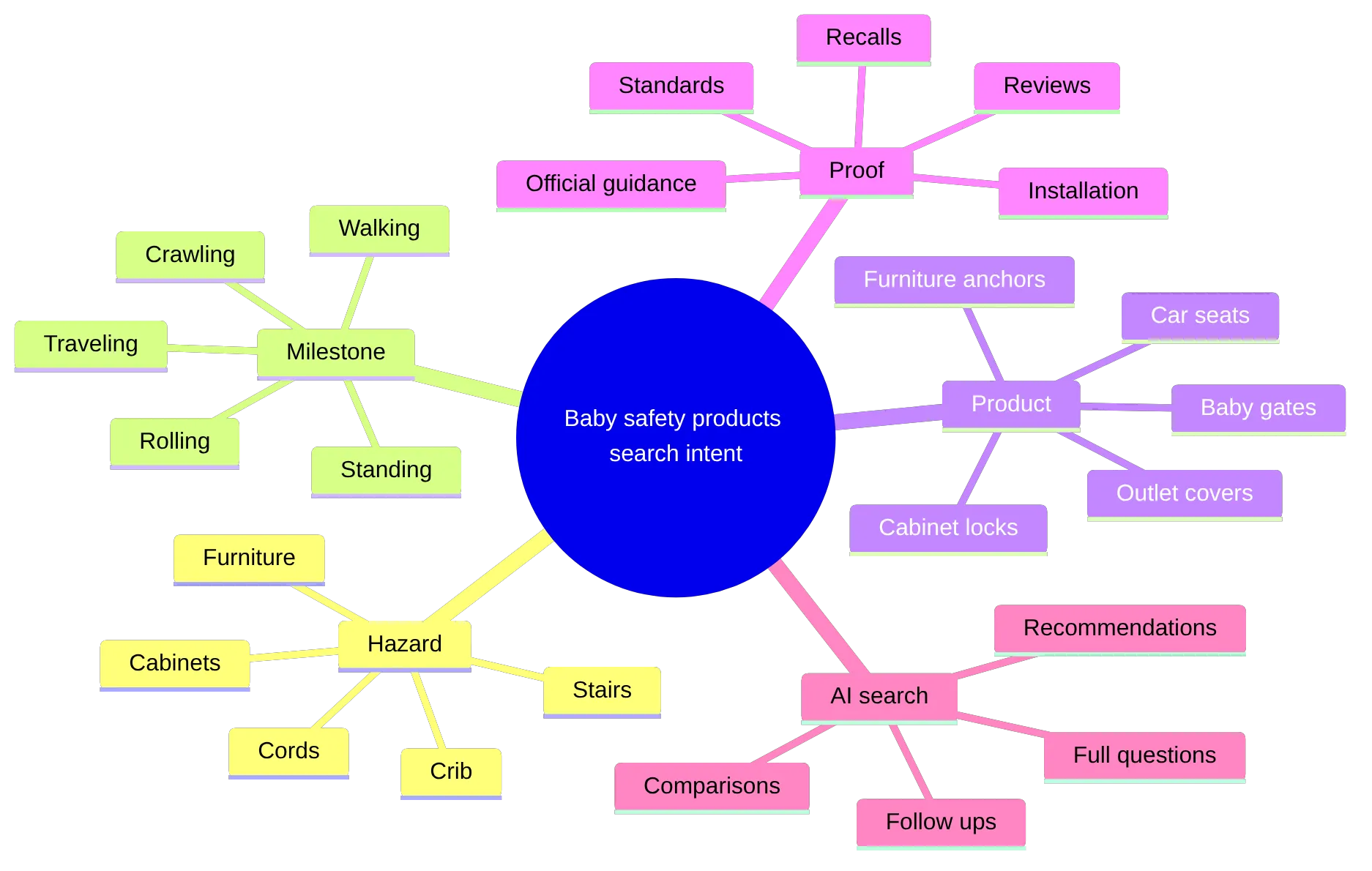
Parents rarely begin with a neat category name. They usually start after noticing a concrete hazard: a baby starts crawling toward the stairs, pulling on cabinet doors, standing near a coffee table, or reaching for cords near the crib. That is why the search behavior around baby safety products is more fragmented, more urgent, and more evidence-sensitive than many ecommerce teams expect.
The U.S. Consumer Product Safety Commission frames home childproofing around hazards such as safety gates, cabinet locks, outlet covers, furniture anchors, corner bumpers, and bath supervision in its childproofing guidance. That structure mirrors how parents search: not "show me a product category," but "what risk do I need to reduce in this room?"
A broad baby safety product search may start the journey, but the higher-intent searches are usually tied to room, milestone, installation, or verification.
| Search pattern | Parent intent | Example query direction | Strong content response |
|---|---|---|---|
| Broad category | Understand what to buy first | "baby safety products" | Pillar guide with room, age, and hazard categories |
| Room-based | Fix a visible risk area | "babyproof kitchen cabinets" | Kitchen babyproofing guide with cabinet locks, stove knob covers, and cord guidance |
| Milestone-based | Prepare for mobility | "baby safety gear before crawling" | Crawling-stage checklist linked to relevant products |
| Product comparison | Choose the right format | "magnetic vs strap cabinet locks" | Comparison table with fit, installation, and limitations |
| Safety verification | Confirm suitability | "check baby product recall" | Recall-check guide linking to official databases |
| Installation | Avoid incorrect setup | "hardware-mounted baby gate top of stairs" | HowTo guide with images, warnings, and product fit notes |
This is where many baby safety product websites lose the buyer. Their category pages say "safe," "durable," or "easy to install," but parents need a different level of clarity. A stair gate page should say where it can be used, where it should not be used, whether it needs drilling, which wall or banister conditions matter, and what the official safety guidance says.
For example, the CPSC guidance says gates at the top of stairs should be mounted to the wall. A brand page that treats all baby gates as interchangeable may look simpler, but it does not match the risk-specific way parents search and decide. In safety-sensitive categories, oversimplification is not good UX; it is a conversion risk.
How parents find baby safety products across search, AI answers, reviews, and video
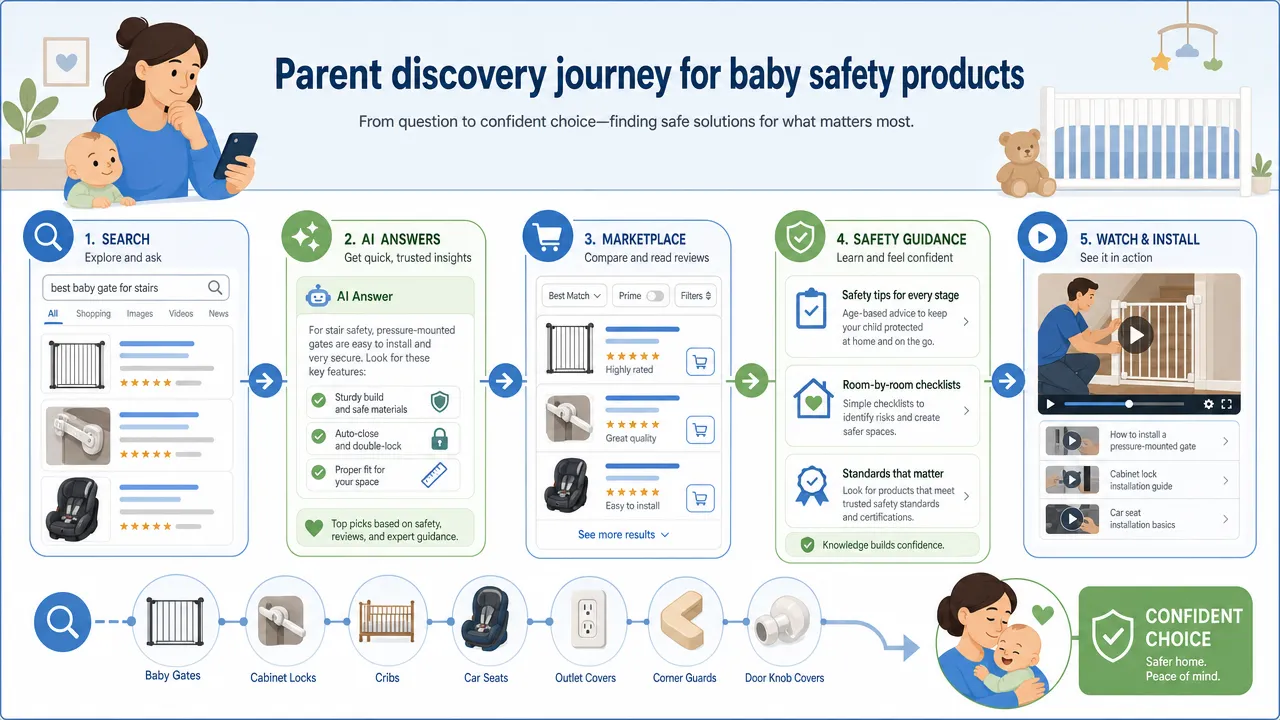
The parent discovery journey is not a straight line from Google to checkout. Parents often compare official safety pages, marketplace reviews, product videos, expert checklists, and AI-generated answers before deciding whether a product is trustworthy enough. This makes baby safety product discovery more like a layered validation process than a normal ecommerce browse.
A realistic journey looks like this:
- A household trigger appears, such as crawling, standing, stairs, travel, or a new sleeping setup.
- The parent searches a broad checklist or asks an AI search system for recommendations.
- The parent narrows the issue to a room, hazard, or product type.
- The parent checks official safety guidance or recall resources.
- The parent compares product features, reviews, installation steps, and returns.
- The parent buys from a marketplace, retailer, brand site, or contacts a supplier.

AI search for baby safety products changes the format of the query. Instead of typing "baby gate stairs," a parent may ask, "What baby safety products do I need for a 9-month-old in an apartment with stairs and low cabinets?" That question contains age, room, housing type, product need, and safety concern in one prompt.
Google Cloud documentation describes generated answers, follow-up questions, grounding, citations, and multi-turn search in its generated answer documentation. For baby safety brands, the implication is practical: answer systems need pages that are specific, structured, current, and easy to cite. Thin product descriptions do not give these systems much to work with.
Deloitte Digital makes a similar point in its analysis of how generative AI is changing brand discovery: brands need clearer information architecture, metadata, taxonomy, and trusted content signals. In baby safety, that means content should separate product claims from safety guidance, use precise page sections, and cite official references where risk is high.
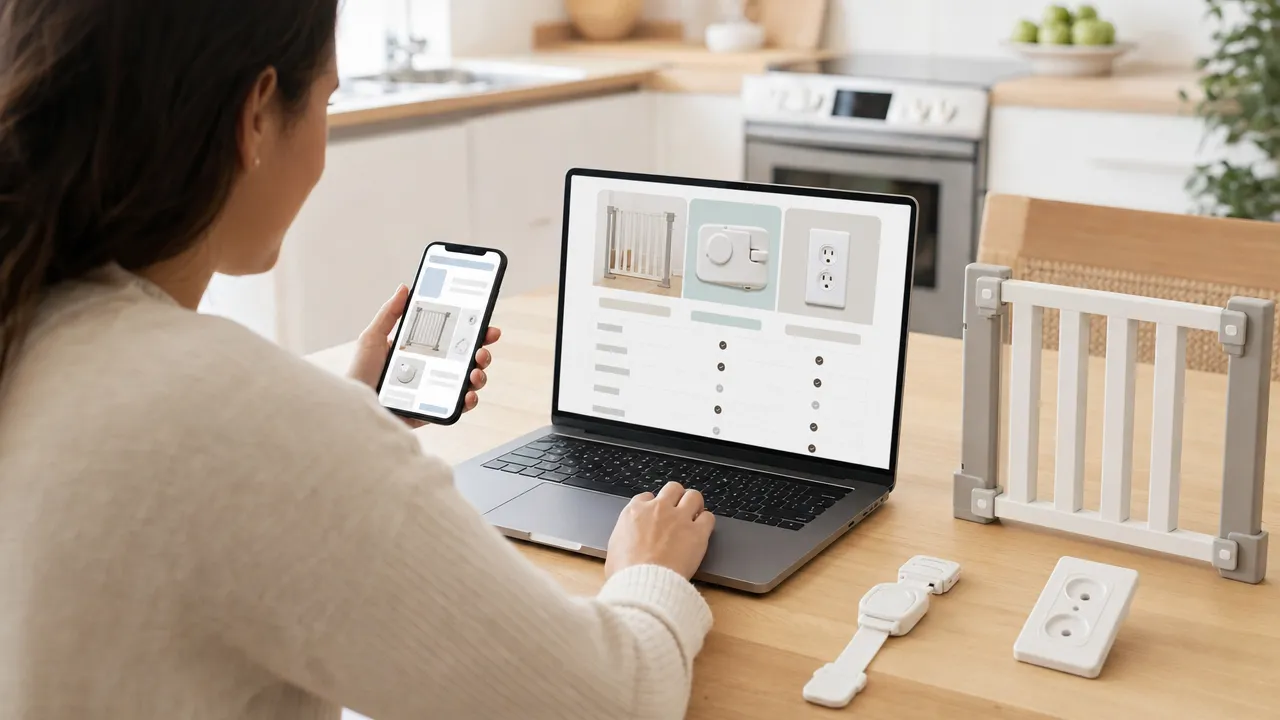
Parents also rely heavily on video for installation-sensitive products. Cabinet locks, furniture anchors, stove knob covers, baby gates, and monitor mounts are hard to evaluate from a product image alone. A parent wants to know whether the adhesive holds, whether the latch is annoying for adults, whether drilling is required, whether the gate fits a banister, and whether a monitor cord can be kept safely away from the crib.
That behavior creates a strong content opportunity for official brand sites. Installation images, short videos, transcripts, troubleshooting notes, and "not suitable for" sections can reduce the need for parents to leave the site and search elsewhere. For exporters and B2B suppliers, the same assets help distributors understand packaging, compliance, use cases, and after-sales support.
Which baby safety products need the strongest content and trust signals
Not all baby safety products require the same level of explanation. A corner guard page does not need the same source discipline as a crib safety or car seat page. A baby monitor page needs cord placement and privacy language, while a baby gate page needs mounting guidance and stair-specific warnings.
This distinction matters for how parents shop for baby safety products. The more severe the risk and the more complex the installation, the more evidence the page needs before a parent trusts it.
| Product category | Parent concern | Content parents need before buying | Trust or schema opportunity |
|---|---|---|---|
| Baby gates | Falls, stairs, restricted rooms | Location guidance, hardware vs pressure-mounted comparison, installation images | Product, FAQPage, HowTo, BreadcrumbList |
| Cabinet locks | Cleaning supplies, sharp objects, medication | Magnetic vs strap vs sliding locks, surface compatibility, adult usability | Product, FAQPage, comparison table |
| Outlet covers | Shock, removable plug cover risks | Plug covers vs sliding plates, choking-risk considerations, room checklist | Product, FAQPage |
| Furniture anchors | Tip-over risks from dressers, shelves, TVs | Wall anchoring steps, tools, photos, limitations | HowTo, Product, Article |
| Crib and sleep products | Suffocation, unsafe sleep setup, recalls | Safe sleep checklist, what should not be in the crib, CPSC and AAP references | Article, FAQPage, official citations |
| Car seats | Age, height, weight, installation, recalls | NHTSA selection guidance, registration, recall information, fit ranges | Product, FAQPage, official links |
| Baby monitors | Cord placement, mounting, privacy | Cord safety, mounting distance, secure setup, connection options | Product, FAQPage, VideoObject |
| Bath and travel gear | Slips, drowning, temporary setup | Supervision warnings, non-slip specs, portable-use limits | Product, FAQPage, ItemList |
Crib, sleep, and car seat content should be especially careful. The CPSC's safe sleep guidance and the American Academy of Pediatrics' parent guidance on safe sleep provide official and medical context that product pages should not try to replace. A crib-related product page should not imply that extra accessories make sleep safer unless the claim is properly supported and compliant.
Car seat content has a similar requirement. The National Highway Traffic Safety Administration provides a Right Seat guidance hub to help caregivers select a car seat based on age and size. A brand or retailer page can explain product specifications, but it should also help parents verify fit, installation, registration, and recall awareness.
Recall checking is a separate search intent. Parents may ask, "How do I check if this baby safety product was recalled?" or "Is this secondhand crib safe?" A brand site can create evergreen recall-awareness pages that link to official resources such as SaferProducts.gov. That kind of page may not look like a direct sales page, but it builds trust at a point where parents are making serious decisions.
The most common mistake is using the same product-page template for every category. A baby gate, a bath mat, a monitor, and a car seat should not all be presented with the same copy blocks. Parents notice missing details quickly, and AI answer systems also struggle when product attributes are vague or inconsistent.
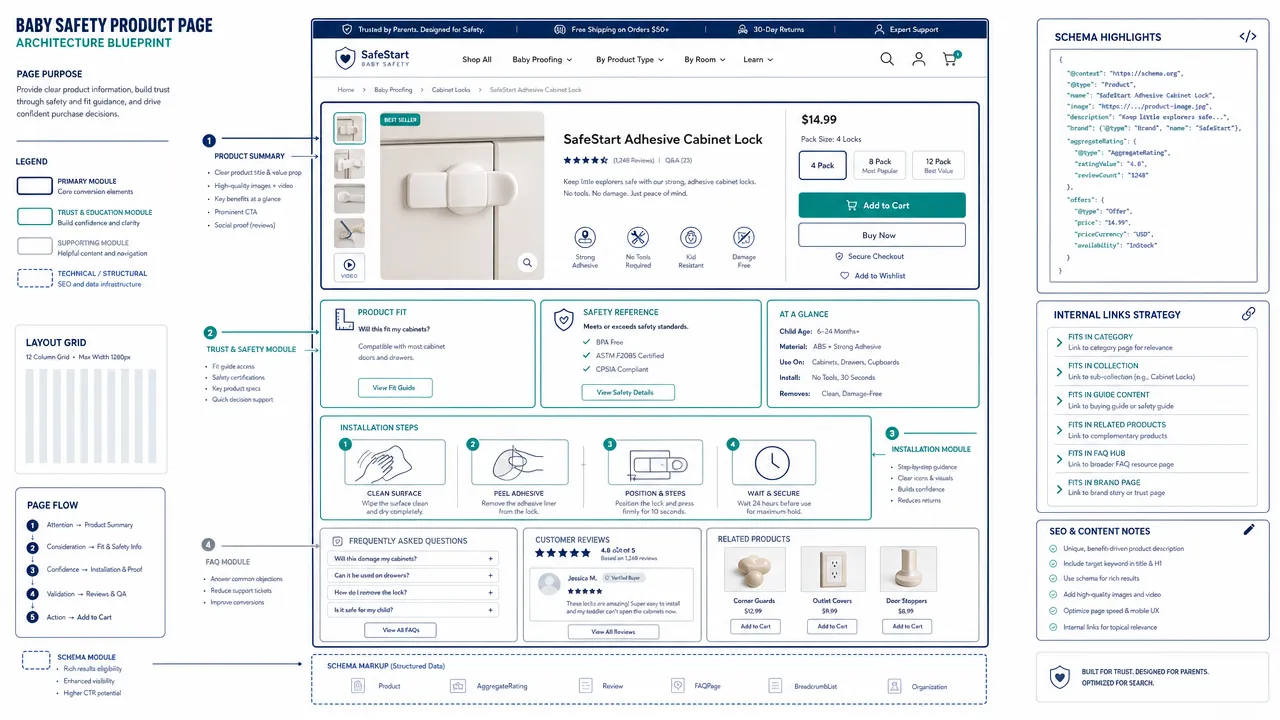
A stronger template includes:
| Page element | Why it matters |
|---|---|
| Use case summary | Helps parents confirm the product solves the right hazard |
| Compatibility table | Reduces returns and installation confusion |
| Safety reference block | Separates official guidance from brand claims |
| Installation media | Helps parents judge whether setup is realistic |
| "Not suitable for" notes | Builds trust by showing limits honestly |
| FAQ section | Captures long-tail objections and AI-answer-style queries |
| Internal product links | Moves education traffic toward buying or inquiry |
| Schema markup | Makes product, FAQ, HowTo, and breadcrumb data clearer to search systems |
What AI search changes for baby safety products and citation readiness
AI search for baby safety products rewards pages that answer full-context questions better than generic ecommerce pages. A parent can now ask a search system for recommendations with constraints: no drilling, apartment stairs, 8-month-old baby, rented home, budget, travel, or specific room layout. That query is closer to a consultation than a keyword.
For a brand website, citation readiness starts with content structure. A page should provide concise answers near the top, then support them with tables, official links, product attributes, FAQs, and installation details. When a page hides the useful information in images, PDFs, or JavaScript-rendered tabs that are not reliably crawlable, it weakens both traditional SEO and AI-driven discoverability.
SeekLab.io's view is that schema markup is not a plugin checkbox. In its guide to advanced schema markup SEO services, SeekLab.io emphasizes that structured data should align with page templates, entity clarity, and maintainability. That matters in baby safety because the same site may need Product schema for product pages, FAQPage for visible safety questions, HowTo for installation guides, BreadcrumbList for category paths, and Organization schema for brand entity consistency.
| Page type | Best-fit schema | Practical warning |
|---|---|---|
| Product detail page | Product, Offer, BreadcrumbList | Do not add safety claims to schema unless visible and supported on the page |
| Installation guide | HowTo, VideoObject, FAQPage | Steps must be visible on the page, not hidden only in video |
| Buying guide | Article, FAQPage, BreadcrumbList | FAQs should match real parent questions, not generic filler |
| Category page | CollectionPage, ItemList, BreadcrumbList | Category copy should explain selection logic, not repeat product names |
| Recall or safety resource | Article, FAQPage | Link to official recall databases and add review dates |
| Multilingual product page | Product with inLanguage plus hreflang | Localize measurements, standards, currency, and terminology |
Structured data also needs technical support. If a React or Vue storefront loads product specifications only after interaction, search engines may miss key details. If FAQ text appears visually but the JSON-LD says something different, the markup becomes unreliable. If localized pages have inconsistent canonical and hreflang tags, the wrong language version may surface for parents in another market.
Google's own documentation on structured data for Search reinforces the principle that markup should describe visible page content. Schema can clarify meaning, but it cannot rescue weak, missing, or misleading content.
For baby safety brands selling internationally, multilingual SEO adds another layer. A U.S. page may cite CPSC and NHTSA. A European page may need different regulatory references and terminology. An Asia-Pacific page may need local market language, distributor concerns, and localized product names. SeekLab.io's guide to multilingual SEO strategy makes the same point in a broader international SEO context: do not directly translate high-value pages without adapting search intent, technical architecture, and conversion expectations.
The practical rule is simple: translate less, localize better. A baby safety exporter does not need every English blog post in every language. It needs the pages that affect product discovery, distributor trust, and inquiry generation to be technically clean, locally relevant, and properly connected to the commercial site structure.
What baby safety products websites often get wrong before parents convert
Many baby safety websites do not fail because the product is poor. They fail because the website does not answer the buying questions parents actually have. The gap usually appears in six places: category architecture, product-page depth, installation proof, safety citations, internal linking, and technical readiness.
| Website issue | What parents experience | Business impact | Better fix |
|---|---|---|---|
| Generic category architecture | Product grids do not match hazards or rooms | Weak long-tail rankings and lower trust | Build room, hazard, milestone, and product hubs |
| Thin product descriptions | Parents cannot judge fit or safety use case | More hesitation and comparison shopping elsewhere | Add compatibility, limitations, images, FAQs, and standards notes |
| Missing installation content | Parents leave for YouTube or reviews | Lost attention before purchase | Add installation steps, videos, transcripts, and troubleshooting |
| Vague safety claims | "Safe" is repeated without proof | Trust loss and compliance risk | Cite official sources and name relevant standards where valid |
| Poor internal linking | Blog traffic does not reach product pages | Traffic grows without inquiries | Link guides to categories, bundles, manuals, and inquiry forms |
| Missing schema | Search systems cannot easily interpret entities and page purpose | Lower rich result eligibility and weaker answer readiness | Use Product, FAQPage, HowTo, BreadcrumbList, and Organization schema selectively |
| Slow mobile templates | Parents abandon pages while comparing on phones | Lower conversion and weaker engagement | Improve image loading, layout stability, and Core Web Vitals |
| Weak multilingual setup | Localized pages compete or show the wrong language | Lost international search visibility | Audit hreflang, canonicals, localized content, and regional references |
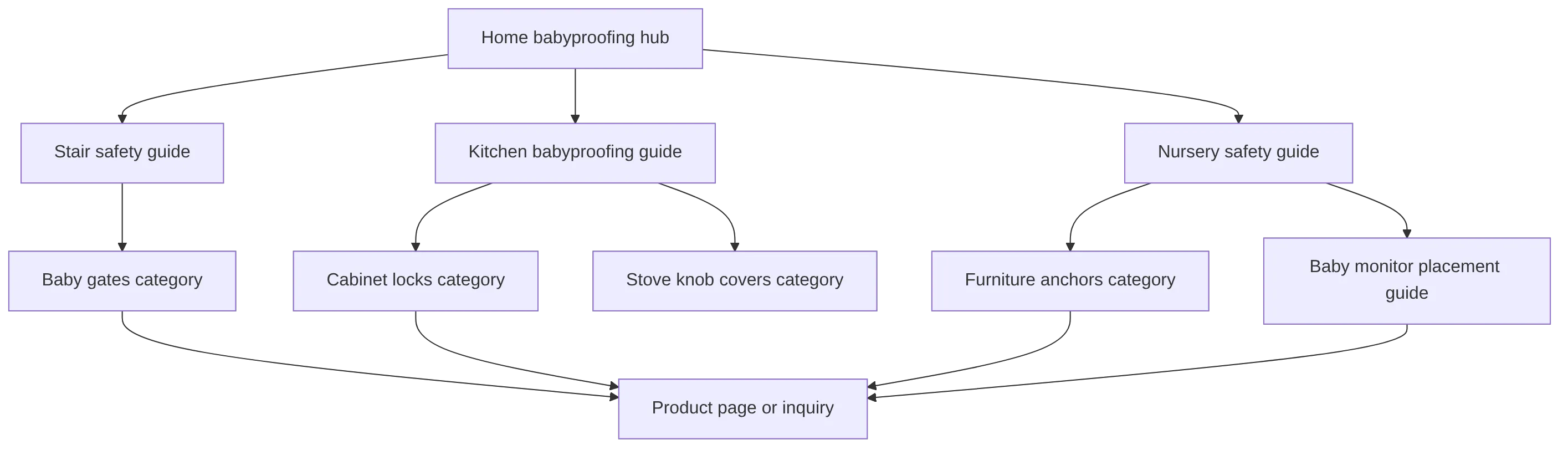
The internal linking problem is especially common. A brand publishes a "babyproofing checklist" that attracts informational traffic, but the page has no clear route to "hardware-mounted baby gates for stairs," "cabinet locks for cleaning supplies," or "furniture anti-tip straps." Traffic looks good in reporting, yet inquiries and sales do not move.
A better architecture connects parent intent to product choice:
For exporter websites and official company websites, the conversion path may not be a checkout button. It may be "request catalog," "ask about certification," "contact us," or "get distributor pricing." The content still needs the same structure, but the trust assets change. A B2B buyer may need product specification sheets, test summaries, packaging documentation, country-specific certification details, and reliable contact routes.
SeekLab.io's audit approach fits this kind of problem because it does not treat content and technical SEO as separate silos. A site may need full-site crawling, Core Web Vitals diagnostics, JavaScript rendering checks, schema validation, internal link analysis, and content gap mapping before deciding what to fix first. The goal is not to fix everything. The goal is to identify which weaknesses are blocking discoverability, trust, and conversion.
For teams that suspect their baby safety product pages are receiving traffic but not enough inquiries, a practical next step is to get a free audit report. The useful question is not "Do we need more content?" It is "Which missing pages, broken templates, weak trust signals, or technical barriers are preventing parents and buyers from moving forward?"
How to build a baby safety products content system that supports SEO and sales
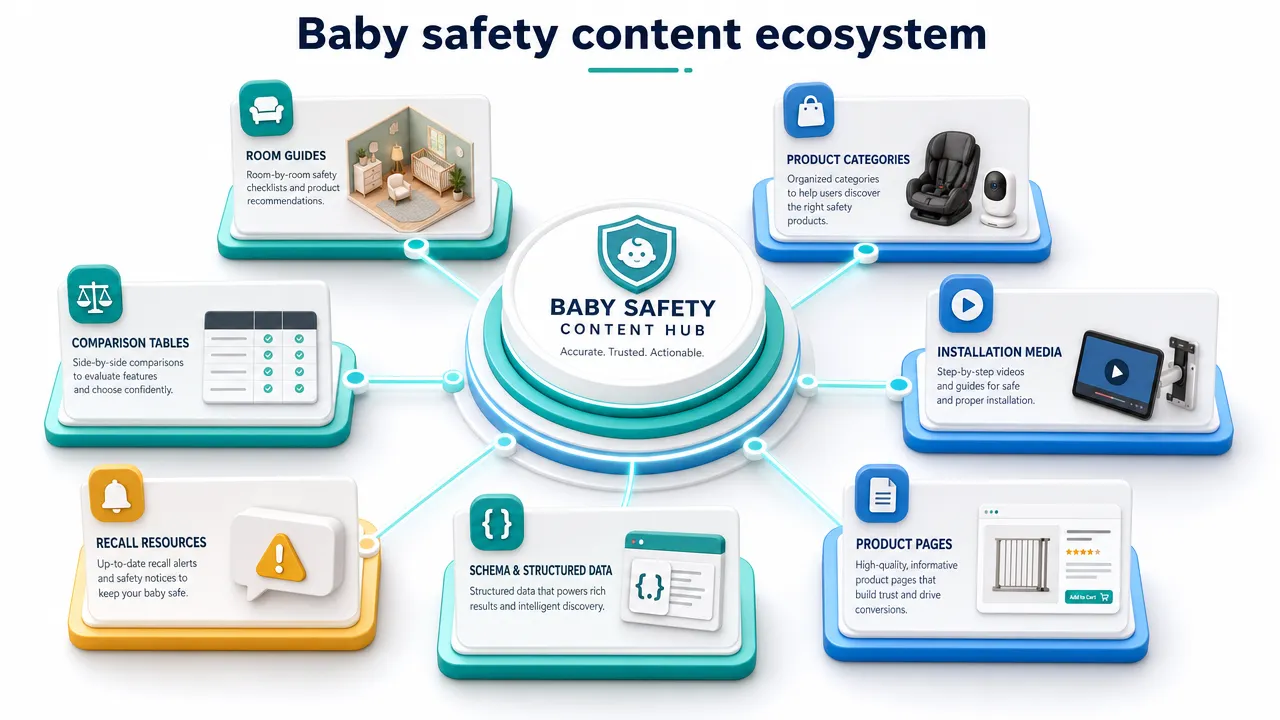
A strong content system for baby safety products starts with parent intent, not blog volume. The highest-value pages usually sit between official safety guidance and product pages. They translate risks into decisions: what hazard is being solved, which product type fits, how it should be installed, how parents can verify safety, and where to buy or inquire.
The system should include five content layers.
| Content layer | Example page | Commercial role |
|---|---|---|
| Pillar hub | Complete babyproofing guide by room and milestone | Captures broad informational searches and builds topical authority |
| Category guide | Baby gates for stairs, hallways, and doorways | Connects hazards to product types |
| Comparison page | Hardware-mounted vs pressure-mounted baby gates | Serves high-intent decision searches |
| Installation guide | How to install furniture anti-tip straps | Reduces purchase anxiety and supports AI-answer-style queries |
| Verification resource | How to check baby product recalls | Builds trust and supports safety-sensitive research |
The strongest pages avoid exaggerated claims. They explain the limits of the product. A page that says "not recommended for the top of stairs" in the right context may convert better than one that tries to make every product sound universal. Parents do not expect one baby safety product to solve every problem; they expect the brand to be honest about fit.
A practical baby safety product content system also needs visuals. Real installation images, annotated diagrams, short videos, and comparison tables often do more work than another paragraph of copy. A cabinet lock page should show surface preparation, placement, locking action, and removal considerations. A monitor page should show safe cord routing and crib distance. A furniture anchor page should show where hardware attaches and what tools are required.
For international brands, the same system should be localized by market. A direct translation of "baby safety products" may miss how parents in each region describe the problem, what marketplaces they trust, which safety references matter, and which measurements or product names feel familiar. SeekLab.io's multilingual SEO work focuses on these structural issues: crawlable localized URLs, hreflang accuracy, localized content quality, schema consistency, and performance by region.
The final operating model is straightforward:
- Audit whether critical product and guide content is crawlable, indexable, and readable.
- Map parent search intent by hazard, room, milestone, and product category.
- Build structured guides that cite official safety sources where needed.
- Improve product pages with fit data, installation media, limitations, and FAQs.
- Add schema that matches visible content and page purpose.
- Connect educational pages to product pages, catalogs, inquiry forms, and support.
- Review performance monthly by rankings, engagement, product clicks, inquiries, and conversion quality.
SeekLab.io helps brands build search visibility and AI-era discoverability through high-quality content production and technical optimization. For baby safety product websites, that means making the site easier for search engines, AI systems, and real parents to understand by improving content structure, information clarity, page architecture, internal linking, schema, and overall site readiness.
The commercial value is not just more traffic. It is better-qualified discovery: parents who understand which product fits their risk, buyers who trust the documentation, distributors who can evaluate compliance, and teams that know which SEO work deserves priority. For brands that want a clearer diagnosis before investing in more content or technical fixes, contact us to discuss the next audit step.
FAQ: GEO for baby safety products
Do AI search systems treat baby safety products differently from other ecommerce categories?
Yes. Because the category is safety-sensitive, AI answer systems weigh official references, specific product attributes, and clearly cited safety guidance more heavily than generic marketing copy.
What is the highest-priority content gap on most baby safety product sites?
Installation and fit content. Parents evaluating gates, anchors, locks, and monitors need to know how a product installs and where it does not fit before they trust a "safe" claim.
Does schema markup alone improve AI visibility for baby safety products?
No. Schema clarifies content that already exists on the page. It cannot substitute for missing installation detail, safety citations, or comparison content.
Should every product category get the same depth of safety content?
No. Crib, sleep, and car seat pages warrant the most citation and official-guidance discipline, while lower-risk categories like corner guards need comparatively lighter treatment.
How does multilingual expansion affect GEO for this category?
Direct translation is not enough. Each market may reference different regulatory bodies (CPSC in the US, different standards elsewhere), so localized pages need adapted safety references, not just translated copy.