International SEO Strategy: Multi-Country, Multilingual, and Regional Search
Expert reviewed

An international SEO strategy decides which markets need their own search experience, which can share a language experience, and how the site will connect those pages without fragmenting authority. The aim is not to create the most country folders or translations. It is to build the smallest maintainable structure that matches real demand, business capacity, and local buyer needs.
International expansion becomes an SEO problem when market decisions, language decisions, website architecture, and content operations are handled separately. A company may translate pages before confirming demand, create country sections that say the same thing, or launch regional URLs that search engines and users cannot navigate reliably.
A better sequence is:
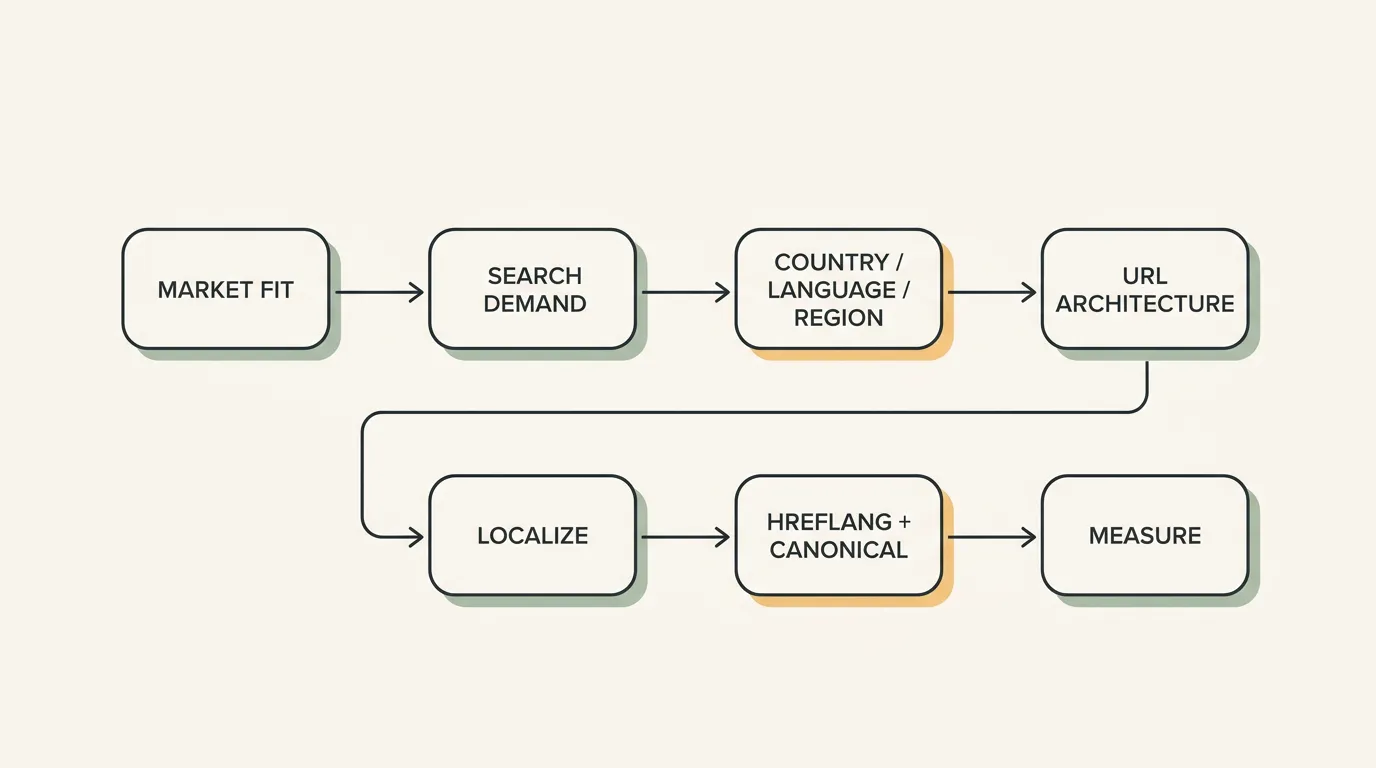
Market → Language → Architecture → Localization → Technical signals → Authority → Measurement
That sequence keeps the business decision ahead of the implementation detail.
What is an international SEO strategy?
An international SEO strategy is a plan for making the right version of a website discoverable and useful in each priority country, language, or region. It covers:
- which markets deserve investment;
- whether each market needs country-specific, language-specific, or shared regional content;
- how international URLs are structured;
- how equivalent pages are connected with
hreflang; - how canonicals, sitemaps, navigation, and internal links support the same structure;
- what must be localized beyond translation;
- how performance is measured by market and language.
Google distinguishes a multilingual site, which offers content in more than one language, from a multi-regional site, which explicitly targets users in different countries. A website can be either or both. That distinction matters because language and country are not interchangeable: English content may serve several countries, while one country may need several languages. Google's international-site guidance explains the technical distinction.
International SEO, multilingual SEO, and regional SEO are related but different
The three disciplines overlap, but they do not own the same decision.
| Approach | Primary question | Example | Main risk |
|---|---|---|---|
| International SEO | Which countries, languages, and regions should the website serve through search? | One global domain serving the US, Germany, and Singapore | Expanding faster than the business can support |
| Multilingual SEO | How should content work across languages? | English and German versions of a product guide | Translating words without localizing search intent |
| Multi-country SEO | When does a country need its own experience? | Separate English pages for the US and Australia | Creating near-duplicate country pages with little user value |
| Regional SEO strategy | Can several markets share one coherent experience? | One English resource hub for markets with the same offer | Treating a diverse region as if every market behaves the same way |
The SeekLab multilingual SEO guide covers language architecture, translation, localization, and multilingual implementation in greater depth. The focus here is the decision that comes first: which international experiences should exist at all, and how they should fit together.
Prioritize markets before creating international pages
Search demand alone is not a market-entry strategy. A country with substantial query volume may still be a poor SEO priority if the company cannot sell, deliver, support, or maintain the relevant offer there.
Evaluate each market through a small set of commercial gates:
| Decision area | Evidence to review | What it should establish |
|---|---|---|
| Market fit | Existing revenue, sales inquiries, distributor input, customer research | The market has a credible business case |
| Search demand | Local keyword data, search-result formats, competitor visibility | Buyers search for relevant products, problems, or services |
| Serviceability | Availability, delivery, support, payment, legal or operational constraints | The business can fulfil the demand it creates |
| Competitive reality | Ranking domains, content quality, authority, page types | The site has a realistic route to visibility |
| Content capacity | Native review, subject expertise, update ownership | The localized experience can stay accurate |
| Conversion readiness | Local contact path, sales routing, proof, response language | Search visits can become useful conversations |
Score country-language combinations separately. Do not average demand across countries and call it a regional market. A query can have different wording, intent, competition, and commercial value in the UAE, Singapore, and Australia even when all three audiences use English.
The output should be a prioritized market list with an evidence note, an owner, and a clear decision: launch, test, research further, or defer.
Decide whether a market needs a country, language, or regional experience
The most important architecture decision is often whether to create another site section at all.
| Situation | Recommended starting point | Why |
|---|---|---|
| Same language, offer, pricing logic, proof, and conversion path across several countries | One shared language experience | Avoids unnecessary duplication and maintenance |
| Same language, but material country differences affect the decision | Country-specific pages | Gives users the availability, evidence, and terms relevant to their market |
| Different language with a real audience and operational support | Separate language experience | Creates a coherent search and user journey in that language |
| Several countries share meaningful regional needs | Regional hub with selective country pages | Provides common guidance without forcing every market into an identical template |
| Demand or serviceability is unproven | Research or a controlled pilot | Prevents a speculative URL footprint from becoming permanent technical debt |
A country page needs more than a country name in the title. It should exist because the user experience changes: product range, regulations, delivery, currency, terminology, proof, contact route, or another decision-relevant factor.
Likewise, a regional page should not become a substitute for market research. “APAC,” “Europe,” and “Middle East” may be useful business groupings, but they do not automatically describe a single search audience.
Choose an international URL structure the organization can maintain
The main URL options are country-code domains, subdomains, and subdirectories. Google supports all three, while URL parameters are a weak choice for locale segmentation. The best structure is the one that provides clear targeting without exceeding the team's technical and editorial capacity.
| Structure | Example | Advantages | Trade-offs | Typical fit |
|---|---|---|---|---|
| Country-code top-level domain | example.de |
Clear country association for users and search engines | Separate infrastructure, authority, and governance | Large country operations with local ownership |
| Subdomain | de.example.com |
Allows technical or organizational separation | Can fragment maintenance and authority | Distinct platforms or teams that need isolation |
| Subdirectory | example.com/de/ |
Consolidates the domain and is usually easier to manage | Requires consistent routing, navigation, and internal linking | Many centrally managed international sites |
| URL parameter | example.com?lang=de |
Easy to generate in some systems | Poorly communicates structure and is not recommended for geotargeting | Generally avoid for primary locale versions |
Do not choose subdirectories only because they are common or ccTLDs only because they look local. Review CMS limitations, release ownership, analytics, consent requirements, backlink profiles, server configuration, and the cost of maintaining equivalent templates.
Once selected, document one repeatable pattern. Mixing /en-gb/, /de/, fr.example.com, and country parameters without a deliberate reason makes implementation, reporting, and quality control harder.
Build a market-language architecture before building pages
Create a page inventory that maps each experience to a market, language, URL, content owner, and equivalent versions.
| Page family | Market | Language | Intended URL | Equivalent versions | Owner |
|---|---|---|---|---|---|
| Product category | United States | English | /us/category/ |
UK, Germany | Product marketing |
| Product category | United Kingdom | English | /uk/category/ |
US, Germany | Product marketing |
| Product category | Germany | German | /de/kategorie/ |
US, UK | German content owner |
This inventory becomes the source for templates, hreflang, sitemaps, navigation, QA, and reporting. It also reveals gaps. If one locale has a product page but its alternate points to a generic homepage, the relationship may not help the user.
Keep local navigation primarily within the same locale. A visitor on a German product page should not be pushed into an English conversion path without a clear reason. Language or country selectors should link to equivalent pages where they exist, with a sensible fallback when they do not.
Implement hreflang as a page relationship, not a ranking shortcut
Hreflang helps Google understand that several URLs are language or regional alternatives. It does not make weak pages rank, replace localization, or determine the canonical URL.
For a valid implementation:
- use supported language codes and add a region only when the page genuinely targets that region;
- list each page itself and its relevant alternates;
- make the relationships reciprocal;
- use fully qualified canonical URLs;
- keep equivalent sets complete and consistent;
- use
x-defaultwhere a language selector or neutral fallback serves unmatched users; - validate rendered output, not only CMS settings.
Google allows hreflang to be implemented in HTML, HTTP headers, or XML sitemaps. The methods are equivalent for Search, so choose one maintainable method rather than creating several implementations that can drift. See Google's localized-version documentation.
Avoid automatic redirects that prevent users and crawlers from reaching another locale. Google recommends separate URLs and visible links between language versions, rather than relying on browser settings, cookies, or IP-based delivery.
Keep canonicals aligned with international intent
Canonical tags and hreflang solve different problems:
- a canonical identifies the preferred representative of duplicate or very similar URLs;
hreflangidentifies language or regional alternatives.
In most international page families, each localized page should be independently useful and self-canonical. Canonicalizing every language or country version to one global page can remove the very URLs the international strategy is trying to make eligible.
Same-language country pages need particular care. If US and UK pages are nearly identical, decide whether their differences justify separate search experiences. If they do, keep their content and targeting meaningfully distinct and align canonical and hreflang signals. If they do not, consolidate rather than maintaining duplicates with changed place names.
The technical SEO audit guide explains how canonicalization, indexability, JavaScript rendering, sitemaps, and international signals are validated together.
Localize search demand, content, and conversion paths
Translation answers “what does this sentence mean in another language?” Localization answers “what does this audience need to find, understand, and do?”
Run keyword and search-result research in each target country. Preserve market-level metrics instead of merging them into a global average. Compare:
- the words buyers use for the product or problem;
- whether search results favor product pages, categories, guides, comparisons, or local directories;
- which specifications and proof points appear repeatedly;
- which objections or requirements are market-specific;
- whether branded and non-branded demand behaves differently;
- which queries lead naturally to the business's real conversion path.
Then decide whether each source page should be translated, adapted, recreated, or omitted. A global company page may need only careful translation. A product category may need local keyword targeting, units, availability, and proof. A regulatory guide may require a completely different page—or may not be appropriate for that market.
Do not translate the entire source-site inventory by default. That multiplies low-value content, indexing risk, and update work. Localize the priority buying journey first: category or service page, supporting explanation, proof, contact route, and any documentation required to make the next decision.
Clear market, language, and entity signals can also make it easier for AI search systems to understand which version of a business, product, or service is relevant to a particular market.
Use internal linking to preserve authority and user journeys
International architecture should not isolate every locale into a small disconnected site.
Within each locale:
- link from navigation and relevant hubs to priority commercial pages;
- connect supporting articles to the page that owns the commercial intent;
- use descriptive anchors in the page's language;
- avoid orphaned regional pages that exist only in a sitemap;
- keep conversion routes in the same locale where possible.
Across locales, use the language or region selector to connect equivalent experiences. Avoid adding large blocks of cross-language links to every page when they do not help the visitor.
SeekLab's internal linking guide covers crawl paths, page relationships, anchors, and authority distribution in more detail.
Check technical readiness before multiplying templates
Every new market or language expands the number of URLs, components, and signals that can fail. Validate the system on a small set of priority templates before rolling it across the website.
Check that:
- priority pages are linked with crawlable HTML and return the intended status;
- core copy, links, canonicals, and alternate tags are present in rendered output;
- XML sitemaps contain canonical, indexable locale URLs;
- robots and
noindexrules do not exclude intended sections; - redirects preserve locale and page equivalence when URLs change;
- translated templates do not retain source-language titles, navigation, or schema values;
- mobile performance is acceptable in the networks and devices used by the target audience;
- analytics, consent, and conversion events work across domains or locale paths.
For a practical implementation review, use the SEO audit checklist and the guide to fixing crawl errors and improving site crawlability.
Roll out international SEO in controlled phases
A phased rollout produces better evidence than a full-site launch built on assumptions.
Phase 1: Validate the opportunity
Confirm market fit, serviceability, local demand, search intent, competition, and content ownership. Define what success would justify expansion.
Phase 2: Build the architecture
Choose the URL model, map equivalent pages, define locale codes, establish canonical and hreflang rules, and prepare reporting dimensions.
Phase 3: Launch one complete journey
Publish a coherent group of pages for one priority market or language. Include the commercial page, necessary supporting content, internal links, proof, and a working conversion route.
Phase 4: Validate and expand
Check crawling, indexing, alternate relationships, query relevance, engagement, and lead quality. Expand into adjacent topics or markets only when the evidence and operating capacity support it.
If existing URLs change during rollout, use a complete one-to-one mapping and permanent redirects rather than sending every old locale URL to a homepage. Update internal links, canonicals, hreflang, sitemaps, and hard-coded assets at the same time.
Measure international SEO by market and business outcome
Domain-level traffic can hide whether the right international pages are working. Build a reporting view by country, language, directory, and priority page group.
| Measurement layer | Example signals | Question answered |
|---|---|---|
| Technical coverage | Valid locale URLs, indexing, canonical selection, hreflang consistency |
Can search engines process the intended structure? |
| Search visibility | Relevant queries, impressions, clicks, landing pages by country | Is the right experience appearing for the right demand? |
| Engagement | Useful page sequences, specification views, downloads, form starts | Does the localized journey help visitors evaluate? |
| Conversion | Valid inquiries, registrations, purchases, bookings | Does the experience produce the intended action? |
| Commercial quality | Qualified leads, opportunity progression, revenue contribution | Is the market creating useful business outcomes? |
Interpret Search Console country data carefully: it reflects where a search occurred, not necessarily the buyer's nationality, delivery destination, or legal market. Combine search data with analytics, CRM, and operational evidence.
Use the same definitions across markets, but do not force identical targets. A new-language pilot and an established country site are at different stages and should not be judged as if they have the same history or authority.
Common international SEO mistakes
Treating translation as market strategy
A translated page can be linguistically correct and still miss local demand, product fit, proof, and conversion expectations.
Creating a page for every country
Country folders without meaningful differences create duplication and permanent maintenance work.
Using one keyword dataset for several markets
Shared language does not mean shared volume, competition, or intent. Keep country observations separate.
Implementing hreflang before mapping equivalent pages
Tags cannot repair an unclear inventory. Define the page relationships first.
Sending all international versions to one canonical
This can undermine the eligibility of localized pages. Use canonicals and alternates for their distinct purposes.
Relying on IP or browser-language redirects
Users and crawlers should be able to reach and select each available version directly.
Launching incomplete buyer journeys
A translated article that leads to an untranslated product page or unsupported form creates a dead end.
Measuring traffic without lead quality
More international visits are not automatically progress if the business cannot serve the audience or the queries do not support its offer.
International SEO checklist
- Priority markets are supported by business and demand evidence.
- Each market has a launch, test, research, or defer decision.
- Country-specific pages exist only where users need a distinct experience.
- Language coverage has native or expert review ownership.
- One maintainable URL pattern is documented.
- Every priority page is mapped to its equivalent locale versions.
- Canonical and
hreflangrules are aligned. - Users can reach other versions through visible links.
- Local keyword research and search-result analysis are complete.
- Priority conversion paths work in the intended language and market.
- Navigation, internal links, and sitemaps reflect the locale structure.
- Crawlability, rendering, indexability, and mobile performance are validated.
- Reporting separates country, language, page group, and commercial outcome.
- Expansion criteria are defined before the next locale is launched.
Build an international search system that the business can support
The strongest international SEO strategy is usually selective. It gives each market enough structure and content to be genuinely useful while avoiding country and language footprints that the company cannot maintain.
SeekLab helps international businesses connect market-specific keyword research, technical SEO, site architecture, multilingual and regional content, internal linking, and measurement into one prioritized system. Explore SeekLab's SEO and GEO services to discuss an international search strategy built around your markets and operating model.
If you first need to identify crawlability, indexing, rendering, or international-signal issues on the current site, run the free technical SEO audit. It is an initial automated check, not a substitute for a deeper international strategy and implementation review.
FAQ
What is international SEO?
International SEO is the process of making the appropriate country, language, or regional version of a website discoverable in search. It combines market selection, local search research, URL architecture, localization, technical signals, internal linking, and measurement.
What is the difference between international SEO and multilingual SEO?
International SEO covers expansion across countries, languages, and regions. Multilingual SEO focuses specifically on serving and optimizing content in more than one language. A site can target several countries in one language or several languages within one country.
Does every country need a separate website or subfolder?
No. Separate country experiences are useful when the offer, availability, proof, terminology, conversion path, or other decision-relevant information changes. If several countries can use the same accurate experience, a shared language section may be more efficient.
Which URL structure is best for international SEO?
There is no universal best structure. Country-code domains provide clear country association, subdomains allow technical separation, and subdirectories often simplify centralized management. The right choice depends on targeting needs, authority, infrastructure, and maintenance capacity.
Is hreflang required for international websites?
Hreflang is recommended when equivalent pages target different languages or regions because it helps Google understand their relationship. It is not a replacement for unique URLs, useful localization, crawlability, or correct canonicals.
Can the same English content target several countries?
Yes, when the offer and user needs are substantially shared. Separate English country pages should have a clear purpose; otherwise they may create duplication without adding value.
Should keywords be translated for each market?
No. Direct translation is a starting hypothesis, not keyword research. Validate the terminology, demand, intent, competition, and search-result format in each target country, and keep country metrics separate.
How should international SEO performance be measured?
Measure technical coverage, relevant search visibility, engagement, conversions, and commercial quality by market, language, and priority page group. Combine Search Console with analytics, CRM, and operational evidence rather than relying on domain-level traffic alone.