What is the BID Framework? SeekLab’s Keyword Selection Methodology
Expert reviewed

The BID Framework is SeekLab.io's SEO keyword selection framework for choosing topics that have Business Value, match search Intent, and are realistic to win based on Difficulty Reality.
BID helps marketing managers, website operators, and international site teams make the right strategic decision before they write content, build a content calendar, or prioritize technical SEO work. A keyword may look attractive in a research tool, but that does not mean it can attract the right buyer, fit the search result format, or perform on a site with weak crawlability, thin authority, poor internal links, or unclear page architecture.
The practical point is simple: keyword selection should not start with volume. It should start with whether the topic can support a real business conversation, whether the page can satisfy search intent, and whether the website can realistically compete. SeekLab.io uses BID to avoid building content plans around topics that may generate impressions but fail to produce qualified inquiries, brand credibility, or long-term organic growth.
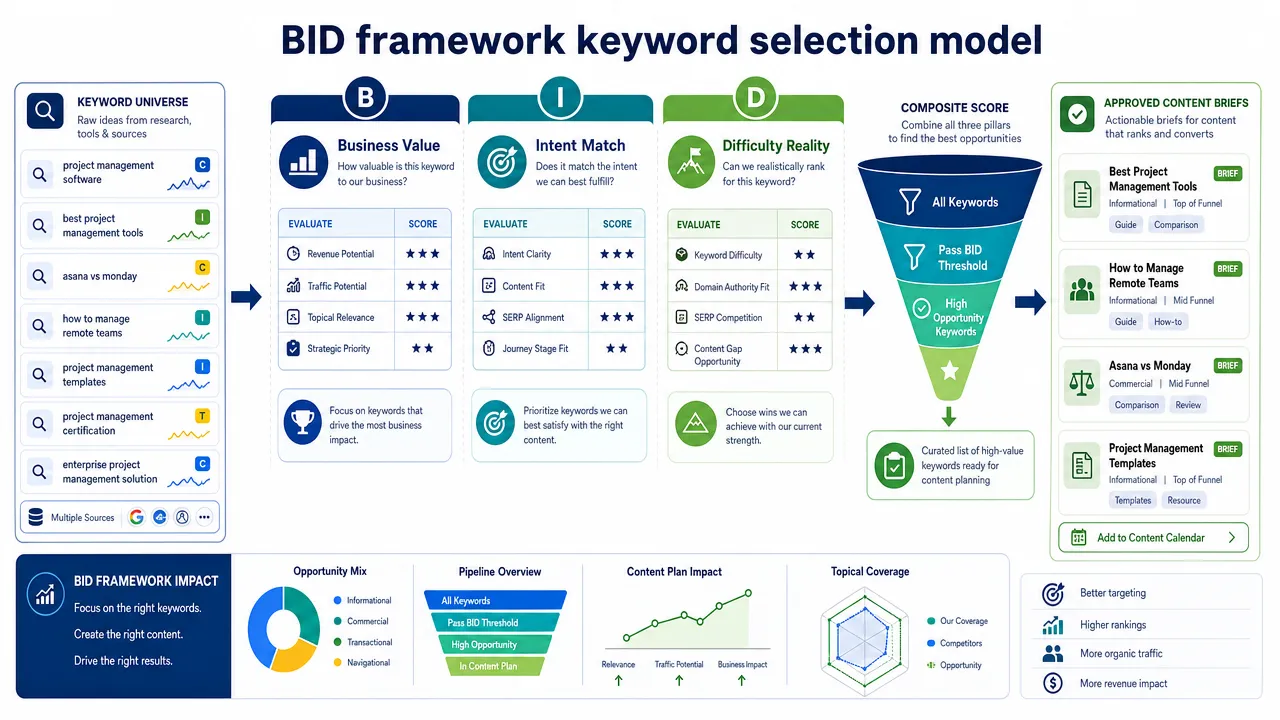
How the SEO keyword selection framework turns BID into a business decision
BID stands for Business Value, Intent Match, and Difficulty Reality. It is not a keyword research tool and it is not a replacement for keyword data. It is the decision layer that sits between keyword discovery and content production.
A typical keyword research process produces too many options. Some terms come from customer language, some from Google Search Console, some from trend monitoring, some from SERP review, and some from competitor observation. The mistake is treating that list as a publishing plan. A list tells you what people search. A framework tells you what deserves investment.
SeekLab.io uses the BID framework SEO methodology to answer three practical questions:
| BID filter | Core question | What it prevents |
|---|---|---|
| Business Value | Will this topic attract the right business conversation? | Traffic that does not become inquiries, leads, or useful brand authority |
| Intent Match | Can the planned page satisfy what the searcher expects? | Articles written for queries that need tools, service pages, comparisons, or checklists |
| Difficulty Reality | Can the website realistically compete now? | Wasted effort on SERPs dominated by stronger domains, deeper content, or better technical foundations |
This matters because SEO failure often starts before a writer touches the article. A team may choose a high-volume keyword, assign a generic post, add internal links later, and then wonder why traffic does not convert. In many cases, the problem was not only writing quality or technical SEO. The original topic had weak business value, mismatched intent, or unrealistic competition.
Google's own guidance consistently points toward useful, reliable, people-first content and websites that are easy to crawl and understand. The Google SEO Starter Guide and helpful content guidance support the same operational principle: pages should be built for real users, not just for search terms. BID turns that principle into a keyword prioritization framework.
For independent websites, official company websites, B2B exporters, and multilingual sites, this distinction is not academic. A content calendar built around weak topics can consume months of budget while leaving the most important product, category, service, and inquiry pages under-supported.
Why an SEO keyword selection framework fails when volume leads the keyword research process
Search volume is useful, but it is a poor first filter. It tells you demand exists. It does not tell you whether that demand belongs to your buyer, whether the searcher is close to a decision, or whether the page you plan to publish has any chance of ranking.
A broad keyword like "SEO tips" may attract readers who want beginner advice. A narrower query like "technical SEO audit for multilingual B2B websites" is more specific, has clearer pain, and connects more naturally to an audit, consultation, or technical review. The second topic may have lower volume, but it can produce better conversations for a company that serves international business websites.
Common selection mistakes look like this:
| Bad selection habit | What usually happens | BID correction |
|---|---|---|
| Choosing the highest-volume term first | The article attracts broad readers with weak buying intent | Score Business Value before volume |
| Copying competitor topics without context | The site publishes content that does not fit its services or authority | Check service relevance, audience fit, and inquiry path |
| Treating every question as a full article | The blog becomes repetitive and thin | Use low-priority questions as FAQs or supporting sections |
| Ignoring the SERP format | A blog post competes against tools, product pages, or comparison pages | Match page type to search intent |
| Targeting competitive head terms too early | The page struggles against stronger domains and deeper resources | Start with long-tail, regional, or industry-specific entry points |
| Publishing without technical checks | Good content underperforms because of crawl, index, speed, or rendering issues | Include technical readiness in Difficulty Reality |
The risk becomes sharper for keyword selection SEO 2026 because search behavior is becoming more fragmented. Users search with longer queries, compare options across multiple surfaces, and expect direct answers faster. At the same time, search systems need cleaner content structure, clearer entities, and stronger page architecture to understand what a page is about.
That does not mean every page needs to chase a new trend. Trend-aware SEO topic selection works only when the topic passes BID. A rising topic can still be a poor investment if it does not connect to a service, does not match the audience, or is already dominated by stronger publishers.
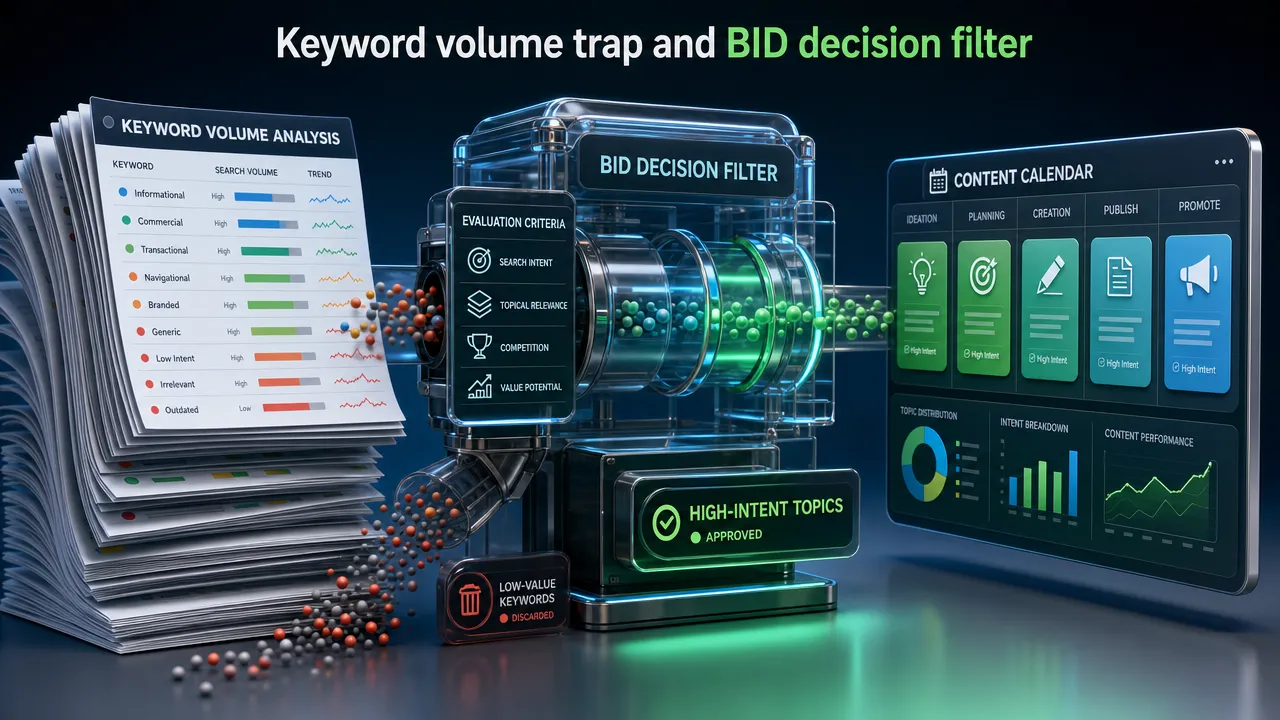
For many websites, the real cost of poor keyword selection is not only low ranking. It is misallocated work. Developers fix pages that do not matter. Writers revise articles that should not have been commissioned. Internal links point toward content that cannot support conversion. A practical SEO keyword selection framework prevents that sequence by forcing the hard decision upfront.
How the SEO keyword selection framework scores Business Value, Intent Match, and Difficulty Reality
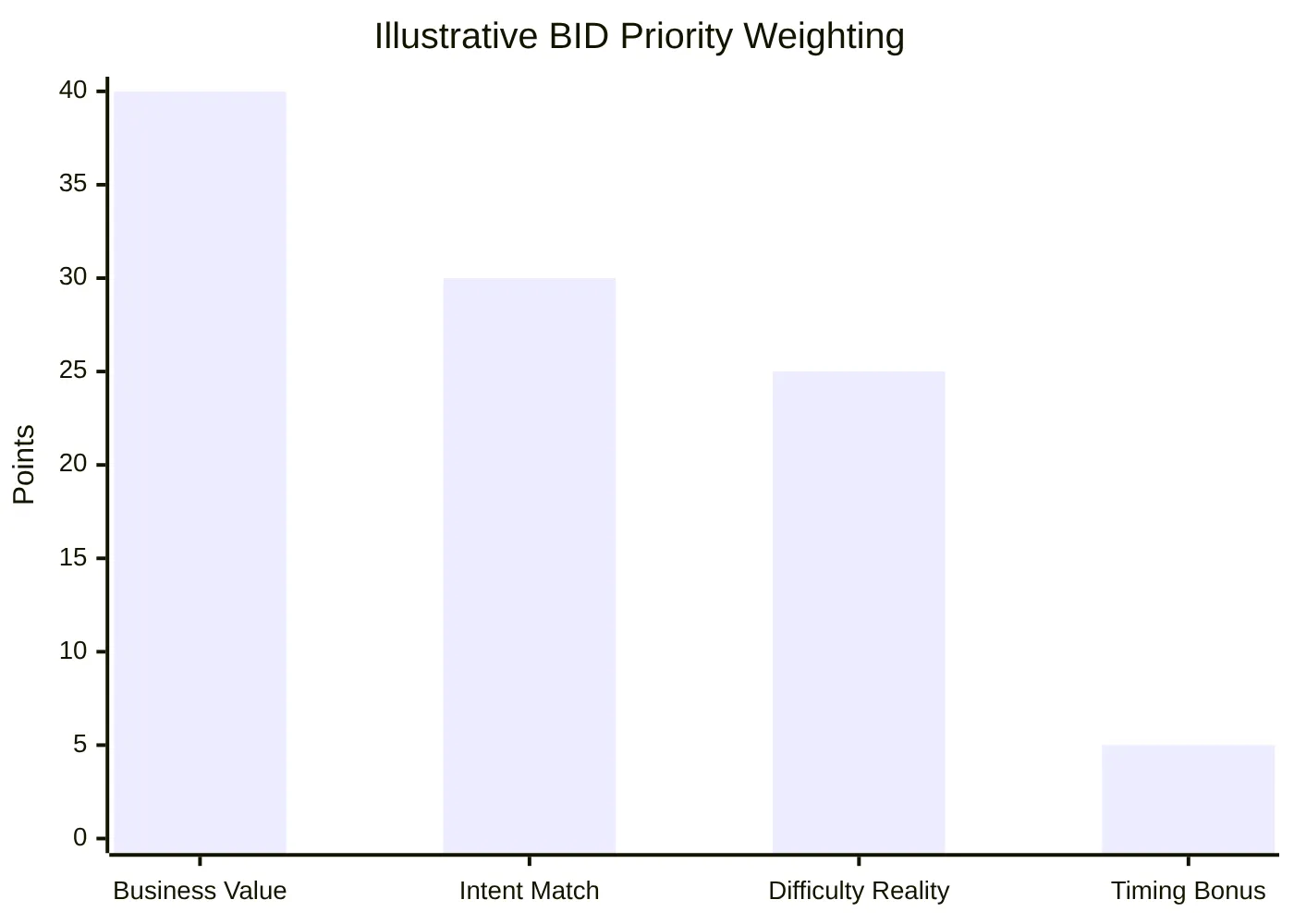
A useful scoring model should be simple enough for a marketing team to use and strict enough to stop weak topics from entering production. SeekLab.io's practical model uses 100 points across the three BID filters plus a small timing bonus.
| Dimension | Weight | Scoring guidance |
|---|---|---|
| Business Value | 40 | Does the keyword connect to services, lead quality, buyer pain, revenue potential, strategic authority, or an inquiry path? |
| Intent Match | 30 | Can the planned page satisfy the dominant search intent and expected page format? |
| Difficulty Reality | 25 | Can the site realistically compete based on SERP strength, authority, content depth, internal links, and technical readiness? |
| Strategic Timing Bonus | 5 | Is the topic tied to a current trend, product launch, market shift, season, or regional opportunity? |
Business Value: Does the keyword support a real outcome?
Business Value is the heaviest filter because not every ranking is worth having. For a company website, a good keyword should connect to a product, service, customer problem, decision process, or authority-building theme.
Strong Business Value signals include:
- The query describes a problem the company solves.
- The searcher may reasonably request an audit, quote, consultation, or technical review.
- The topic can link naturally to a service page, product page, or contact path.
- The content helps qualify the reader before they speak to the business.
- The topic supports future clusters instead of standing alone.
- The article can include examples, tables, visuals, and practical judgment specific to the industry.
For SeekLab.io, "SEO topic selection for international trade websites" has stronger Business Value than "what is SEO" because it fits the audience: independent website operators, official company site managers, exporters, and developers managing international visibility.
A warning is useful here: awareness topics are not useless. They simply need a role. A broad educational query may work as a supporting article, but it should not outrank more commercially relevant topics in the content calendar unless it supports a clear cluster.
Intent Match: Does the page fit what the searcher expects?
Search intent keyword analysis decides the format before writing begins. A team should not assign a blog post just because the keyword is informational. Some informational queries need a checklist. Some need a template. Some need a comparison. Some need a short definition and structured examples.
| Query type | Searcher expectation | Best page format |
|---|---|---|
| "What is..." | A direct definition, examples, and practical context | Explainer or framework article |
| "...checklist" | A scannable list with steps and review points | Checklist or audit guide |
| "...service" | A provider, scope, process, and next step | Service landing page |
| "...best..." | Evaluation criteria and comparison logic | Decision guide or comparison page |
| "...tool" | A functional tool or tool list | Tool page or curated resource |
| "...for B2B exporters" | Industry-specific guidance | Use-case article or solution page |
Intent Match also affects structure. A page targeting "What is the BID Framework?" should define BID immediately, use named sections for each component, and provide a scoring model. A page targeting "SEO audit checklist" should not spend half the article explaining basic SEO theory. Readers came to inspect their site, not read a lecture.
Google's AI features guidance also reinforces the value of clear, accessible page structure. SeekLab.io helps brands build search visibility and AI-era discoverability by making websites easier for search engines, AI systems, and real users to understand through better content structure, information clarity, page architecture, internal linking, and overall site readiness.
Difficulty Reality: Can the site compete now?
Difficulty Reality is where many plans become more honest. A keyword can have excellent Business Value and strong Intent Match, yet still be too difficult for the current site.
Difficulty Reality should evaluate:
| Factor | Practical implication |
|---|---|
| Keyword difficulty | Useful as a screening metric, but not enough by itself |
| SERP strength | Strong domains, tools, official documentation, and deep guides raise the effort required |
| Content depth | Some topics need diagrams, examples, original structure, tables, images, or expert review |
| Topical authority | A site with few related pages may need supporting content first |
| Internal linking | Isolated articles usually underperform compared with connected clusters |
| Technical readiness | Crawlability, indexation, rendering, Core Web Vitals, schema, and mobile performance can limit results |
| Regional opportunity | Some markets may be more realistic than broad global English searches |
| Multilingual variation | Direct translation often misses local search behavior and buyer language |
For deeper technical evaluation, SeekLab.io's SEO audit checklist is a useful next step when Difficulty Reality exposes crawlability, indexing, rendering, Core Web Vitals, schema, or architecture concerns.
A realistic keyword prioritization framework should not punish ambition. It should sequence it. A site may eventually target "SEO content planning," but it may first win "SEO content planning for B2B exporters," "SEO content planning for multilingual websites," or "SEO content planning for Singapore company websites." Those long-tail and regional terms can build topical authority before broader competition becomes realistic.
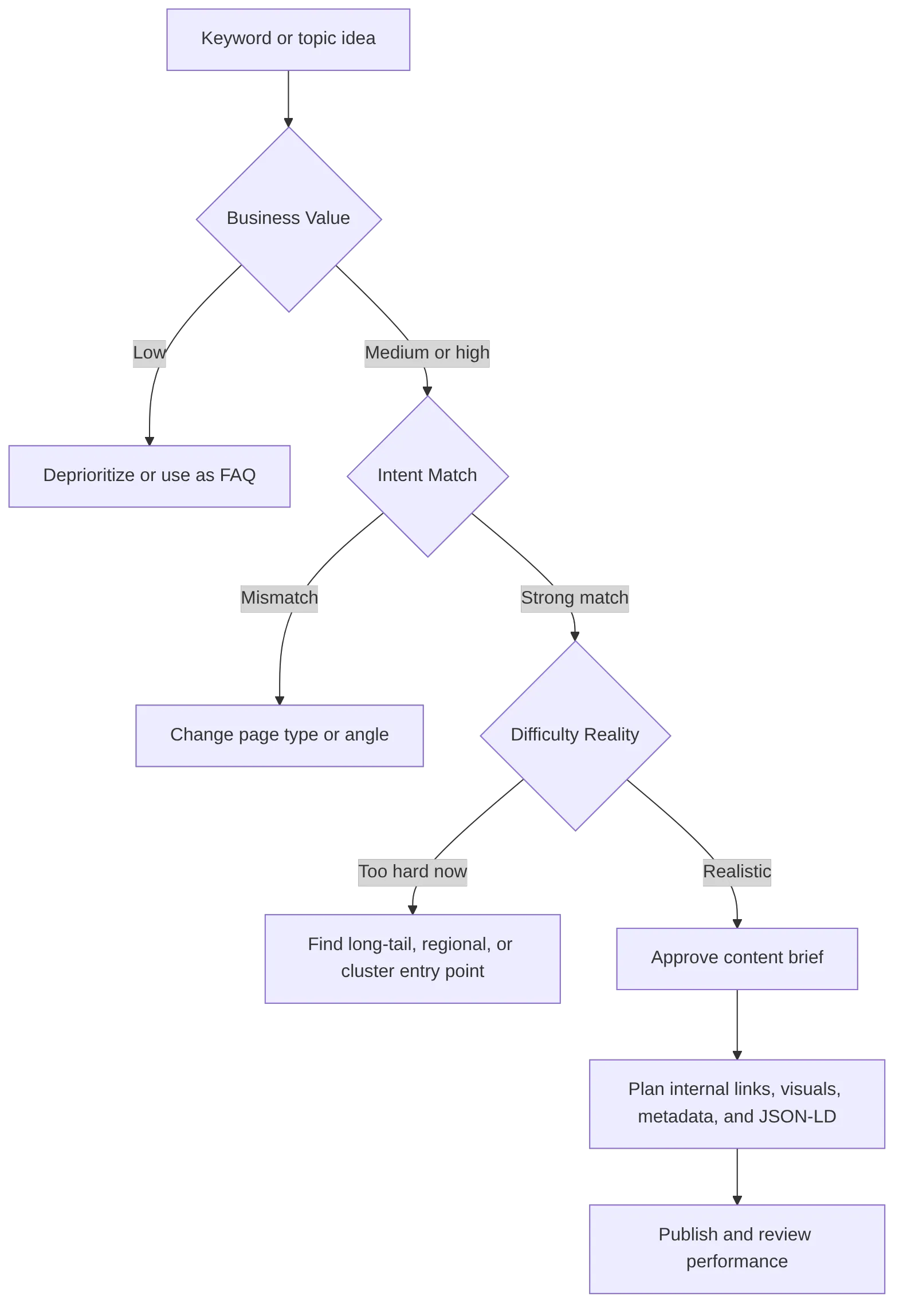
Example BID scoring table
The scoring below is a planning example, not an industry benchmark. The point is to make decisions visible instead of relying on instinct or volume alone.
| Keyword or topic | Business Value /40 | Intent Match /30 | Difficulty Reality /25 | Timing /5 | Total /100 | Decision |
|---|---|---|---|---|---|---|
| BID framework SEO | 40 | 30 | 23 | 4 | 97 | Build brand ownership and define clearly |
| SEO topic selection for international trade websites | 38 | 27 | 20 | 4 | 89 | Prioritize as a strong long-tail opportunity |
| SEO keyword selection framework | 35 | 28 | 17 | 3 | 83 | Build as a strategic framework article |
| Keyword selection SEO 2026 | 32 | 24 | 18 | 5 | 79 | Use with careful, current, non-speculative framing |
| SEO content planning | 34 | 27 | 14 | 3 | 78 | Good opportunity, but needs a specific angle |
| Search intent keyword analysis | 30 | 28 | 16 | 3 | 77 | Strong supporting concept |
| Keyword research process | 20 | 25 | 13 | 2 | 60 | Use as a supporting section, not the main topic |
| Free keyword tool | 8 | 12 | 5 | 2 | 27 | Deprioritize because tool intent and competition are poor fits |
The model also gives teams a common language. A marketing manager may care about lead quality. A developer may care about technical feasibility. A content lead may care about structure and production cost. BID puts those concerns in the same decision table.
How the SEO keyword selection framework changes SEO content planning
SEO content planning becomes more useful when it starts from approved opportunities rather than a raw keyword export. A strong plan should decide the page type, cluster role, internal links, visuals, metadata, and review cadence before drafting begins.
A BID-approved content plan usually includes:
| Planning element | BID-driven decision |
|---|---|
| Pillar page | Choose only if the topic has high Business Value and enough cluster potential |
| Supporting articles | Use long-tail, problem-specific, and regional terms to build topical depth |
| Internal links | Connect supporting pages to priority service, pillar, or conversion pages |
| Images and tables | Add visual explanations where users need comparison, process, or decision support |
| Metadata | Match the topic's search intent and avoid generic titles |
| JSON-LD | Use appropriate structured data such as Article, Organization, BreadcrumbList, or FAQPage when relevant |
| Review cycle | Monitor rankings, clicks, queries, countries, and inquiry quality after publication |
For example, a BID-driven cluster around keyword selection could include:
| Cluster role | Example page |
|---|---|
| Pillar article | What is the BID Framework? SeekLab.io's Keyword Selection Methodology |
| Supporting article | How to Score Keywords by Business Value |
| Supporting article | Search Intent Keyword Analysis: How to Match Page Type to Query |
| Supporting article | Keyword Difficulty Reality: When Not to Chase High-Volume Terms |
| Supporting article | SEO Topic Selection for International Trade Websites |
| Supporting article | SEO Content Planning: From Keyword List to Content Calendar |
| Supporting article | How to Use Google Search Console to Validate Topic Performance |
Internal linking should not be added as decoration. It should help the reader make the next decision. A topic selection article can link to a technical readiness guide. A content cluster article can link to internal linking guidance. A multilingual planning section can link to architecture guidance.
SeekLab.io's article on internal linking SEO best practices is relevant when a selected topic needs cluster support, stronger page relationships, or better conversion paths. Its guide to SEO site architecture for B2B and ecommerce is useful when topic selection exposes deeper structure issues across categories, product pages, regional pages, or multilingual sections.
For multilingual and international websites, the planning layer matters even more. A keyword that works in the United States may not translate into the same intent in Singapore, Germany, the United Arab Emirates, or China. Regional search behavior, local phrasing, and buyer expectations can change the page type and internal link path. A direct translation can create pages that are technically present but commercially weak.
Google Search Console is useful after publication because it shows query, page, country, click, impression, and position data. The Search Console Performance report helps teams validate whether approved topics are gaining the right search visibility, not just any visibility. The review should also include whether organic users move toward contact, audit, quote, or consultation actions.
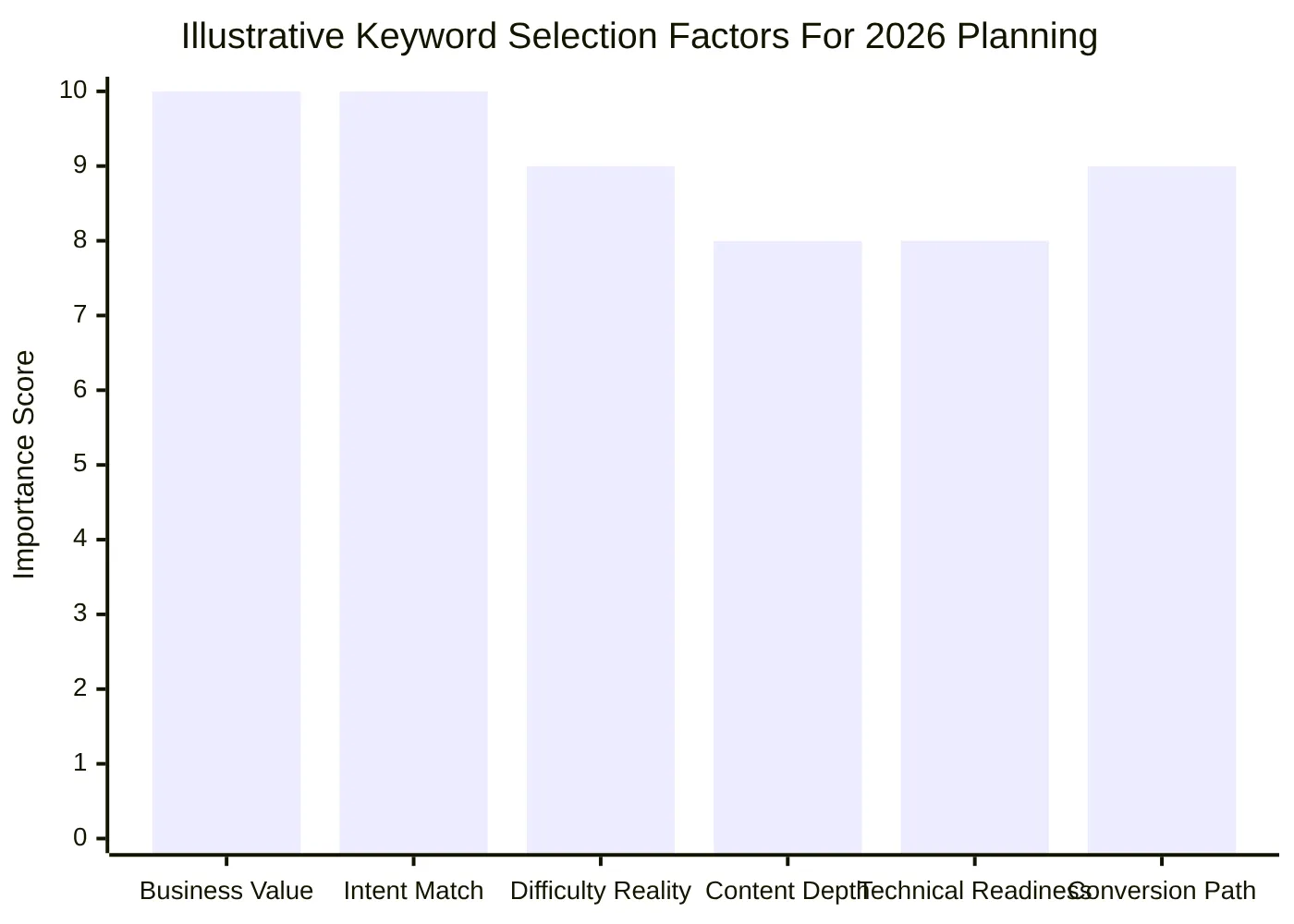
SeekLab.io's approach is not to fix everything equally. The better sequence is to identify what actually affects growth, what can be deprioritized, and which content or technical actions support priority pages. That is especially important for teams concerned about paying for SEO work that looks active but does not produce meaningful business results.
How SeekLab.io applies the SEO keyword selection framework to audits, content, and technical priorities
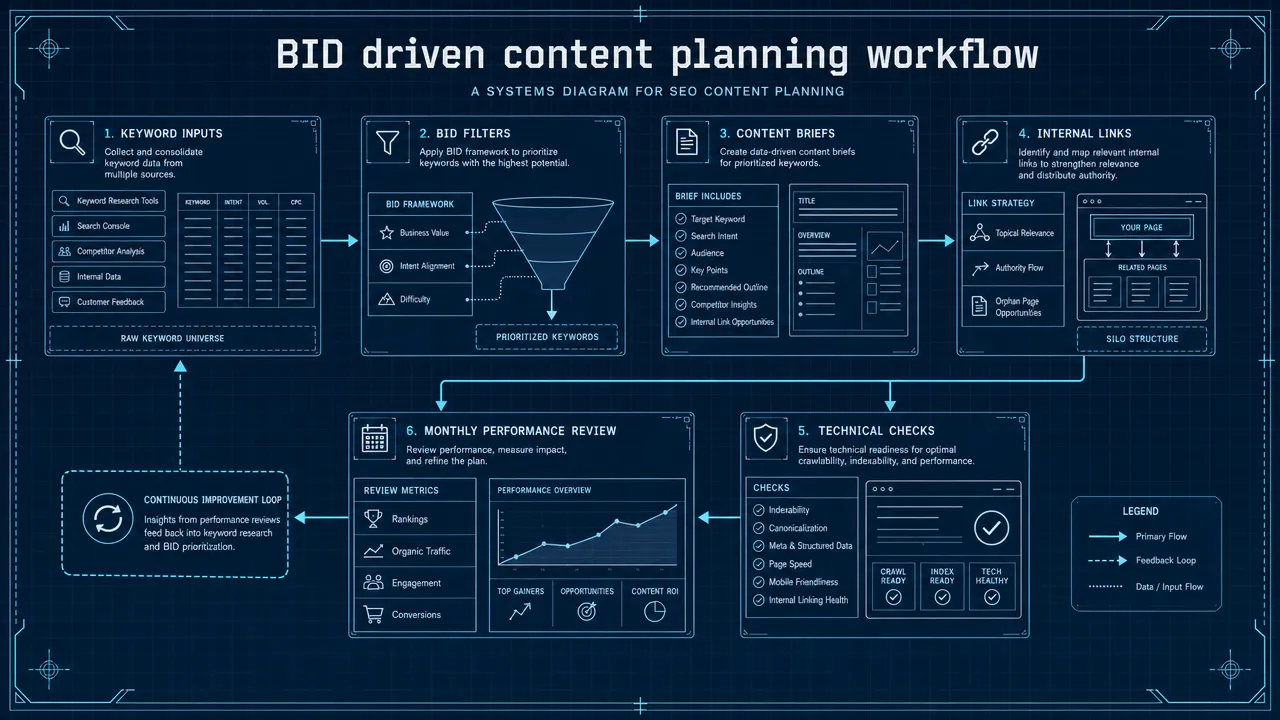
SeekLab.io uses the BID Framework before content production, audit prioritization, and technical SEO recommendations so effort is concentrated on pages and topics that can affect growth. The method is practical because it connects strategic selection with execution details: page structure, internal links, performance, crawlability, schema, visuals, and conversion paths.
The workflow usually looks like this:
| Stage | What SeekLab.io evaluates | Output |
|---|---|---|
| Topic discovery | Search demand, customer language, trend timing, regional variations, existing queries | Candidate keyword and topic list |
| BID filtering | Business Value, Intent Match, Difficulty Reality | Prioritized keyword list |
| Content brief | Headings, search intent, examples, tables, visuals, internal links, metadata | Production-ready brief |
| Technical review | Crawlability, indexing, rendering, Core Web Vitals, schema, robots.txt, sitemap.xml, JavaScript compatibility | Clear technical recommendations |
| Content production | Industry-specific writing, structured layouts, images, conversion paths, brand consistency | Search-ready content assets |
| Performance review | Rankings, impressions, clicks, query mix, countries, inquiry paths, lead quality | Monthly improvement plan |
This is where content and technical SEO stop operating in separate lanes. A topic may score well on Business Value and Intent Match, but Difficulty Reality may reveal that the site has orphan pages, weak internal link equity, slow templates, rendering problems, duplicate metadata, or unclear architecture. In that case, the right recommendation is not simply "write more." The right recommendation may be to strengthen the technical foundation behind the pages that matter most.
SeekLab.io provides comprehensive website SEO audits, SEO content topic selection, high-quality blog creation tailored to the industry, and consultation on technical SEO issues. The work covers both technical and non-technical factors: full-site crawling, structured analysis, Core Web Vitals, indexing, rendering, JavaScript compatibility, semantic structure, schema enhancement, sitemap.xml and robots.txt validation, website tech stack analysis, content topic selection, SERP structure analysis, internal links, multilingual architecture, and monthly performance reporting.
The content side is equally important. A BID-approved topic still needs a page that deserves to rank and helps users make decisions. That means structured headings, clear definitions, useful images, tables, internal links, meta tags, and JSON-LD where appropriate. For complex B2B or international trade topics, plain generic text usually fails because buyers need specificity: product context, market context, technical constraints, and next-step clarity.
SeekLab.io also supports brands across major countries worldwide, with operational coverage especially relevant to Asia-Pacific, the United States, and Europe. Teams and legal entities in Singapore and Shanghai, plus a business development team based in Dubai, give the company practical context for multilingual and cross-border website challenges. For international sites, this matters because keyword selection is rarely a one-market decision.

The commercial value of BID is not that it guarantees rankings. No responsible framework can do that. Its value is that it reduces avoidable waste. It helps teams avoid heading in the wrong direction before they spend money on articles, images, internal links, or technical fixes that do not support business outcomes.
For teams unsure which pages, topics, or technical issues actually affect growth, SeekLab.io can provide a free audit report and clear recommendations. Simple technical issues may be resolved for clients free of charge, and customized content can be planned based on client needs, with monthly data review and performance reports. To discuss a practical keyword selection and SEO content planning workflow, contact us.
FAQs about the SEO keyword selection framework
What does BID stand for in SEO?
BID stands for Business Value, Intent Match, and Difficulty Reality. In SeekLab.io's methodology, it is used to decide whether a keyword or topic deserves SEO investment before content writing, technical optimization, or internal linking begins.
Is BID a keyword research tool?
No. BID is not a keyword research tool. It is a keyword prioritization framework that helps teams interpret keyword ideas, search demand, SERP observations, and performance data through a business-first decision model.
How is BID different from keyword difficulty?
Keyword difficulty is only one part of the decision. BID also checks whether the keyword can support business outcomes and whether the planned page matches search intent. A keyword can be easy to rank for and still be a poor topic if it attracts the wrong audience.
Should low-volume keywords be ignored?
No. Low-volume keywords can be valuable when they show clear buyer pain, industry specificity, regional intent, or service relevance. For many B2B and international websites, lower-volume long-tail terms can produce better inquiry quality than broad high-volume keywords.
How often should keyword priorities be reviewed?
Priority topics should be reviewed monthly after publication, especially through Google Search Console query, page, country, click, impression, and position data. The review should also consider whether organic traffic contributes to contact actions, audit requests, quote requests, or other meaningful business outcomes.
Can BID be used for multilingual websites?
Yes. BID is especially useful for multilingual websites because it prevents direct keyword translation from becoming the strategy. Each market should be reviewed for local search behavior, intent differences, competition, page format, internal linking, and technical architecture before content is produced.