Why Skincare and Beauty Brands Get Left Out of AI Shopping Recommendations
Expert reviewed

Skincare and beauty brands get left out of AI shopping recommendations when their products cannot be reliably accessed, compared, verified, or purchased for the shopper's specific market and needs.
For independent brands, the issue is rarely that an AI shopping system has decided a product is poor. More often, the official product page is vague, the price or availability differs between the site and checkout, variant information is incomplete, or a retailer provides more useful local purchase evidence. AI shopping recommendations for skincare brands depend on commercial clarity as much as product quality.
The practical diagnosis starts with five questions: Can the product page be crawled and rendered? Can a system identify the formula, intended use, ingredients, and variant? Do schema, feeds, checkout, and retailer records agree? Is the product actually available in the shopper's country? Does the page help a buyer decide, rather than merely promote?
Why AI shopping recommendations for skincare brands exclude legitimate products
AI shopping is not a single channel with one ranking formula. A shopper may encounter a product through Google Shopping, Gemini, retailer recommendation modules, marketplace listings, editorial roundups, review platforms, or conversational search results. A product that performs well in one surface can still be absent from another.
Google states that eligible free product listings can appear across Search, Maps, Gemini, YouTube, the Shopping tab, Images, and Lens. That makes Merchant Center data more than an advertising input. It is part of the commercial information layer that helps platforms understand whether an offer is current, purchasable, and appropriate for a market. See Google's guidance on free listings for products.
This explains why some skincare brands are left out of AI recommendations even when their branded search traffic looks healthy. Ranking for a brand name proves that a page can be found. It does not prove that the system can match a serum to "fragrance-free vitamin C serum for beginners," verify its current price, confirm local stock, or distinguish the full-size product from a travel-size bundle.
The problem usually falls into four separate layers:
| Layer | What a platform or shopper needs | Common beauty-brand failure |
|---|---|---|
| Technical access | Crawlable, indexable, stable product URLs | Important product facts only appear after fragile JavaScript loads |
| Product understanding | Product type, ingredients, routine role, skin-type fit, variants | Lifestyle copy replaces decision-grade details |
| Commercial verification | Accurate price, stock, shipping, returns, and seller information | Feed, product page, checkout, and retailer data conflict |
| Buyer confidence | Reviews, local fulfillment, authenticity, comparisons, clear policies | The official site provides less usable evidence than a retailer |
This is why beauty brands AI search visibility should not be treated as a content-only project. A polished article cannot compensate for a product page that shows a product as available while checkout rejects the purchase. Likewise, adding markup cannot solve an unclear formula description or missing ingredient list.
A useful starting point is to separate recommendation eligibility from recommendation selection. Eligibility means the page and offer can be considered. Selection means the product is judged useful for a specific query, shopper location, budget, inventory state, and set of constraints. No brand can guarantee either outcome across every platform.
How AI shopping recommendations for skincare brands use product evidence
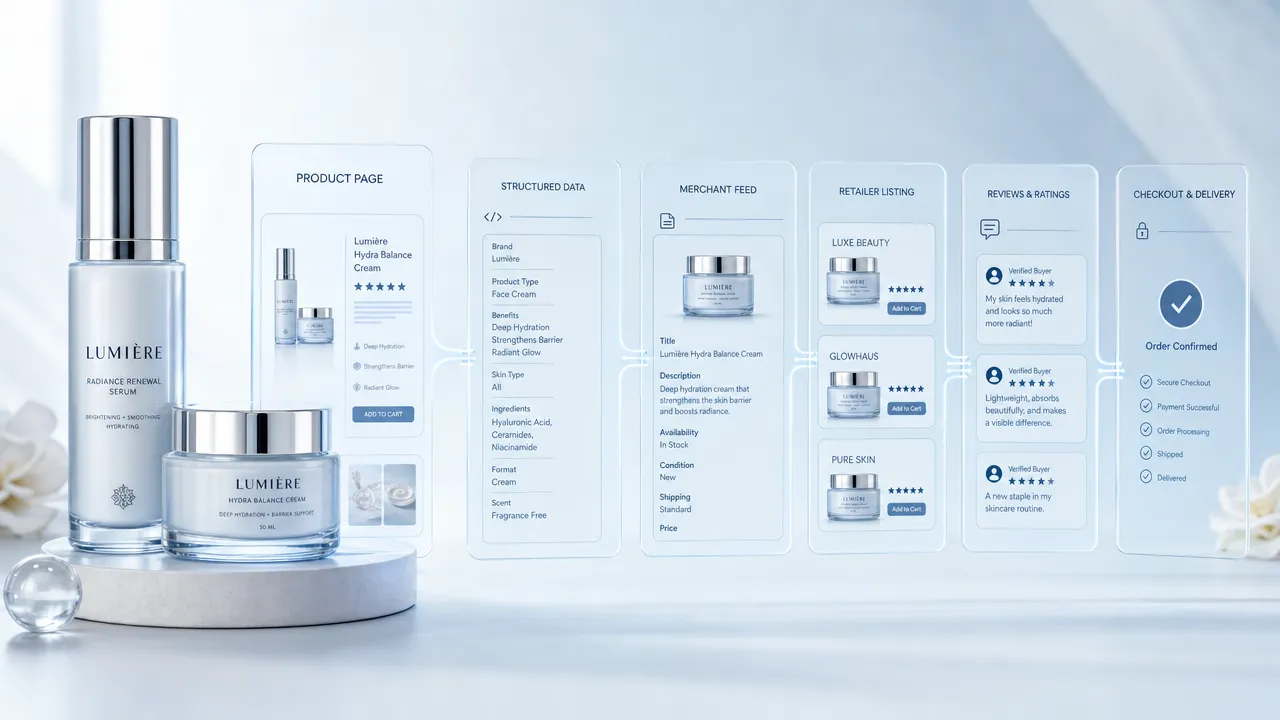
AI shopping results for beauty products are assembled from overlapping sources, not from a brand website alone. The official site provides product truth and the best conversion path. Merchant feeds provide structured offer information. Retailers may contribute local pricing, inventory, delivery estimates, ratings, and verified-purchase reviews. Editorial sources may answer comparison-led questions that a product page does not address directly.
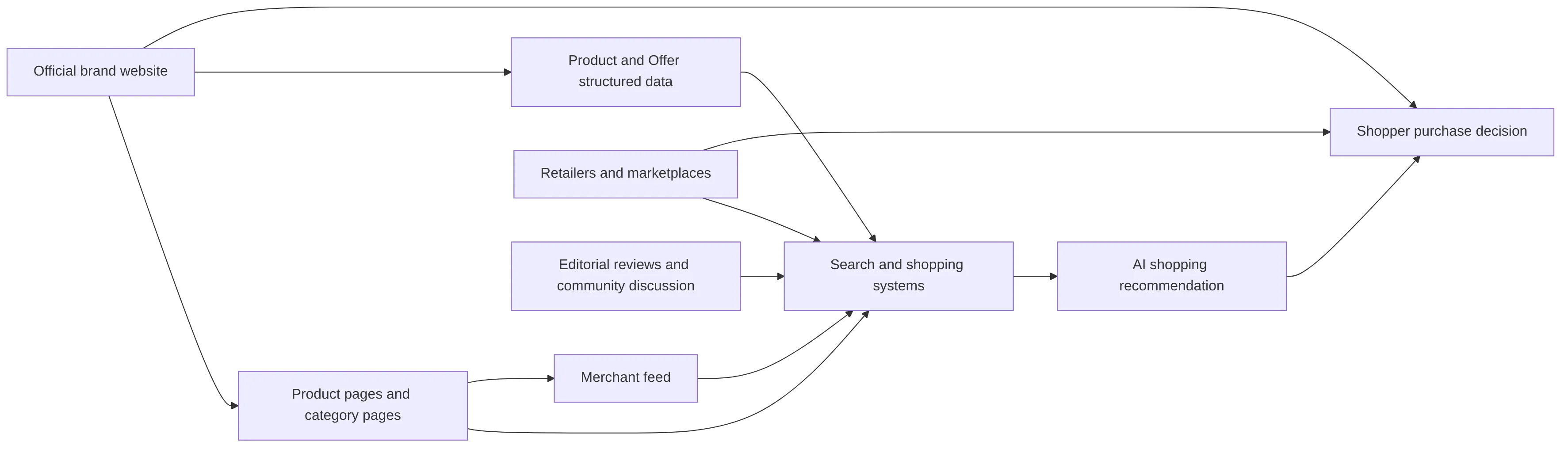
Google recommends using both Product structured data and a Merchant Center feed where applicable. The combination can help Google understand and verify product data, although it does not guarantee a product will appear in any individual shopping result. Review the official Product structured data documentation for the relevant technical requirements.
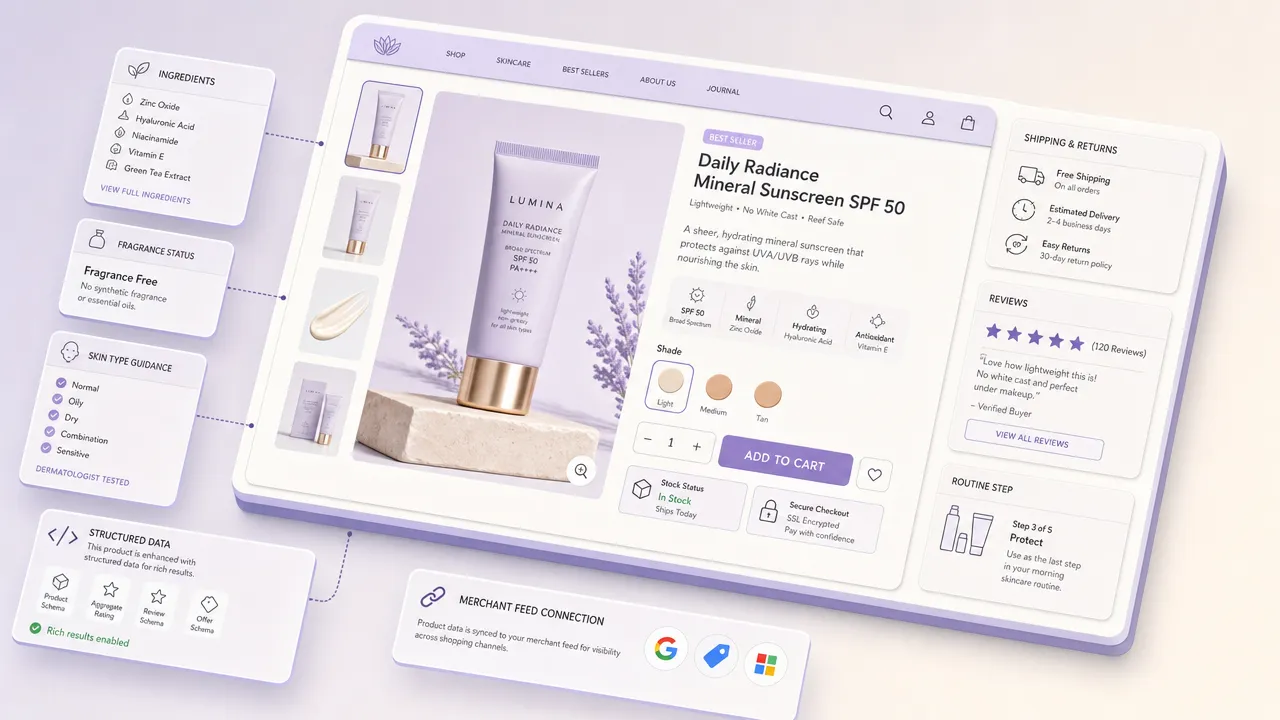
For beauty brands, product evidence needs more depth than a generic title, a hero image, and a short benefit statement. Recommendation systems and shoppers often need to assess:
- Product category and formula type, such as gel moisturizer, cleansing balm, mineral sunscreen, or cream blush.
- Intended routine step and suggested usage frequency.
- Ingredient disclosure and fragrance status.
- Skin-type relevance and clearly stated limitations.
- Shade, size, refill, subscription, and bundle differences.
- Current price, stock status, shipping, returns, and local availability.
- The official seller and authorized retailer status.
Consider a product called "Cloud Dew." That name may work in a campaign, but it does not tell a system whether the product is a moisturizer, mist, essence, or serum. A title such as "Cloud Dew Fragrance-Free Gel Moisturizer for Oily and Combination Skin" is clearer for both shoppers and machines, provided it accurately reflects the product.
Retailers can appear ahead of a brand when they have stronger immediate purchase evidence. A retailer may show local delivery dates, a loyalty price, shade availability, verified reviews, and a simple returns policy. That does not mean platforms always prefer retailers. It means retailers may better answer the buyer's actual question.
For brands trying to understand why products do not show up when shoppers ask AI for recommendations, the right question is not "Which prompt should we optimize for?" It is "Which public source currently provides the clearest, most accurate answer to the shopper's constraints?"
Why beauty brands do not appear in AI shopping results
The most common reasons are operational. They usually involve missing facts, conflicting facts, inaccessible pages, or a poor connection between educational content and purchasable products.
1. Product pages are difficult to crawl, index, or render
A product page cannot contribute reliable evidence if it returns a redirect loop, carries a noindex directive, canonicalizes to an irrelevant page, or exposes its price and availability only after a JavaScript interaction fails.
This problem is common on storefronts with complex variant selectors. The parent page may load, but a selected shade or size does not update in rendered HTML. A crawler or shopping system may therefore see incomplete stock, a generic image, or the wrong price.
Google's merchant listing structured data guidance is specifically intended for pages where shoppers can purchase products directly. Priority product pages should be technically stable, indexable, and usable on mobile before a brand spends heavily on more trend content or outreach.
2. Product descriptions are too promotional to support matching
Beauty copy often uses phrases such as "radiance in a bottle" or "your glow essential." Those lines may support positioning, but they do not answer a constrained shopping query.
A shopper comparing products needs practical details: texture, routine step, fragrance status, full ingredients, intended skin-type relevance, directions, size, and relevant cautions. A fragrance-free gel moisturizer should not force a visitor to inspect a small packaging image to find its ingredient list.
This is also where beauty product recommendation algorithms face a harder problem than many other categories. A foundation needs shade-level information. A serum needs formula and routine context. A sunscreen needs accurate market-specific information. A subscription or holiday set needs distinct offer data from the standalone product.
3. Structured data, feeds, and visible pages do not agree
A product page may display a sale price while its structured data retains the original price. A Merchant Center feed may list an item as in stock while checkout shows it as unavailable. A retailer may use a discontinued product title or old ingredient list.
These mismatches create uncertainty. Google identifies price, description, and availability as core product information for free listings, with further requirements based on country, category, and offer conditions. Brands should regularly compare the product page, structured data, merchant feed, checkout, and major retailer records.
Use both the Rich Results Test and Merchant Center diagnostics, but do not stop at a validation pass. A technically valid schema field can still be commercially wrong.
4. Local availability is unclear or inaccurate
A U.S. product page shown to a shopper in Germany may have the wrong price, shipping terms, returns policy, regulatory wording, or inventory status. Translation does not make an offer local.
This is a recurring reason beauty brand discoverability in AI shopping weakens across international markets. A shopper asking for an official store in Singapore or France needs a real local answer, not a translated version of a U.S. page.
Localized commercial pages need accurate currency, shipping, return policies, available variants, product descriptions, and reciprocal language or regional annotations. Google's localized versions guidance explains the technical relationship layer, but the business still has to maintain accurate local offer data.
For international teams, SeekLab.io's multilingual SEO strategy guide is a useful companion resource because architecture problems and offer-data problems often appear together.
5. Retailers provide better shopping evidence than the official site
Retailers and marketplaces may have clearer stock, local delivery, seller details, product ratings, swatches, bundle choices, and return terms. An editorial publisher may also provide direct comparisons, texture notes, or testing context that brand-led copy lacks.
Brands should not try to replace third-party sources with self-authored claims. Instead, they should govern the information that reaches those sources. That means providing approved product titles, images, ingredient lists, claim boundaries, SKU mappings, authorized-seller information, and timely availability updates.
Authentic reviews are useful because they can describe buyer experience in areas brand copy cannot credibly settle alone, such as texture, scent perception, packaging performance, shade matching, or use under makeup. They are not a guaranteed recommendation signal, and they should never be fabricated or selectively hidden.
6. Category pages and buyer content fail to connect questions to products
A skincare blog may contain dozens of broad educational articles but no useful path from a concern to a product category or purchasable item. An article about niacinamide, for example, should not end at generic ingredient education if the brand sells products relevant to that topic.
The stronger pattern is a connected structure:
- Ingredient explainers clarify what the ingredient does and what the brand can responsibly claim.
- Routine guides explain product order, frequency, and product-type differences.
- Category pages explain selection criteria, not just display product grids.
- Product pages provide the final detail required for a purchase decision.
- Internal links use descriptive language that connects each topic to relevant collections or products.
For an example of a niche product-led content angle, see Birch Juice Moisturizer: Niche Skincare SEO. The point is not to publish more ingredient pages indiscriminately. It is to make sure buyer questions lead to accurate, relevant commercial pages.
How to optimize skincare brand for AI recommendations without chasing shortcuts
The most reliable work is not a platform trick. It is a prioritized cleanup of product truth, technical access, buyer information, and market consistency.
Start with a governed source of truth for priority SKUs. This does not always require a new product information management system. A well-maintained operating sheet can be enough for a smaller brand, provided it has clear ownership and update rules.
| Product field | Why it affects recommendation readiness | Typical owner |
|---|---|---|
| Product name and product type | Helps distinguish a serum from a moisturizer, refill, or set | Merchandising |
| SKU, GTIN, and variant mapping | Prevents parent and variant confusion | E-commerce operations |
| Formula version and INCI list | Prevents outdated ingredient information | Product and regulatory teams |
| Price and sale dates | Prevents visible-page and feed mismatches | E-commerce operations |
| Inventory and destination availability | Avoids recommending unavailable products | Operations |
| Images and variant-specific visuals | Helps confirm shade, size, and packaging | Creative and merchandising |
| Shipping, returns, and official seller status | Supports buyer confidence and regional relevance | Operations and customer support |
Next, audit the commercial pages that matter most. Do not begin with every URL on the site. Start with high-margin products, bestsellers, products with retailer distribution, and products that align with valuable non-branded queries.
A practical priority order is:
- Fix crawlability, indexation, rendering, canonical, sitemap.xml, and robots.txt issues on priority product and category pages.
- Align price, availability, images, variants, and shipping between the page, schema, feed, checkout, and retailer listings.
- Improve visible product-page details, especially ingredients, fragrance status, routine role, usage instructions, size, texture, and limitations.
- Validate Product and Offer markup against visible content.
- Improve category architecture and internal links from educational pages to relevant purchasable pages.
- Localize commercial offers by market rather than translating global pages.
- Build accurate retailer records, authentic reviews, and credible editorial coverage where there is a legitimate fit.
The table below helps distinguish work that should happen now from work that often gets overfunded too early.
| Action | Likely impact | Why it should be prioritized or delayed |
|---|---|---|
| Fix blocked, weakly rendered, or non-indexable product pages | High | A product cannot be reliably interpreted if access is unstable |
| Resolve feed, page, checkout, and retailer mismatches | High | Inconsistent commercial facts damage trust and eligibility |
| Add decision-grade product information | High | Specific buyer constraints require specific facts |
| Improve variant titles, stock, imagery, and identifiers | High | Beauty products are frequently shade, size, and bundle dependent |
| Add advanced markup to low-value pages | Low to moderate | Core product and offer accuracy matters more |
| Publish generic skincare trend articles | Low | Broad education rarely resolves purchase questions |
| Pursue low-quality mentions | Low | Copied descriptions and thin affiliate pages add little useful evidence |
| Earn credible editorial coverage | Situational | Valuable for research-stage queries, but not a replacement for product truth |
Claims need particular care. U.S. cosmetic claims can affect how a product is regulated, and the Food and Drug Administration does not maintain a list of approved cosmetic claims. Consult the FDA's cosmetics labeling claims guidance before expanding disease-adjacent, treatment-oriented, or universal-safety language. In the European Union, cosmetic claims must meet criteria covering legal compliance, truthfulness, evidential support, honesty, fairness, and informed decision-making under Commission Regulation EU No. 655/2013.
The commercial implication is straightforward: product pages should explain boundaries, not make inflated promises. "Fragrance-free gel moisturizer designed for oily and combination skin" is more useful and safer than "heals irritated skin for everyone."
How to measure AI shopping recommendations for skincare brands without overclaiming
No single dashboard can prove that a product was included or excluded because of one change. AI outputs vary by location, language, account context, stock, pricing, retailer coverage, and ongoing product experiments.
Instead, measure the inputs you control and the business outcomes that follow.
The practical order in which most brands should investigate problems is: access, data accuracy, product clarity, local offer, and conversion.
Track the following before and after major changes:
| Measurement area | What to check | Useful business signal |
|---|---|---|
| Technical access | Indexable priority URLs, rendered content, canonical conflicts, sitemap coverage | Whether important product pages can be found and interpreted |
| Product-data health | Schema validity, feed warnings, page-to-feed price and stock consistency | Whether commercial facts are machine-readable and aligned |
| Search and shopping discovery | Impressions, clicks, product landing pages, query groups | Whether relevant commercial pages are gaining exposure |
| Product-page behavior | Variant selection, add-to-cart rate, checkout starts, support questions | Whether discovery turns into buyer action |
| Market readiness | Local stock, currency accuracy, shipping terms, hreflang errors, returns |
Whether localized pages reflect a real offer |
| External corroboration | Retailer accuracy, review quality, authorized seller consistency | Whether public product information is trustworthy |
| Prompt monitoring | Fixed prompt set by country, language, device, and date | Recurring omissions, wrong product details, and source patterns |
Use a small, repeatable prompt sample rather than random searches. For example:
- "Fragrance-free gel moisturizer for oily skin in the United States."
- "Official store for [brand name] in Germany."
- "Mineral sunscreen under makeup with a lightweight finish."
- "Best facial cleanser for a simple evening routine."
- "Where can I buy [product name] with current local delivery?"
Record the recommended products, cited or linked sources, stock accuracy, price accuracy, retailer availability, and whether the official product page appears. Keep a change log. If visibility changes after technical repairs, a feed update, product-page rewrites, and retailer corrections, do not assign credit to only one intervention.
Brands that need a broader view of research-stage discovery can also review how DTC brands get into AI best-of product roundups. Roundups, merchant listings, retailer pages, and official product pages serve different buyer moments. Treating them as one channel leads to poor decisions.
A skincare brand does not need to be everywhere at once. It needs to be accurate and useful where its customers make decisions. SeekLab.io helps brands identify the technical, commercial, content, and multilingual issues that materially limit growth, then prioritize the fixes that are worth pursuing before resources are spent on lower-impact work.
For a focused review of product discoverability, feed consistency, rendering, site structure, and conversion readiness, get a free audit report.
FAQ
Why does a skincare brand rank well for its own name but still get left out of AI shopping recommendations?
Ranking for a brand name only proves the page can be found. It does not prove a system can match a specific product to a constrained query, verify current price and stock, or confirm the offer is available in the shopper's market. Eligibility and selection are separate problems, and branded search performance only speaks to the first.
Does adding Product structured data guarantee a beauty product will appear in AI shopping results?
No. Structured data helps platforms interpret facts that are already accurate and consistent elsewhere. It cannot fix a vague product description, resolve a price mismatch between the page and checkout, or invent an ingredient list that isn't there.
Why do retailers sometimes get recommended over the brand's own official product page?
Retailers often provide clearer immediate purchase evidence: local delivery dates, verified reviews, real-time stock, and straightforward return terms. This isn't a general platform preference for retailers over brands; it reflects which source currently answers the shopper's actual question more completely.
Is localization for skincare brands just a translation problem?
No. A translated page without accurate local price, currency, shipping terms, and stock status is not a real local offer. Shoppers and platforms both need commercial facts that are correct for the specific market, not just language that reads correctly.
How should a skincare brand handle ingredient or efficacy claims when trying to improve AI visibility?
Carefully. In the US, the FDA does not maintain a list of pre-approved cosmetic claims, and in the EU, cosmetic claims must meet specific truthfulness and evidentiary standards under Regulation (EC) No. 655/2013. Clear, bounded claims (for example, stating a product is fragrance-free and suited to oily skin) are both safer and more useful for matching than broad, treatment-oriented language.