Why Your Products Don’t Show Up When Shoppers Ask AI for Recommendations
Expert reviewed

Products fail to appear in AI product recommendations because the systems cannot confidently discover, understand, verify, or match them to the shopper's request. The issue is usually not one mysterious algorithm. It is a practical evidence problem across crawlability, indexing, product content, structured data, feed consistency, internal linking, reviews, regional signals, and conversion readiness.
A product page can look acceptable to a human buyer and still be weak at machine level. Common blockers include products not showing up in AI recommendations because the URL is not indexed, the page hides key content behind JavaScript, the Product schema is missing, the product feed conflicts with the page, or the product has too little credible external proof. For teams working on AI shopping search visibility, the first job is to find which of these blockers actually limits growth, not to fix every minor SEO issue in the backlog.
The practical checklist starts with access, then moves to interpretation, trust, matching, and conversion: can search systems crawl the page, can they read product facts, can they verify price or availability, can they connect the product to a buyer scenario, and can the page turn the visit into an inquiry or sale?
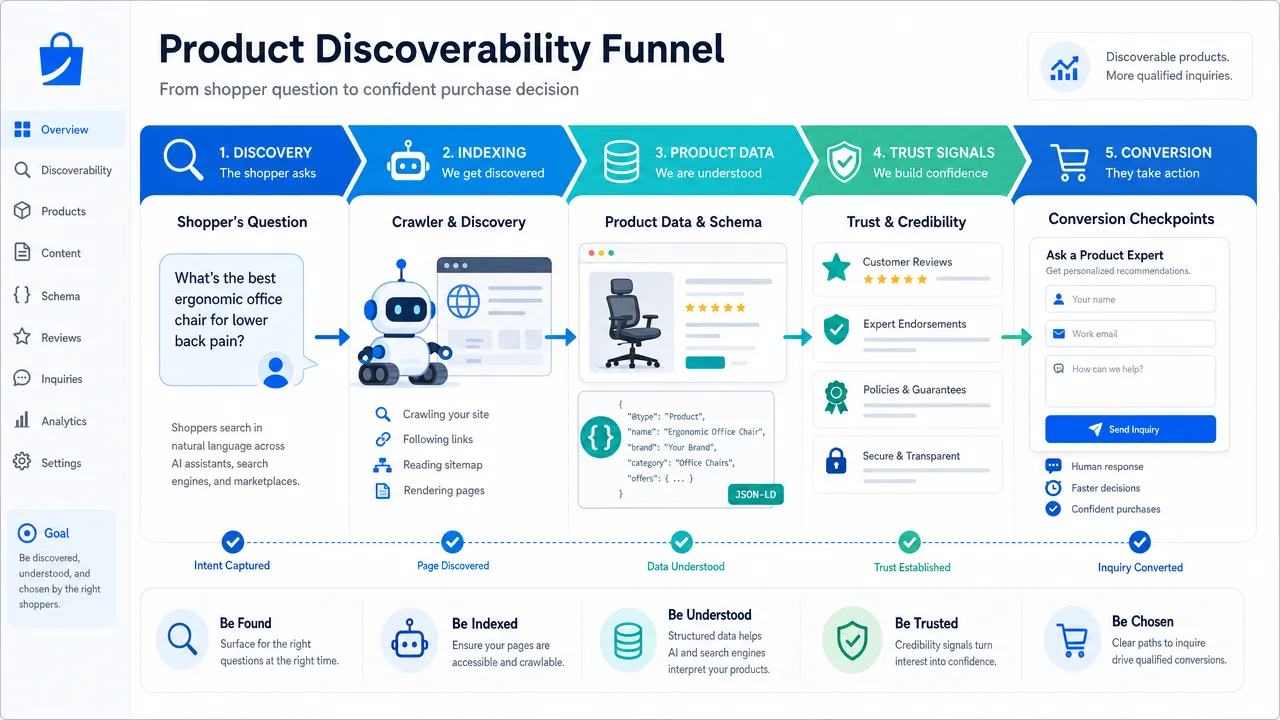
Why AI product recommendations skip products that machines cannot discover, understand, or verify
AI product recommendations are built from evidence. Search assistants and AI-powered shopping experiences may use indexed product pages, structured data, product feeds, reviews, third-party references, merchant data, and query context. Public documentation does not reveal a universal formula for every recommendation system, but official search and merchant documentation gives website owners a clear operating model: products need to be accessible, factual, consistent, and useful.
Google explains that Search works through crawling, indexing, and serving. That means a product URL must first be discoverable before it can be considered in search-driven experiences. Google also documents that product data can be provided through structured data, Merchant Center feeds, or both, which matters because recommendation-style shopping depends on product facts such as name, brand, image, price, availability, identifiers, and reviews.
The business behavior has changed as well. A shopper no longer has to search only "waterproof backpack" and compare ten pages manually. They may ask, "best waterproof laptop backpack for business travel under $150" or "corrosion-resistant pump for a coastal food-processing plant." Those prompts combine category, use case, budget, operating environment, and decision criteria. Thin product pages rarely provide enough evidence for that level of matching.
For independent websites, exporter websites, B2B brand sites, and multilingual official websites, this creates a practical problem: product discoverability in AI search depends on more than ranking for a head keyword. A product page must show what the product is, who it fits, where it can be used, why it is credible, and how a buyer can take the next step.
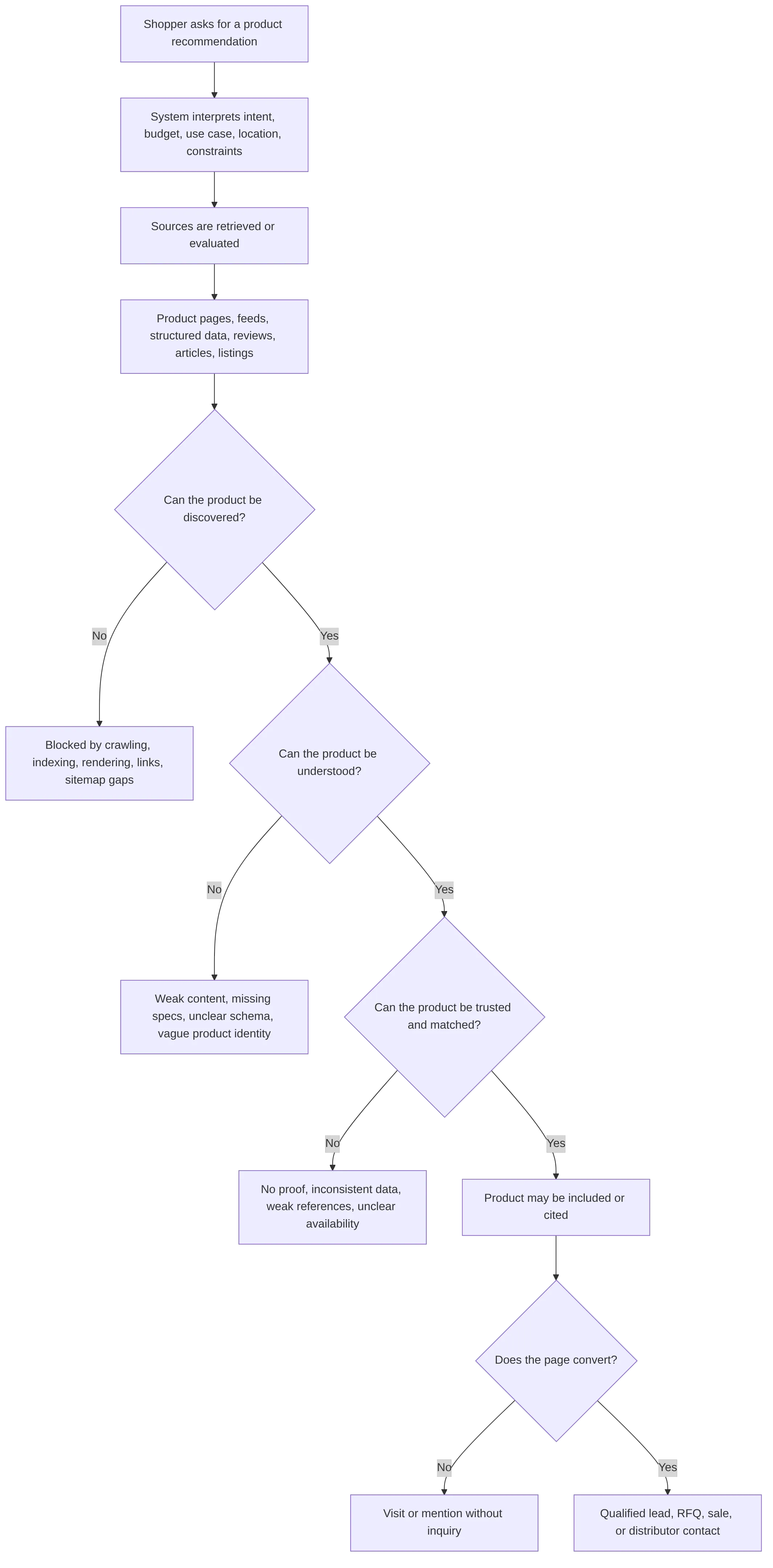
A useful way to look at the issue is to separate "being online" from "being usable evidence." A product can exist in the CMS, appear in the navigation, and still fail as evidence if the page is excluded from the index, the product name is inconsistent across languages, or the page says "contact us" before giving buyers enough technical detail.
For a deeper technical starting point, SeekLab.io's technical SEO audit checklist is a useful companion because the same audit areas, including crawling, indexing, rendering, schema, internal linking, and Core Web Vitals, often determine whether product pages are eligible to be found at all.
How AI product recommendations expose weak product pages and broken SEO foundations
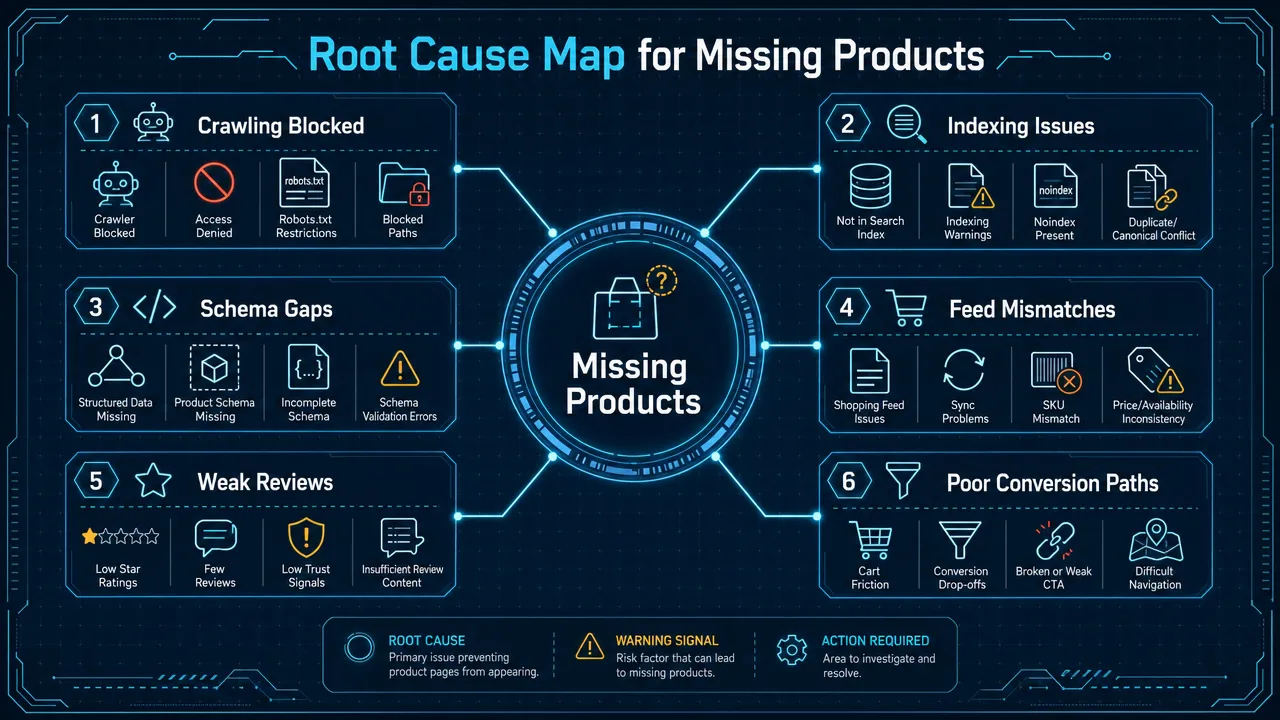
Most cases of why products do not appear in AI results come down to one of five failures: the page cannot be accessed, the product cannot be interpreted, the commercial data cannot be trusted, the page lacks external support, or the product does not match the buyer's scenario clearly enough.
| Failure point | What it looks like on the website | Practical implication |
|---|---|---|
| Discovery failure | robots.txt blocks, noindex, wrong canonical, orphan URLs, missing sitemap entries |
Search systems may never build reliable evidence for the product |
| Interpretation failure | Thin copy, missing specs, vague category pages, content loaded late by JavaScript | The product is hard to match to detailed shopper questions |
| Data consistency failure | Feed price differs from page price, availability is outdated, product names vary | Systems and buyers have less confidence in the commercial facts |
| Trust failure | Few reviews, no case studies, no credible mentions, inconsistent brand signals | The product may lose to competitors with stronger proof |
| Conversion failure | No RFQ path, unclear shipping, missing MOQ, weak CTA, poor mobile experience | Product discovery does not turn into business growth |
The first failure is often technical. Product pages may be blocked by robots.txt, marked noindex, canonicalized to a parent category, or buried behind filters that crawlers do not follow reliably. Google's documentation on how Search works makes the sequence clear: crawling and indexing come before serving. For recommendation-style discovery that depends on search retrieval, a non-indexed product page is a weak source.
JavaScript-heavy websites add another common failure. Product names, prices, specifications, and links may render only after client-side scripts run. Google provides JavaScript SEO guidance because rendering affects what can be discovered. Even when rendering works, relying on late-loading scripts for core product facts creates unnecessary fragility, especially on large catalogs.
The second failure is content quality at product level. Many product pages use copy such as "high-quality, durable, reliable, suitable for many industries." That copy does not help a system recommend the product for a specific buyer scenario. A better page gives crawlable specifications, ideal use cases, limitations, compatible environments, certification details, comparison points, and next steps.
For example, a weak B2B product page says:
"Industrial valve suitable for demanding applications."
A stronger version says:
"316 stainless steel ball valve for coastal food-processing environments, designed for corrosion resistance, X pressure range, Y temperature range, and Z connection types. Not recommended for automated flow control unless paired with the optional actuator."
The second version gives machines and buyers specific evidence. It also reduces low-quality inquiries because the buyer can qualify fit before contacting sales.
The third failure is inconsistent data. Google Merchant Center's product data specification includes attributes such as title, description, link, image, price, availability, brand, GTIN, and MPN. Even outside classic retail, the same principle applies: product identity, commercial terms, and availability should not conflict across the product page, structured data, feed, marketplace listing, distributor page, and regional version.
A product may also be skipped because the official website is weaker than external sources. Competitors can appear more often because their pages include better comparison content, visible reviews, stronger category architecture, consistent product identifiers, or credible mentions from industry sites. The better product offline does not always become the easier product to recommend online.
Where AI product recommendations depend on structured data, feeds, and internal links
Structured data does not guarantee inclusion in AI product recommendations, but it reduces ambiguity. Google describes structured data as a standardized format for classifying page content, and its Product structured data documentation explains how product facts can support product snippets and merchant listing experiences.
For product pages, the most useful markup usually includes Product, Offer, Brand, SKU, GTIN, MPN, AggregateRating, Review, BreadcrumbList, Organization, and WebSite where accurate and visible. The important condition is accuracy. Google's structured data introduction and review guidance make clear that markup should represent visible page content and follow documented requirements.
A practical schema audit should compare visible content against JSON-LD. If the page shows one price and the structured data shows another, the problem is not "missing SEO." The problem is a trust mismatch.
| Product evidence | Visible page content | Structured data or feed field |
|---|---|---|
| Product identity | Product name, model, variant, category | name, sku, gtin, mpn, brand |
| Commercial facts | Price, currency, availability, condition | Offer, price, priceCurrency, availability |
| Buyer proof | Reviews, ratings, testimonials | Review, AggregateRating when compliant |
| Site context | Category path, breadcrumbs | BreadcrumbList |
| Entity clarity | Company name, logo, official profiles | Organization, WebSite |
| Shopping data | Title, description, image, link, availability | Merchant feed attributes |
SeekLab.io has a dedicated resource on schema markup SEO audit that fits this stage well because schema problems are often template-level issues. One broken product template can affect hundreds or thousands of URLs, especially on ecommerce, exporter, and multilingual websites.
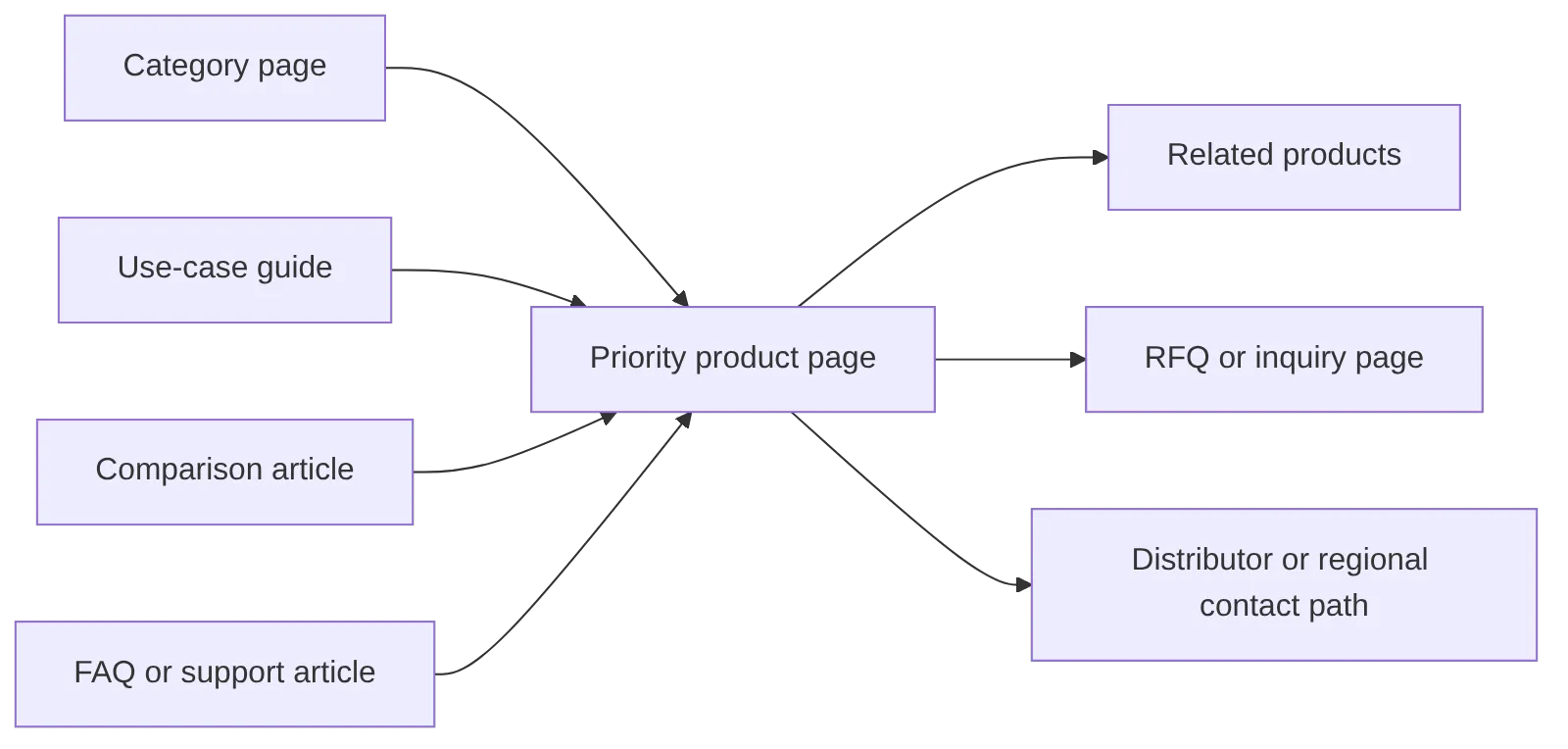
Internal linking is the next layer. A product page connected to a category, comparison article, use-case guide, FAQ, and related product module gives clearer context than an orphan URL. Google notes that URLs can be discovered through links and sitemaps, so architecture still matters even when product feeds are in place.
A common pattern on weak sites is that blog posts generate impressions but do not link to relevant products. A buying guide discusses "how to choose industrial filters for humid warehouses" but never links to the filter category or the right product series. That wastes semantic support and wastes high-intent traffic. SeekLab.io's guide to SEO content strategy for product discoverability is relevant here because topic selection should connect buyer intent to product pages, not just fill a content calendar.
The fourth layer is product feeds. Feed-page-schema consistency is especially important for AI shopping search visibility. Product title, description, price, availability, image, brand, and identifiers should align across the live page, structured data, and merchant feed. Google's Merchant Center diagnostics documentation is useful for identifying disapprovals and product data issues, but teams should also run their own comparisons because feed problems can reflect deeper catalog governance issues.
The fifth layer is external evidence. Reviews, expert comparisons, distributor listings, partner pages, industry directories, and credible mentions help show that a product is known beyond the seller's own claims. Google's guidance on helpful content emphasizes original information, expertise, and usefulness. Product pages that only repeat generic manufacturer copy rarely satisfy that standard.
How to optimize products for AI product recommendations without wasting effort
The fastest path is not to publish hundreds of generic articles or add schema everywhere at once. The practical sequence is blocker removal, product evidence improvement, trust building, regional clarity, and conversion measurement.
Start with priority products, not the whole catalog. Pick the SKUs, product families, or service pages that matter most to revenue, strategic expansion, or inquiry quality. Then run a diagnostic pass in this order:
| Priority | Check | Fix first |
|---|---|---|
| 1 | Crawlability and indexability | Remove accidental noindex, fix robots.txt, correct canonical tags |
| 2 | Rendering and HTML visibility | Make product name, specs, price or quote path, and links readable in rendered HTML |
| 3 | Sitemap and internal links | Add canonical product URLs to XML sitemaps and link from categories, guides, and related products |
| 4 | Product content | Add specs, use cases, comparison points, limitations, images, documents, and FAQs |
| 5 | Structured data | Add valid Product, Offer, BreadcrumbList, Organization, and review markup where accurate |
| 6 | Feed consistency | Align title, price, availability, images, brand, SKU, GTIN, MPN, and regional data |
| 7 | Trust signals | Add genuine reviews, certifications, case studies, testing data, distributor references, and warranty details |
| 8 | Conversion path | Improve CTAs, RFQ forms, quote paths, mobile usability, lead-time details, and regional contact options |
For B2B and exporter websites, product pages often fail because they behave like brochures. Buyers need enough information to qualify fit before speaking with sales. That means MOQ, lead time, customization options, certifications, materials, compatibility, application scenarios, shipping terms, and regional availability should be visible where appropriate. Hiding every detail behind "contact us" may increase form submissions, but it often lowers lead quality.
For multilingual websites, the most common mistakes are hreflang errors, wrong canonicals, direct translation without local buyer intent, inconsistent product names, and regional pages with the wrong currency or availability. Google's localized versions documentation explains how hreflang helps search engines understand language and regional alternates. In practice, the technical tags and the commercial content must agree. A German product page should not canonicalize to the US page while showing German inquiry terms and European availability.

Some work can be deprioritized. Cosmetic schema additions on low-value pages, rewriting every old product description before fixing indexing, publishing generic blogs without product links, or chasing tiny design details before fixing missing CTAs are usually poor first moves. A mature SEO plan separates growth blockers from nice-to-have improvements.
The goal is not to control every recommendation output. No website can do that. The goal is to make product evidence easier to retrieve, easier to parse, easier to verify, and more useful for both search systems and buyers.
A monthly review should track more than rankings. Product-level impressions, indexed URL counts, rich result eligibility, feed diagnostics, recommendation-style query coverage, organic-assisted inquiries, RFQs, lead quality, and conversion paths all matter. Traffic without commercial movement is still a weak outcome.
SeekLab.io approaches this as a combined technical, content, and business-priority problem. The team helps brands build search visibility and AI-era discoverability through high-quality content production and technical optimization, focusing on content structure, information clarity, page architecture, internal linking, schema readiness, and overall site quality. The work is not limited to technical issue detection; non-technical gaps such as poor product messaging, weak inquiry paths, and topic direction are also part of the diagnosis.
For content execution, SeekLab.io's SEO content production and topic selection service is designed around industry context, search intent, structured page layouts, images, tables, internal links, headings, meta tags, and JSON-LD. That matters for product discoverability because content should not just attract traffic. It should help the right buyer understand the product and take action.
SeekLab.io works across major markets, including Asia-Pacific, the United States, and Europe. For international product websites, that regional experience helps when reviewing multilingual architecture, localized product intent, and regional inquiry paths.
For teams that do not know where the problem is, the best first step is not a large content campaign. It is a prioritized audit. SeekLab.io focuses on identifying what truly impacts growth and what can be deprioritized, then provides actionable solutions and technical guidance. Some simple technical issues can be resolved for clients free of charge, and no charge applies if the minimum expected results are not achieved under the agreed terms.
FAQs about AI product recommendations for product and brand websites
Why are my products not showing up in AI product recommendations?
Products are usually missing because they are hard to crawl, not indexed, poorly described, missing structured data, inconsistent across feeds and pages, or unsupported by credible reviews and references. Start with the priority product URLs and check access, content, schema, feed data, internal links, and trust signals.
Do I need Product schema to appear in AI product recommendations?
Product schema is not a guarantee, but it helps machines interpret product facts such as name, brand, image, price, availability, SKU, GTIN, MPN, reviews, and ratings. Use Google's Product structured data guidance and validate markup with the Rich Results Test or Schema Markup Validator.
Can a product appear if the page is not indexed?
A non-indexed page is much less likely to be used as evidence by systems that depend on search indexes or web retrieval. Indexing is not the only possible source of product information, but it remains one of the first gates for official product pages.
Why do competitors appear even when our product is better?
Competitors may provide clearer specifications, stronger internal linking, better Product schema, more consistent feed data, more reviews, stronger category pages, or more credible external mentions. The better product offline is not always the easier product to understand online.
What product data should stay consistent across the website and feed?
Product name, title, description, image, brand, SKU, GTIN, MPN, price, availability, variant details, shipping information, and regional availability should align. Conflicting data weakens confidence and can create product data diagnostics issues.
Should B2B companies care about shoppers ask AI for recommendations?
Yes. B2B buyers also ask detailed recommendation-style questions about suppliers, materials, equipment, certifications, regional availability, technical fit, and use cases. B2B product page optimization should include specifications, applications, limitations, downloadable documents, RFQ paths, and proof near the CTA.
What should I fix first to optimize products for AI recommendations?
Fix crawlability and indexability first. Then improve product content, structured data, feed consistency, internal linking, reviews, external references, multilingual signals, and conversion paths. Do not start by publishing generic content if priority product pages cannot be indexed or understood.
How can SeekLab.io help with product discoverability in AI search?
SeekLab.io can audit full-site crawling, indexing, rendering, JavaScript compatibility, internal links, schema compliance, product content quality, multilingual structure, Core Web Vitals, and conversion readiness. The result is a prioritized plan that separates growth blockers from lower-impact tasks.
To find out why your products are not appearing where buyers search, get a free audit report from SeekLab.io with your website domain.