How Long Does SEO Actually Take?
Expert reviewed

SEO may show early measurable signals within roughly 3–6 months, while meaningful organic traffic, qualified leads, and commercial impact often require 6–12 months or longer. The range depends on the website’s starting condition, competition, technical health, content quality, authority, and ability to turn visits into action. It is a planning range, not a guarantee.
Implementation time is not the same as search response. A team can remove an accidental noindex tag or improve internal links in days, but crawling, indexing, impressions, ranking movement, clicks, qualified inquiries, and revenue occur at different stages. Google explicitly says crawling and indexing take time, depend on many factors, and cannot be predicted or guaranteed in its crawling and indexing FAQ.
| SEO outcome | Common planning range | What the signal means |
|---|---|---|
| Implementation | Days to weeks | The work has been completed, but search systems may not have processed it yet. |
| Crawling and indexing response | Hours to weeks | Google may discover, revisit, render, or index the affected URLs. Not every crawled page is indexed. |
| Impressions and query expansion | Weeks to months | Pages are beginning to appear for more searches, often before click volume grows. |
| Ranking movement | 1–6 months | Relevant page-query combinations may move upward without yet reaching high-visibility positions. |
| Clicks and organic traffic | 3–12 months | More pages are appearing prominently enough to attract visits from real demand. |
| Qualified inquiries | Often 6–12+ months | Relevant visitors reach commercial pages and complete useful actions. |
| Revenue impact | Often 6–12+ months | Lead quality, sales cycles, attribution, and deal progression begin to show commercial contribution. |
A real six-month SEO example
A first-party SeekLab project record shows what the early stages can look like for a new website starting without indexed history or organic visibility. At the end of six months, the recorded Search Console totals were:
- 103,000 impressions
- 329 clicks
- 12.9 average position
- 0.3% CTR
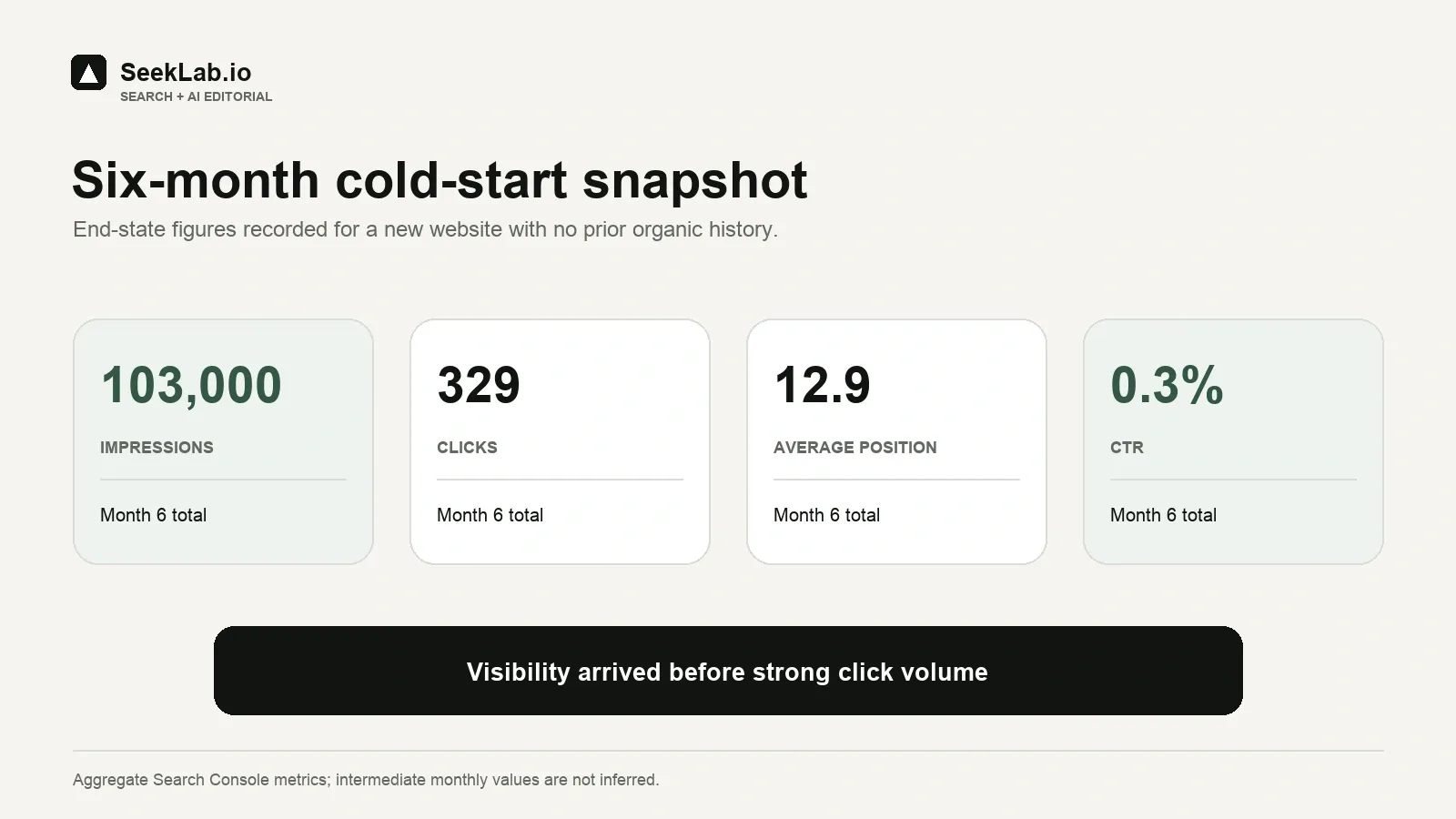
The example is useful because visibility developed before strong click volume. During the first eight weeks, impressions and clicks remained close to zero while Google discovered, crawled, indexed, and began surfacing the site’s pages. Impressions appeared before clicks, then expanded more quickly during months five and six.
An average position of 12.9 does not mean every page “ranked on page two.” Search Console average position is an aggregate based on the topmost result from the property across the impressions included in the report. Here, it indicates that a substantial share of visibility was still occurring below the highest-visibility positions, leaving room for CTR to increase as stronger pages moved upward. Google recommends paying attention to trends in impressions and clicks rather than interpreting average position in isolation in its Search Console performance guidance.
The 0.3% CTR is also context, not a benchmark. CTR generally rises as pages move into more visible positions, but the actual rate varies by query, intent, device, SERP layout, brand recognition, and AI-result presence. The defensible conclusion is narrower: at month six, the site had established meaningful search visibility, but much of that visibility had not yet translated into clicks.
This is why judging the project by leads in month two would have missed the leading signals. The right question at that stage was whether visibility and relevant query coverage were expanding.
How long SEO takes in practice
SEO does not move from “not working” to “working” on one date. It progresses through a series of dependent stages:
technical implementation → crawling and indexing → impressions → ranking movement → clicks → qualified traffic → inquiries → revenue
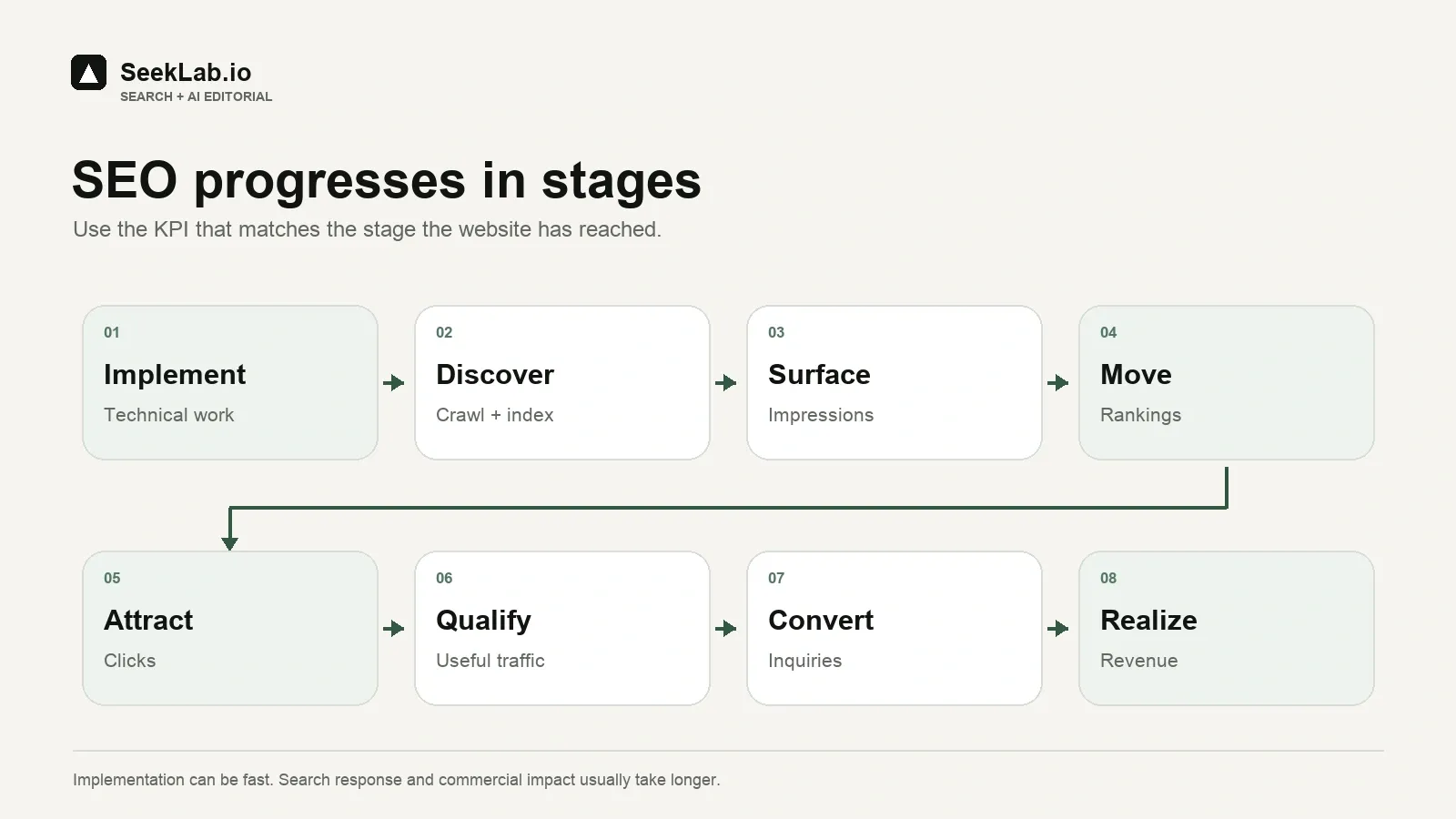
The stages overlap, and different parts of a website can sit at different stages. A corrected product page may be recrawled while a new comparison page is still waiting for its first impressions. An established service page may gain clicks while the inquiry form continues to suppress conversions.
Google describes Search as a process of crawling, indexing, and serving results in its How Search Works documentation. That is why the right KPI changes over time. A newly fixed site should first be evaluated on access and indexation. A page already earning impressions should be evaluated on relevance, ranking movement, and presentation. A page with traffic should be evaluated on visitor quality and the next action.
Starting condition matters more than a universal calendar. An established site recovering from a confirmed canonical error may show a response faster than a new website entering a competitive category. A technically healthy site with weak commercial content needs a different plan from a content-rich site whose important pages are not rendered reliably.
What counts as an SEO result?
Calling every signal a “result” creates confusion. The useful distinction is between work completed, search response, audience response, and business outcome.
- Implementation: the planned fix or page improvement is live.
- Crawling and indexing: Google can access, process, and potentially index the intended canonical URL.
- Impressions: the page or property is appearing in Search results.
- Ranking movement: visibility is shifting for relevant queries or pages.
- Clicks: searchers are choosing the result.
- Qualified traffic: visitors match the intended market, problem, or offer.
- Inquiries: visitors take an identifiable commercial action.
- Revenue: the inquiry progresses through the sales cycle and produces measurable value.
Search Console defines impressions, clicks, CTR, and average position precisely in its performance-metric documentation. Analytics and CRM data are then needed to evaluate on-site behavior, inquiry quality, assisted conversions, and revenue. A last-click report may understate SEO’s role when users research, return through branded search, and contact the company later.
The reporting mistake is skipping stages. Publishing an article is not evidence of demand. Indexing is not evidence of ranking. Impressions are not clicks. Traffic is not a qualified inquiry. Each signal matters, but it answers a different question.
What happens during the first 12 months
The table below describes a common pattern, not a universal schedule. Workstreams can overlap, and a site with a serious technical block may remain in diagnosis longer than a healthy established domain.
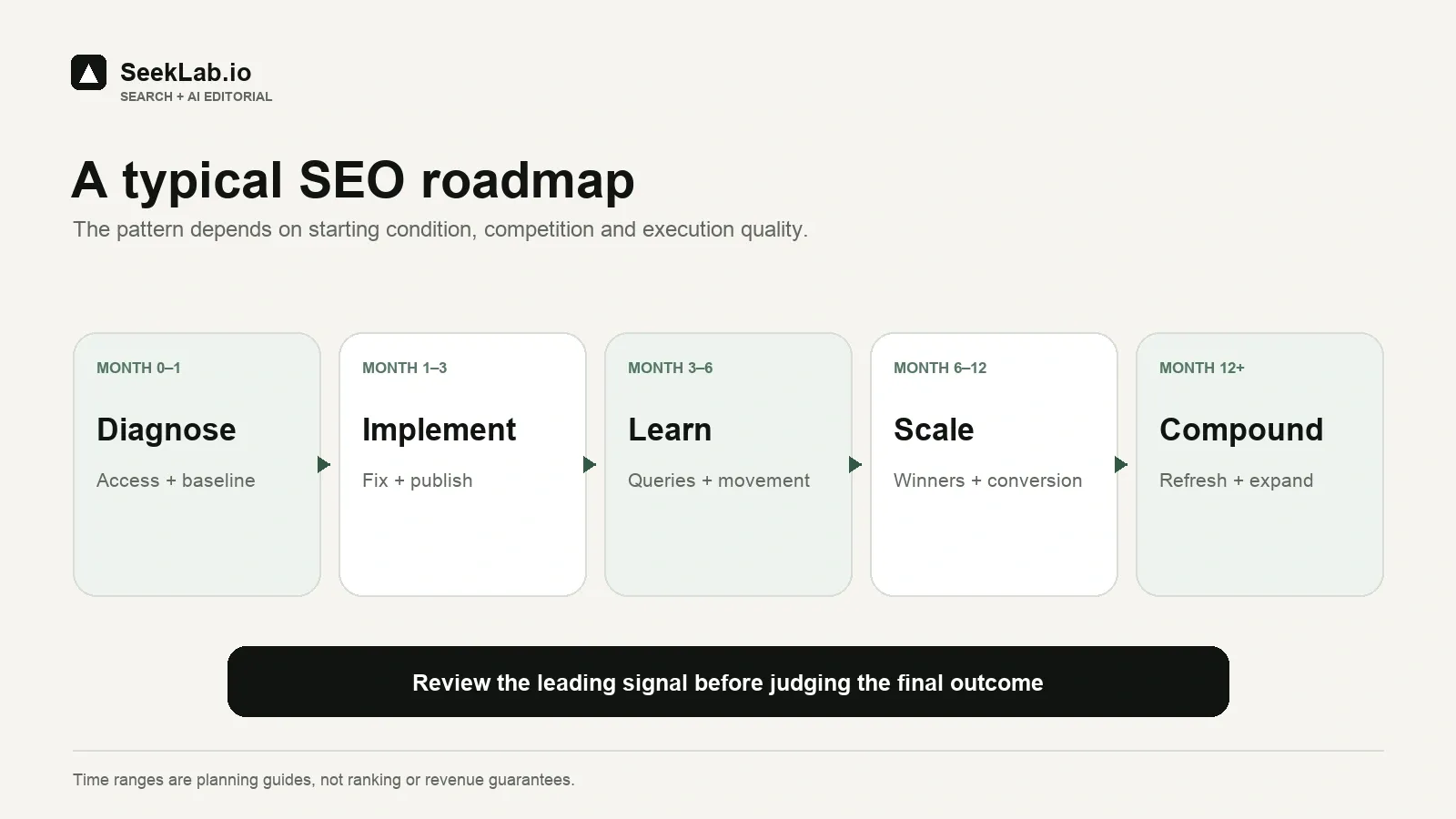
| Stage | Work often happening | Reasonable early signals | Unrealistic expectation | KPIs to monitor |
|---|---|---|---|---|
| Month 0–1 | Baseline crawl, Search Console review, sitemap and robots checks, indexability diagnosis, Core Web Vitals review, and conversion-path checks | Confirmed blockers, clearer index status, recrawling of corrected priority URLs | Strong lead growth or competitive page-one rankings | Indexable priority pages, crawl and server errors, canonical issues, sitemap quality, baseline impressions and clicks |
| Month 1–3 | Technical fixes, rendering checks, internal-link improvements, priority-page updates, and first targeted content | More indexed priority pages, new queries, rising impressions, and early long-tail movement | High-volume traffic from every new page | Query expansion, page indexation, page-query position trends, links into commercial pages |
| Month 3–6 | Refreshing pages with traction, strengthening commercial hubs, improving titles and descriptions, and expanding proven topics | More non-branded visibility, long-tail clicks, and clearer page winners | Predictable revenue from each article | Pages gaining impressions, CTR by query and page, qualified landing-page visits, CTA engagement |
| Month 6–12 | Scaling proven formats, consolidating overlap, improving decision-support assets and conversion paths | Stronger click growth, more qualified visits, and clearer inquiry contribution | Permanent rankings without maintenance | Organic inquiries by landing page, lead quality, assisted conversions, refresh opportunities |
| Month 12+ | Refreshing, consolidating, strengthening authority, and expanding into justified markets or topics | More stable contribution from a healthier content portfolio | SEO becoming a finished one-time project | Organic share of qualified demand, revenue influence, market-specific visibility, content health |
Diagnosis should come before output. A website with crawl and rendering problems needs a different first quarter from a site whose strongest opportunity is improving pages already receiving impressions. SeekLab’s SEO audit checklist provides the implementation sequence, while the guide to what a technical SEO audit includes explains how findings become priorities.
Why SEO takes longer for some websites
Several variables influence the timeline at once:
| Starting condition | What may slow progress | Most useful early priority |
|---|---|---|
| New website | No search history, limited coverage, weak external references | Build clean foundations and target specific, relevant demand |
| Existing site with weak content | Thin pages, topic overlap, or mismatched intent | Improve pages already gaining impressions and consolidate cannibalization |
| Established site with technical problems | Crawl blocks, canonical conflicts, broken templates, or redirects | Fix confirmed access, indexation, rendering, and internal-link problems |
| International or multilingual site | Hreflang mistakes, duplicated translations, or wrong-market pages | Validate language architecture, local intent, and market-specific paths |
| B2B site | Low-volume queries, long evaluation cycles, and delayed attribution | Build decision support around buyer problems, comparisons, proof, and specifications |
| Catalog or JavaScript-heavy site | Index bloat, faceted duplication, or content unavailable until rendering | Review indexation rules, rendered HTML, crawlable links, and priority templates |
Technical health can accelerate or block every later stage. Accidental exclusions, conflicting canonicals, orphaned commercial pages, server errors, and unreliable JavaScript rendering should be investigated before expanding the publishing calendar. SeekLab’s guides to JavaScript SEO and internal linking cover those issues in more depth.
Content strategy shapes the middle of the timeline. More articles are not always the fastest route to growth. Before creating another generic informational post, consider whether the better opportunity is:
- a page already gaining impressions;
- a commercial or comparison page;
- technical documentation;
- a decision-support page;
- a useful checker, calculator, selector, or template;
- an existing page-query combination with realistic ranking upside.
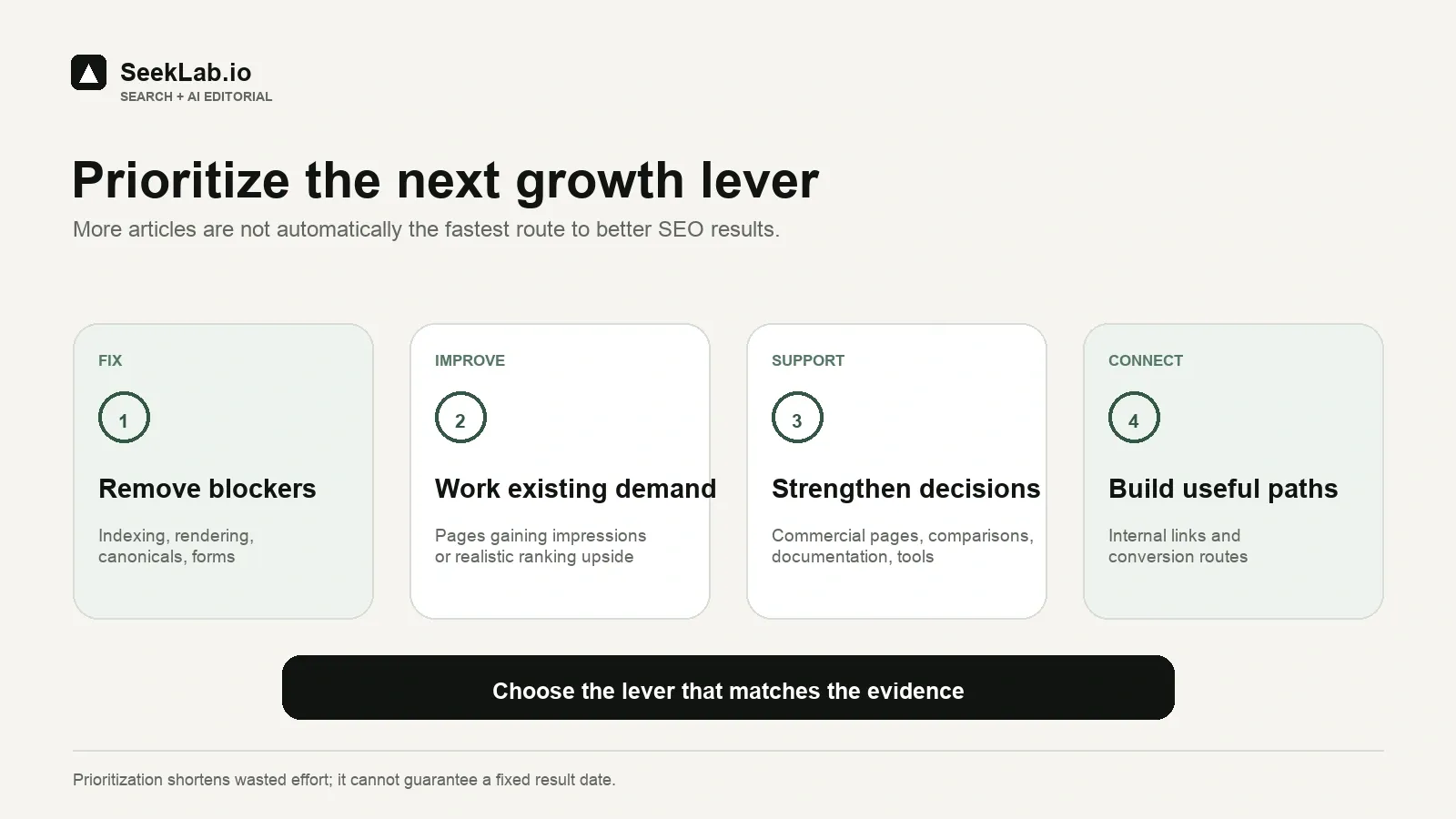
The right format comes from search intent and business value, not from an article quota. SeekLab’s search-intent guide explains how page purpose affects both visibility and lead quality. For multilingual sites, the international SEO strategy guide covers the additional architecture and localization work that can make progress differ by market.
How to tell whether SEO is actually working
Use a stage-based diagnosis and stop at the first failed condition:
- Can search engines access and index the intended pages? Check response codes, directives, canonicals, rendering, sitemaps, and crawlable internal links.
- Are relevant impressions increasing? If not, review indexation, topic selection, intent fit, internal linking, and whether the page answers real demand.
- Are the right pages and queries moving? If visibility grows without upward movement, compare the page’s usefulness, evidence, depth, authority, and format with competing results.
- Are impressions turning into clicks? Review query alignment, titles, descriptions, SERP layout, brand recognition, and the page-query combination—not just a site-wide average position.
- Are qualified visits turning into inquiries? Check internal progression, product or service-page visits, CTA engagement, form starts and completions, repeat visits, and lead quality.
This sequence prevents a common mistake: solving a conversion problem by publishing more articles, or solving an indexation problem by rewriting titles. It also creates a clearer conversation about timing. If the first failed stage is crawlability, revenue is not yet the useful KPI. If traffic is growing but inquiries are flat, waiting longer may not fix the conversion path.
SeekLab is an international SEO + GEO agency that helps companies understand where they are in this progression, identify what is blocking the next stage, and prioritize technical, content, internal-linking, and conversion work accordingly.
Start with the free website audit for an initial diagnosis, or explore SeekLab’s SEO + GEO service for a deeper strategy and implementation program.
Frequently asked questions
How long does SEO take to show results?
Early measurable signals may appear within roughly 3–6 months. Meaningful organic traffic, qualified inquiries, and commercial impact often require 6–12 months or longer. The starting condition and work completed matter more than the calendar alone.
Why does SEO take months instead of days?
Implementation can happen quickly, but search engines still need to crawl, render, index, evaluate, and serve pages. Users then need to see, choose, and act on those results. Each stage has a different timeline.
When does SEO start working?
SEO often starts producing technical and visibility signals before it produces leads. Useful early evidence includes corrected indexation, more relevant impressions, new queries, and upward page-query trends.
How long does SEO take for a new website?
A new website may need 6–12 months or more to build meaningful traffic and qualified demand. Early months may mainly show that its priority pages are becoming discoverable and relevant to a growing set of queries.
Can SEO guarantee page-one rankings in 30 days?
No responsible provider can guarantee a competitive page-one result on a fixed date. Rankings depend on technical condition, relevance, competition, authority, search behavior, and factors outside the provider’s control.
Why do impressions often rise before clicks?
A page can begin appearing for relevant queries before it reaches highly visible positions or earns a compelling share of clicks. CTR also varies with intent, device, SERP layout, brand recognition, and AI-result presence, so impressions and clicks should be reviewed together and segmented by page and query.