How to Get Your Products Recommended by ChatGPT Shopping: The 2026 E-commerce GEO Guide
Expert reviewed

ChatGPT Shopping GEO helps e-commerce brands improve product discovery in ChatGPT by making their product pages crawlable, structured, accurate, comparable, and trustworthy. The goal is not to "hack" ChatGPT or force a recommendation. The goal is to make your official website, catalog, product data, and buying information clear enough that ChatGPT-like shopping systems, search engines, and real buyers can understand what you sell and why it fits a specific shopping prompt.
A practical ChatGPT Shopping GEO guide starts with the parts that affect discovery before content volume: robots.txt access, OAI-SearchBot permissions, indexable product pages, rendered product data, Product and Offer schema, accurate price and availability, clear shipping and return policies, useful category content, internal links, multilingual structure, and buyer trust signals. For independent stores, official brand websites, exporters, B2B catalogs, and cross-border e-commerce sites, these are the areas most likely to affect shopping search visibility and lead quality.
OpenAI has confirmed that ChatGPT Shopping Research can create personalized buyer guides, ask clarifying questions, and compare products. OpenAI has also stated that product results are organic and unsponsored, and that Instant Checkout does not give products ranking preference. That means the safest approach is disciplined AI shopping optimization: fix the discovery foundation first, label uncertain ranking claims carefully, and prioritize the products that matter commercially.
Why a ChatGPT Shopping GEO guide starts with crawlable, trustworthy product data
A product cannot be recommended, compared, or cited reliably if the page is blocked, incomplete, duplicated, or showing stale product data. Many e-commerce teams want to start with new content, but the first gate is simpler: can a crawler access the product page, understand the key product facts, and follow links to related products or categories?
OpenAI's crawler documentation says OAI-SearchBot is used for ChatGPT search features. If a site opts out of OAI-SearchBot, OpenAI says it will not be shown in ChatGPT search answers, though it may still appear as a navigational link. That makes robots.txt a commercial visibility decision, not just a developer setting.
Google's guidance for optimizing websites for generative AI features on Google Search also starts with normal Search requirements: crawlability, index eligibility, helpful content, images, page experience, and clear product information. This matters because generative shopping experiences still depend on accessible, understandable web and merchant data.
For product discovery in ChatGPT, the practical implication is direct: do not start with speculative AI shopping tricks while your key product pages are noindex, buried behind filters, blocked by robots.txt, or missing visible price and stock information.
| Foundation area | What to check first | Common failure | Commercial impact |
|---|---|---|---|
| Crawling | robots.txt, OAI-SearchBot, server status, blocked folders | Product or category paths disallowed after migration | Product pages may not be discoverable |
| Indexing | noindex tags, X-Robots-Tag, canonical URLs | Product templates inherit noindex from filtered pages | Search and AI-driven discovery potential drops |
| Rendering | Product title, price, stock, links, schema in rendered HTML | Data loads through blocked API calls or late JavaScript | Machines may see a thin or incomplete page |
| Product data | Title, SKU, GTIN, MPN, price, currency, availability | Page, schema, feed, and checkout show different values | Buyer trust and machine confidence decline |
| Trust | Reviews, policies, official seller proof, support details | Official store looks weaker than reseller pages | AI-assisted buyers may choose clearer sources |
For a deeper technical review, SeekLab.io's technical SEO audit checklist is useful when teams need to inspect crawling, indexing, Core Web Vitals, schema, JavaScript rendering, internal links, sitemap.xml, and robots.txt together instead of treating each issue separately.
What the ChatGPT Shopping GEO guide can and cannot promise
A credible ChatGPT shopping guide must separate confirmed platform facts from practical SEO and GEO inferences. OpenAI has not published a full ChatGPT Shopping ranking algorithm. Any vendor or consultant claiming a guaranteed formula for ChatGPT product recommendations is overpromising.
Here is what is confirmed by official sources:
| Confirmed point | Source | Practical meaning |
|---|---|---|
| ChatGPT Shopping Research can create personalized buyer guides and ask clarifying questions | OpenAI Shopping Research | Product and category pages should answer real buying constraints, not just list specs |
| Shopping Research may make mistakes about price and availability | OpenAI Shopping Research | Price, stock, shipping, and return data must be kept current |
| Instant Checkout supports purchases from supported merchants and is built around the Agentic Commerce Protocol | OpenAI Instant Checkout | Commerce workflows are moving closer to AI-assisted buying |
| Product results are organic and unsponsored | OpenAI Instant Checkout | ChatGPT Shopping should not be described as paid placement based on current public information |
| Instant Checkout items are not preferred in product results | OpenAI Instant Checkout | Checkout integration is not a ranking shortcut |
| When ranking multiple merchants selling the same product, ChatGPT may consider availability, price, quality, primary seller status, and Instant Checkout enablement | OpenAI Instant Checkout | Official brand websites should clearly prove seller status and keep merchant data accurate |
The practical inferences are still important, but they should be worded carefully. Product schema may help machines understand your catalog, but OpenAI has not confirmed it as a direct ChatGPT Shopping ranking factor. Reviews may improve trust and product understanding, but exact weighting is not public. External mentions may support brand confidence, but they should be earned through legitimate product information, not manipulated citations.
A safer way to think about a generative engine optimization guide is this: GEO extends traditional SEO, structured data, feed hygiene, entity clarity, and conversion content into AI-assisted discovery scenarios. It does not replace SEO. A store with weak canonical logic, incomplete product data, and thin category pages does not become AI-ready by adding a few keywords to product descriptions.
GEO, SEO, and shopping feed optimization are connected but not identical
| Discipline | Main job | Typical assets | Limitation |
|---|---|---|---|
| Product SEO | Help product and category pages rank in search | Titles, descriptions, category pages, internal links, schema | Rankings do not guarantee AI shopping recommendations |
| Shopping feed optimization | Make product data eligible and competitive in merchant platforms | Feed attributes, product IDs, price, availability, images | Feeds may not explain use cases, trust, or official brand authority |
| ChatGPT Shopping GEO | Help AI systems discover, interpret, compare, and trust products | Crawlable pages, schema, product data, guides, reviews, policies, entity clarity | Platform logic is partly opaque and may change |
This distinction matters for budget decisions. A team should not buy complex monitoring software before fixing blocked product pages, stale prices, missing Offer schema, or product grids with no decision-support content. The work that improves AI shopping optimization is often the same work that makes the website more useful for buyers.
The ChatGPT Shopping GEO guide framework for product discoverability
The best sequence is not "publish more pages." It is "make the right products discoverable, understandable, and commercially convincing." For many independent stores and official company websites, 20 well-structured priority products will do more for shopping search visibility than 500 weak pages with inconsistent data.
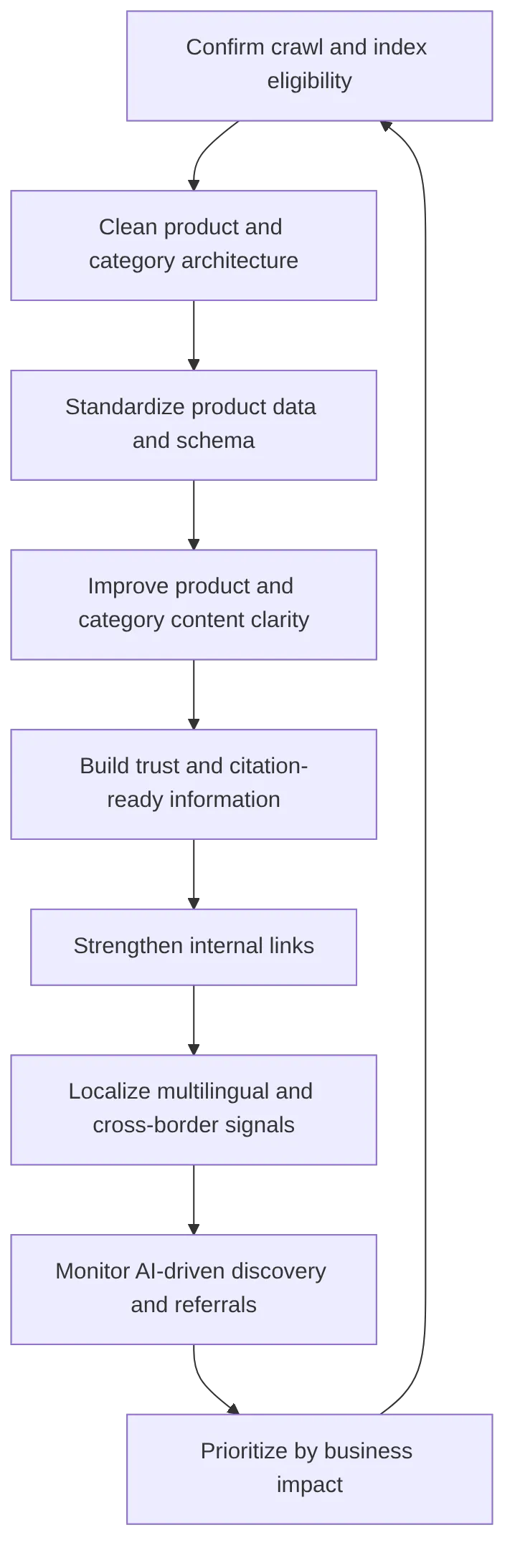
1. Confirm crawl and index eligibility
Start with the revenue pages: priority categories, best-selling products, high-margin SKUs, product families, and RFQ pages. Check robots.txt, OAI-SearchBot access, noindex tags, canonical URLs, HTTP status codes, XML sitemaps, and crawl depth.
A common e-commerce failure is a product page that looks fine in the browser but is noindex, canonicalized to the wrong URL, missing from the sitemap, or only accessible through internal search. That page is functionally weak for product discovery in ChatGPT because machines may not treat it as a reliable product source.
2. Clean product and category architecture
Category architecture tells machines how products relate to each other. Thin grids, faceted crawl traps, duplicated variants, and orphan products make the catalog harder to interpret.
For example, a category such as "industrial pumps" should not only display products. It should clarify pump types, use cases, materials, capacity ranges, compatibility, and selection criteria. That content helps both AI systems and buyers compare options.
SeekLab.io often approaches this through full-site crawling and structured analysis, not isolated page checks. The point is not to fix everything. The point is to identify which architecture issues are suppressing growth and which can be deprioritized.
3. Standardize product data and schema
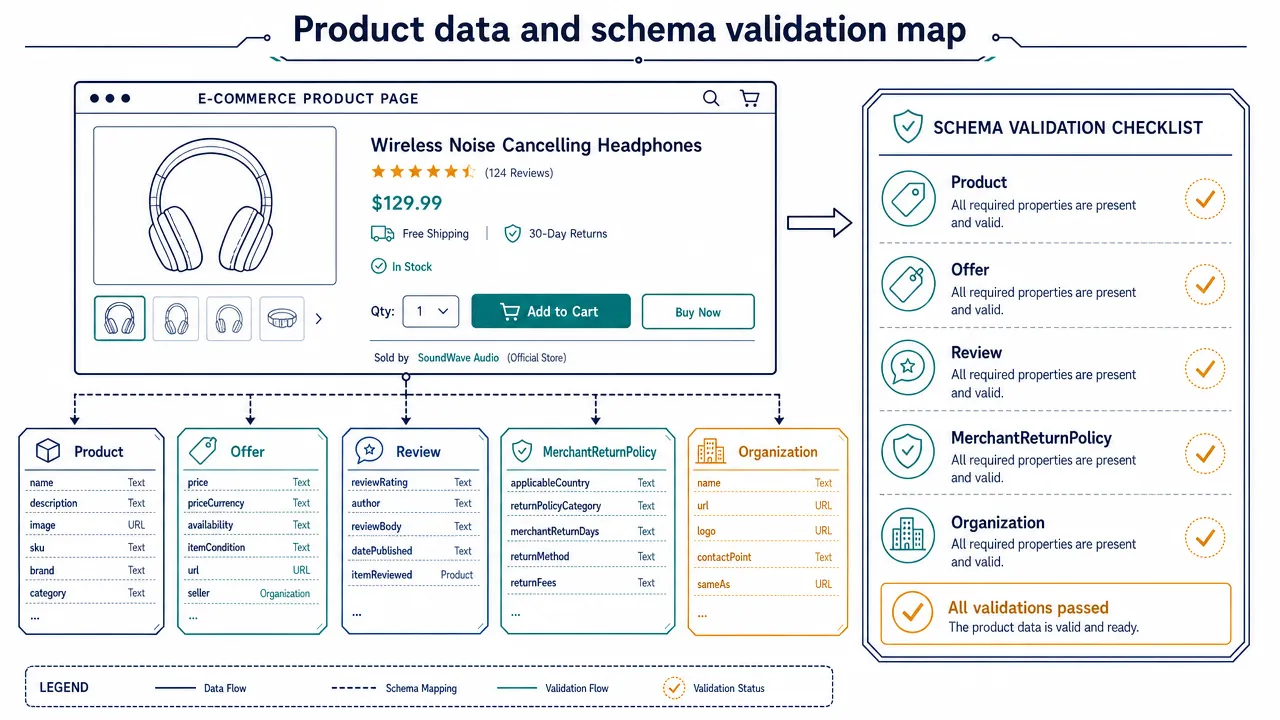
Google's product structured data documentation explains how Product markup can support rich product information such as price, availability, ratings, shipping, and returns. Schema.org also defines relevant vocabulary for Product, Offer, Review, AggregateRating, and MerchantReturnPolicy.
For ChatGPT Shopping GEO, structured data should be treated as a clarity layer. It helps machines parse what is already visible on the page. It should not contradict the page, hide information, or mark up reviews that users cannot see.
| Product data field | Why it matters | Practical rule |
|---|---|---|
| Product name | Core matching signal for shopping prompts | Include product type, model, key attribute, and use case where natural |
| Brand | Helps entity understanding | Use one consistent brand name across page, schema, feed, and Organization data |
| SKU, GTIN, MPN | Reduces ambiguity across merchants and markets | Publish identifiers where useful and commercially safe |
| Price and currency | Supports comparison and trust | Keep page, schema, feed, and checkout aligned |
| Availability | OpenAI names availability in merchant comparison context | Do not mark sold-out products as in stock |
| Images | Supports product understanding and rich results | Use clean product images and valid image URLs in schema |
| Shipping and returns | Reduces buying uncertainty | Show visible policies and add structured data where appropriate |
| Reviews and ratings | Supports trust and product evaluation | Mark up only authentic, visible, eligible reviews |
Teams that need implementation support can review SeekLab.io's work around schema data compliance, especially where Product, Offer, Organization, Breadcrumb, FAQ, and Review markup need to be validated at template level.
4. Improve product and category content clarity
ChatGPT Shopping Research is designed for comparisons, constraints, and trade-offs. That means thin product descriptions are a weak asset. A buyer may ask for "best carry-on backpack for a 3-day business trip," "manufacturer of corrosion-resistant fasteners for marine use," or "official store for replacement filters available in Germany." A generic product page does not answer those prompts.
Useful product content usually includes:
- Best-fit use cases.
- What the product is not ideal for.
- Compatibility details.
- Material, size, capacity, tolerance, or performance specifications.
- Comparison tables between models.
- Shipping regions and return conditions.
- Certifications, warranty, or official seller proof.
- FAQs based on real buyer objections.
For B2B and exporter websites, this is especially important. Many manufacturers write about capabilities but omit purchase decision details such as MOQ, customization options, packaging, lead time, certificates, export markets, and RFQ steps. AI-assisted buyers need those details before they treat the site as a credible supplier source.
SeekLab.io's AI-era keyword research supports this layer by identifying intent-driven and conversational product queries before teams write content in the wrong direction.
5. Build trust and entity clarity
OpenAI says primary seller status may be considered when ranking multiple merchants selling the same product. For official brand websites, that creates a simple warning: your own site should not look less trustworthy than reseller pages.
Use clear official seller language where accurate. Add Organization schema, legal entity information, support contacts, warranty terms, authenticity guidance, certifications, and policy pages. Keep brand names, product names, and company details consistent across markets.
For deeper entity structure, SeekLab.io's entity SEO and schema roadmap explains how organization, product, service, and content relationships can be clarified for search systems.
6. Localize for cross-border and multilingual discovery
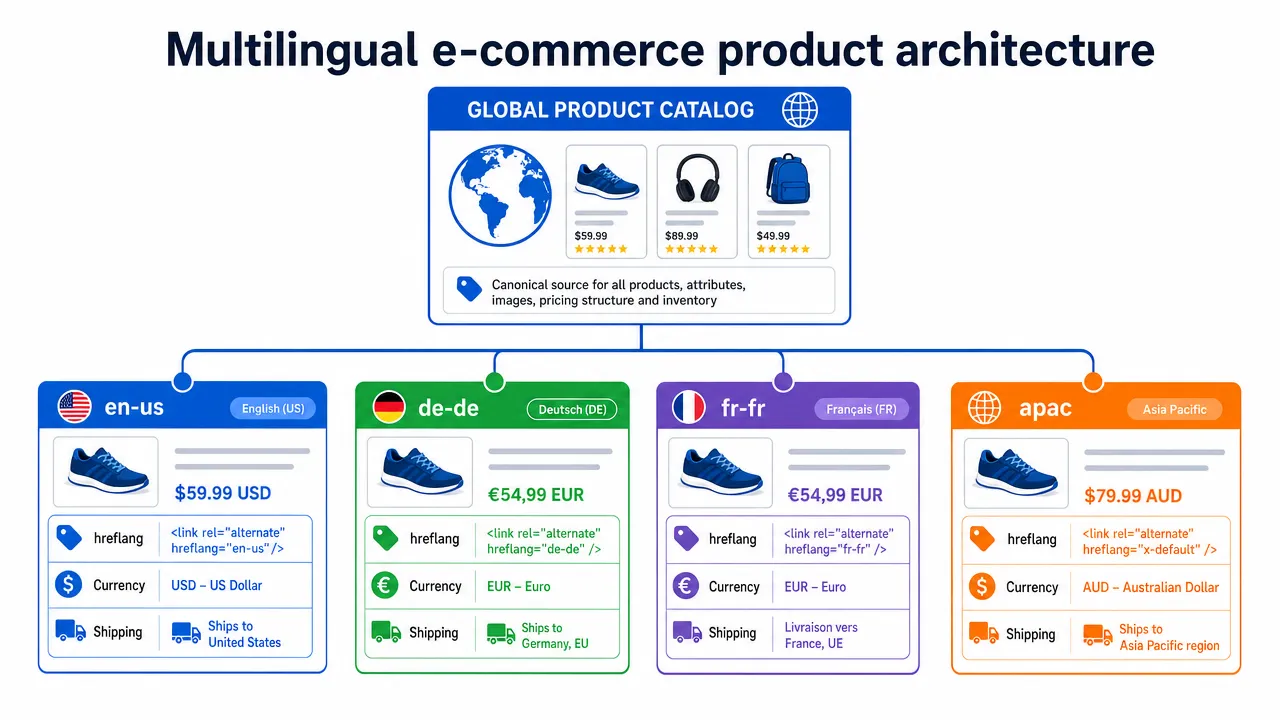
A translated product page is not the same as a localized product page. Cross-border shoppers care about currency, stock, shipping time, duties, return rules, measurements, support language, and local proof.
Google's documentation on international and multilingual sites highlights the importance of stable localized URLs and hreflang. For a multilingual product catalog, that means each important product page should have a crawlable localized URL, reciprocal hreflang, canonical alignment, localized product data, and market-specific commercial details.
SeekLab.io's multilingual SEO strategy is relevant for brands operating across APAC, the United States, Europe, and other international markets where regional search behavior and buying trust vary.
Technical checklist in the ChatGPT Shopping GEO guide for e-commerce teams
A checklist is useful only if it helps teams decide what to fix first. For most e-commerce sites, the first pass should focus on high-impact templates and priority URLs rather than the whole catalog. Audit the top product templates, top category templates, localized page types, and important RFQ or checkout paths.
Crawling and robots.txt
Check whether important product and category folders are blocked. Review robots.txt rules for OAI-SearchBot if ChatGPT search visibility is desired. Also check whether CDN, WAF, or bot protection settings are blocking legitimate crawlers even when robots.txt allows them.
Practical warning: staging rules often leak into production after migrations. A single disallow rule can quietly remove a product catalog from meaningful discovery.
Indexing and canonicalization
Inspect noindex tags, X-Robots-Tag headers, canonical tags, sitemap inclusion, redirects, and duplicate URLs. Google's guidance on canonical URL consolidation is especially relevant for variant-heavy catalogs.
Common problems include:
- Every color or size variant canonicalizes to a generic page.
- Filtered URLs generate thousands of thin duplicates.
- Discontinued products return 200 status with no useful alternative.
- Canonical tags point to redirected or noindex URLs.
- Localized pages canonicalize to the wrong language version.
JavaScript rendering
Google's JavaScript SEO basics are worth reviewing for e-commerce templates. Product titles, prices, availability, internal links, and schema should not depend on fragile late rendering.
A practical test is to compare raw HTML, rendered HTML, and structured data testing outputs for the same product URL. If the raw page is nearly empty and the rendered version depends on blocked API calls, product discovery becomes more fragile.
Structured product data
Validate Product and Offer schema at scale. Do not only test one clean product page. Test discounted products, out-of-stock products, variants, localized products, review-enabled products, and quote-based B2B products.
Use Google's Rich Results Test to identify structured data errors and mismatches. The schema should reflect visible content. If the page says "out of stock" and the Offer markup says "InStock," that is a trust problem for both users and machines.
Product content and comparison support
A product page should help a buyer make a decision without forcing them to open five other tabs. That does not mean adding long generic copy. It means adding decision-specific information.
| Weak product content | Stronger product content |
|---|---|
| "High-quality stainless steel valve for industrial use." | "316 stainless steel ball valve for marine and chemical processing environments, suitable for corrosive conditions, available in DN15 to DN100, with datasheet and RFQ support." |
| "Comfortable travel backpack." | "35L carry-on backpack for 2-3 day business trips, fits 16-inch laptop, opens flat for security checks, not ideal for heavy hiking loads." |
| "Fast shipping available." | "Ships from U.S. warehouse in 2-4 business days for eligible ZIP codes, with 30-day returns on unused items." |
This is where a shopping GEO guide becomes practical. AI systems need precise information to compare products, and buyers need precise information to convert.
Multilingual and international readiness
For multilingual sites, check stable URLs, self-referencing hreflang, reciprocal hreflang, localized schema fields, translated product names, local currency, regional stock, and local shipping or return rules.
A common failure is translating all product descriptions while keeping U.S. currency, U.S. shipping rules, and U.S. testimonials on European pages. That may look localized, but it does not answer regional buying concerns.
Monitoring product discovery in ChatGPT
AI shopping visibility is less stable than standard rank tracking. Results can vary by prompt wording, location, session context, availability, and timing. That makes disciplined prompt testing more useful than one-off screenshots.
Build a monthly prompt set around priority products and categories:
| Prompt type | Example pattern | What to record |
|---|---|---|
| Category recommendation | "Best [product type] for [use case] in [market]" | Products mentioned, sources cited, competitors shown |
| Official source | "Official store for [brand/product]" | Whether official site appears and how it is described |
| Constraint-based | "[Product] under [budget] with [feature]" | Which attributes influence recommendations |
| B2B supplier | "Manufacturer of [product] for [industry] with [certification]" | Supplier names, evidence used, missing details |
| Local availability | "[Product] available in [country/region]" | Currency, stock, shipping, local pages |
Track AI referrals in analytics where possible, but do not treat referral traffic alone as the whole story. For many official websites and B2B catalogs, the business outcome is not only a purchase. It may be an RFQ, distributor inquiry, demo request, sample order, or qualified contact form submission.
If you want to know whether your product pages are crawlable, indexable, structured, and ready for AI-driven discovery, Get a free audit report from SeekLab.io.
How SeekLab.io applies this ChatGPT Shopping GEO guide to real website growth
SeekLab.io helps brands build search visibility and AI-era discoverability through high-quality content production and technical optimization. The work focuses on making websites easier for search engines, AI systems, and real users to understand by improving content structure, information clarity, page architecture, internal linking, schema data, and overall site readiness.
The key difference is prioritization. We do not aim to fix everything just because it appears in a crawl report. We focus on identifying what truly affects growth, what can be deprioritized, and what needs a clear technical or content solution before budget is spent in the wrong place.
For e-commerce teams, independent websites, official company websites, international trade sites, and multilingual catalogs, that usually means looking at both technical and non-technical blockers:
- Full-site crawling and structured analysis.
- Core Web Vitals and product template performance.
- Indexing, crawling, rendering, and JavaScript compatibility checks.
- Internal link equity and semantic structure analysis.
- Schema compliance and enhancement.
- AI search friendliness and citation readiness evaluation.
- Sitemap.xml and robots.txt validation.
- Website tech stack analysis.
- Trend-driven topic selection and high-potential content themes.
- Product and category content aligned with buyer intent.
- High-quality blog assets with images, tables, internal links, and conversion support.
- Multilingual site architecture for global search opportunities.
- Monthly data review and performance reporting.
A strong ChatGPT Shopping GEO guide is not only about appearing in product cards. It is about helping the right buyer understand the right product at the right moment. If traffic grows but inquiries do not, the site still has a business problem. Product pages need trust proof, clear policies, useful comparisons, and CTAs that match the buying stage.
What to fix first by website type
| Website type | First priority | Why it matters |
|---|---|---|
| Independent e-commerce store | Crawlability, Product/Offer schema, reviews, product data accuracy | Smaller stores cannot rely on marketplace authority to compensate for weak pages |
| Official brand website | Entity clarity, official seller proof, warranty, product documentation | The official site should be the clearest source about its own products |
| Exporter or manufacturer site | Product taxonomy, technical specs, RFQ paths, certifications, multilingual pages | Buyers search for supplier fit, not only checkout availability |
| B2B product catalog | Specification tables, datasheets, comparison pages, internal links | No-price catalogs still need clear product discovery and inquiry paths |
| Cross-border DTC store | Local currency, shipping, returns, hreflang, regional trust | International buyers need total-cost and delivery clarity |
| Marketplace-dependent brand | Official product source, consistent names, where-to-buy pages | The brand needs a reliable source of truth outside marketplaces |
SeekLab.io has teams and legal entities in Singapore and Shanghai, with a BD team based in Dubai, supporting brands across APAC, the United States, Europe, and other international markets. That matters for cross-border product discovery because localization is rarely just translation. It involves market structure, product terminology, page architecture, trust expectations, and conversion paths.
Some simple technical issues can be resolved for clients free of charge. Customized content can be provided based on client needs, with monthly data review and performance reports. SeekLab.io also offers a practical business commitment: no charge if the minimum expected results are not achieved.
If your team needs help turning product data, technical SEO, schema, multilingual content, and buyer-focused pages into a practical GEO roadmap, contact us.
Common ChatGPT Shopping GEO guide mistakes to avoid
Many weak GEO projects fail because teams chase visible tactics before fixing hidden blockers. The most expensive mistake is not usually one bad meta tag. It is spending months on content, tracking, or tools while priority product pages remain hard to crawl, hard to parse, or hard to trust.
| Mistake | Why it hurts | Safer approach |
|---|---|---|
| Blocking OAI-SearchBot while expecting ChatGPT search visibility | OpenAI says OAI-SearchBot is used for ChatGPT search features | Allow OAI-SearchBot where visibility is desired and review bot protection settings |
| Treating Product schema as a guarantee | OpenAI has not confirmed Product schema as a direct ranking factor | Use schema as an eligibility and understanding layer |
| Letting price and availability drift | OpenAI warns Shopping Research may make mistakes about price and availability | Sync page, schema, feed, and checkout data |
| Publishing category pages as only product grids | AI shopping prompts often involve comparison and constraints | Add concise buying guidance, filters explanation, and comparison content |
| Translating pages without local commercial details | Regional buyers need currency, stock, shipping, and return clarity | Localize the full buying context |
| Optimizing every SKU equally | Large catalogs waste effort on low-value pages | Start with high-margin, high-intent, in-stock products |
| Buying advanced tracking before fixing fundamentals | Visibility reports do not solve crawl, schema, or content quality problems | Audit and repair the product discovery foundation first |
FAQ
Can I submit products directly to ChatGPT Shopping?
OpenAI's public documentation does not describe a universal "submit and rank" system for all merchants. OpenAI has announced Shopping Research, Instant Checkout, and the Agentic Commerce Protocol, but merchant support and product discovery details may evolve. Monitor OpenAI Instant Checkout for current details.
Does Product schema make ChatGPT recommend my products?
No official OpenAI source confirms Product schema as a direct ChatGPT Shopping ranking factor. Product schema is still a strong best practice because it helps search engines understand product information and supports rich product results in Google.
Should I allow OAI-SearchBot?
If you want visibility in ChatGPT search features, review OpenAI's crawler documentation. OpenAI says sites opted out of OAI-SearchBot will not be shown in ChatGPT search answers, though they may still appear as navigational links.
Is ChatGPT Shopping the same as Google Shopping?
No. There is overlap in product data needs, but the experiences are different. Google Shopping, Google product results, ChatGPT Shopping Research, and Instant Checkout each have their own systems and documentation.
What should an e-commerce team fix first?
Fix crawler access, indexability, rendered product data, price and availability mismatches, Product/Offer schema, canonical issues, and priority category content before investing heavily in advanced experiments.
How should multilingual e-commerce sites approach AI shopping optimization?
Start with stable localized URLs, hreflang, local currency, local stock, regional shipping and returns, translated schema where appropriate, and market-specific trust proof. Translation alone rarely solves international product discovery.