The 90/10 Content Rule: What Happened When We Broke Our Own Editorial Calendar for a News Cycle
Expert reviewed

The 90/10 content rule is a planning guardrail: protect most editorial capacity for evergreen, commercial, technical, and refresh work that compounds over time, while reserving a smaller share for genuinely useful reactive content. The split is illustrative, not universal. Its value is that it stops a rigid calendar from ignoring meaningful change without allowing every trend to displace the work that builds durable search visibility.
The decision should begin with the user need, not with an assumed format. A new signal might justify an article, an update to an existing page, a comparison or landing page, a checklist, a calculator or checker, monitoring only, or no publication at all.
The practical question is not “Is this trending?” It is: Does this development create a verified, relevant question that deserves editorial capacity—and what is the most useful response?
What the 90/10 content rule means
A strong SEO content strategy and content calendar should coordinate more than publication dates. It should show which pages support priority products or services, where internal links need strengthening, which articles require factual refreshes, and which markets or language versions need different treatment.
A calendar becomes too rigid when it cannot accommodate a material platform update, regulatory deadline, product launch, supply-chain change, or repeated buyer question. But the opposite failure is just as costly: teams abandon planned work whenever a topic gains attention and end the quarter with disconnected posts instead of a stronger commercial and evergreen foundation.
In this article, 90/10 means reserving roughly:
- 90% of editorial capacity for validated evergreen, commercial, technical, refresh, and strategic work.
- 10% of editorial capacity for justified time-sensitive research, updates, approvals, localization, and reactive publishing.
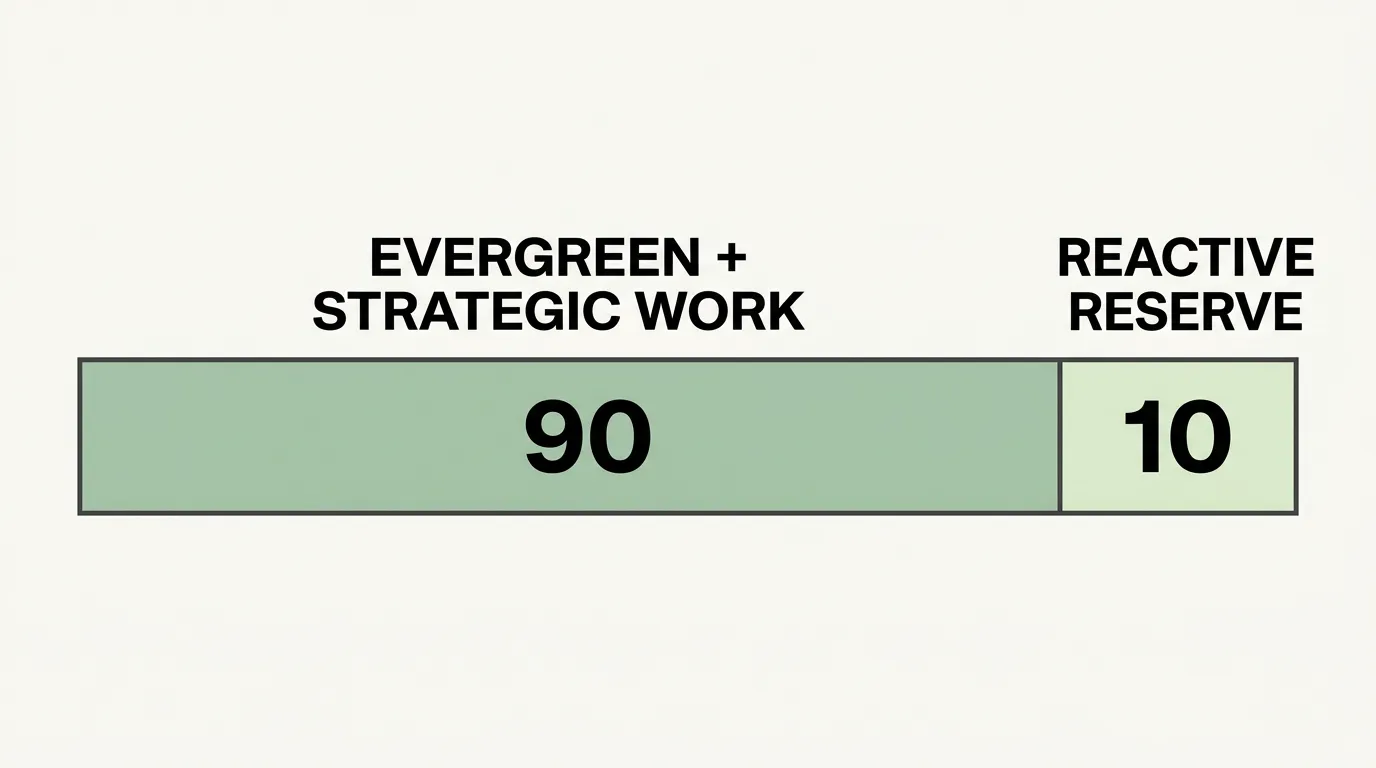
This is a capacity model, not an article-count formula. One important update may require more research, expert review, technical work, and localization than several planned posts. A quiet month with no justified reactive work is not a failure; the reserve can support overdue refreshes, internal-link improvements, source collection, or the next planning cycle.
Different teams may use 95/5, 80/20, or another split. The right guardrail depends on team size, sector volatility, regulatory change, product launches, seasonality, and whether the website is undergoing a migration or rebuild. The allocation can change for a defined period, but it should never become a target that teams feel obliged to fill.
| Capacity area | Protected strategic work | Possible reactive use |
|---|---|---|
| Content production | Evergreen guides, commercial pages, product education, topic clusters | Timely analysis, event-specific guidance, substantive updates |
| SEO improvement | Internal links, consolidation, metadata, search-intent alignment | Query review, topical-gap checks, update-versus-new-page assessment |
| Technical readiness | Crawlability, indexing, rendering, performance, schema, sitemaps | QA for a time-sensitive page or localized version |
| International work | Language architecture and planned market content | Market-specific fact validation, terminology, and CTA adaptation |
| Governance | Editorial planning, refresh calendar, ownership | Expert, legal, regional, or executive review |
When a new signal deserves action
A reactive opportunity should meet a higher bar than an ordinary content idea because acting on it displaces something else. It needs a defined audience, credible evidence, a useful contribution, and a clear relationship to the business or its existing content system.
Use the signal as a prompt for investigation—not as automatic permission to publish.
| Signal | What it may mean | First response |
|---|---|---|
| A platform releases a documented feature change | Existing implementation advice may now be incomplete | Check whether an established guide needs an update |
| A regulator announces an effective date | Users in affected markets may need operational guidance | Verify the official source, scope, terminology, and deadline |
| Sales or support receives the same new question repeatedly | Buyer need may be emerging before search tools show it clearly | Create a brief and assess format, evidence, and commercial relevance |
| Search impressions rise for a related query | Interest may be increasing, but intent may still be unclear | Review query patterns, countries, existing coverage, and conversion fit |
| A social conversation gains attention | The topic may be relevant—or may be broad noise | Monitor unless audience and business relevance are obvious |
| Competitors publish multiple similar pages | A category may be developing, or the market may be copying itself | Validate the underlying user need before reacting |
Three tests usually separate a useful response from trend-chasing:
- Relevance: Does the change materially affect a priority audience or buyer decision?
- Evidence: Can the team verify what changed and explain it accurately?
- Usefulness: Can the response add practical value beyond summarizing someone else’s announcement?
Google’s guidance on helpful, reliable, people-first content supports the same principle. A fresh publication date does not make a thin summary useful.
Choose the response: publish, update, tool, landing page, monitor, or reject
Do not decide the content format before understanding the task. The user may need an explanation, a revised instruction, a comparison, a transaction path, a calculation, a diagnosis, or simply no new page.
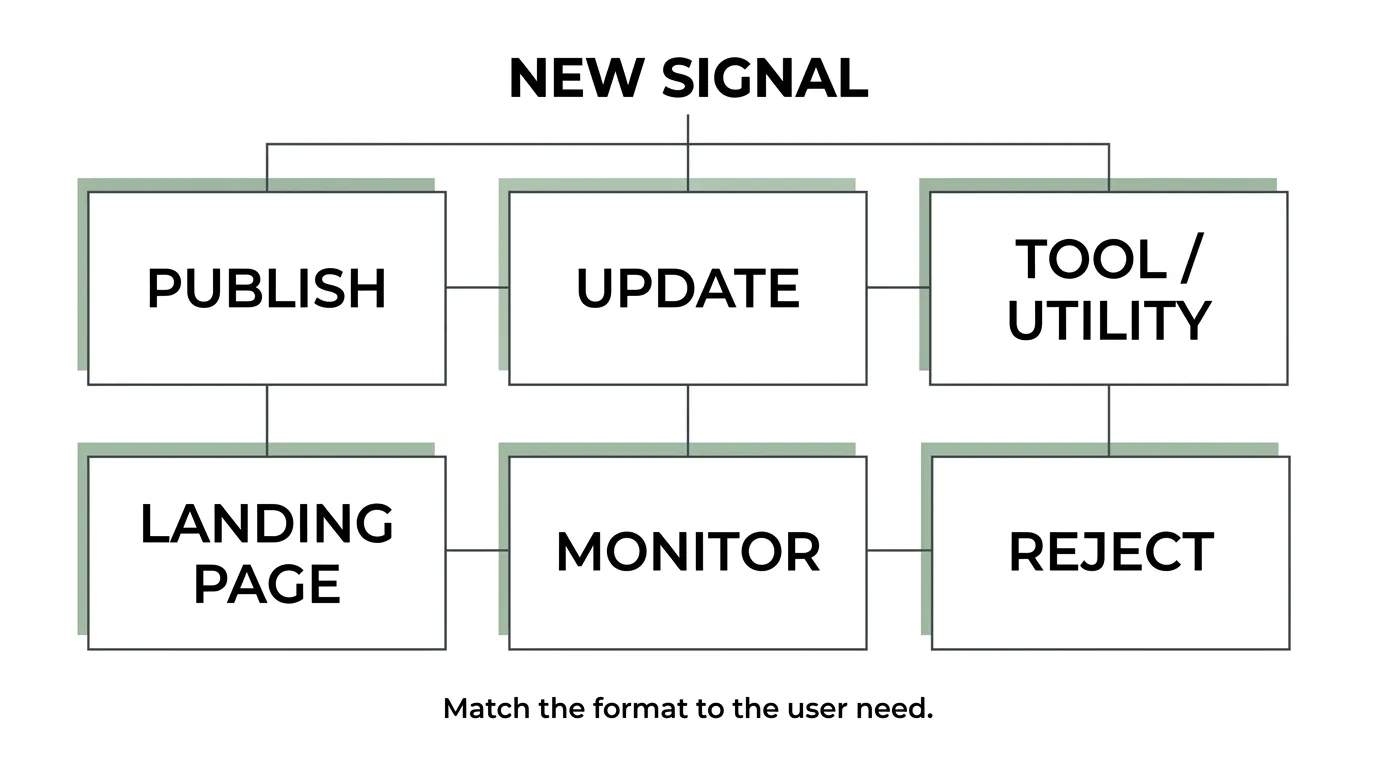
| Response | Use it when | Avoid it when |
|---|---|---|
| Publish | A development creates a distinct, timely, commercially relevant question that deserves its own durable URL | An existing page already owns the same core intent |
| Update | An evergreen page already answers the main question and needs substantive new facts, examples, instructions, or dates | The new need is materially different and would make the original page unfocused |
| Tool / utility | The user’s real task is to check, calculate, compare, generate, or diagnose something | A simple explanation or existing page solves the task adequately |
| Landing page | Intent is commercial, service-led, or conversion-focused rather than editorial | The query is primarily educational and the page would become a thin sales pitch |
| Monitor | The signal is credible but demand, evidence, timing, or business value is not strong enough yet | Delay would make verified, high-impact guidance less useful |
| Reject | Relevance, evidence, expertise, originality, or business value is weak | The topic is uncomfortable but genuinely important and supportable |
Publish a new page
Publish when the development produces a distinct question with enough expected life and value to justify a new URL. A new regulatory process, a major product category, or an event-specific question that cannot fit cleanly inside an evergreen guide may qualify.
The new page should still connect to the durable content system through relevant internal links, a clear next step, and a scheduled review date.
Update an existing page
Update when the core search intent has not changed. A software release may alter one section of an established implementation guide; a legal deadline may require a dated note and revised instructions. Strengthening the page that already owns the topic is usually better than creating a competing version.
Before adding another URL, confirm the intent using a search-intent review and check for content overlap, internal-link fragmentation, and future maintenance cost.
Build a tool, utility, or checklist
Some signals reveal a task rather than a reading need. If users repeatedly need to check eligibility, estimate a value, compare options, generate an output, or diagnose a problem, a calculator, checker, interactive comparison, or concise checklist may be more valuable than another article.
This is the product-led extension of the framework: choose the smallest useful format that completes the user’s job.
Use a landing page
A service page or landing page is appropriate when the new demand is primarily commercial and the business can satisfy it. It should still offer enough evidence and clarity to answer the decision-stage question. Do not disguise a sales page as reactive editorial coverage.
Monitor or reject
Monitoring is an active decision. Record the signal, sources, owner, evidence gaps, and the condition that would trigger another review. Reject when the topic lacks audience relevance, credible evidence, subject expertise, useful differentiation, or a reasonable business path.
Score reactive opportunities without overcomplicating the decision
A compact scorecard makes trade-offs visible and prevents the loudest request from automatically winning. Score each criterion from 0 to 2.
| Criterion | 0 points | 1 point | 2 points |
|---|---|---|---|
| Audience relevance | Tangential to priority users | Relevant to a narrow segment | Material to a priority audience |
| Business relevance | No clear connection | Indirect connection | Changes a buyer decision, need, or market condition |
| Evidence readiness | Weak or unverified sources | Some credible support | Primary or authoritative sources available |
| Demand signal | No identifiable signal | Early or ambiguous signal | Clear query movement, buyer question, or on-site demand |
| Original contribution | Repeats headlines | Useful synthesis | Adds expertise, process, evidence, or practical implications |
| Timing | Useful window has passed | Moderate urgency | Verified guidance is useful now |
| Conversion path | No relevant next step | General educational path | Clear route to a guide, tool, service, or qualified action |
| Risk control | Material unresolved risk | Review is needed but feasible | Required reviewers and approvals are available |
Illustrative thresholds:
- 13–16: Prioritize a response, then choose the right format.
- 9–12: Monitor, prepare a brief, or schedule deeper analysis.
- 0–8: Reject reactive production.
These thresholds are not universal benchmarks. Adjust them to your risk, team, and sector. A score also cannot override a hard stop: inadequate evidence, missing legal review, material reputational risk, or a page that would simply repeat reporting without adding value.
Build a fast workflow with clear approvals
Reactive work usually fails before writing begins. Teams discover the issue late, cannot locate a reliable source, lack an assigned reviewer, or publish a page that is technically isolated from the rest of the site.
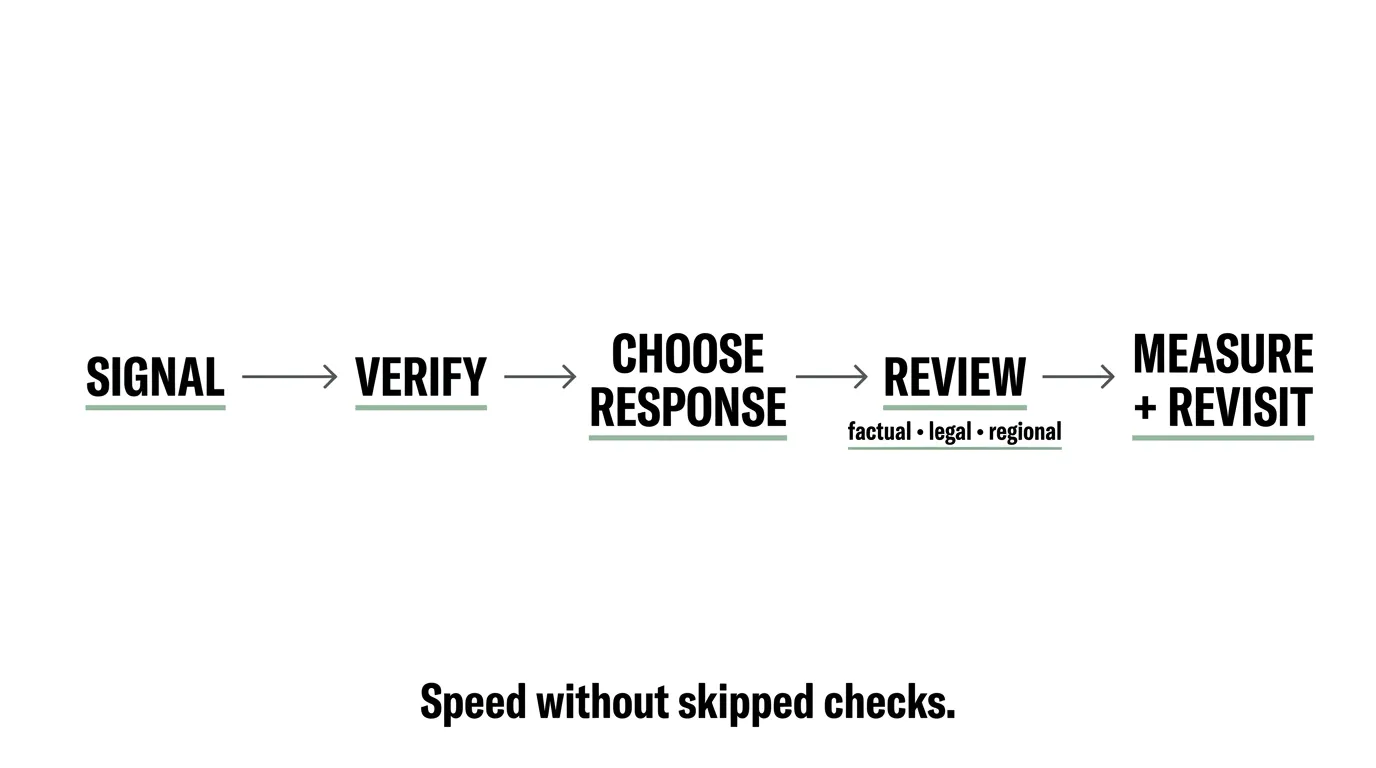
A usable workflow has five stages:
- Signal: Record what changed, who raised it, and why it may matter.
- Verify: Collect primary sources, confirm dates, and separate facts from interpretation.
- Choose the response: Publish, update, tool, landing page, monitor, or reject.
- Review: Assign factual, legal, regional, brand, and final approval only where required.
- Measure and revisit: Track quality and business signals, then refresh, consolidate, redirect, archive, or retire.
Every approved brief should capture:
- The confirmed development and source date.
- The affected audience and user question.
- Primary evidence and important caveats.
- The search-intent hypothesis.
- The selected response format and why.
- Existing pages that should be updated or linked.
- The factual reviewer and final owner.
- The user’s next step or conversion path.
- A review date and expected lifecycle decision.
| Monitoring input | Useful signal | Likely owner |
|---|---|---|
| Google Search Console | New queries, changing impressions, unexpected language or market demand | SEO or content lead |
| Sales and support | Repeated objections, implementation concerns, decision-stage questions | Marketing or operations lead |
| Official documentation | Product releases, standards changes, regulator notices | Subject expert |
| On-site search and support tickets | Information gaps identified by existing visitors | Operations or support owner |
| Credible industry sources | Confirmed developments and specialist analysis | Content strategist |
| Teams in different markets and language versions | Local applicability, terminology, availability, legal differences | Relevant market owner |
Technical validation belongs inside this workflow. A timely response has limited value if the URL cannot be indexed, important content fails to render, or the page has no crawlable internal path. Use a technical SEO audit to identify constraints that could prevent otherwise useful content from performing.
International publication also needs judgment. Do not copy every response across all markets by default. Confirm whether the development applies, whether the date and terminology are correct, and whether local sources, links, and CTAs support the page. The international SEO strategy guide explains the wider structure for market and language versions.
Measure reactive content beyond the traffic spike
A traffic spike does not automatically create business value. Attention may come from people outside the target audience, researchers seeking general news, or users with no relevant next step. Measurement should test whether the response reached the right audience and strengthened the wider content system.
| Measurement layer | What to review | What it tells you |
|---|---|---|
| Operational efficiency | Time from signal to decision, approval delays, justified rejections | Whether the workflow is fast without rewarding rushed publication |
| Search relevance | Impressions, clicks, query themes, countries, languages, indexation | Whether the page matched the actual demand |
| Engagement quality | Internal-link clicks, engaged sessions, return visits, downloads, tool use | Whether visitors found useful next steps |
| Commercial contribution | Qualified CTA clicks, forms, consultations, assisted conversions | Whether attention supported meaningful action |
| Sales feedback | Lead quality, recurring questions, market fit | Whether the topic reflects real buyer needs |
| Lifecycle value | Continued demand, update burden, evergreen-page movement | Whether the response deserves maintenance or consolidation |
Ask five questions at the review point:
- Did the response reach the intended audience?
- Did it support an evergreen or commercial asset?
- Did it create useful internal-link paths rather than another isolated URL?
- Did it contribute to a qualified action or clearer buyer journey?
- Is its ongoing maintenance justified?
Refresh, consolidate, redirect, archive, or retire
Set the review date before publication. Reactive content should not remain untouched simply because it once performed well.
Refresh when the question remains active and the page still owns a distinct intent. Consolidate when the strongest material belongs in an evergreen page. Redirect when a durable successor provides the closest relevant answer. Archive when historical context remains useful but the content is no longer current. Retire when the page has no continuing user, search, backlink, or business value.
The best outcome is sometimes not a long-lived reactive page. A short-term response may expose a recurring buyer concern that deserves a permanent section, tool, service page, or foundational guide. In that case, the reactive work has improved the evergreen system rather than competing with it.
How SeekLab applies the framework
SeekLab helps companies decide what deserves publishing, what should be updated, what should become a more useful format, and what should be deprioritized. That decision connects content strategy with technical SEO, internal linking, international SEO, and SEO + GEO prioritization so new work strengthens the website rather than adding disconnected volume.
Not sure which content and technical priorities deserve attention first? Run the free SeekLab audit for an initial diagnosis. For a deeper strategy and implementation review, explore SeekLab’s SEO and GEO services.