GEO Case Study: From Limited AI Visibility to 451 AI Citations
Expert reviewed

This AI visibility case study shows how a brand moved from limited AI visibility to 451 AI citations across 310 cited pages. Citations grew 82.6%, while brand mentions grew 10.4%, showing that the website became a more widely used source in AI-generated answers before the brand itself achieved comparable name recognition.
This GEO case study explains the result, the content and technical work behind the citation growth, the gap between citations and mentions, and the priorities for the next stage. The practical lesson is not that AI citations can be guaranteed. It is that search-relevant content, clear page structure, technical SEO, internal linking, and consistent brand information can make a site easier for search engines, AI systems, and real users to understand.
For independent websites, international companies, and multilingual teams, this distinction has commercial implications. A page can help answer a buyer's question in ChatGPT, Gemini, Google AI Mode, or Google AI Overviews without prominently naming the company. The work after that is to convert source-level visibility into stronger entity recognition, qualified traffic, and relevant inquiries.
AI visibility case study results
By August 2026, measured worldwide across major AI platforms, the tracked website recorded 451 AI citations across 310 cited pages. The data also recorded 53 brand mentions. These measures describe different outcomes: a citation indicates that a page was used as a source, while a mention indicates that the brand name appeared in the answer itself.
| Metric | What it measures | Value | Change |
|---|---|---|---|
| AI citations | Times the site's content was used as a source | 451 | +82.6% |
| Cited pages | Distinct pages pulled as sources | 310 | +71.3% |
| Brand mentions | Times the brand was named in AI answers | 53 | +10.4% |
The stronger signal was the expansion in cited pages. A result driven by one or two isolated articles would look very different from a website with 310 pages being selected as sources. The data suggests that AI systems increasingly found usable information across a broader portion of the site, rather than repeatedly relying on a narrow group of pages.
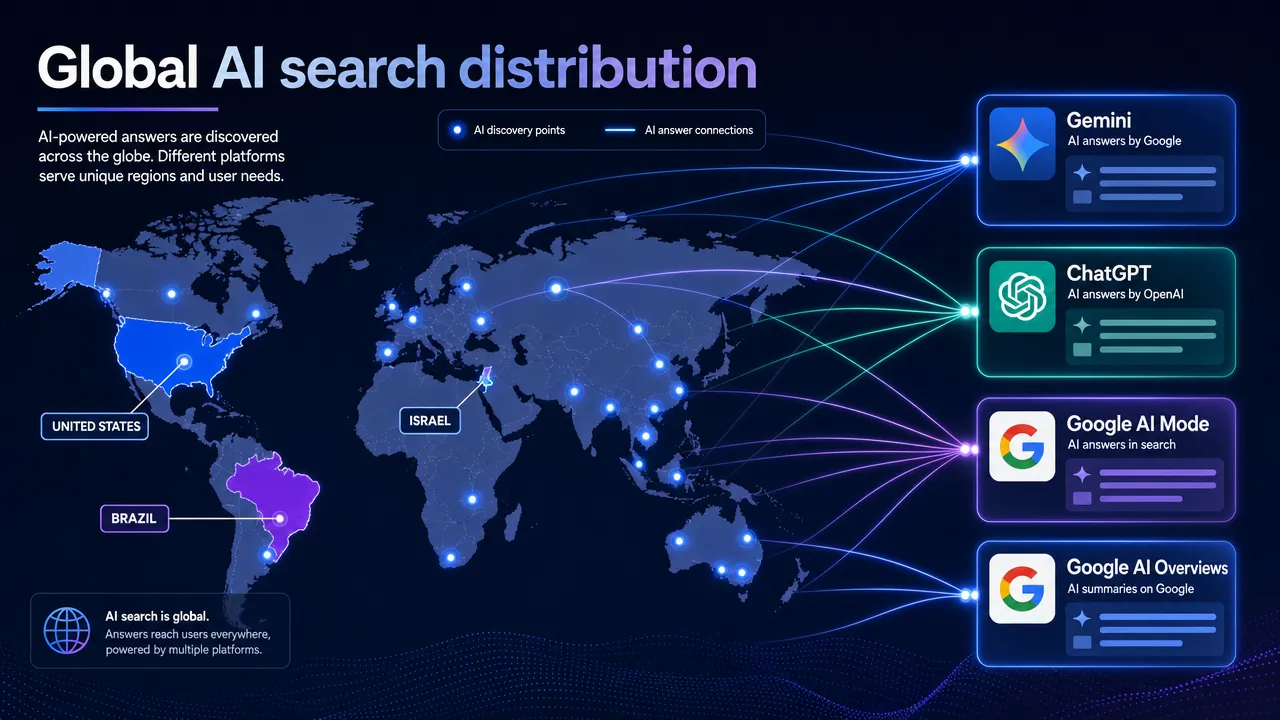
Visibility appeared across ChatGPT, Gemini, Google AI Mode, and Google AI Overviews. Internationally, the United States accounted for 43.4% of mentions and Brazil accounted for 15.1%. This matters for globally oriented companies because AI discovery may surface useful pages in markets where traditional brand awareness is still developing.
AI visibility case study starting point and timing
The starting point was limited AI visibility. During late 2025, citation activity remained low. Visibility began accelerating around the end of 2025 and early 2026, then continued to build over the following months. The sharpest acceleration appeared in the final two to three months of the tracked period.
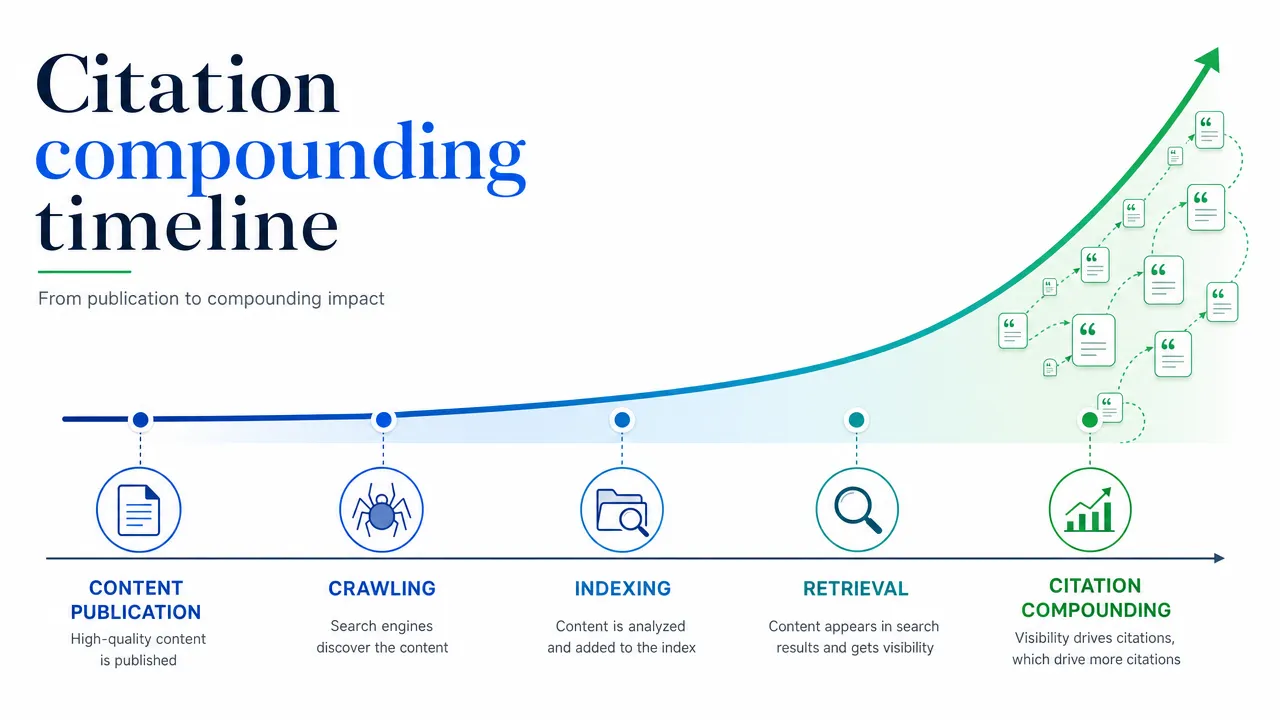
This pattern aligns with SeekLab.io's Citation Lag Problem. GEO content commonly needs a six-to-eight-week build before it begins compounding into citations. Publication alone does not create immediate pickup. A page still needs to be crawled, indexed, understood in context, retrieved for relevant questions, and selected as evidence for an answer.
The result developed across roughly nine to eleven months. That timeline is a useful warning for teams expecting a newly published page to immediately appear in AI answers. Early flat activity does not necessarily mean the strategy is failing. It can mean the website has not yet built enough topical coverage, internal context, and technically accessible source material for citations to compound.
Indexing is also not the finish line. Google's guidance explains that a page must be indexed and eligible to appear with a snippet before it can be eligible as a supporting link in AI Overviews or AI Mode. Google's AI features guidance reinforces the operational need to treat crawling, indexing, rendering, and content clarity as connected requirements.
AI visibility case study strategy for citation growth
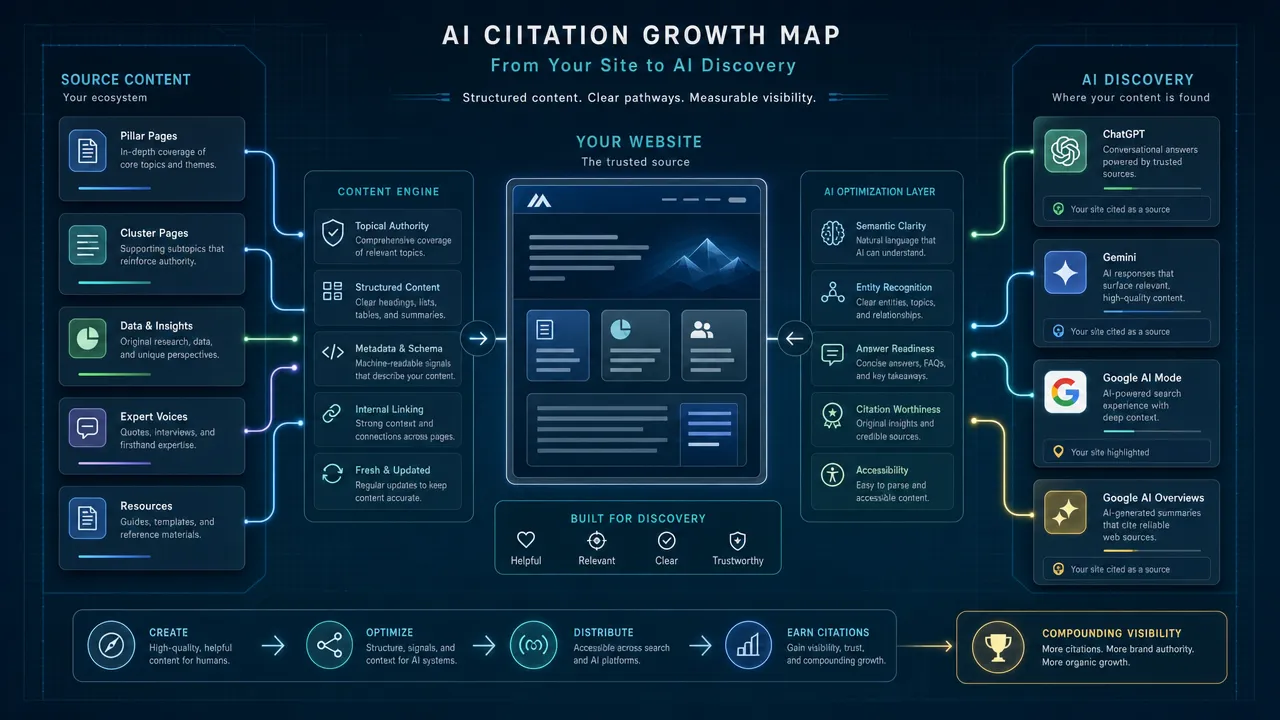
The work followed SeekLab.io's GEO methodology. Rather than treating AI search as a collection of prompt-level tactics, the focus was on strengthening the search and content foundation that makes pages discoverable, understandable, and useful across traditional and AI-driven search environments.
Building search-relevant content
Content was developed around actual search intent rather than disconnected articles published only to chase traffic. Each priority page needed a clear role: answer a specific question, explain a decision, compare options, define a topic, or guide a relevant visitor toward the next commercial step.
A buyer comparing services, checking a technical requirement, or evaluating a supplier needs a direct answer before they need a broad introduction. Pages that bury the answer under generic context make both reader evaluation and source extraction harder. The stronger pattern is to answer the practical question early, then add the explanation, limitations, examples, and relevant next steps.
Expanding topical coverage
The strategy did not rely on a handful of high-performing URLs. It expanded coverage around relevant topic clusters, giving search engines and AI systems more context about the site's areas of expertise and creating more entry points for discovery.
This matters particularly for international websites. Translating every article without checking local search intent can create a large but weak content footprint. A more useful approach is to prioritize the markets, languages, and commercially relevant questions that matter to the business, then make sure the related pages are internally connected and easy to navigate.
Improving content structure
Pages used SeekLab.io's answer-first / citation-bait anatomy: a one-line direct definition, a concrete example, and a falsifiable mechanism claim near the top of the page, followed by clear headings and focused sections. This structure makes an individual passage easier to identify, interpret, and retrieve.
Clear headings, concise answer blocks, comparisons, tables, useful images, and internal links are not formatting extras. They reduce ambiguity. They show what each section is answering, how one concept relates to another, and where a reader should go next. A polished page that never addresses a specific question is far less useful than a focused page with a clear job.
Strengthening the technical SEO foundation
Technical SEO remained part of the strategy because useful content cannot reliably contribute to citations if systems struggle to crawl, render, index, canonicalize, or discover it through internal links. The work included crawlability, indexing, rendering, sitemap.xml and robots.txt validation, internal-link architecture, structured data, and page readiness.
This is especially relevant for JavaScript-heavy and multilingual sites. A page may appear complete in a browser while important text, links, or schema are difficult for crawlers to process. Weak canonical or hreflang implementation can also direct systems toward the wrong language or regional version. Those are growth constraints, not minor technical housekeeping issues.
Treating SEO and AI discovery as one system
The work treated SEO and AI-driven discovery as connected outcomes. Search visibility provides the foundation for discoverability. Clear content structure and information quality increase the likelihood that pages can also be used as sources in generated answers.
Google states that there are no special technical requirements for appearing in AI features beyond established Search requirements, including indexing and snippet eligibility. Google's documentation on AI features and websites is a useful reference for teams that want to improve readiness without pursuing unsupported tactics.
AI visibility case study platform and market distribution
The resulting mentions were distributed across several major AI search environments. Gemini accounted for the largest share, while ChatGPT and Google AI Mode each represented the same share of mentions.
| AI platform | Share of mentions | Mentions |
|---|---|---|
| Gemini | 41.5% | 22 |
| ChatGPT | 26.4% | 14 |
| Google AI Mode | 26.4% | 14 |
| Google AI Overviews | 5.7% | 3 |
Combining Google's surfaces, Gemini, Google AI Mode, and Google AI Overviews accounted for roughly 74% of all mentions, compared with about 26% from ChatGPT. That does not make one platform inherently better than another. It identifies where the website already has stronger exposure and where the next testable opportunity sits. In this case, ChatGPT is the clearest underexposed lever for the next phase.
OpenAI explains that ChatGPT Search can provide answers with cited web sources. Publishers that want their content included in summaries and snippets should avoid blocking OAI-SearchBot. OpenAI's publisher and developer FAQ provides relevant crawler-control guidance.
| Country | Share of mentions | Mentions |
|---|---|---|
| United States | 43.4% | 23 |
| Brazil | 15.1% | 8 |
| Israel | 5.7% | 3 |
| Other | 35.8% | 19 |
Brazil's second-place position is notable. AI-distributed content can introduce a brand to potential customers in markets where the company does not yet have strong traditional name recognition. The 35.8% Other share also indicates broad international pickup once content becomes a usable source.
For cross-border websites, this creates a practical requirement: the correct market page must be available for the relevant question. Localized URLs, accurate canonical tags, hreflang implementation, market-specific internal links, and locally meaningful content can reduce the risk that the wrong regional or language version becomes visible.
AI visibility case study insight: Citation-to-Mention Ratio
The central insight is the gap between 451 citations and 53 mentions: a Citation-to-Mention Ratio of roughly 8.5:1. The website was cited much more frequently than the brand was named. That suggests the content had become useful supporting evidence before the brand gained comparable recognition as an entity.
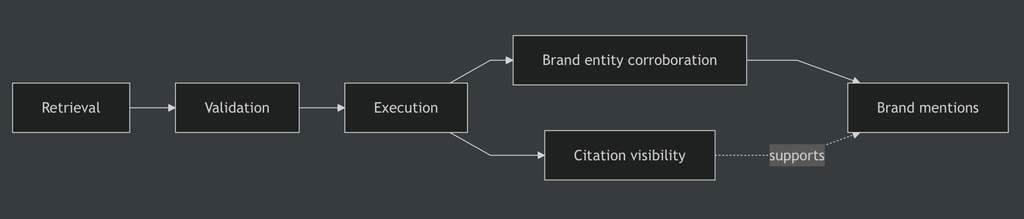
Citation visibility concerns whether a page can be retrieved and validated as a useful source. Crawlable pages, direct answers, accurate definitions, relevant comparisons, clear internal links, and focused topical coverage all support this outcome. The site was winning decisively on this objective.
Brand visibility concerns whether the business is named or recommended as an authority. That requires stronger entity corroboration and typically depends more heavily on third-party mentions and consistent public information. It is a separate objective with a slower-moving set of inputs.
This distinction is exactly what SeekLab.io's Three-Gate Model predicts. Retrieval and validation are largely won on the website itself through accessible, extractable, answer-first content. Brand-entity corroboration is won more heavily off-site through third-party references and consistent entity data. Citations can therefore outpace mentions by a wide margin without indicating a weak strategy.
What comes next
The next opportunity is to turn citation authority into stronger brand-level recognition and business value. Producing more content without addressing entity corroboration would risk widening the gap between source usage and brand recognition.
- Identify missing brand opportunities: review queries where competitors are named but the brand is absent.
- Strengthen third-party corroboration: pursue credible industry references, partner pages, directories, association listings, and other legitimate external sources that accurately describe the business.
- Maintain citation-ready pages: refresh priority content, retain direct answer blocks, and continue expanding commercially relevant topic clusters.
- Close the ChatGPT gap: improve accessible, well-structured content and consistent brand information for the platform with the lower share of mentions.
- Build strategically in Brazil: validate the market demand, localize high-priority pages, and make sure market-specific content is technically accessible.
- Improve conversion paths: ensure that cited educational pages lead naturally to relevant service pages, contact paths, case studies, or audit options.
Key takeaway
AI visibility does not appear overnight from adding a few GEO-optimized articles. It compounds as more useful, crawlable, and relevant pages become available for search and AI systems to retrieve.
The move from limited AI visibility to 451 citations across 310 pages, with citations growing 82.6% and cited pages increasing 71.3%, shows the value of building a broad technical and content foundation. The next challenge is converting that information authority into stronger brand recognition, qualified search traffic, and business results.
If you need to identify which technical, content, internal-link, multilingual, or search-readiness issues are most likely to affect growth, get a free audit report from SeekLab.io.
AI visibility case study frequently asked questions
What is the difference between an AI citation and a brand mention?
A citation is when an AI system uses a site's content as a source for an answer. A mention is when the brand name appears in the answer text. A site can be cited often without being named, which produces a high Citation-to-Mention Ratio.
Why did brand mentions grow so much slower than citations?
Citations reflect content being retrieved as a source, which is won on-site. Mentions reflect the brand being named as an authority, which depends more on off-site signals. On-site content work compounded quickly (+82.6% citations), while brand-naming signals grew more slowly (+10.4% mentions).
What is a good Citation-to-Mention Ratio?
There is no universal target, but a ratio far above parity - here, about 8.5:1 - signals strong content retrieval and weaker brand corroboration, a cue to invest in off-site brand signals rather than more content.
Which AI platform is the biggest opportunity here?
ChatGPT. It delivered about 26% of mentions versus roughly 74% across Google's surfaces, making it the most underexposed platform to target next.
How long does AI citation growth take?
In this case, citations rose over roughly nine to eleven months, accelerating most sharply in the final two to three months as the source footprint compounded.