How to Get Your Brand Cited by ChatGPT
Expert reviewed

To get your brand cited by ChatGPT in 2026: fix crawlability first, make your brand entity unmistakable, publish comparison and definition content with direct verdict sentences and specific numbers, build consistent third-party references, and measure citation frequency across your target queries — not just one test prompt.
SeekLab has now seen this pattern hold twice. A comparison article published for a Web3 client ranked #1 on Google and appeared in Google's AI Overview in 14 days. A second comparison article for the same client appeared in Google's AI Overview in 24 hours. Both used the same formula: direct verdict sentences per item, specific verifiable numbers, and "Best for:" labels. This is the practitioner foundation behind everything in this guide.
Getting a brand cited in ChatGPT is not something any marketer can force. The practical goal is to make your brand easier to crawl, understand, verify, and quote when ChatGPT Search or similar answer experiences look for sources. This article gives you a working framework for how to get brand cited in ChatGPT, covering technical access, entity clarity, content structure, earned media for AI citations, monitoring, and the mistakes that waste budget.
The short version: fix crawlability and indexability first, make your brand entity unmistakable, publish pages that answer real buyer questions, support claims with credible third-party references, and track ChatGPT brand mentions over time instead of treating one prompt as a fixed ranking. OpenAI explains that ChatGPT Search can use web search, rewrite queries, perform additional searches, and show citations when search is used, but it does not publish a guaranteed citation formula. OpenAI also separates crawlers such as GPTBot, OAI-SearchBot, and ChatGPT-User, which means access matters, but access alone does not guarantee inclusion. You can read the official explanations in OpenAI's ChatGPT Search documentation and OpenAI's crawler documentation.
For independent websites, exporter websites, official company sites, and multilingual business sites, the issue is not only whether ChatGPT links to you. A buyer may ask for options, comparisons, definitions, or suppliers before ever visiting Google. If your brand is absent, described vaguely, or placed in the wrong category, you lose consideration early. The work below is about citation readiness: making your website and public footprint clear enough for search engines, AI systems, and real users to understand.
What getting a brand cited in ChatGPT actually means
A brand cited in ChatGPT usually means the response includes your website or another source as a linked reference. A ChatGPT brand mention is different: the brand may be named in the answer without a citation. This distinction matters because a marketing report that counts only links can miss brand awareness, while a report that counts only mentions can overstate source trust.
OpenAI's documentation says ChatGPT Search may show inline citations and a sources panel when search is used. It may also rewrite a user's query and perform additional searches after reviewing results. That means the result can change depending on prompt wording, region, freshness, source availability, and whether search is triggered. A single test prompt is useful as a snapshot, not as proof of stable brand authority for ChatGPT.
| Item | What it means | What your team can control | What you cannot control |
|---|---|---|---|
| ChatGPT brand mentions | Your brand is named in the answer without a linked source | Clear brand positioning, consistent naming, external references, relevant content | Whether a specific prompt includes your brand |
| ChatGPT citations | Your site or another page is shown as a source | Crawlable pages, structured content, schema, page quality, source credibility | Which source ChatGPT chooses to cite |
| AI search brand visibility | How often your brand appears across answer-style discovery journeys | Technical SEO, content assets, earned media, monitoring cadence | Platform behavior, model updates, query rewriting |
| SEO for AI answers | SEO work adapted for extractable, answer-ready pages | Semantic structure, internal links, concise definitions, comparison tables, FAQs | Guaranteed inclusion in any answer surface |
The most useful mental model is not "How do we trick ChatGPT into citing us?" It is "Would a retrieval system, editor, or buyer find enough clear evidence to describe this brand accurately?" If the homepage says "innovative solutions for global businesses" but never states the product category, markets served, proof points, or use cases, both users and machines have to guess.
For a B2B manufacturer, this could be the difference between being recognized as "a stainless steel valve supplier for food processing plants" and being ignored as another vague industrial company. For a SaaS company, it could be the difference between being placed in the correct workflow category or being compared with tools that solve a different problem. Citation readiness starts with being specific.
How to make your brand cited in ChatGPT through technical readiness
Before publishing more articles or chasing mentions, check whether your important pages can be discovered and parsed. Many company websites have reasonable content sitting behind weak technical foundations: blocked folders, canonical mistakes, JavaScript-rendered content that is not visible in raw HTML, orphaned product pages, broken hreflang, or sitemap files full of low-value URLs.
OpenAI's crawler documentation is especially relevant here. OAI-SearchBot is used to surface websites in ChatGPT search results, while GPTBot has a separate role related to improving foundation models. If your robots.txt blocks the wrong crawler, you may reduce eligibility for search-based discovery. Allowing access does not guarantee a brand cited in ChatGPT, but blocking access can remove opportunities before content quality is even evaluated.
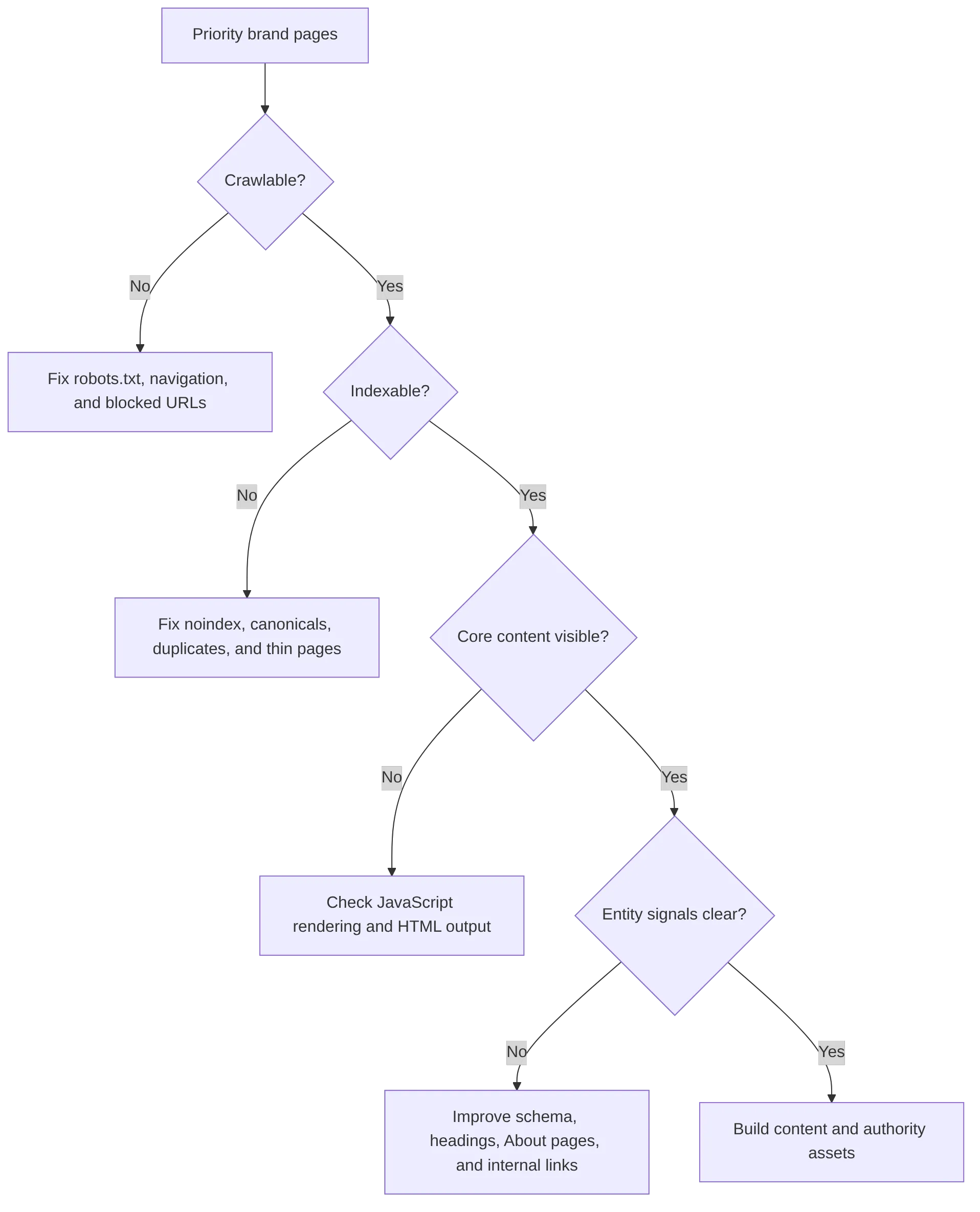
Use this technical checklist before deciding that your brand has a "content problem."
| Technical check | Why it matters for citation readiness | Practical warning |
|---|---|---|
| robots.txt and crawler access | Search-related crawlers need access to important pages | Do not make blanket block decisions without knowing crawler purpose |
| Crawlability | Pages need internal links and clean paths | A product page only reachable through a search box is easy to miss |
| Indexability | Canonicals, noindex tags, and duplicates affect discoverability | A translated page canonicalized to English may never build its own market relevance |
| JavaScript rendering | Crawlers need to see core text, links, product names, and FAQs | Visual catalog pages can look complete to users but thin to crawlers |
| Sitemap.xml | Search engines need intended canonical URLs | Do not fill sitemaps with parameter URLs or expired pages |
| Core Web Vitals | Slow or unstable pages hurt user experience and lead completion | Perfect scores matter less than fixing slow commercial templates |
| Schema markup | Structured data helps clarify page type and entity relationships | Schema cannot rescue vague or inaccurate visible content |
| Internal linking | Search engines and users need clear paths between topics and services | Footer-only links are weaker than contextual links from relevant pages |
| Multilingual architecture | International pages need language and region signals | Translating every page is less useful than localizing the pages that affect demand |
Google's SEO documentation supports the same access-first logic: search systems need crawlable links, useful content, clean sitemaps, and understandable page structure. For JavaScript-heavy websites, Google's guidance on JavaScript SEO basics is worth reviewing before assuming your content is visible. For structured data, Google's structured data introduction explains how markup helps systems understand page content, although it does not guarantee ranking or citations.
SeekLab.io approaches this stage by separating growth blockers from cosmetic issues. A site may have hundreds of SEO warnings, but only a smaller group actually affects crawl access, entity clarity, content usefulness, or conversion. If you want to check whether crawlability, rendering, schema, or internal linking issues are limiting your citation readiness, you can start with SeekLab.io's complete SEO audit checklist.
How content helps get your brand cited in ChatGPT
Content that improves the chance of a brand cited in ChatGPT is usually not generic blog volume. It is content that gives answer systems and buyers something precise to extract: definitions, use cases, comparisons, specifications, limitations, FAQs, author expertise, visuals, and clear next steps.
SeekLab's campaign data points to two specific principles that consistently produce citations — what we call the Two-Gate Model. Gate 1 is retrieval selection: the AI system has to find and index your content. Gate 2 is answer absorption: once retrieved, your content has to contain extractable claims the AI can use in its answer. Most brands failing at AI visibility are stuck at Gate 1. Brands that clear Gate 1 but still don't appear in answers are failing at Gate 2 — typically because their content contains no specific numbers, no direct verdicts, and no structured comparison data.
The content types that clear Gate 2 most reliably: comparison articles ("best X for Y"), definition pages with direct answer blocks, and FAQ sections in proper Q&A format. Comparison content produces AI citations at 3-4x the rate of general informational content based on SeekLab's testing across multiple client campaigns.
There is also a timing factor — what SeekLab calls the Citation Lag Problem. AI citations take 6-8 weeks to build after well-structured content is published, and they begin decaying 3-4 weeks after publishing activity slows. This means most teams never connect the cause (slowing down content) to the effect (citations dropping) because the timing gap hides the relationship. Consistent publishing cadence is the only reliable fix — not a one-time content push.
Google's guidance on creating helpful content emphasizes content made for people, with usefulness, originality, and trust. That is practical advice for AI-era discoverability too. A page that says "we provide quality solutions" gives almost nothing to cite. A page that defines a category, explains selection criteria, shows a comparison table, and links to the right product or service page is easier to summarize and more useful for real buyers.
A strong content system for SEO for AI answers usually includes the following assets.
| Content asset | What it should include | Why it helps |
|---|---|---|
| Definition page | Clear definition, examples, use cases, limitations, related services | Helps connect your brand to a category or problem |
| Comparison page | Fair criteria, best-fit scenarios, tables, trade-offs | Captures buyer prompts asking for alternatives or options |
| Problem-solution page | Problem, cause, solution, proof, next action | Matches real sales objections and inquiry behavior |
| Product or service page | Buyer segment, use case, deliverables, proof, process, CTA | Turns discovery into commercial action |
| Expert article | Named perspective, practical examples, screenshots, diagrams | Builds brand authority for ChatGPT beyond keyword matching |
| FAQ section | Concise answers to real buyer questions | Makes objections easier to extract and reuse |
| Data-backed page | Original findings, benchmarks, process data, tables | Creates more quotable material for third-party references |
| About and author pages | Company details, locations, expertise, credentials, sameAs links | Supports entity clarity and buyer trust |
For example, an exporter site should not publish ten generic articles about "how to choose a supplier" before fixing its category pages. A better page states the product category, materials, certifications, regions served, minimum order context, quality-control process, delivery considerations, and application scenarios. That page can then link to supporting guides, FAQ sections, and inquiry paths. The content is useful because it reflects how buyers evaluate risk.
For official company websites, the same principle applies. The first screen of a service page should tell visitors what the company does, who it serves, what outcome it supports, and why the claim is credible. If that information is buried below slogans and rotating banners, both users and systems receive weaker signals.
SeekLab.io's content work focuses on topic selection before writing. The point is not just to generate more articles; it is to avoid heading in the wrong direction. Topics should come from buyer intent, current demand, industry knowledge, search results, and answer-style structures. The finished content should include headings, meta tags, keywords, JSON-LD where appropriate, images, tables, and internal links. For more on structuring content for answer environments, see SeekLab.io's content adaptation guide.
A useful content plan also considers conversion. If ChatGPT cites a detailed guide but the page has no internal link to the relevant service, no proof points, no contact path, and no explanation of who the solution fits, the citation may bring traffic without leads. That is a common failure: rankings improve, but inquiries do not.
How earned media supports a brand cited in ChatGPT
Earned media for AI citations matters because your own website is only one evidence layer. A brand that is consistently described across relevant publications, associations, partner pages, directories, and review platforms is easier to verify than a brand whose only claims appear on its own homepage.
This does not mean buying large numbers of low-quality placements. Relevance and credibility matter more than raw mention volume. Google's helpful content guidance and broader search quality direction favor trust, expertise, and usefulness. Ahrefs' article on brand mentions also frames mentions as reputation and relationship signals, not just link-building targets.
| Source type | What makes it useful | What to avoid |
|---|---|---|
| Industry publications | Specific category context, named experts, editorial standards | Generic syndicated announcements with no substance |
| Partner pages | Real relationship, use case, integration, project context | Logo walls with no explanation |
| Directories | Accurate brand name, URL, category, location, description | Inconsistent profiles using old names or wrong categories |
| Review platforms | Real customer language and current product details | Manipulated or irrelevant reviews |
| Association pages | Membership, speaking, standards, event participation | Treating one badge as full authority |
| Interviews and commentary | Practical opinions and firsthand expertise | Empty quotes that could come from any company |
| Unlinked mentions | Accurate name and category association | Mentions on irrelevant websites |
For a brand trying to improve ChatGPT brand mentions, consistency is often underrated. Use the same official brand name, domain, business description, headquarters or operating locations, and category language across your website and external profiles. If one directory calls the company a "software provider," another calls it an "agency," and the website calls it a "growth partner," systems and buyers get mixed signals.
This is especially important for multilingual and cross-border websites. A company operating across APAC, the United States, and Europe may need separate language or regional pages, but the core brand entity should remain consistent. Google documents how localized URLs and hreflang help signal language and regional versions in its localized versions guidance. SeekLab.io's multilingual SEO strategy guide makes a similar practical point: not every page deserves translation, but priority commercial pages and topic pillars should be adapted for the markets that matter.
For SeekLab.io, the same naming discipline applies: the brand should be written as SeekLab.io everywhere. Variants fragment recognition and make public references less tidy. For any brand, this small operational detail can affect how confidently a system connects the website, profiles, articles, and third-party mentions.
How to monitor whether your brand cited in ChatGPT is improving
Monitoring matters, but it should not become the whole strategy. A dashboard or spreadsheet can show whether your brand appears, but it cannot fix a blocked page, a vague service description, weak schema, or thin comparison content. Treat monitoring as feedback for technical SEO, content planning, and authority building.
Start with prompt groups rather than one prompt. A real buyer does not ask only "best company for X." They ask definitions, alternatives, comparisons, supplier questions, regional queries, problem-solving questions, and risk-related questions.
| Prompt group | Example prompt style | What it reveals |
|---|---|---|
| Category discovery | "What are good providers for [category]?" | Whether your brand is associated with the category |
| Problem solving | "How do I solve [specific problem]?" | Whether your content matches buyer pain |
| Comparison | "Compare [brand] with alternatives for [use case]" | Whether your positioning is understood accurately |
| Regional | "Providers of [service] for US and APAC companies" | Whether location and market signals are clear |
| Product selection | "What should I look for in [product type]?" | Whether guides and product pages answer selection criteria |
| Brand accuracy | "What does [brand] do?" | Whether public descriptions are accurate |
| Competitor context | "Alternatives to [competitor category]" | Whether you appear in consideration sets |
| Citation check | "Give sources for [topic]" | Whether your pages are retrieved as references |
Track five things separately: mentions, citations, source URLs, description accuracy, and competitors that appear. Add notes about prompt wording, date, region, whether search was used, and whether the answer cited your own site or a third-party page. Repeat monthly or quarterly. Do not overreact to one result; look for patterns.
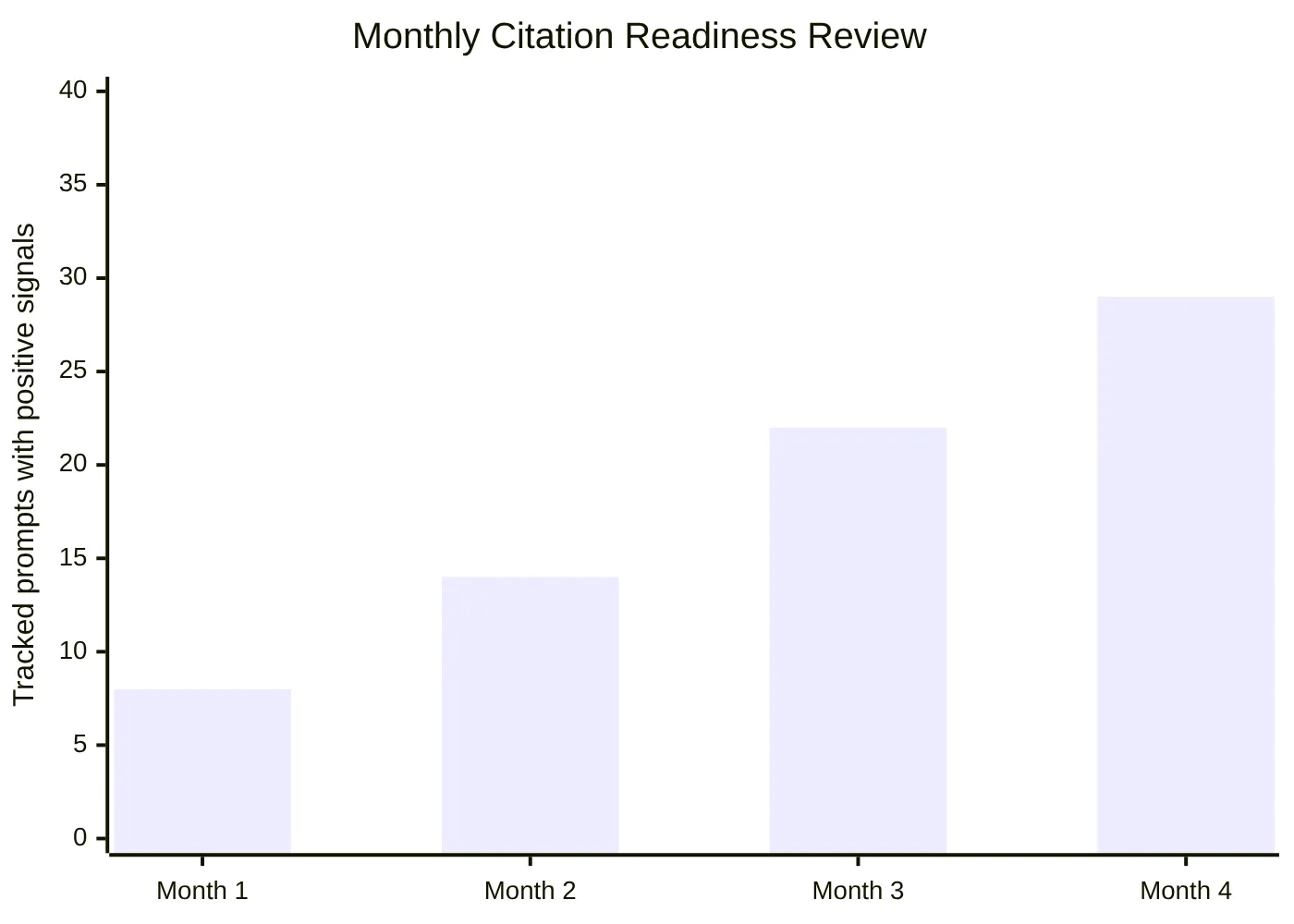
The chart above is a planning example, not a benchmark. Your numbers will depend on the size of your prompt set, market, language, and category maturity. A small B2B website in a niche market may see fewer total mentions but higher commercial value when the prompts match real purchasing behavior.
The key is to convert monitoring into work. If prompts show that ChatGPT describes your product category incorrectly, update your homepage, About page, product pages, Organization schema, and external profiles. If it cites third-party guides instead of your content, build better definition or comparison pages. If competitors appear because they have stronger earned references, review industry publications, partner pages, directories, and review sites for realistic authority opportunities.
How SeekLab.io helps improve brand cited in ChatGPT readiness
SeekLab.io helps brands build search visibility and AI-era discoverability through high-quality content production and technical optimization. The work is not limited to technical issue detection. It also covers content direction, page structure, information clarity, internal linking, schema enhancement, multilingual architecture, and conversion paths.
The most useful starting point is diagnosis. Many teams want to publish more content immediately, but the better question is: "What is actually limiting growth?" Sometimes the issue is a blocked catalog. Sometimes it is weak service-page positioning. Sometimes a multilingual site has broken hreflang. Sometimes the brand has no credible third-party references. Sometimes the content is ranking but not producing inquiries because the page never explains the next step.
SeekLab.io focuses on identifying what truly impacts growth and what can be deprioritized. That may include:
- Full-site crawling and structured analysis.
- Core Web Vitals and page performance diagnostics.
- Indexing, crawling, rendering, and JavaScript compatibility checks.
- Internal link equity and semantic structure analysis.
- Schema compliance and enhancement.
- Sitemap.xml and robots.txt validation.
- AI-era discoverability and citation readiness evaluation.
- Content topic selection based on user intent, current trends, and business scenarios.
- Blog creation with structured layouts, images, tables, internal links, and conversion-aware CTAs.
- Multilingual site architecture for international markets.
- Monthly data review and performance reporting.
For brands with product or service pages that receive traffic but fail to generate inquiries, content structure often needs the same attention as rankings. SeekLab.io's advanced product page SEO guide explains how product clarity, visuals, internal links, and conversion signals work together. For sites where entity clarity is weak, SeekLab.io's advanced schema markup article shows why schema should support real visible content rather than act as a shortcut.
A practical 90-day plan usually looks like this:
| Timeline | Priority | Main output |
|---|---|---|
| Days 1-15 | Technical access audit | Crawlability, indexability, robots.txt, sitemap, rendering issues |
| Days 16-30 | Entity cleanup | Brand naming, About page, service pages, Organization schema |
| Days 31-60 | Content assets | Definition pages, comparison pages, FAQs, visuals, internal links |
| Days 61-75 | Third-party consistency | Directory cleanup, partner pages, earned media topic planning |
| Days 76-90 | Monitoring and review | Prompt baseline, citation tracking, lead quality review |
The point is not to fix everything. The point is to make the right strategic decisions before spending months writing content or handing developers a long list of low-impact tasks. For many independent websites and international business sites, that alone prevents wasted budget.
If you want to know whether technical issues are limiting your brand's citation readiness, get a free audit report from SeekLab.io. If you need help prioritizing technical fixes, content topics, schema, internal links, and authority-building actions, contact us with your domain.
FAQ
How long does it take to get cited by ChatGPT?
Based on SeekLab's campaign data, AI citations typically begin appearing 6-8 weeks after well-structured content is published on a site with adequate topical authority. This is the Citation Lag Problem — there is a delay between publishing and citation that most teams don't account for. A second article on the same domain often gets cited faster because the domain has already built topical trust signals from earlier content.
What content type gets cited most by ChatGPT?
Comparison content — "best X for Y" articles, tool roundups, and framework comparisons — produces AI citations at 3-4x the rate of general informational content based on SeekLab's testing. The structural elements that drive this: a direct verdict sentence per item before any explanation, specific verifiable numbers (not vague claims), comparison tables near the top, and "Best for:" labels per item that map directly to how ChatGPT generates recommendation answers.
Does ChatGPT cite your website directly?
ChatGPT Search can show inline citations and a sources panel when search is triggered. But a ChatGPT brand mention (being named in the answer) is different from a ChatGPT citation (your website linked as a source). Both matter. A brand that appears consistently in answers without a citation is still building awareness at the decision moment. Track both separately.
What is the Two-Gate Model for AI citations?
The Two-Gate Model is SeekLab's framework for understanding why brands fail to appear in AI answers. Gate 1 is retrieval selection — the AI system has to find and index your content. This is a technical SEO problem. Gate 2 is answer absorption — once retrieved, your content has to contain extractable claims the AI can actually use in its generated answer. Most brands failing at AI visibility are stuck at Gate 1 and never get evaluated for Gate 2.
Does blocking GPTBot hurt ChatGPT citation chances?
Yes. OAI-SearchBot is used to surface websites in ChatGPT search results. If your robots.txt blocks OpenAI crawlers, you reduce eligibility for search-based discovery before content quality is even evaluated. Allowing access doesn't guarantee citations, but blocking access removes opportunities entirely.
How do you measure ChatGPT brand citations?
Manual prompt testing is the most reliable method: ask your target queries across ChatGPT, Perplexity, Gemini, and Google AI Overviews and record which sources appear. Track citation frequency (how often your brand appears across a defined query set), cited pages (how many individual pages have been cited at least once), and description accuracy (whether ChatGPT describes your brand correctly). Repeat monthly and look for patterns, not single-test snapshots.
What is the Citation Lag Problem?
The Citation Lag Problem is SeekLab's term for the timing asymmetry in GEO results. AI citations take 6-8 weeks to build after content is published, but they begin decaying 3-4 weeks after publishing activity slows. Most teams never connect the cause to the effect because the timing gap obscures the relationship. The fix is consistent publishing cadence — not a one-time content push.