Technical SEO Audit for Programmatic Success
Expert reviewed

Programmatic SEO can be a growth engine when your site can safely publish hundreds or thousands of pages without creating thin content, index bloat, or crawl waste. The catch is that small technical mistakes scale just as fast as your content does. A technical SEO audit built for programmatic SEO focuses less on one-off pages and more on repeatable URL patterns, template logic, and the systems that control crawling, indexing, rendering, and performance.
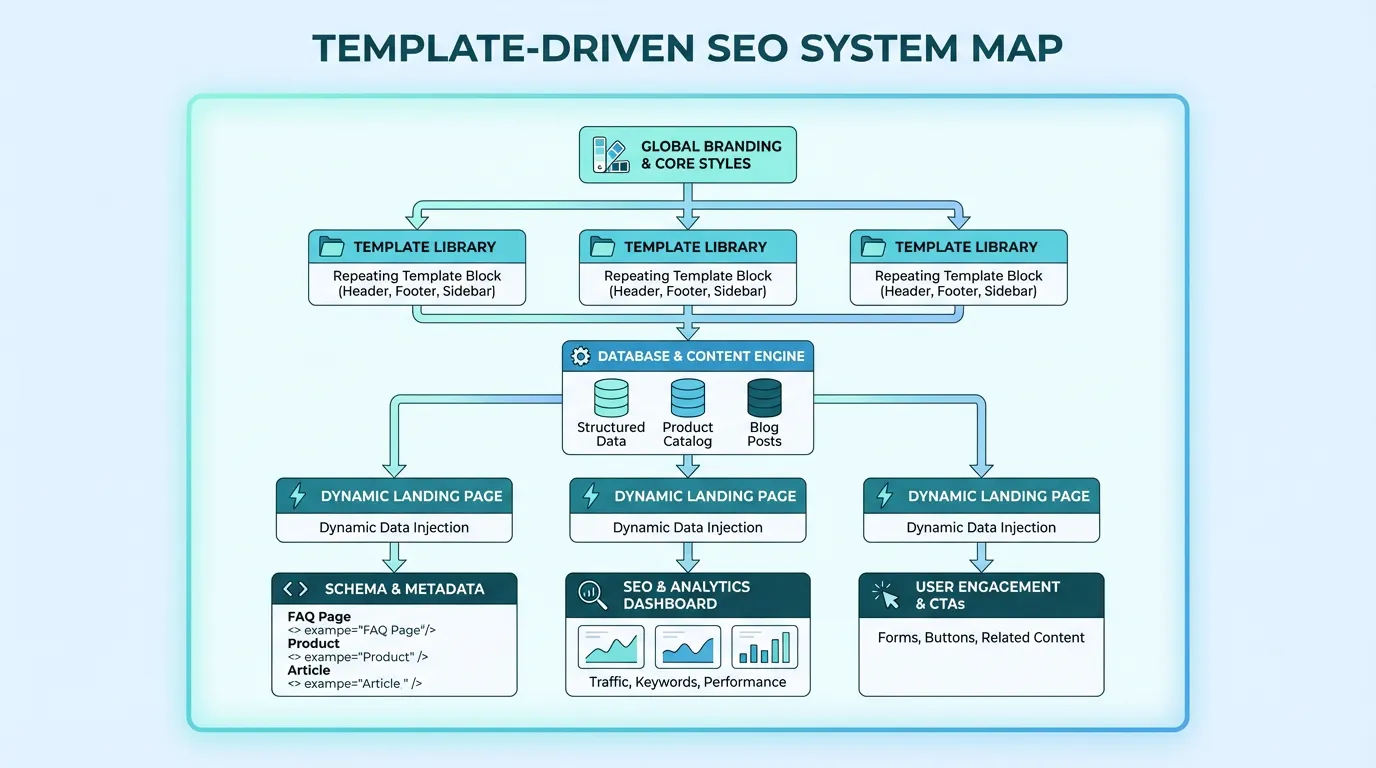
What makes a technical SEO audit different for programmatic SEO
Unlike a traditional audit that samples a few high-value URLs, a programmatic SEO audit treats templates as the unit of analysis:
- Templates are the leverage point: Fix one canonical rule or performance bottleneck and you improve thousands of pages.
- Crawl budget becomes a real constraint: Google notes crawl budget matters most for very large or frequently updated sites, which programmatic SEO often becomes (see Google's crawl budget documentation).
- Duplicate risk is structural: Near-duplicate pages are rarely a "writer problem." They are usually a template, faceted navigation, or parameterization problem.
- Rendering and JavaScript decisions compound: If key content is injected late client-side, indexing at scale becomes slower and less reliable (see Google's JavaScript SEO guidance).
The goal is not "fix everything." It is to identify what truly impacts growth, what can be deprioritized, and what will prevent scaling mistakes before you invest in more templates.
10 high-impact checks for template-driven sites (the audit list)
Use this list as a practical, template-by-template audit pass. Each item is designed to catch issues that multiply across large page sets.

- Crawl traps and infinite URL spaces
- Look for faceted filters, internal search pages, and sort parameters that generate unlimited combinations.
- Cross-check with Google's crawling and indexing overview to ensure you are not feeding bots endless low-value URLs.
- Sitemap hygiene (only canonical, indexable URLs)
- XML sitemaps should not include parameter URLs, non-canonical variants, or pages blocked by robots or noindex.
- Validate using Google's guidance on crawling and indexing.
- robots.txt rules that block value by accident
- Programmatic sites often over-block to stop crawl waste and accidentally hide critical template sections.
- Review against Google's robots.txt intro.
- Canonical tags that correctly consolidate duplicates
- Confirm self-referencing canonicals on primary template pages.
- Watch for conflicting signals between canonicals, internal links, and sitemaps.
- Reference: Google on consolidating duplicate URLs.
- Indexation mismatches at scale
- When many pages are "Discovered, currently not indexed," it can indicate quality, duplication, or crawl prioritization problems.
- Treat this as a template diagnosis question: "What pattern of pages is being deprioritized, and why?"
- Near-duplicate content clusters
- The fastest way to lose momentum is producing pages where only one token changes (for example, a city name).
- Align with Google's helpful content guidance: pages must provide unique value, not just scaled text.
- Site architecture and internal linking coverage
- Template sections need hub pages and logical clusters so crawlers and users can navigate meaningfully.
- Use Google's site architecture guidance to evaluate depth, orphan risk, and link equity flow.
- Core Web Vitals by template family
- One heavy script or unoptimized hero image can degrade LCP or CLS across the entire template set.
- Benchmark with Google's Core Web Vitals documentation.
- JavaScript rendering and content visibility
- Compare "View source" vs rendered output for key content and internal links.
- If content only appears after client-side rendering, consider SSR or SSG for high-value template pages (see Google's JavaScript SEO guidance).
- Schema markup consistency and entity clarity
- Templates should output valid, consistent structured data that matches on-page content.
- Validate against Google's structured data intro and structured data policies.
A prioritization framework that prevents wasted work (with a practical table)
A programmatic SEO audit should end with decisions, not a checklist. A simple approach is to rank each issue by:
- Impact on growth: indexing, crawl efficiency, rankings, conversions.
- Effort to fix: template change, engineering time, data availability.
- Risk: could it trigger index bloat, deindexation, or site-wide quality drag?
Here is a prioritization table you can adapt:
| Issue type (template-level) | Typical impact | Typical effort | Recommended priority |
|---|---|---|---|
| Crawl traps from filters/parameters | Very high | Medium | Must fix |
| JS-only rendering of main content | Very high | High | Must fix |
| Incorrect or missing canonicals | High | Medium | Must fix |
| Near-duplicate template copy | High | Medium | Should fix |
| Weak internal linking / orphan patterns | Medium-high | Medium | Should fix |
| Core Web Vitals template bottlenecks | Medium-high | Medium | Should fix |
| Invalid/missing schema markup | Medium | Low-medium | Nice-to-have (unless rich results are core) |
| Minor meta tag polish | Low | Low | Deprioritize |
This aligns with SeekLab.io's philosophy: focus on what truly impacts growth, and do not burn time on cosmetic fixes while structural problems remain.
International templates: hreflang and multilingual pitfalls to audit early
If you are scaling across the US, Europe, and Asia-Pacific, internationalization mistakes can create duplicate sets and mis-targeted rankings.
Key checks for multilingual template systems:
- hreflang reciprocity and correctness: Each language-region URL should reference its alternates properly (see Google's localized versions (hreflang) guidance).
- Alignment between hreflang and canonical: hreflang should not point to non-canonical versions.
- Consistent routing rules: subfolders like
/en/,/de/,/zh/must be applied consistently across templates. - Localization quality: Avoid producing pages that feel mechanically translated and low-value. Thin localization becomes thin content at scale.
If you are unsure which market or language set to build first, make the strategic decision before expanding template coverage. Scaling the wrong language architecture is expensive to unwind.
How to measure whether your audit actually improved programmatic SEO
Track performance by template family, not just by page.
Recommended KPIs:
- Index coverage by pattern: how many generated URLs are actually indexed.
- Impressions and clicks by template type: location pages vs directory pages vs variants.
- Core Web Vitals distribution by template: the "bad URLs" list often reveals one shared bottleneck.
- Conversion rate by template family: scalable traffic that does not convert is a template-intent mismatch, not a volume win.
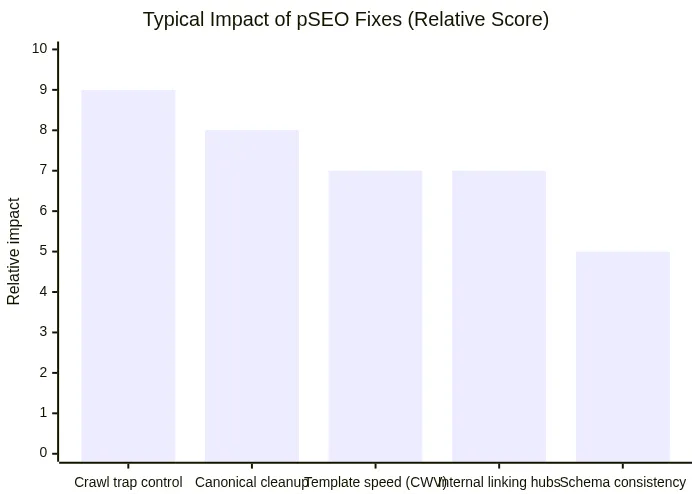
Get a roadmap built for scale with SeekLab.io
If you are planning programmatic SEO, or you already have template-driven pages that are not indexing, not ranking, or not converting, the fastest way to reduce risk is an audit that is built for scale: full-site crawling, template-level diagnostics (CWV, JavaScript rendering, schema, internal linking), plus clear prioritization so your team knows what to fix first and what can wait.
For a practical next step, request the SeekLab.io Technical SEO Audit for Programmatic Success via the contact page: Get a free audit report, contact us, and leave your website domain.