Technical SEO Audit vs Search & AI Audit: Which One Do You Need?
Expert reviewed

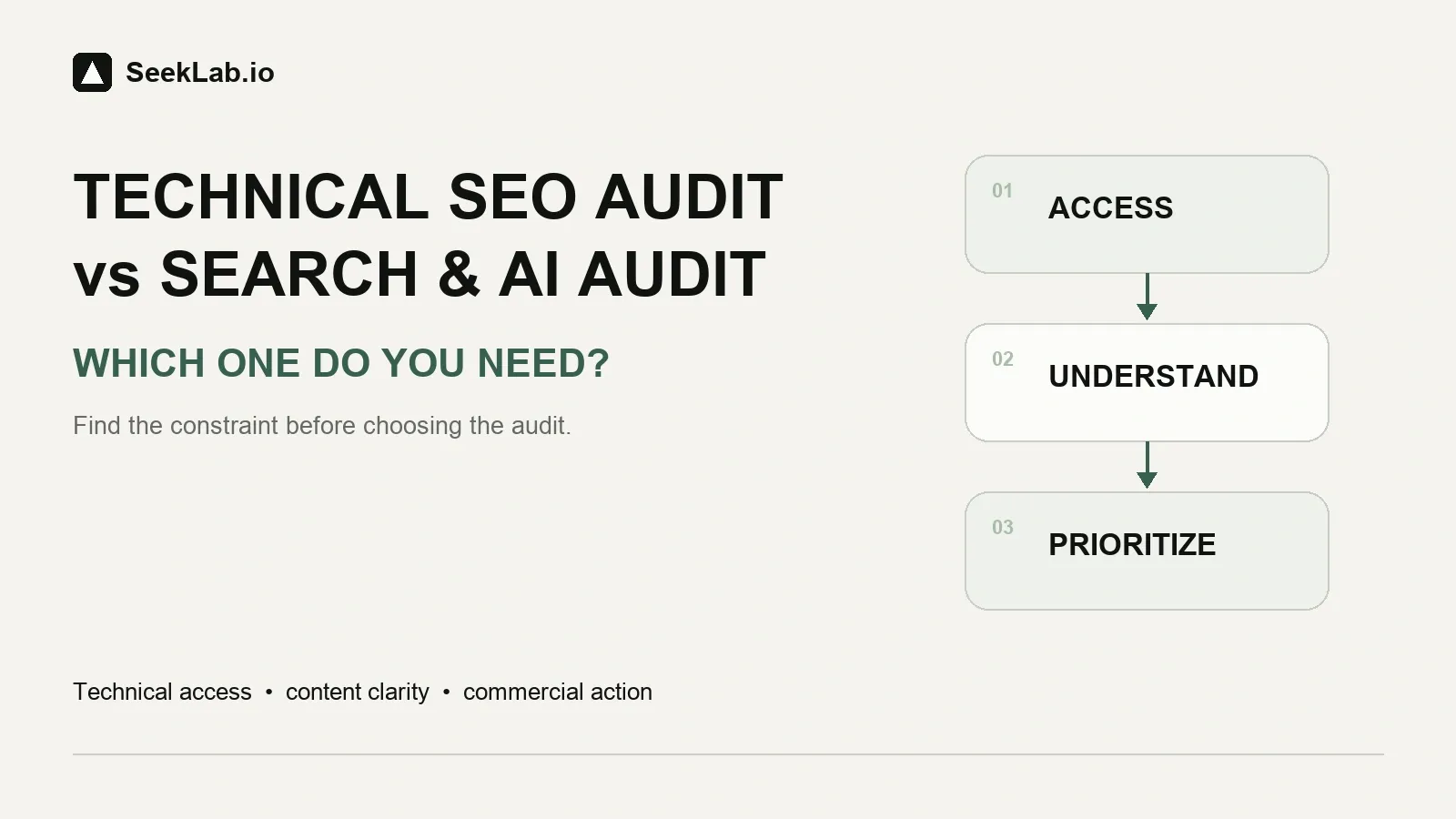
A Technical SEO Audit identifies barriers that prevent priority pages from being discovered, rendered, indexed, or correctly targeted. A Search & AI Audit goes further: it examines whether search engines, answer-driven search experiences, and prospective buyers can understand the offer, find the right page, trust the information, and take a meaningful next step.
For most independent, B2B, exporter, and multilingual websites, the decision is not about choosing the more fashionable service label. It is about identifying the constraint that is suppressing growth. A blocked service page needs technical repair before more content. A fully indexed site with vague service pages, overlapping blogs, and weak inquiry paths needs a wider diagnosis than a crawler report can provide.
A useful website audit separates technical eligibility from commercial outcomes. Being crawlable does not guarantee rankings, qualified traffic, or enquiries. Likewise, publishing more content does not solve a rendering failure, incorrect canonical tag, or poorly targeted language version.
Start with the growth constraint
Choose a technical SEO audit first when strategic URLs may be inaccessible, incorrectly redirected, blocked from indexing, poorly rendered, or structurally difficult for crawlers to reach. These failures are common after a migration, a CMS change, a JavaScript rebuild, or the launch of new language folders.
Choose a Search & AI Audit first when the technical foundation is broadly stable but organic growth is commercially weak. Typical symptoms include blog traffic with few enquiries, generic service pages, overlapping content, weak internal links to commercial pages, or translated pages that do not reflect local buyer needs.
The practical distinction is straightforward:
| Primary question | Technical SEO Audit | Search & AI Audit |
|---|---|---|
| Can search systems access the page? | Core focus | Checked as a foundation |
| Can the page render reliably? | Core focus | Checked where it affects clarity or usability |
| Is the intended URL indexable and canonical? | Core focus | Checked for priority pages |
| Does the page match a valuable search intent? | Limited review | Core focus |
| Does the business offer make sense to a buyer? | Usually outside a narrow technical scope | Core focus |
| Are content, evidence, internal links, and next steps clear? | Limited review | Core focus |
| Does the site support international users correctly? | Technical setup focus | Technical setup plus localisation and buyer journey |
| Does the page help generate qualified enquiries? | Usually outside scope | Core focus |
A combined or phased approach often makes sense. A UK manufacturer expanding into Europe may have both hreflang conflicts and generic translated product pages. Fixing hreflang alone may improve targeting, but it will not clarify delivery requirements, product specifications, certifications, or the right contact route for each market.
SeekLab.io approaches this as a prioritisation exercise. As an international SEO + GEO agency, it identifies whether the main constraint is technical, content-related, structural, international, AI-search-related, or commercial—then assigns the right owner and sequence.
What each audit actually reviews
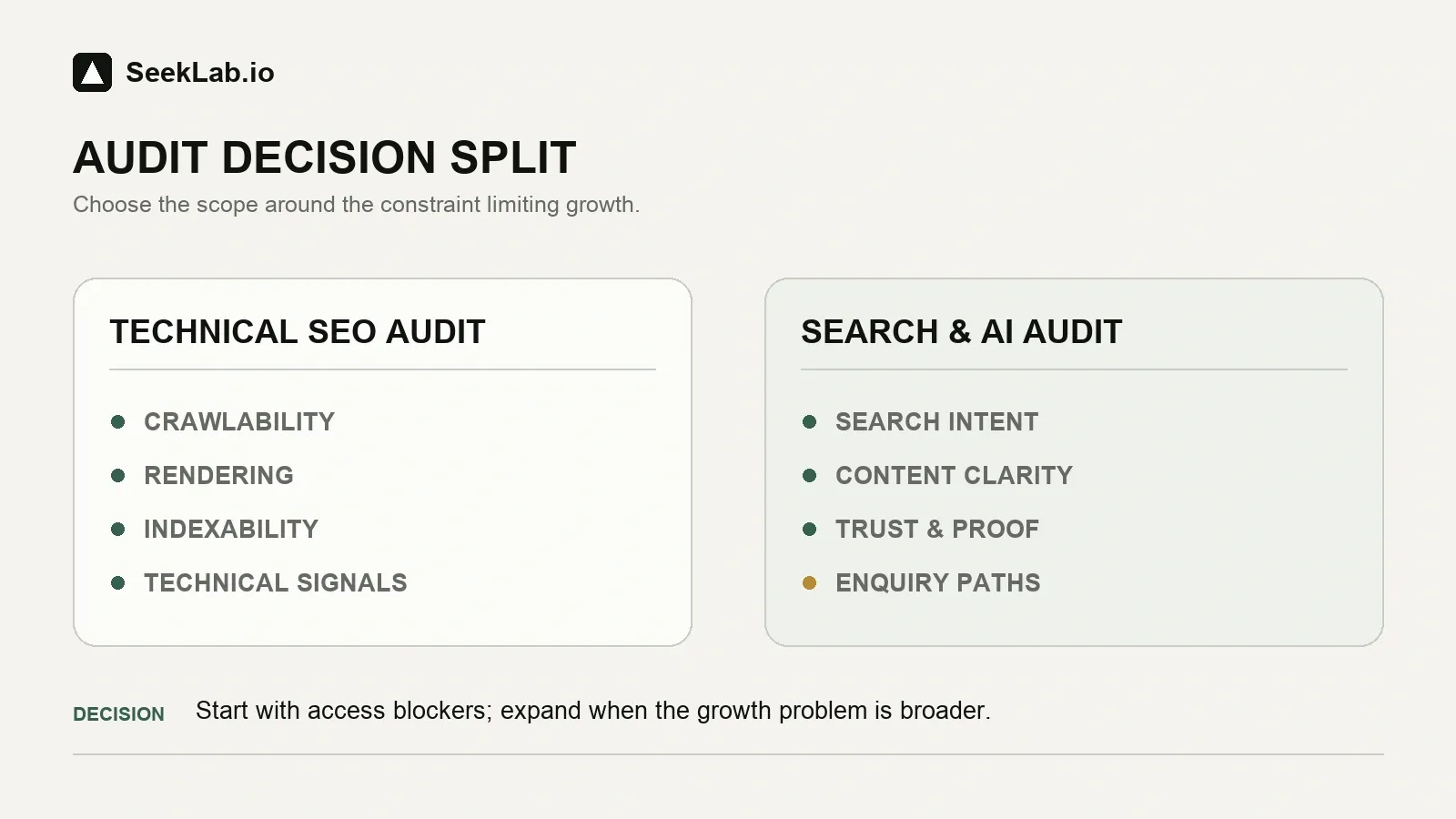
A technical SEO audit establishes whether strategically important pages can be processed as intended. It should not stop at a numerical score or a list of generic warnings. The review needs to test real templates, high-value URLs, target markets, and conversion pages.
Google treats crawling, rendering, and indexing as separate processes. A reachable page can still be excluded, point to the wrong canonical, or expose incomplete JavaScript-rendered content. The failure point determines the fix; Google's crawling and indexing controls explain the underlying mechanisms.
A thorough technical SEO audit usually examines:
- Robots.txt, meta robots directives, X-Robots-Tag headers, and XML sitemaps.
- Status codes, redirect chains, server errors, canonicals, and duplicate URL patterns.
- Crawlable internal links, navigation depth, and orphaned commercial pages.
- JavaScript rendering of primary content, links, metadata, and structured data.
- Mobile usability, page performance, HTTPS, and mixed-content risks.
- Hreflang, locale routing, and language-region URL logic.
- Template defects that affect many pages at once.
An apparently correct sitemap can still leave valuable pages buried behind filters, scripts, or non-standard navigation. For a practical sequence, see SeekLab.io's technical audit checklist.
A Search & AI Audit includes these foundations but also asks questions a crawler cannot answer. It checks whether each strategic page has a clear role in the search journey and buyer journey.
That review usually includes:
- Search intent, topic gaps, content overlap, and cannibalisation.
- Clear definitions of services, products, use cases, constraints, markets, and proof.
- Answer structure, tables, FAQs, images, and supporting assets.
- Brand and entity consistency across company, service, author, location, and contact pages.
- Internal routes from educational content to commercial and enquiry pages.
- Localised content, trust signals, buyer qualification, and answer-driven discoverability.
An AI search audit is not a shortcut to citations. Google says normal Search requirements and helpful, reliable content remain the basis for eligibility in AI features, but eligibility is not selection. Its guidance on AI features and websites and generative AI optimisation is a foundation, not a formula.
Technical SEO Audit vs Search & AI Audit: Side-by-side
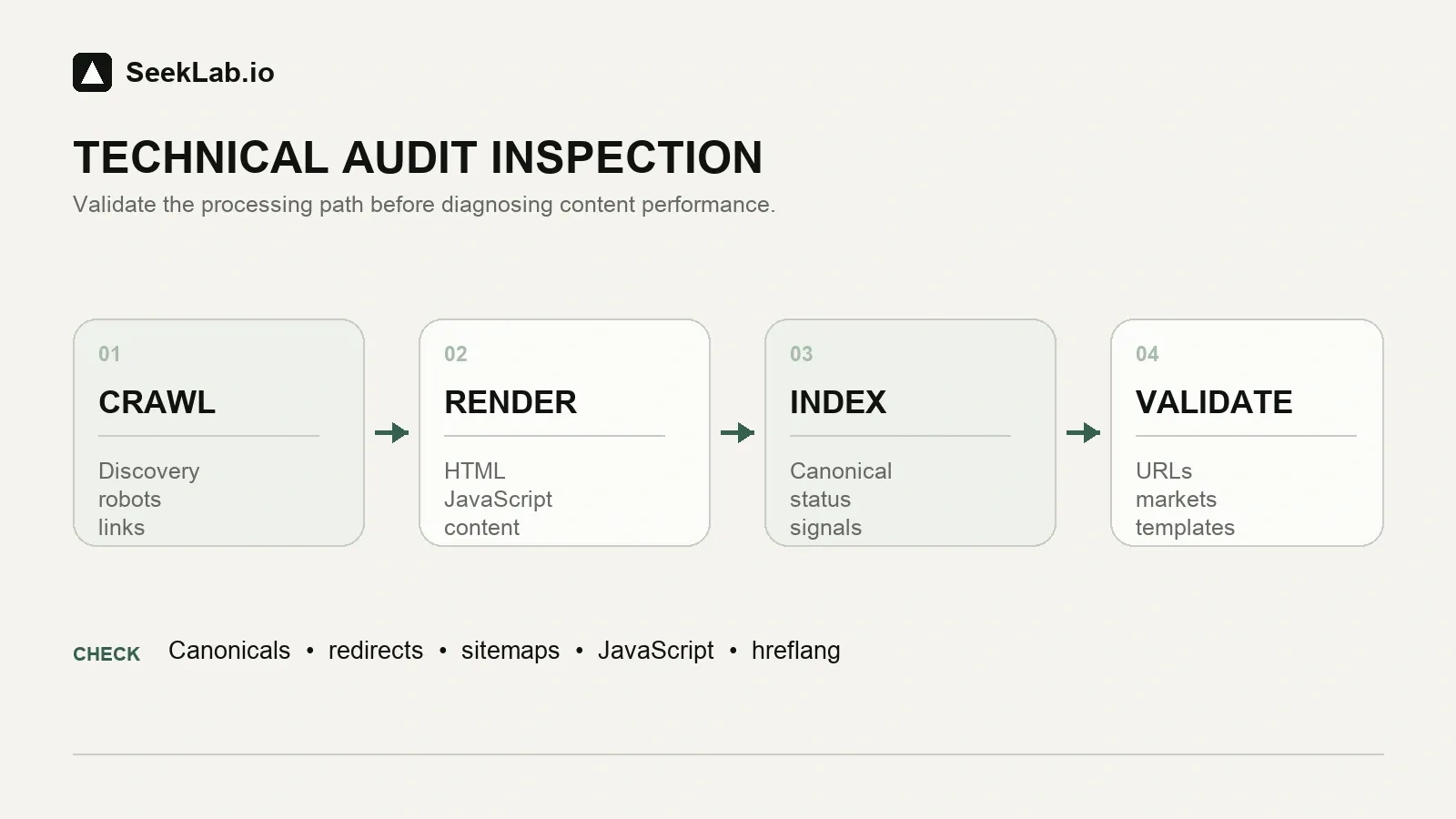
The following SEO audit comparison shows where the two models overlap and where they differ. The labels matter less than the scope, evidence, priorities, and implementation plan behind the work.
| Audit area | Technical SEO Audit | Search & AI Audit | Why it matters commercially |
|---|---|---|---|
| Crawlability and indexability | Primary | Included as a prerequisite | A page that cannot be found or indexed cannot reliably generate organic demand. |
| Redirects, canonicals, robots, and sitemaps | Primary | Included for strategic pages | Conflicting signals may cause the wrong URL to be selected or important pages to disappear. |
| JavaScript rendering | Primary | Included where rendered content affects understanding | Product copy, internal links, and metadata can fail after client-side rendering. |
| Core Web Vitals and mobile performance | Primary | Reviewed against priority page journeys | A slow enquiry page deserves more attention than a low-traffic archive page. |
| International architecture | Primary | Expanded to localisation and market intent | Correct hreflang cannot compensate for irrelevant translated copy. |
| Internal linking | Technical discovery focus | Topic, commercial, and conversion-path focus | Relevant links help systems and users move from learning to evaluation. |
| Search intent | Limited | Primary | A technically perfect page can still solve the wrong problem. |
| Topic selection and content overlap | Limited | Primary | More articles can dilute effort when the topic strategy is weak. |
| Service and product clarity | Limited | Primary | Buyers need specifics, not broad marketing language. |
| Structured data | Validation and technical compliance | Validation plus semantic fit | Markup should describe visible content accurately, not act as a speculative signal. |
| Answer structure and extractability | Limited | Primary | Clear definitions, tables, and evidence reduce ambiguity for readers and systems. |
| Trust, proof, and enquiry paths | Usually outside narrow scope | Primary | Qualified visitors may leave if the next step is unclear or credibility is thin. |
A technical review is strongest when a site has an access or processing problem. An exporter may have hundreds of product URLs, but only a small percentage may be indexable because category parameters, canonicals, and sitemap entries conflict. That is not a content-production problem.
A Search & AI Audit is stronger where content exists but does not support decision-making. A service page may claim "global solutions" without identifying industries served, delivery regions, project scope, proof, onboarding, or contact expectations. It can rank for broad queries and still fail to create qualified conversations.
The overlap should not be ignored. Internal linking, international structure, structured data, and site architecture sit between technical correctness and user understanding. A good audit checks both the mechanics and the meaning of those elements.
For large inventories and repeated template faults, SeekLab.io's guide to template-level technical checks provides additional context on how one implementation issue can affect many URLs.
Which audit should you start with?
Start with a technical SEO audit when one or more of these conditions is true:
- Important product, service, solution, or location pages are missing from search.
- A redesign, migration, CMS replacement, or domain move is planned or recently completed.
- The site uses heavy JavaScript, client-side routing, lazy loading, or complex faceted navigation.
- Priority pages have noindex directives, incorrect canonicals, recurring errors, or redirect chains.
- Language targeting, internal navigation, or XML sitemaps appear unreliable.
- Search visibility declined after a technical release rather than after a content or market change.
Start with a Search & AI Audit when these symptoms are more familiar:
- Organic traffic is stable or rising, but qualified enquiries are weak.
- Articles gain little traction, overlap, or fail to connect with commercial pages.
- Service pages are generic, thin, or difficult to compare.
- New regional content feels mechanically translated rather than locally useful.
- Buyers cannot quickly identify the offer, evidence, constraints, delivery model, or next step.
Use a combined audit when technical and strategic symptoms overlap, which is common on multilingual sites and sites with years of accumulated content. If technical blockers could invalidate later work, validate access, rendering, indexation, priority URLs, and language architecture first. Then decide what to consolidate, rewrite, link, or retire.
| Website situation | Best starting point | First action |
|---|---|---|
| New site with limited indexation | Technical SEO audit | Validate priority URLs, robots rules, canonicals, sitemaps, links, and rendering. |
| Traffic without enquiries | Search & AI Audit | Review intent, page clarity, proof, internal routes, and enquiry friction. |
| Multilingual exporter website | Combined audit | Check hreflang and canonicals alongside local intent and commercial content. |
| JavaScript-heavy site | Technical SEO audit | Compare source HTML with rendered output on important templates. |
| Frequent publishing with no traction | Search & AI Audit | Consolidate overlap and rebuild topic-to-commercial-page pathways. |
| Migration or redesign | Combined, phased technical-first | Protect legacy URLs, content value, internal links, and conversion routes. |
| Hundreds of automated warnings | Focused technical triage | Validate strategic impact before assigning development work. |
For multilingual websites, technical targeting and local buyer expectations must be reviewed together. Google's international site guidance covers locale-adaptive limitations; SeekLab.io's multilingual SEO architecture guide explains the operational approach.
Free audit or full Search & AI Audit?
| Need | Best starting point |
|---|---|
| Quick automated technical baseline | Free Technical SEO Audit |
| Known crawl, indexation, or rendering problem | Technical SEO Audit |
| Technical, content, search, and AI-visibility diagnosis | Search & AI Audit |
The Free Technical SEO Audit is an automated baseline: three free reports, no signup, and roughly 30 checks across nine categories, usually completed in minutes. It helps identify technical warning signs but does not replace strategic review.
The Search & AI Audit is human-reviewed and broader. It connects technical evidence with content quality, site structure, search intent, AI-search readiness, international needs, and commercial priorities.
What to fix now and what can wait
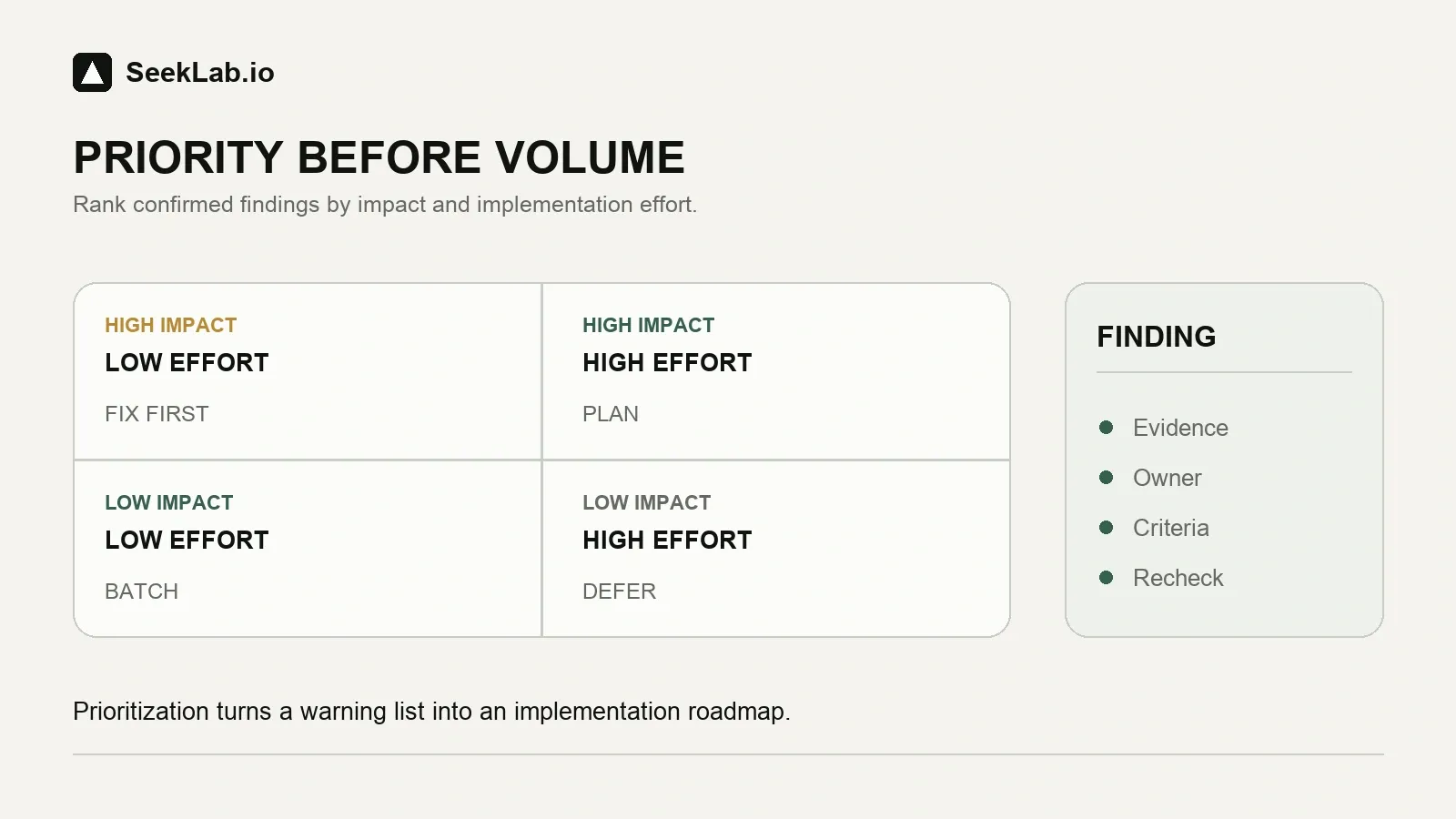
The most expensive audit mistake is treating every warning as equally important. A report with 500 alerts can look rigorous while leaving the real constraint untouched.
Prioritise technical issues when they affect important templates, revenue-relevant pages, or core markets:
- Blocked, noindexed, or inaccessible priority URLs.
- Broken enquiry forms, quote-request routes, or contact interactions.
- Incorrect canonical tags, redirect loops, and persistent server errors.
- Missing rendered content, links, canonicals, or structured data.
- Sitemap, hreflang, locale-routing, mobile, or performance defects affecting high-value pages.
Prioritise Search & AI issues when pages are technically available but commercially weak:
- Unclear product, service, category, or company definitions.
- Pages that target the wrong search intent or wrong decision stage.
- Multiple articles competing for the same topic without a distinct purpose.
- Educational content that does not lead readers to relevant comparison, service, or enquiry pages.
- Missing specifications, proof, internal links, or market-specific details.
- Localised pages or contact paths that lose relevance or create friction.
Several common warnings can usually wait until higher-impact constraints are resolved:
- Isolated title-length alerts.
- A generic "SEO score" that has no connection to strategic pages.
- Minor heading-order or decorative alt-text gaps with no usability consequence.
- Schema additions that do not match visible content.
- Mass meta description edits before indexation, page purpose, or content overlap is addressed.
Schema is a good example of a useful but frequently misprioritised task. Accurate structured data can help search systems understand a page and may make it eligible for supported enhanced features. It does not guarantee ranking, rich results, supporting links, citations, traffic, or enquiries. Google's structured data documentation is explicit that eligibility is not a guarantee of display.
A practical finding should include evidence, affected URLs, likely root cause, business impact, implementation owner, dependencies, acceptance criteria, and a post-release validation method. Without those details, a task list is only a backlog.
How to measure the outcome
Measure a technical SEO audit through validated improvements to the conditions it was designed to repair. Do not measure it only through a single ranking movement in the week after deployment.
Useful technical indicators include:
- Number and share of priority URLs that are crawlable, indexable, and correctly canonicalised.
- Resolution of confirmed 4xx, 5xx, redirect, rendering, sitemap, and hreflang issues.
- Coverage of crawlable internal links to important service, product, and location pages.
- Stable mobile rendering and usable key interactions.
- Improved performance on high-value templates where real users were affected.
Measure a Search & AI Audit through page usefulness and commercial relevance, not only impressions:
- Organic entrances to strategically relevant landing pages.
- Visibility for queries that align with the actual offer and target market.
- Reduced overlap between pages targeting the same intent.
- Movement from informational pages to relevant commercial pages.
- Engagement with comparisons, specification tables, proof, FAQs, and contact routes.
- Qualified enquiry volume, lead quality, and sales feedback.
- Consistency of business information across language and market versions.
Answer-driven search monitoring needs restraint. Track notable appearances, referrals, query themes, and page types over time where data is available. Individual mentions are not guaranteed or repeatable; results can vary by query, location, language, freshness, account context, and product changes.
SeekLab.io helps international brands improve search visibility and AI-era discoverability by connecting technical readiness, content clarity, page architecture, internal linking, and conversion potential. The goal is to identify the real constraint before budget is committed to large content programmes or development backlogs.
For a deeper view of how answer-driven search environments differ, see how major answer experiences vary.
Need a fast technical baseline? Run the Free Technical SEO Audit. If the problem spans technical SEO, content, search intent, international structure, AI visibility, and conversion, review the Search & AI Audit. For an ongoing international programme, explore SeekLab's SEO + GEO support.