What Does an SEO Score Mean? How to Read Tool Grades Without Chasing 100
Expert reviewed

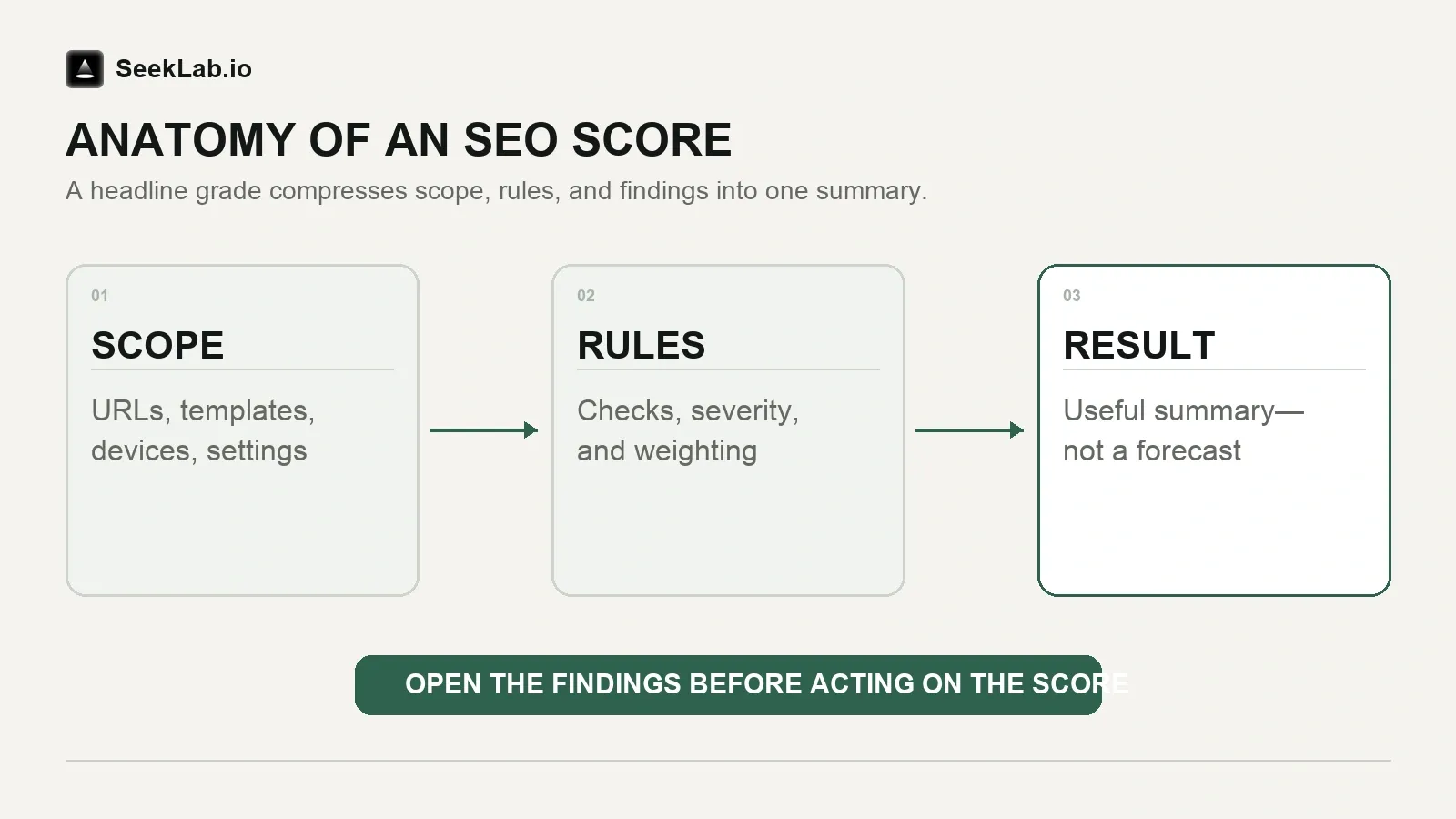
An SEO score summarizes how a page or website performs against one tool's selected checks. It is not a universal grade from Google, a prediction of rankings, or a measure of qualified inquiries. What an SEO score means in practice depends on three things: what was tested, which rules were applied, and how the results were combined.
Read the score by identifying the metric, checking its coverage, and opening the underlying findings. Then separate confirmed problems on important pages from intentional configurations and low-value warnings. That process gives you a defensible improvement plan, rather than a target number that may have little connection to growth.
What an SEO score actually measures
A score compresses findings into a convenient summary. That makes it useful for spotting changes, but it also hides detail. One commercially important page can have a serious problem while the rest of the tested website looks healthy.
For example, an accidental indexing restriction on a core service page deserves attention even if it barely changes the overall grade. Conversely, hundreds of minor warnings on archived announcements may not justify interrupting planned product-page improvements.
Different score types answer different questions
Before interpreting a number, check its exact label. These measurements answer different questions:
| Measurement | What it summarizes | What it does not establish |
|---|---|---|
| Site-wide technical health score | Selected findings across crawled URLs | Complete website coverage or commercial importance |
| Single-page SEO score | Automated checks on one tested page | Full-site health or competitive content quality |
| Content optimization score | Compliance with a vendor's editorial criteria | Industry expertise or buyer usefulness |
| Link-profile metric | Relative backlink strength under a proprietary model | Technical readiness |
| Laboratory performance score | Performance under simulated test conditions | Every visitor's actual experience |
| Field Core Web Vitals | Real-user loading, responsiveness, and visual stability | Overall SEO quality |
A homepage test cannot represent an entire multilingual catalog. A content score cannot confirm that a product page answers procurement questions. Neither becomes more comprehensive simply because its interface displays a percentage.
What counts as a good score?
There is no universal threshold. A favorable band is meaningful within the vendor's methodology, not across every platform.
Ahrefs, for example, labels Health Scores from 91 to 100 as "Excellent." That describes its calculation, not a guarantee that every valuable landing page is ready for search.
A useful operational target is more specific:
Resolve confirmed problems affecting important pages, maintain representative crawl coverage, and investigate unexplained regressions.
A remaining warning may be acceptable when its purpose, impact, and review conditions are documented. An unexplained critical finding should not be dismissed because the overall score is green.
Why Ahrefs, Semrush, and Lighthouse give different grades
Two tools can inspect the same website and produce different results without either being broken. Their scoring units, issue classifications, and tested populations differ.
| Tool and metric | Calculation approach | Interpretation caution |
|---|---|---|
| Ahrefs Site Audit Health Score | Percentage of crawled internal URLs without Error-level issues | Warnings and Notices do not reduce this score |
| Semrush Site Audit Site Health | Errors and warnings assessed relative to checks performed, with errors having greater impact | It is not simply the percentage of error-free URLs |
| Lighthouse SEO | Weighted automated audits of a tested page | A page-level pass does not establish site-wide health or ranking potential |
Ahrefs counts URLs without Errors
The documented Ahrefs calculation is:
Health Score = internal URLs without Errors / total crawled internal URLs x 100.
Its documentation illustrates ten crawled internal URLs, with Errors affecting two. Eight are error-free, producing a score of 80%.
A URL with several Errors is still one error-affected URL in that calculation. Fixing one of its problems may therefore leave the score unchanged if another Error remains. The repair can be real even when the headline number does not move.
Ahrefs also allows issue importance and checks to be configured. Record those changes before presenting a higher score as evidence of improvement.
Semrush evaluates errors and warnings against checks
Semrush includes both errors and warnings in Site Health; notices do not affect the overall score. Its documentation identifies check type, issue frequency, and other calculation factors.
Semrush does not publish a complete formula that readers can reproduce independently. Do not substitute the Ahrefs formula or assume that equivalent issue counts should produce equivalent grades.
Excluding a check also changes the calculation. A report should distinguish "we fixed this condition" from "we stopped evaluating this condition."
Lighthouse grades selected conditions on one page
Lighthouse separates its SEO category from Performance. A strong result in one does not mean the other has passed.
Its weighting also depends on version. The versioned Lighthouse configuration assigns greater weight to the crawlability/indexing audit than to individual other automated SEO audits. Older statements that all SEO checks are equally weighted should not be treated as universally current.
Passing a check can establish presence without establishing quality. Chrome's meta-description audit documentation explicitly states that it does not assess description quality. An irrelevant description can therefore pass while still needing editorial attention.
Compare conditions before comparing numbers
Record these controls:
- Exact metric, tool version where available, and test date.
- Included domains, subfolders, languages, and URL types.
- Crawl limits, exclusions, and tested URL counts.
- Rendering configuration and crawler access.
- Device settings, especially for performance testing.
- Changed checks or severity classifications.
A crawler that misses JavaScript-generated product links may examine a cleaner but incomplete population. A homepage-only report and a catalog crawl are not competing assessments of the same scope.
For broader software-selection considerations, compare website audit workflows. Here, the useful comparison is between findings and methods, not competing headline numbers.
SEO score vs rankings: Why a clean audit can still produce weak results
A proprietary audit score is not Google's ranking assessment. The underlying conditions can matter, but the vendor's numerical summary is a separate measurement.
Google distinguishes technical eligibility from actual indexing. Meeting minimum requirements does not guarantee inclusion in the index. Its ranking systems also evaluate many factors and signals beyond a crawler's checklist.
That leaves three separate questions:
- Can the page participate in search? Access, indexing directives, rendering, and other technical conditions need investigation.
- Does it deserve attention for the intended query? The content must address the user's task with relevant, useful information.
- Can that attention become a qualified inquiry? The offer, market fit, and contact journey must work.
A score may help investigate the first question. It cannot settle all three.
How scores and inquiries can move differently
Consider these hypothetical situations, not claimed client results:
| Website situation | Why a better grade may not help enough | Better next investigation |
|---|---|---|
| An exporter fixes metadata on old news posts | Product pages still omit specifications and delivery details | Review the information buyers need before contacting sales |
| A service website excludes an error-heavy directory | The tested population changes without repairing pages | Determine whether excluded pages still serve a useful purpose |
| A multilingual site passes automated checks | Visitors reach an inquiry form in the wrong language | Test each market's complete landing-to-inquiry journey |
| A product page passes description checks | Its wording does not accurately represent the offer | Review the actual page, query intent, and description |
These are reasons to broaden diagnosis, not reasons to ignore technical issues. An inaccessible product page still needs repair. The mistake is assuming that technical compliance completes the commercial work.
For the boundary between automated findings and content investigation, see when a technical scan needs broader review.
How to read SEO tool grades and assess their accuracy
SEO tool score accuracy is not one question. A tool can correctly detect a missing element while assigning it a priority that does not fit your business.
Evaluate accuracy across five dimensions:
| Dimension | Practical validation |
|---|---|
| Detection | Reproduce the finding in headers, HTML, rendered output, or browser behavior |
| Coverage | Compare tested URLs against important templates, locales, and a relevant URL inventory |
| Repeatability | Repeat the test under comparable settings and document changed conditions |
| Prioritization | Check whether the recommendation reflects page value, reach, effort, and risk |
| Prediction | Ask for evidence before accepting claims that score changes predict rankings or leads |
No universal accuracy percentage meaningfully ranks these tools by their ability to predict rankings or business outcomes. Trust validated findings within a documented scope.
Turn the report into a decision record
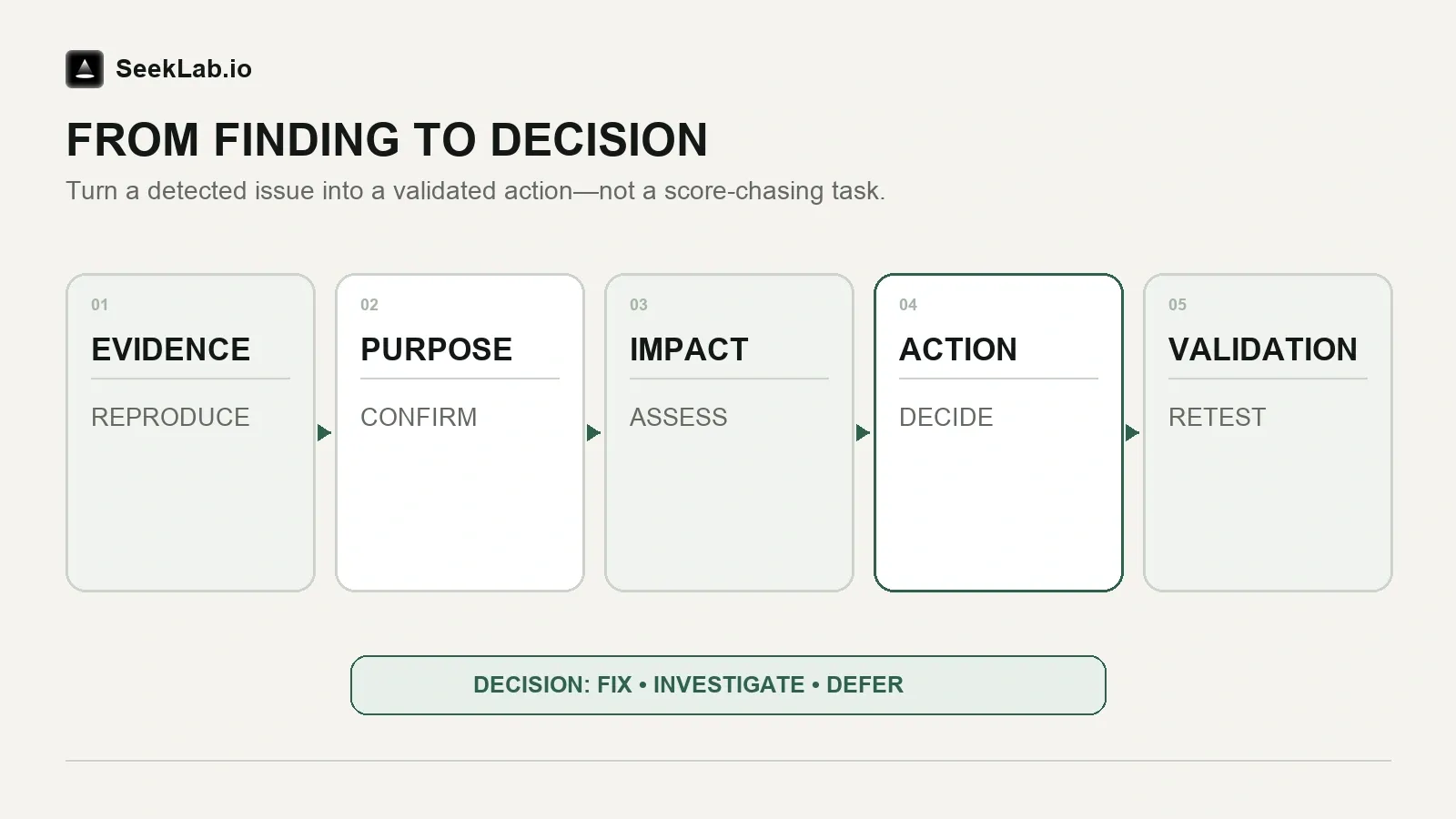
Use this sequence before assigning implementation work:
- Identify the metric. Confirm whether it measures technical health, page checks, performance, content, or links.
- Check the population. Confirm that important product, service, and market pages were actually tested.
- Group affected URLs. Separate shared template defects from isolated page problems.
- Confirm intended behavior. Should the page be indexed, redirected, consolidated, or excluded?
- Reproduce the finding. Inspect representative URLs and investigate the shared cause.
- Estimate consequences. Consider the affected journey, page importance, reach, and evidence confidence.
- Assign an action. Fix, investigate, or defer with a reason and review trigger.
- Retest consistently. Verify production behavior, not just a new dashboard color.
Grouping matters. Fifty alerts caused by one template defect may need one engineering change. Fifty unrelated content gaps may require separate editorial decisions.
A useful ticket states the finding, evidence, affected URL pattern, likely consequence, proposed fix, owner, implementation risk, and acceptance criteria. "Raise the score" is not an acceptance criterion.
For report navigation, use the audit report reading guide. For deeper implementation checks, refer to the detailed website audit checklist.
Prioritize blockers and defer defensible warnings
The right priority depends on what is broken, where it is broken, and what a safe repair requires. Vendor severity is evidence to consider, not an automatic development schedule.
| Finding | Escalate when | Deferral may be reasonable when |
|---|---|---|
| Indexing restriction | An important landing page is unintentionally excluded | Exclusion is deliberate and appropriate |
| Missing rendered content | Specifications, service information, or navigation are unavailable | No meaningful content or journey is affected |
| Incorrect canonical or redirect | An intended product or market page points somewhere inappropriate | Consolidation is deliberate and correctly implemented |
| Broken internal route | Product discovery or inquiry access fails | The obsolete route has no useful destination, after review |
| Poor performance | Field evidence and testing indicate problems on valuable journeys | The alert reflects an isolated laboratory fluctuation |
| Content or intent gap | Buyers cannot find information needed to evaluate the offer | The page has no current strategic role |
| Minor metadata warning | Wording is inaccurate or confusing | The content is accurate, readable, and has no demonstrated problem |
A multilingual canonical error affecting a valuable market can deserve more attention than many minor metadata alerts. Likewise, a broken inquiry route deserves investigation even if the scoring system does not grade it.
When to stop chasing 100 SEO score targets
Stop chasing points when the proposed change lacks a useful outcome or introduces unnecessary risk.
Do not remove an intentional noindex directive simply to pass a check. Do not dismantle correct redirects or canonical relationships because a report flags them. These mechanisms can be necessary parts of site architecture.
There are implementation details to validate. Google's guidance on indexing exclusions explains that Google must be able to crawl a page to see its noindex instruction. Blocking crawling is not an interchangeable solution. Similarly, canonicalization guidance describes signals, not an absolute command that guarantees the selected canonical.
Safe deferral needs three things:
- A documented reason the behavior is acceptable.
- Evidence that important content and journeys remain intact.
- A trigger for review, such as a migration, template change, or new market launch.
"Ignore all warnings" is no better than "fix every warning." Both replace judgment with a shortcut.
Google's page-experience guidance also cautions against pursuing perfect scores solely for SEO. That guidance specifically concerns page experience, but the budgeting lesson is relevant: fund improvements for their underlying value, not the satisfaction of a full progress bar.
Measure resolved problems, search performance, and qualified inquiries separately
After deployment, verify the repair before discussing growth. A corrected directive should be confirmed in production. A repaired form should be tested. A template change should be checked across representative pages and languages.
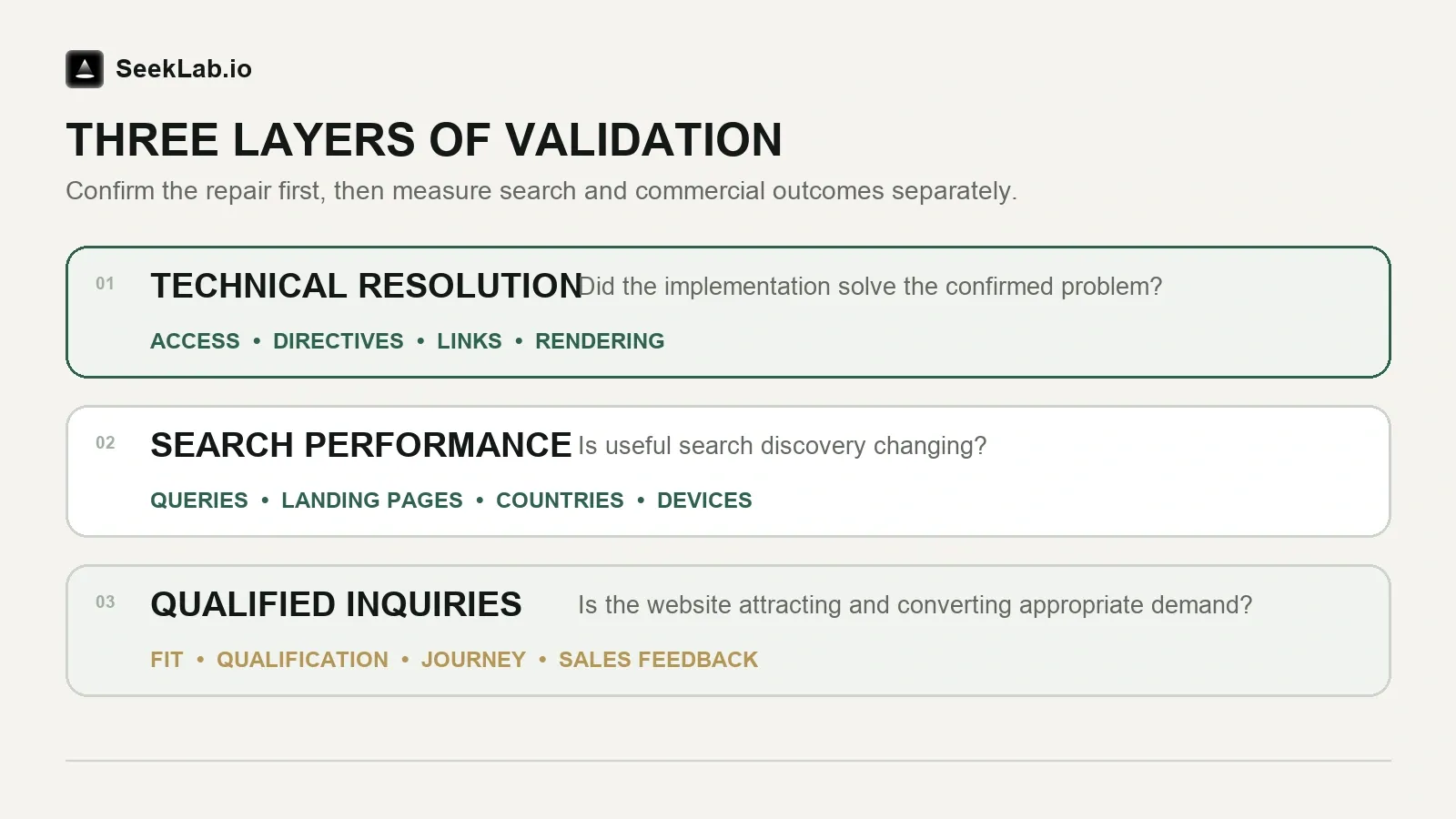
Then review three measurement layers:
| Layer | Evidence | Decision it supports |
|---|---|---|
| Technical resolution | Access, directives, rendered content, canonicals, working links, comparable crawl findings | Did the implementation solve the confirmed problem? |
| Search performance | Relevant impressions, clicks, landing pages, query groups, countries, and devices | Is useful search discovery changing? |
| Commercial performance | Qualified inquiries, qualification rate, product fit, market fit, and sales feedback | Is the website attracting and converting appropriate demand? |
Keep deployment dates, crawl-scope changes, tracking changes, and seasonal conditions beside the results. A higher score and rising traffic after a redesign do not isolate which change caused the improvement.
Performance measurements also need patience. PageSpeed Insights documentation distinguishes laboratory tests from real-user field data, which uses a trailing 28-day collection period. Field results are not an immediate release test.
Choose the right level of audit
The SeekLab free audit is a quick automated diagnostic baseline. It provides three free reports without signup, completes in minutes, and checks roughly 30 items across nine categories. Use it to identify initial technical and on-page findings, then judge the individual findings rather than treating the headline score as the objective.
That baseline is not equivalent to a full crawler or SEO suite. Dedicated tools are better suited to recurring, large-scale crawling, monitoring, and technical data collection. When the problem needs root-cause diagnosis, business context, and prioritization across technical SEO, content, search, and AI visibility, a human-reviewed Search & AI Audit is the more appropriate next step.
- Need a quick automated baseline? Run the SeekLab free audit.
- Need recurring large-scale crawling or monitoring? Use a dedicated crawler or SEO suite.
- Need root-cause diagnosis and prioritization? Use an expert Search & AI Audit.
- Need broader implementation across organic and AI search? Review SeekLab's SEO + GEO services.
The useful target is not a perfect score. It is a verified improvement on a page or journey that matters.