How to get cited by AI: answer the question in your first sentence
Expert reviewed

To get cited by AI, answer the user's question clearly in the first sentence, then support it with context, proof, and a structured explanation.
If you searched for "AI citation first sentence answer," you are likely trying to improve the chance that your content is selected, summarized, or cited by AI-powered search and answer systems. This article gives you a practical way to do that: write direct first-sentence answers, structure each section as a standalone answer unit, support claims with reliable evidence, and make sure the page can be crawled, indexed, parsed, and trusted.
The useful pattern is simple but easy to execute poorly: answer the question in your first sentence, add a qualifier, prove the claim, then expand with examples, tables, internal links, visuals, and technical SEO checks. No one can guarantee that Google, Bing, Perplexity, Microsoft Copilot, or any other answer system will cite a page. But you can improve citation readiness by making the page easier for search engines, AI systems, and real buyers to understand.
Why the AI citation first sentence answer matters
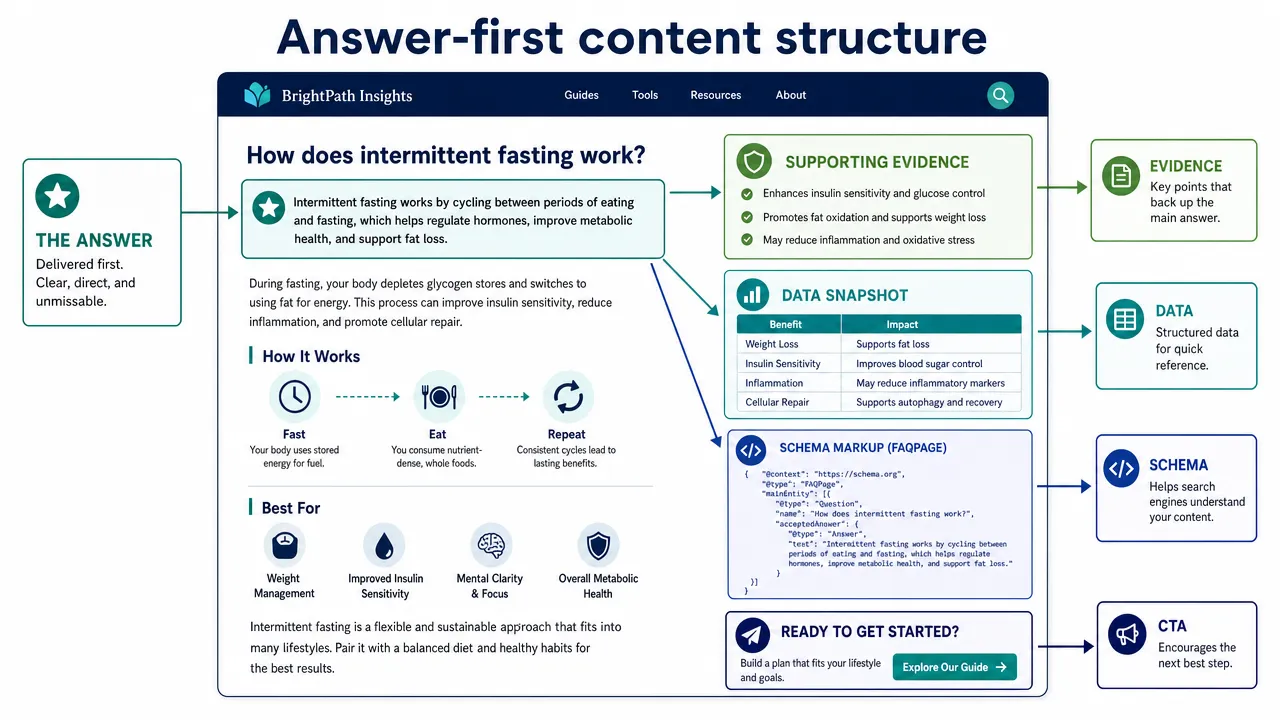
The AI citation first sentence answer matters because it turns the most important claim on the page into a clear, extractable answer unit before the reader or system has to work for it. A marketing manager looking for a practical AI citation strategy does not want three paragraphs of vague setup before finding the action: say the answer first, then prove it.
This is not a new writing gimmick. Nielsen Norman Group's guidance on the inverted pyramid for web writing recommends starting with the most important information, using descriptive headings, keeping paragraphs short, and making the first sentence of each paragraph the most important. That same principle fits direct answer writing because both readers and retrieval systems benefit from clear information hierarchy.
A weak opening usually sounds like this: "AI search is changing how people find information online." It is not wrong, but it does not answer anything. A stronger opening says: "To get cited by AI, write direct, source-backed answers that are crawlable, extractable, and useful at the passage level." The second version gives the user a usable answer immediately and tells the system what the passage is about.
For independent websites, official company sites, exporter websites, and multilingual websites, this detail has commercial consequences. Buyers often search in question form: "What does a technical SEO audit include?", "How do I choose an injection molding supplier?", or "Should we translate every blog post?" A page that answers first can serve the buyer faster. A page that opens with polished but generic positioning can lose the buyer before the useful information appears.
The first sentence should not overpromise. "This guarantees AI citations" is not credible. A safer and more useful sentence is: "A direct first-sentence answer can improve citation readiness by making the passage clearer, more relevant, and easier to extract, but citation selection still depends on the platform and the page's overall quality."
| Opening pattern | Example | Practical issue |
|---|---|---|
| Vague trend opening | "AI search is changing content marketing." | No clear answer, no operational value. |
| Sales-first opening | "Our company provides professional SEO solutions." | Buyer does not learn what the page actually explains. |
| Direct answer opening | "To get cited by AI, answer the user's question clearly in the first sentence." | Useful, but still needs proof and context. |
| Best answer-first opening | "To get cited by AI, answer the user's question clearly in the first sentence, then support it with context, proof, and a structured explanation." | Clear answer, realistic scope, and a preview of the method. |
How the AI citation first sentence answer fits AI search systems
The AI citation first sentence answer fits AI search systems because many AI-powered search experiences retrieve, compare, and summarize content from multiple sources rather than simply repeating one blue-link result. Google says AI Overviews and AI Mode may use query fan-out, issuing related searches across subtopics and sources before generating a response, according to its documentation on AI features and your website.
That does not mean a first sentence alone wins the citation. Google's documented baseline for supporting links in AI Overviews and AI Mode is still technical eligibility: the page must be indexed, eligible to appear in Search with a snippet, crawlable, internally findable, and supported by visible textual content. If your strongest answer is hidden in a PDF, buried behind JavaScript issues, or located on an orphan page, direct answer writing will not fix the retrieval problem by itself.
Bing has also moved toward generative search experiences. In its announcement of Bing generative search, Microsoft describes a system that combines Bing's search results with large and small language models, reviews sources, matches content, and generates an answer layout. The practical implication is straightforward: content for AI answers has to be both understandable as a passage and accessible as a web page.
Industry studies show why page position alone is not the whole story. Ahrefs found that 37.9 percent of URLs cited in Google AI Overviews also appeared in the top 10 organic result blocks, while other cited URLs came from positions 11 to 100 or outside the top 100 for the original query, based on its AI Overview citation overlap study. CXL also reported directional evidence that many citations in its sample came from the upper portion of cited pages in its analysis of where Google AI Overviews cite from. These are not fixed platform rules, but they support a practical habit: put the answer where it can be found quickly.
The takeaway for AI search visibility is not "write shorter content." The real opportunity is to make the useful answer visible early, then build enough depth around it for humans and systems to trust it. A thin answer with no proof is weak. A direct answer followed by definitions, examples, citations, schema, internal links, and a clear next step is much stronger.
How to write the AI citation first sentence answer
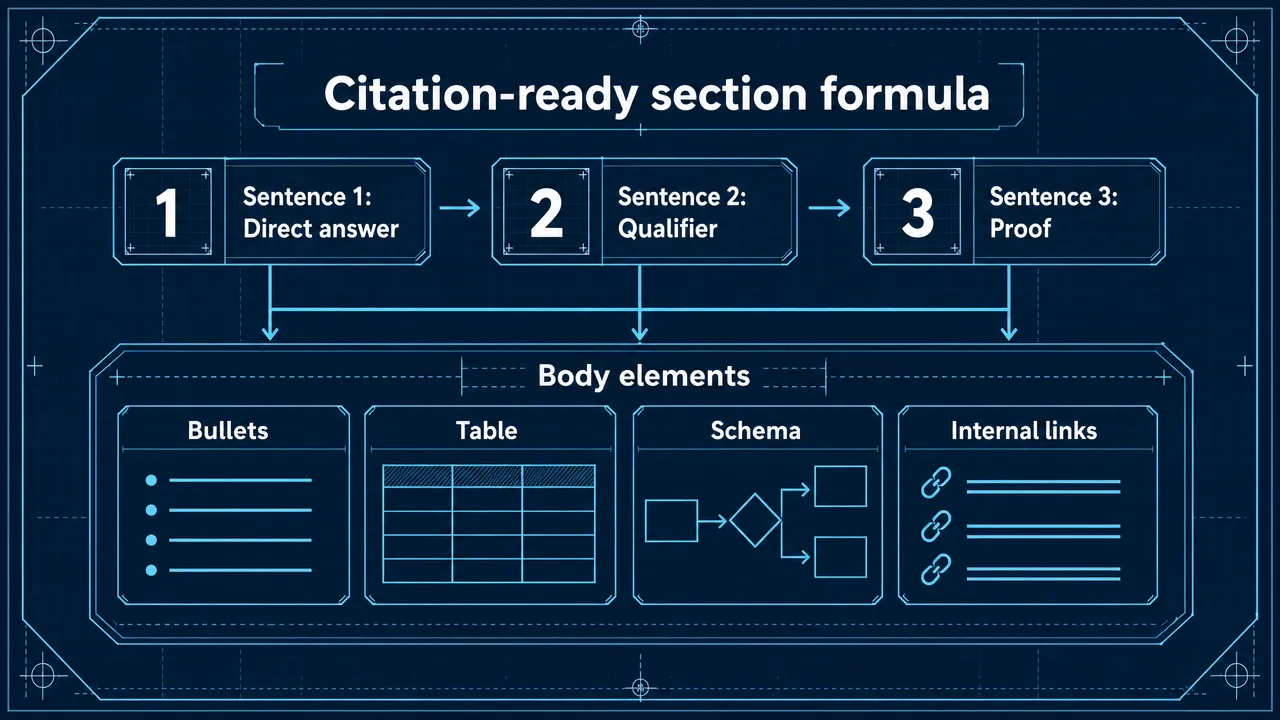
The AI citation first sentence answer should use a four-part structure: direct answer, key condition, proof, and structured expansion. This works for blog posts, service pages, product category pages, FAQ sections, comparison articles, and technical explainers.
Sentence 1: Answer the question directly
The first sentence should answer the exact question in natural language. If the query is "How do I get cited by AI?", the first sentence should not start with market commentary. It should say what to do.
Weak: "Many companies are now thinking about AI search."
Better: "To get cited by AI, write direct, source-backed answers that are crawlable, extractable, and useful at the passage level."
For direct answer writing, avoid clever intros. A clever sentence may sound polished to a brand team, but it often creates friction for buyers and systems. If a section is about JavaScript SEO, define JavaScript SEO first. If a section is about schema, say what schema does and what it cannot do.
Sentence 2: Add the condition
The second sentence should add the main limitation or condition. This protects the page from overclaiming and gives the answer commercial realism.
Example: "This improves citation readiness, but it does not guarantee a citation because each platform uses its own retrieval and source-selection behavior."
This matters for B2B and exporter websites because buyers often compare options under constraints. The right answer may depend on material, region, regulation, lead time, technical stack, budget, or language market. A first sentence that ignores conditions can sound confident but unhelpful.
Sentence 3: Add proof
The third sentence should support the claim with an official source, standard, data point, or concrete example. For AI citation strategy, official documentation is often safer than speculative commentary. Google says site owners do not need special AI-specific markup or files to appear in generative search features in its AI optimization guide, which reinforces the point that fundamentals still matter.
For a technical SEO audit page, proof might be a list of checked systems: crawlability, indexability, rendering, Core Web Vitals, internal links, schema, canonicals, sitemap.xml, robots.txt, and hreflang. For a manufacturer page, proof might be a tolerance table, inspection process, certificate explanation, or material comparison.
Body: Make the answer extractable and useful
After the first three sentences, the section should expand in a way that helps both readers and systems. Use headings for intent, bullets for criteria, tables for comparison, images for process clarity, and internal links for related expertise.
SeekLab.io builds this pattern into planning, not only editing. For teams producing many articles, an SEO content brief for scalable production can define the exact first-sentence answer, required evidence, internal links, schema notes, visuals, and conversion path before drafting starts. That prevents writers from producing polished content that answers the wrong question.
| Page type | User question | Strong first sentence | What to add next |
|---|---|---|---|
| Blog article | How do I get cited by AI? | "To get cited by AI, answer the user's question clearly in the first sentence, then support the answer with evidence and structured detail." | Sources, examples, checklist, technical checks. |
| FAQ page | Can schema guarantee AI citations? | "Schema cannot guarantee AI citations, but it can help search systems understand page entities and content type when it matches visible content." | Google structured data guidance, visible FAQ content, validation notes. |
| Service page | What does a technical SEO audit include? | "A technical SEO audit reviews crawlability, indexability, rendering, Core Web Vitals, internal links, schema, canonicals, and site architecture to find issues blocking organic growth." | Deliverables, prioritization logic, audit CTA. |
| Exporter page | How do I choose an injection molding supplier? | "Choose an injection molding supplier by comparing tooling capability, material experience, quality inspection, lead time, export documentation, and communication reliability." | Supplier checklist, tolerances, certificates, RFQ path. |
| Multilingual site | Should we translate every blog post? | "You should not translate every blog post; translate or recreate pages that support revenue, local search intent, and buyer needs in each target market." | Market selection, hreflang, localization examples. |
Technical SEO behind the AI citation first sentence answer
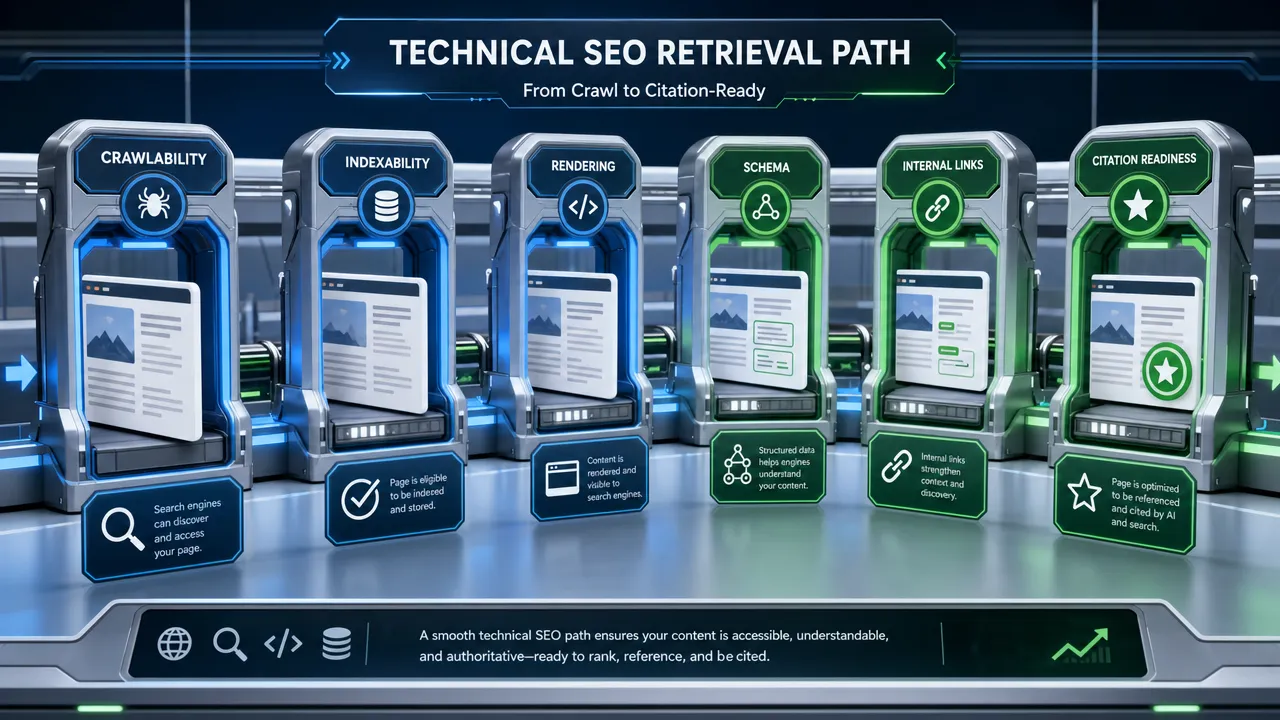
The AI citation first sentence answer only helps if the page can be crawled, indexed, rendered, understood, and connected to the rest of the site. A brilliant answer on a blocked page is like a locked showroom: the product may be good, but buyers and crawlers cannot enter.
Google's AI feature documentation states that pages need to meet Search technical requirements and be eligible for snippets to appear as supporting links in AI Overviews or AI Mode. That makes SEO fundamentals part of AI-friendly content. You are not optimizing only for wording. You are optimizing the whole page environment around the answer.
The technical checks that matter most are often basic, but they are also where weak websites fail. A page may be noindexed by accident after staging. A canonical tag may point to an older URL. Important answer text may appear only after a delayed script. A multilingual page may lack hreflang annotations, sending US, APAC, and European buyers to the wrong version. These issues do not look exciting in a content calendar, but they can quietly limit discoverability.
For a practical audit process, SeekLab.io's SEO audit checklist for technical and content readiness is a useful companion because it covers crawlability, indexation, Core Web Vitals, internal linking, schema, JavaScript SEO, international SEO, and prioritization. The point is not to fix every warning. The point is to identify which problems actually affect growth and which can be deprioritized.
| Technical factor | Why it affects citation readiness | What to check |
|---|---|---|
| Crawlability | If bots cannot access the page, the answer cannot be retrieved from that page. | robots.txt, server rules, blocked resources. |
| Indexability | AI search support in Google depends on Search eligibility and snippet eligibility. | noindex, canonical, indexing status, snippet controls. |
| JavaScript rendering | Important content may be delayed, hidden, or missing in rendered output. | Rendered HTML, visible links, client-side content. |
| Internal links | Orphan pages are harder for crawlers and users to discover. | Hub links, breadcrumbs, related articles, service links. |
| Schema | Structured data can clarify entities and page type when it matches visible content. | Article, Organization, BreadcrumbList, valid FAQ where appropriate. |
| Core Web Vitals | Slow or unstable pages hurt users and may reduce page experience. | LCP, INP, CLS, mobile performance. |
| Multilingual setup | Wrong language or region signals can weaken international discoverability. | hreflang, canonicals, localized content, market-specific terminology. |
| Freshness | Stale claims reduce trust, especially for fast-changing topics. | Updated examples, source review, visible update date. |
Schema deserves a specific warning. It can help clarify meaning, but it cannot compensate for vague visible content. Google's structured data introduction says structured data helps Google understand content and enables rich result eligibility, but markup should match what users can see. If you want a deeper implementation path, SeekLab.io's entity SEO and schema roadmap explains how entities, JSON-LD, Organization schema, and internal linking should work together.
International websites need another layer of care. A translated page that keeps the English intro, ignores local search terms, and uses the wrong units can still be technically valid but commercially weak. SeekLab.io's guide to multilingual SEO strategy for international websites is relevant for brands operating across APAC, the United States, Europe, and cross-border markets because localization affects both search interpretation and buyer trust.
Checklist: optimize for AI citations with an AI citation first sentence answer
To optimize for AI citations with an AI citation first sentence answer, review each priority page as both a content asset and a retrieval asset. Do not start by rewriting everything. Start with pages that already map to buyer questions, revenue paths, or high-potential search topics.
Use this checklist on service pages, blog articles, product category pages, technical explainers, comparison posts, and multilingual landing pages.
| Checklist area | Pass condition | Common failure |
|---|---|---|
| Query ownership | The page answers one clear user question or decision need. | The page targets a keyword but never decides what answer it should own. |
| First sentence | The introduction answers the main question immediately. | The page opens with brand claims or broad trend commentary. |
| Section openings | Major H2 and H3 sections begin with direct answers. | Useful answers are buried halfway through the section. |
| Qualifier | The answer includes the key condition, limitation, or use case. | The content sounds absolute and overpromised. |
| Evidence | Claims are backed by official sources, data, standards, or examples. | The page uses generic claims like "best solution" without proof. |
| Extractability | Bullets, tables, definitions, and short paragraphs make the passage easy to parse. | Long walls of text hide the useful answer. |
| Technical access | The page is crawlable, indexable, renderable, and internally linked. | The page is blocked, orphaned, noindexed, or script-dependent. |
| Entity clarity | Brand, author, service, location, and topic signals are consistent. | The page has inconsistent naming, missing organization details, or unclear authorship. |
| Schema | Markup matches visible content and validates correctly. | Schema is added mechanically or marks up hidden content. |
| Conversion path | The user has a relevant next step after getting the answer. | The page gets traffic but leaves buyers without a clear action. |
| Freshness | Time-sensitive claims are reviewed and updated. | Old screenshots, outdated platform claims, or stale examples reduce trust. |
A practical warning: do not turn every paragraph into a repeated keyword block. The phrase "AI citation first sentence answer" belongs in the article's structure, but real buyers do not want mechanical repetition. They want clear answers, credible proof, and guidance that helps them make a decision.
Another warning: do not separate SEO content from technical SEO. A content team may rewrite 30 articles while the site's canonical tags, JavaScript rendering, and internal links remain broken. A developer may improve speed while the pages still open with empty claims. AI-friendly content needs both sides working together.
For teams studying answer-engine behavior beyond Google, SeekLab.io's article on how to get your website cited by Perplexity AI explains a useful two-gate idea: first, the page must be eligible for retrieval; second, the content must be useful enough to support a generated answer. The same distinction helps avoid wasted effort on content polish when access problems remain unresolved.
How SeekLab.io applies the AI citation first sentence answer to real websites
SeekLab.io applies the AI citation first sentence answer by treating citation readiness as a combined content, technical SEO, and business prioritization problem. The goal is not to produce more pages for the sake of volume. The goal is to decide which pages should become trusted answer sources, then make those pages clearer, more accessible, and more useful for buyers.
SeekLab.io helps brands build search visibility and AI-era discoverability through high-quality content production and technical optimization. In practice, that means improving content structure, information clarity, page architecture, internal linking, schema, multilingual setup, and overall site readiness so search engines, AI systems, and real users can understand the website faster.
This work is especially relevant for independent websites, official company websites, exporter websites, and multilingual business sites. These teams often face practical problems: SEO services that overpromise, articles that feel generic, visuals that do not support the content, traffic that does not turn into inquiries, and technical issues that are hard to diagnose internally. A first-sentence answer is useful, but it should be part of a wider system that includes topic selection, technical validation, high-quality visuals, internal links, JSON-LD, and conversion planning.
SeekLab.io's approach starts before writing or fixing. The first question is strategic: which topics, pages, and technical problems are actually worth acting on? Some simple technical issues can be resolved for clients free of charge, while larger recommendations are prioritized by growth impact. The team does not aim to fix everything at once. It focuses on what truly affects visibility, credibility, and conversion potential, while deprioritizing low-impact work.
For content, SeekLab.io identifies trending search topics and high-potential content themes based on user intent, buyer scenarios, brand knowledge, and industry context. That is how brands avoid heading in the wrong direction. The team creates in-depth articles with structured layouts, headings, meta tags, images, tables, internal links, and JSON-LD requirements, balancing search rankings with user conversion.
For technical SEO, SeekLab.io reviews full-site crawling, Core Web Vitals, page performance, indexing, crawling, rendering, JavaScript compatibility, internal link equity, semantic structure, schema compliance, sitemap.xml, robots.txt, and website tech stack issues. It also supports multilingual site architecture for brands targeting APAC, the United States, Europe, and cross-border markets, with teams and legal entities in Singapore and a BD team based in Dubai.
If your team wants to improve AI search visibility without chasing unsupported shortcuts, start with a focused review of your priority pages. Check whether they answer the question in the first sentence, whether the answer is supported by proof, whether the page is technically retrievable, and whether the reader has a realistic next step. If you want an outside view, you can get a free audit report from SeekLab.io or contact us to discuss which pages should become your strongest answer sources.