How to get cited by AI: answer the question in your first sentence
Expert reviewed

To get cited by AI, answer the user’s question early, then support the answer with evidence, context, clear structure and a page that can actually be retrieved. Answer-first content can improve passage-level clarity and citation readiness, but no platform documents the first sentence as a guaranteed citation factor.
The practical method is straightforward: give the direct answer, state the main condition, provide proof and expand in the format that best helps the user. That format might be an article, but it could also be a comparison table, checklist, calculator, technical document, service page or interactive tool.
Why Answer-First Content Helps AI Citation Readiness
Answer-first content reduces the work required to understand a passage. A reader can see the main point immediately, while a retrieval system gets a clearer statement to evaluate alongside the rest of the page.
This is not a special AI-writing trick. Nielsen Norman Group’s guidance on the inverted pyramid for web writing recommends leading with the most important information, using descriptive headings and making opening sentences carry real meaning. The same discipline is useful for AI search because it improves information hierarchy without sacrificing depth.
Compare these openings:
| Opening pattern | Example | Practical issue |
|---|---|---|
| Vague trend opening | “AI search is changing content marketing.” | It provides context but no answer. |
| Sales-first opening | “Our company provides professional SEO solutions.” | It asks for trust before giving the reader anything useful. |
| Direct answer | “To get cited by AI, publish clear, source-backed answers on pages that search systems can retrieve.” | It answers the question, but still needs conditions and proof. |
| Answer first, then prove it | “To get cited by AI, answer the question early, state the main limitation and support the answer with evidence and structured detail.” | It gives the action, its boundaries and the structure that follows. |
The distinction matters commercially. A buyer asking what a technical SEO audit includes, how two products compare or which option fits a specific constraint is already trying to make a decision. A broad industry introduction delays that decision. A concise answer followed by useful proof moves it forward.
Answer-first writing should not become oversimplified writing. A sentence such as “Put the answer first and AI will cite you” is both unsupported and unhelpful. The stronger claim is narrower: an early, self-contained answer can make the relevant passage easier to identify and use, while citation selection still depends on retrieval, source quality, platform behavior and the strength of competing sources.
For measurement, keep citations separate from mentions and recommendations. SeekLab.io’s guide to AI citations versus brand mentions explains why those outcomes should not be collapsed into one visibility score.
How Answer-First Structure Fits AI Search
AI search systems may retrieve and compare information from several sources before generating an answer. Google says AI Overviews and AI Mode can use “query fan-out” to search across related subtopics and data sources. Its documentation on AI features and your website also states that a page must be indexed and eligible to appear in Google Search with a snippet to qualify as a supporting link.
That documentation does not name first-sentence placement as a ranking or citation factor. Google’s current guide to optimizing for generative AI features emphasizes useful content, crawlability, internal links, visible text and alignment between structured data and on-page content. In other words, the answer has to exist on a technically accessible, genuinely useful page.
There is some directional evidence for putting important passages early. CXL mapped 100 Google AI Overview citations to their source pages and reported that 55% of the cited passages appeared within the first 30% of the page in its study of where AI Overviews cite from. This small observational sample supports front-loading useful information; it does not prove that moving a sentence upward causes a citation.
The practical conclusion is not “make every page shorter.” It is “stop making readers hunt for the answer.” A short unsupported statement is weak. A direct answer followed by definitions, evidence, examples and a useful next step gives the passage enough context to stand on its own.
Different answer systems also have different retrieval and citation behavior. The two-gate model in SeekLab.io’s Perplexity citation guide is useful here: a page must first become retrievable, then contain something worth using as evidence.
How to Write Citation-Ready Answers
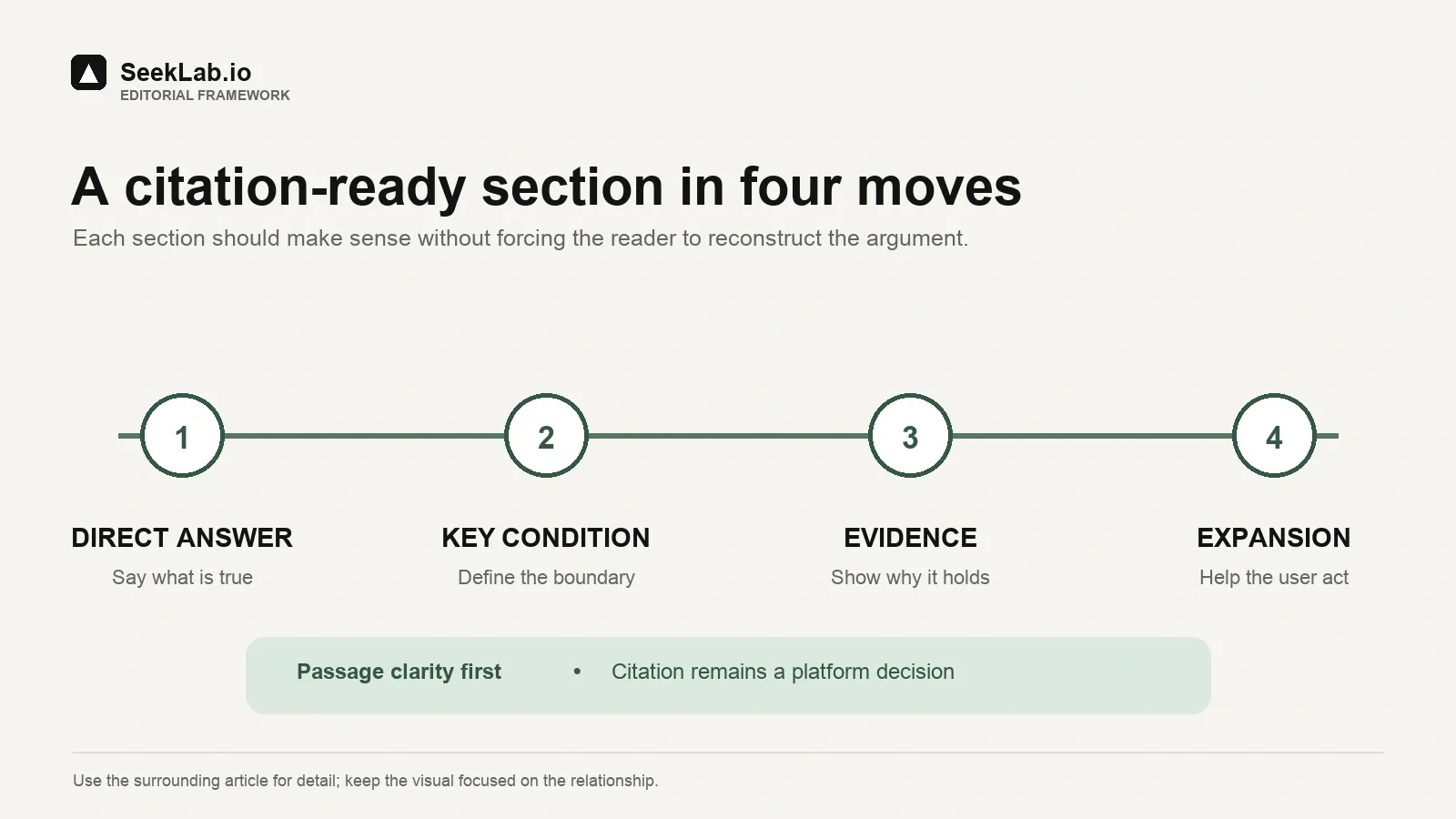
Use a four-part framework for important page openings and section introductions:
- Direct answer — answer the question in plain language.
- Key condition or limitation — state when the answer applies and where it does not.
- Supporting evidence — add an official source, data point, standard, example or verifiable product fact.
- Structured expansion — use the format that best helps the reader understand or act.
1. Give the Direct Answer
The first meaningful sentence should answer the question rather than announce the topic.
Weak: “Many companies are now thinking about AI search.”
Better: “To get cited by AI, publish direct, source-backed answers that are clear at the passage level and accessible to retrieval systems.”
The answer does not always need to be the literal first sentence on the page. A short context line may be useful for legal, medical or highly technical subjects. The real requirement is that the user should not have to scroll through a generic introduction before finding the point.
2. Add the Main Condition
The next sentence should prevent the answer from sounding absolute.
Example: “This can improve citation readiness, but it cannot guarantee inclusion because each platform controls its own retrieval and source-selection process.”
Conditions make content more useful, not less confident. A product recommendation may depend on budget or integration requirements. An international SEO decision may depend on market demand and operating capacity. A technical fix may work for one rendering architecture but not another.
3. Prove the Claim
Evidence should match the type of claim being made. Use official platform documentation for platform behavior, primary research for measured findings and first-party product documentation for capabilities.
For this article, Google’s documentation supports the importance of Search eligibility, crawlability and useful visible content. It does not support a claim that sentence position guarantees citation. The CXL study supports the practice directionally, but its sample size and observational design require a clear caveat.
On a service page, proof might be a concise list of deliverables and a sample output. On a product page, it may be specifications, compatibility limits, testing data or documentation. On a comparison page, it should be criteria applied consistently across the options.
4. Expand in the Right Format
After the answer, condition and proof, choose the structure that fits the user’s task. Use bullets for criteria, tables for comparison, diagrams for relationships and step-by-step instructions for processes. Internal links should lead to the implementation detail that would otherwise make the current section too broad.
| Page type | User question | Strong opening answer | Best supporting format |
|---|---|---|---|
| Blog article | How do I get cited by AI? | “Answer the question early, then support it with evidence, context and clear structure.” | Sources, examples and a checklist. |
| FAQ | Can schema guarantee AI citations? | “No. Schema can clarify entities and content type, but it does not guarantee citation.” | Short explanation and official documentation. |
| Service page | What does a technical SEO audit include? | “A technical SEO audit checks whether important pages can be crawled, indexed, rendered and understood correctly.” | Deliverables, sample findings and CTA. |
| Product page | Which model fits this use case? | “Choose the model that meets the required capacity, compatibility and operating constraints.” | Selector, specification table or calculator. |
| Comparison page | Which option is better? | “The better option depends on the criteria that affect the buyer’s decision.” | Side-by-side table with consistent criteria. |
| Technical documentation | How does this integration work? | “The integration sends X through Y, then returns Z.” | Diagram, prerequisites and implementation steps. |
The Best Answer Format May Not Be Another Article
Citation-ready content is a decision-support problem, not an article-production quota. If the user needs to compare specifications, build a table. If the decision depends on inputs, a calculator, checker or selector may be more useful. If the query is transactional, a well-structured product or service page may be the right owner. Technical questions often belong in documentation, while narrow recurring questions may fit a concise FAQ.
The page format should match the work the user is trying to complete. Forcing every query into a long blog post can bury the answer and create unnecessary overlap across the site.
Technical SEO Still Determines Whether the Page Can Be Retrieved
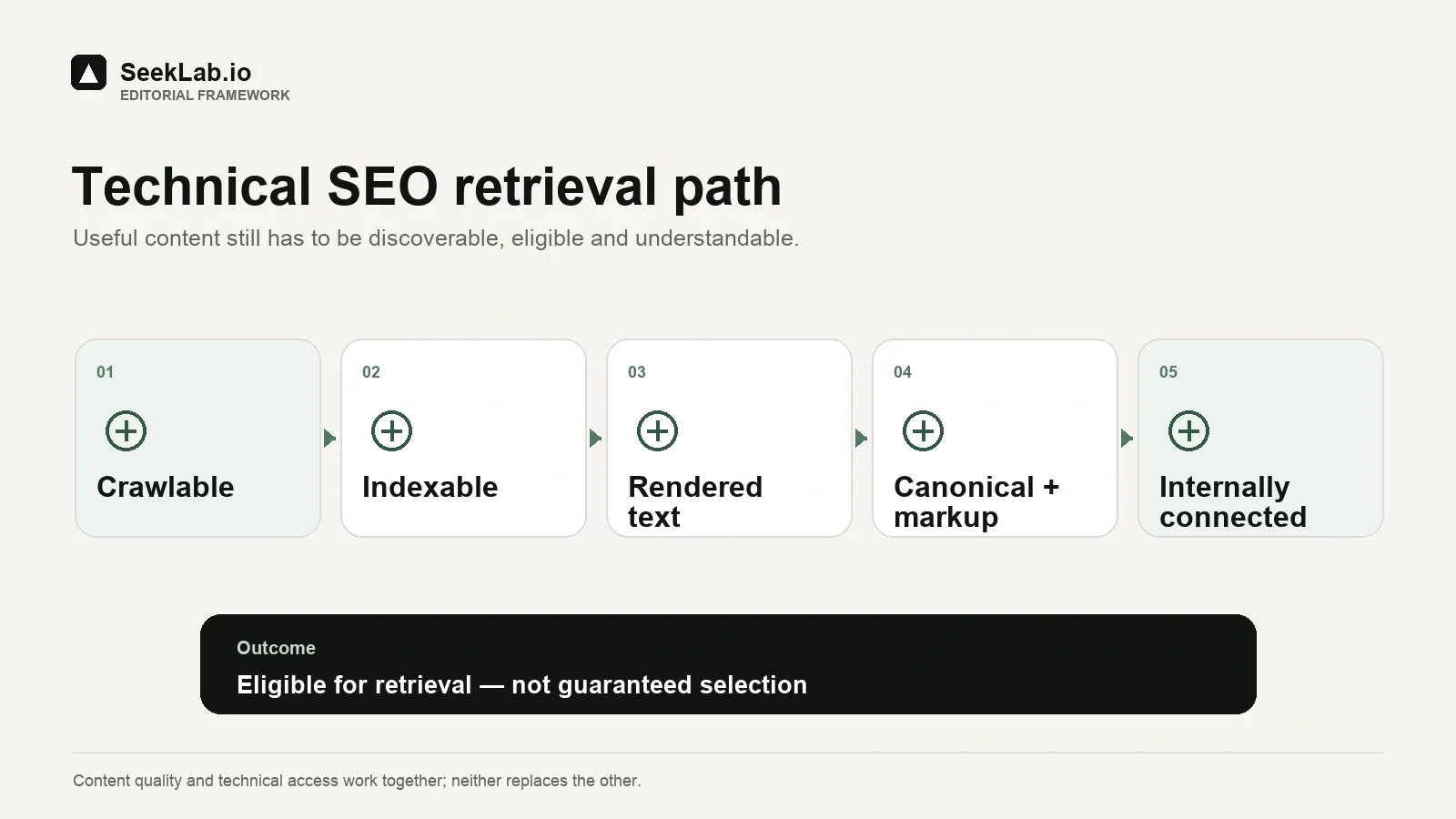
Clear writing only helps if systems can access and interpret the page. Google’s published requirements connect AI-feature eligibility to ordinary Search eligibility, so the relevant technical checks are focused rather than exotic.
| Technical factor | Citation-readiness question |
|---|---|
| Crawlability | Can crawlers reach the page and its important resources? |
| Indexability | Is the canonical page indexable and eligible for a Search snippet? |
| Rendering | Is the main answer present in rendered, visible text? |
| Internal links | Can crawlers and users discover the page from relevant hubs and related content? |
| Structured data | Does valid markup match the visible content and entities? |
| Canonical consistency | Do canonicals, sitemaps and internal links agree on the preferred URL? |
| Multilingual correctness | Do localized pages have accurate language content, canonicals and hreflang relationships? |
A noindexed page, incorrect canonical or client-rendered answer missing from the rendered output can remove the page from consideration before writing quality matters. Orphan pages create a different problem: the content exists, but the site architecture gives users and crawlers little reason to find it.
For deeper implementation guidance, use SeekLab.io’s current technical SEO audit guide, JavaScript SEO guide, internal linking guide and international SEO strategy. Those resources cover the implementation details without turning this article into a full technical audit.
AI Citation Optimization Checklist
Use this checklist on priority pages that already map to a real customer question or decision. Do not rewrite the entire site at once.
| Check | Pass condition | Common failure |
|---|---|---|
| Query ownership | The page answers one clear question or decision need. | Several pages compete for the same intent. |
| Early answer | The main answer appears before generic background or sales copy. | The useful passage is buried. |
| Limitation | The answer states its main condition or boundary. | The copy sounds absolute or promotional. |
| Evidence | Important claims have relevant, current support. | The page repeats common advice without proof. |
| Passage clarity | Key sections can be understood without reading the whole page. | Pronouns, vague headings or missing context make sections dependent on earlier text. |
| Format | The page uses the right format for the task. | A long article replaces a table, tool or documentation page that would work better. |
| Technical access | The canonical page is crawlable, indexable and renderable. | Blocking, canonical or JavaScript issues prevent retrieval. |
| Internal links | Relevant pages point to this answer and onward to deeper guidance. | The page is isolated or links only to navigation. |
| Structured data | Markup is valid and matches the visible page. | Schema marks up hidden, missing or inconsistent content. |
| Next step | The reader can compare, calculate, check, download, contact or continue learning. | The page answers the question but leaves no useful action. |
The strongest opportunities are usually pages that already have authority, impressions or commercial relevance but answer slowly. Moving the useful passage forward, improving its evidence and fixing retrieval blockers can be more valuable than publishing another overlapping article.
How SeekLab.io Applies Answer-First Content
SeekLab.io combines answer-first content structure with technical SEO, internal linking, page architecture and GEO strategy. The aim is to make priority pages both retrievable and useful enough to support traditional search and AI-assisted discovery—not to chase a single formatting shortcut.
If you want to identify technical blockers first, run the free technical SEO audit. For a broader program covering content, site structure and AI-search readiness, review SeekLab.io’s SEO & GEO service.