SEO Used to End at the Click. AI Agents Are Changing That
Expert reviewed

AI agents SEO means preparing a website not only to be found by AI systems, but also to provide enough accurate commercial evidence and reliable next steps for an agent to compare options, make a recommendation, and advance an authorized action.
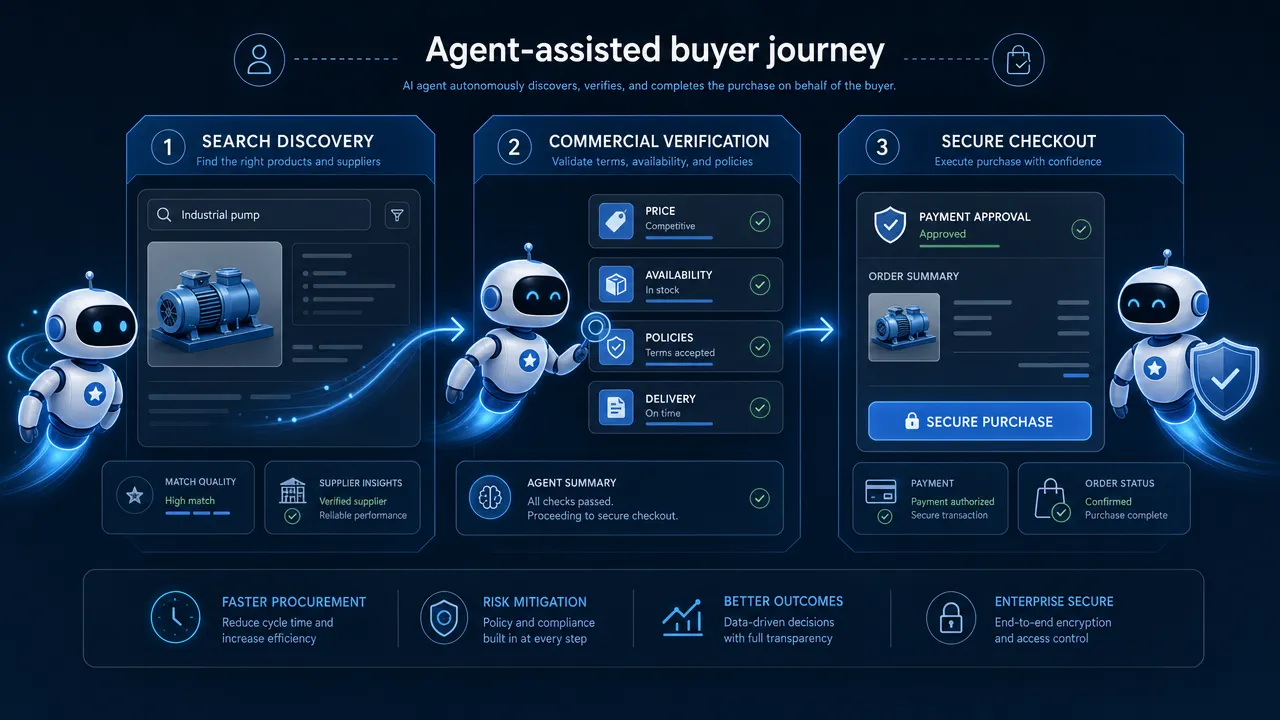
That is a different job from optimizing for an AI-generated answer or a conventional organic click. An AI assistant can now do more than summarize a product category. It may compare specifications, check availability, narrow variants, begin a quote request, select a booking slot, or move a cart toward payment. The business that wins that journey is not necessarily the one with the most AI-themed content. It is the one with information and workflows that are clear enough to be retrieved, verified, and acted on.
This changes the practical scope of SEO content strategy. Rankings and citations still matter, but they are only the first stage. A product page with vague specifications, a service page with no defined scope, or a checkout that changes totals late in the process can stop an agent-assisted buyer journey even after the site has earned discovery.
Why AI agents SEO now includes execution, not only discovery
Traditional SEO often ends at the click. A user searches, chooses a result, reaches a page, and decides what to do next. The site owner measures impressions, rankings, sessions, and conversion rate.
AI agents SEO adds work between each of those steps.
A capable agent can research options on a user's behalf. It can collect product details, compare dimensions, assess delivery terms, filter by price range, identify compatibility issues, and ask the user for approval before proceeding. For a B2B website, the intended action may not be an immediate purchase. It may be a structured RFQ, a sample request, a qualified inquiry, or a consultation booking.
This is why post-click SEO is no longer only about making a page easier for a human to read. It also involves making commercial facts and next steps sufficiently explicit for a system to interpret without guessing.
Consider a manufacturer that appears for a technical component query. Its page may rank because the product name and broad category are visible. But an agent cannot safely advance a procurement request if the site omits material grade, minimum order quantity, lead-time range, certifications, target markets, and shipping terms. The company is retrievable, but not commercially usable.
The same issue appears in ecommerce. A shopper may ask an assistant to find a fragrance-free moisturizer under a certain price that ships within a week. If the page hides ingredient details in an image, shows stale inventory, and reveals shipping costs only after payment details are entered, the agent has no reliable basis to select it.
AI-driven search behavior therefore shifts the question from "Can we be mentioned?" to "Can we be selected and moved forward?"
That distinction matters for independent websites, exporter sites, brand websites, and multilingual businesses. Their most expensive problem is rarely a lack of pages. It is often a lack of commercial clarity on the pages that already attract demand.
AI agents SEO is being shaped by commerce infrastructure, not theory
The shift toward agent-assisted commerce is not just a prediction about user behavior. Major platforms have published infrastructure that separates discovery from execution.
Google announced the Universal Commerce Protocol in January 2026 as an open-source standard for agentic commerce. Google's documentation positions UCP as an integration layer for commerce interactions across AI surfaces and notes compatibility with AP2. Its merchant materials also show that participation involves integration and approval requirements rather than automatic availability to every merchant.
OpenAI has taken a similar direction. Its Agentic Commerce Protocol announcement connected product discovery with Instant Checkout, while its product discovery documentation explains that shared, structured merchant product data supports product recommendations in ChatGPT.
The important operational point is simple: product discovery, commercial validation, and checkout are becoming connected technical layers.
Trade publications also reported that ChatGPT began testing or launching multi-product, product-feed advertising carousels in August 2026. Digiday's reporting described screenshot-verified placements, while Search Engine Land reported product carousel activity connected to campaign formats.
These reports do not prove that every advertiser, user, country, or merchant has access. They do show that product-feed completeness is becoming relevant beyond conventional shopping results.
A weak feed is no longer just a Merchant Center problem. It can become a discoverability, validation, and merchandising problem across AI-mediated surfaces.
The same caution applies to automated traffic. Reporting based on Cloudflare data indicated that automated systems represented roughly 57 percent of observed HTML requests in mid-2026. That does not mean more than half of a website's visitors are shopping agents. Automated traffic includes search crawlers, training crawlers, monitoring systems, security services, scrapers, APIs, and other bot activity.
The useful conclusion is narrower: websites increasingly serve automated systems as well as human browsers. The discovery-related slice matters for AI Search Optimization, but it should not be confused with transaction volume or buyer intent.
| What the metric may indicate | What it does not prove |
|---|---|
| More automated systems are requesting web content. | Most traffic is coming from AI shopping agents. |
| Crawler access and page rendering deserve closer monitoring. | Every bot request has commercial value. |
| Structured data and accessible HTML matter to more systems. | An AI agent can complete every purchase or quote flow. |
| Site owners need better crawler governance. | Blocking all bots is a sensible SEO decision. |
For many businesses, the immediate response should not be a speculative protocol project. It should be making existing commercial pages, feeds, policies, forms, and confirmation paths more dependable.
AI agents SEO requires retrieval, validation, and execution
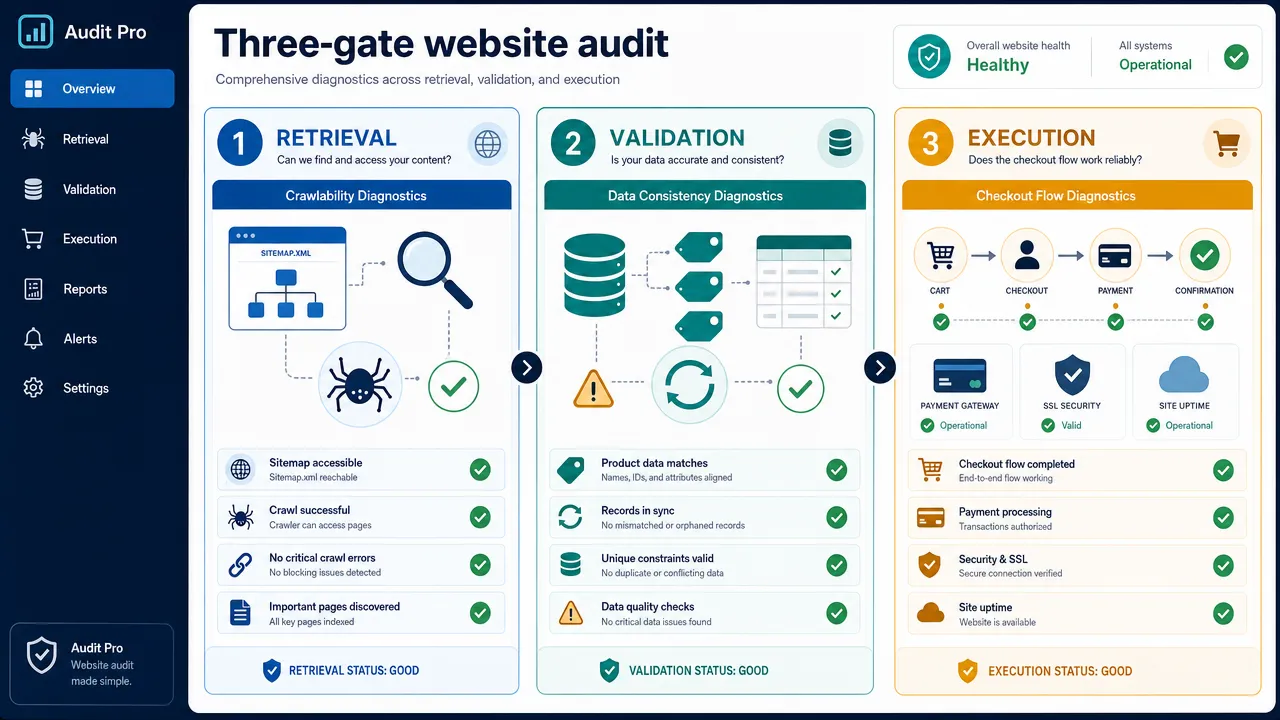
A useful way to assess readiness is the Three-Gate Model.
| Gate | Core question | Typical failure | Commercial consequence |
|---|---|---|---|
| Retrieval | Can the AI system find and understand the offer? | Critical facts are hidden, blocked, duplicated, or poorly structured. | The business is not retrieved or is misunderstood. |
| Validation | Can the AI system verify price, availability, suitability, policies, and credibility? | Product pages, feeds, policies, and checkout facts conflict. | The business is mentioned but not shortlisted. |
| Execution | Can the intended action advance safely and reliably? | Forms, carts, logins, permissions, or confirmations fail. | The buyer journey stalls after selection. |

Gate 1: Retrieval
Retrieval is still grounded in technical SEO. The essential facts about a product, service, company, location, or market need stable URLs, accessible HTML, meaningful headings, internal links, and accurate structured data.
A product page that renders its price only after an unstable JavaScript request is a weak candidate for reliable retrieval. So is a service page that calls itself a "global solutions provider" without identifying what it sells, which industries it serves, or where it operates.
For multilingual websites, Retrieval also depends on crawlable language and market URLs, reciprocal hreflang, self-referencing canonicals, and content that is genuinely localized. A German page that routes users to a US checkout or displays US policy terms creates confusion before the commercial journey even begins.
Teams working on commercial architecture can also review SeekLab.io's guide to commercial site architecture for B2B and ecommerce. The core lesson is practical: important category, service, policy, and conversion pages should be connected deliberately, not left as isolated URLs.
Gate 2: Validation
Validation is where generic content fails.
An agent asked to compare two products needs more than persuasive adjectives. Terms such as "premium," "advanced," and "high-performance" do not establish fit. Useful validation evidence includes model numbers, variant details, measurements, material specifications, compatibility, delivery eligibility, returns conditions, warranty terms, service boundaries, certifications, and accurate pricing.
For an ecommerce brand, the key question is whether product page, schema, feed, cart, and checkout agree.
For a B2B company, the question is whether the website explains enough for a qualified next step. A serious buyer may need to know minimum order quantity, country coverage, lead times, quality standards, customization limits, installation responsibilities, and documentation available before requesting a quote.
| Business model | Evidence needed for validation | Avoidable weak point |
|---|---|---|
| Ecommerce | Variant-level price, stock, sizing, ingredients or materials, shipping, returns, warranty. | A feed says "in stock" while checkout says unavailable. |
| B2B SaaS | Plan limits, security information, integrations, onboarding scope, support model. | "Enterprise-ready" claims with no evidence. |
| Exporter | MOQ, technical specifications, certification, packaging, lead time, Incoterms, RFQ requirements. | A product catalog with no procurement details. |
| Professional service | Service area, scope, exclusions, credentials, availability, pricing basis, cancellation terms. | A generic contact form that hides the real engagement process. |
Validation is also where search experience optimization becomes commercially meaningful. Good tables, clear FAQs, policy summaries, and comparison blocks do not merely improve page layout. They reduce ambiguity at the moment a user or agent must decide whether an option is suitable.
For support on language-market structure, review SeekLab.io's published guidance on multilingual SEO architecture and hreflang implementation. Translation alone is not localization if currency, units, delivery rules, customer support, and terms remain tied to another market.
Gate 3: Execution
Execution is the differentiating gate in AI agents SEO.
This is not ordinary conversion-rate optimization with a new label. Human-focused CRO asks whether visitors can understand and trust a page. Execution readiness asks whether a user-authorized system can advance an action without misreading a field, encountering an unexplained error, or exceeding the user's permission.
OpenAI's Agentic Checkout Spec and Google's native checkout guidance for UCP show why this layer is becoming technically relevant. These materials do not mean every checkout is agent-compatible today. They do make clear that commerce systems are moving beyond content retrieval alone.
A reliable execution path needs:
- Accurate price, stock, quantity, tax, delivery, and variant information at the point of action.
- Clear form labels, required fields, validation rules, and meaningful error messages.
- Predictable transitions between storefront, CRM, scheduling platform, payment provider, and confirmation page.
- Explicit user confirmation before payment capture, contractual commitments, or sensitive data sharing.
- A visible handoff path for login, CAPTCHA, fraud checks, regulatory review, or complex custom requirements.
- Reliable success states, confirmation IDs, receipts, booking details, or lead acknowledgments.

A checkout may look polished and still fail this gate. For example, a fashion retailer can lose the action if its size options are visual swatches without accessible names, stock updates lag behind the product page, and shipping cost appears only after the payment stage.
For B2B businesses, execution does not need to mean autonomous purchase completion. The right goal may be an RFQ that collects product code, quantity, target market, certification requirements, delivery terms, and expected timeline. A vague "Tell us what you need" form forces both human buyers and systems to infer details that should be structured.
AI agents SEO priorities should focus on the highest-value paths
The sensible response is not to rebuild every site around emerging protocols. Most teams have more immediate problems: pages that cannot be indexed properly, commercial facts that conflict across systems, and forms that fail after a buyer has already shown intent.
Start with the pages and workflows that already matter to revenue: top categories, highest-margin products, core service pages, key language-market pages, booking journeys, and RFQ forms.
| Priority | What to do | Why it matters |
|---|---|---|
| Fix now | Repair crawlability, rendering, canonical, sitemap, and internal-link failures on key commercial pages. | No search engine or AI system can reliably use inaccessible content. |
| Fix now | Move price conditions, specifications, availability, policies, and service coverage into visible HTML. | These facts support both Retrieval and Validation. |
| Fix now | Reconcile product data across CMS, PIM, feed, cart, checkout, and confirmation pages. | Conflicting data creates recommendation and conversion risk. |
| Fix now | Test high-value form, booking, and checkout paths from landing page through confirmation. | Execution failure wastes demand already earned. |
| Fix now | Replace generic B2B inquiry forms with structured qualification fields. | Better inputs produce more useful leads and reduce sales follow-up friction. |
| Monitor | Review supported UCP, ACP, or platform integration opportunities. | Access, eligibility, and business value are still uneven. |
| Monitor | Track crawler activity and AI-platform referrals where analytics allows. | Directional signals are useful, but request volume is not a revenue metric. |
| Deprioritize | Build a proprietary agent interface without a supported platform or clear buyer use case. | Data integrity and workflow reliability usually create more value first. |
| Deprioritize | Publish large volumes of repetitive AI-generated pages. | More pages do not solve missing commercial evidence. |
This is where organic traffic changes can be misunderstood. A decline in clicks does not automatically mean AI systems are harming the business. A rise in traffic does not automatically mean the site is ready for agent-assisted commerce. The useful diagnosis is more specific:
- Is the right page being retrieved?
- Does the page provide enough evidence for selection?
- Can the buyer complete the next appropriate action?
SeekLab.io helps teams answer those questions through structured crawling, rendering checks, Core Web Vitals diagnostics, schema review, internal-link analysis, content planning, multilingual architecture review, and conversion-path evaluation. The goal is not to fix every visible issue. It is to identify the blockers that materially affect growth and deprioritize work that does not.
For content teams, SeekLab.io's article on how content structure supports AI-system extraction is useful supporting context. But extraction is only one part of the commercial journey. A well-structured page still needs verified facts and an executable next step.
AI agents SEO FAQ
What is AI agents SEO?
AI agents SEO is the practice of preparing website content, commercial data, technical structure, and conversion workflows so AI systems can retrieve an offer, validate important facts, and potentially advance a user-authorized action. It goes beyond earning an AI citation or search mention.
How are AI agents different from AI search summaries?
AI search summaries mainly synthesize information. AI agents can be designed to research, compare, filter, select, submit, book, or transact, subject to platform capability, merchant support, and user authorization.
What is the Three-Gate Model for AI agents SEO?
The Three-Gate Model separates readiness into Retrieval, Validation, and Execution. Retrieval asks whether the offer can be found and understood. Validation asks whether commercial facts can be trusted. Execution asks whether the next action can proceed safely and reliably.
Does AI agents SEO replace traditional SEO?
No. Technical SEO, crawlability, rendering, internal linking, structured data, content structure, and multilingual architecture remain foundational. AI agents SEO expands the work by adding commercial validation and operational execution.
What should B2B websites prioritize first?
B2B websites should make the next best action executable. That usually means clear service scope, qualification criteria, technical details, structured RFQ forms, realistic timelines, market coverage, and reliable confirmation after submission. Not every high-consideration sale should be automated.
How should ecommerce businesses prepare?
Ecommerce businesses should synchronize product pages, feeds, variants, pricing, stock, shipping rules, returns terms, cart totals, checkout states, and confirmation pages. A product can be discovered successfully but still lose the sale if the final price or availability changes unexpectedly.
Does more bot traffic mean more AI buyers?
No. Bot traffic includes many categories that have no commercial intent, including training crawlers, search crawlers, monitoring systems, security services, and other automation. Treat bot data as an operational signal, not proof of buyer volume.
Should every company adopt UCP or ACP immediately?
No. Monitor official platform access, merchant eligibility, technical requirements, and real business fit. Most companies will gain more from fixing information clarity, data consistency, and conversion-path failures before investing in emerging integrations.
A focused audit can identify whether your highest-value pages fail Retrieval, Validation, or Execution, then prioritize the fixes most likely to support visibility, credibility, and conversion potential. Get a free audit report