SEO Used to End at the Click. AI Agents Are Changing That
Expert reviewed

AI-assisted search increasingly handles part of the research journey before the click. A searcher may receive a definition, comparison criteria, and follow-up suggestions inside an AI search experience before visiting a source. The visit that remains is often a verification or decision visit—and the page has to earn the next step.
That does not make traditional SEO less relevant. Google still requires pages to be indexed and eligible for Search snippets before they can be considered as supporting links in AI features. The practical shift is that crawlability, content clarity, page architecture, and conversion paths now need to work as one system. Modern SEO runs from discovery to action, not ranking to click.
Why post-click experience now matters more
Search visibility gets a visitor to the door. It does not make the website useful once they arrive.
A conventional search journey was often reported as keyword, ranking, click, and session. The click became the outcome. But a visitor who lands on a generic page, cannot verify a claim, cannot find product details, or has to fight through a long inquiry form has not had a good search experience. The ranking did its job; the website did not.
AI-mediated discovery raises the standard. A user can ask an assistant to compare suppliers, explain technical options, identify requirements, or build a shortlist. By the time that person lands on a website, vague marketing copy and disconnected articles are less likely to be enough.
The commercial implication is straightforward: some broad informational clicks may become less frequent, while later-stage visits become more valuable. A B2B buyer may use an AI interface to understand terminology, then visit the original provider to check specifications, delivery coverage, process, evidence, and response expectations.
That is where post-click SEO matters:
| Post-click element | What a visitor needs | Common failure on business websites |
|---|---|---|
| Immediate relevance | A direct connection between the query and the page | A generic headline and a long company introduction |
| Answer clarity | A clear explanation of scope, conditions, and limitations | The useful answer is buried under promotional copy |
| Evidence | Proof that claims are credible | Unsupported statements about expertise or results |
| Internal progression | A sensible route to deeper evaluation | Blog posts that end without links to services, products, or proof |
| Technical reliability | Fast, stable, usable pages and working forms | JavaScript delays, layout shifts, or broken mobile forms |
| Market fit | The correct language, offer, and contact route | Visitors land on the wrong market or language version |
| Conversion path | An action that matches the visitor's intent | Every page pushes the same vague contact form |
A product manufacturer, for example, should not expect a buyer to submit an inquiry after reading a short category description. The buyer may need application guidance, dimensions, certifications, lead times, delivery details, and a way to ask a precise question. Supporting that evaluation is not merely conversion-rate optimization. It is part of whether search visibility creates commercial value.
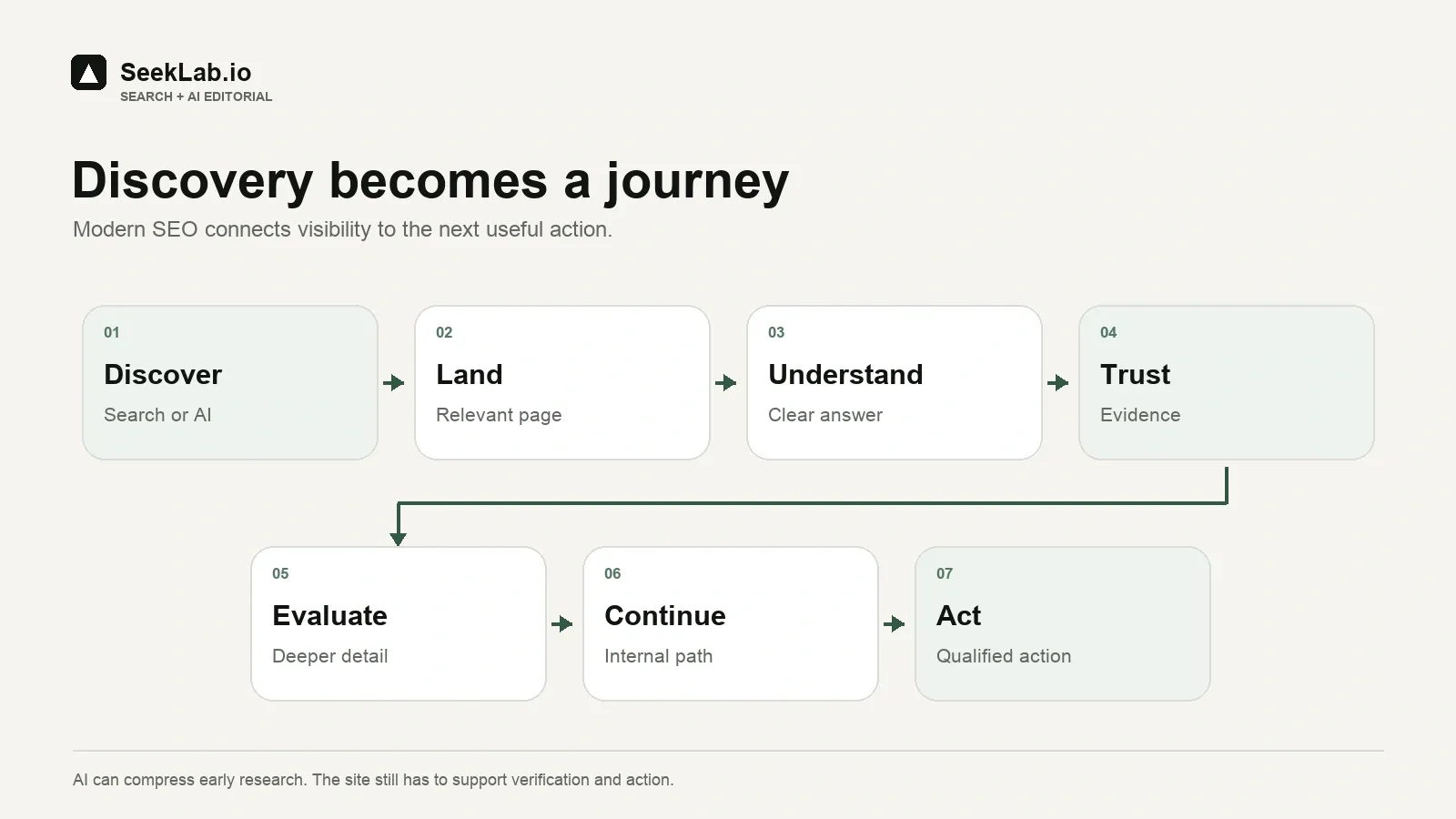
Google's guidance on AI features and websites reinforces the same foundation: useful pages still need crawl access, indexability, visible text, internal discoverability, and a sound page experience.
How AI-assisted search changes organic traffic
AI-assisted search changes the sequence of research, not the need for trustworthy websites. Users can ask broader questions, request comparisons, narrow requirements, and refine their thinking inside an AI interface. Some early research may end there. Other tasks still require a visit because the user needs original detail, proof, a transaction, or direct contact.
This makes top-line traffic harder to interpret. A decline in sessions to generic definition pages does not automatically mean SEO has failed. At the same time, a smaller number of organic visits may create more value if visitors reach product, service, comparison, pricing, location, or technical documentation pages with stronger intent.
The mistake is responding to a traffic decline by publishing more generic content before checking what actually changed. Segment performance first:
| Question to investigate | Why it matters |
|---|---|
| Which query groups declined? | Generic informational queries behave differently from branded or commercial queries |
| Which landing pages lost visits? | A decline on glossary pages has different implications from a decline on product pages |
| Did qualified visits change? | A visitor reaching a comparison or quote page is more meaningful than a shallow session |
| Did inquiry quality change? | More leads are not better if they do not fit the offer or market |
| Did technical conditions change? | Indexing, rendering, canonical, form, or release problems can mimic an AI-search effect |
| Did the decline affect one language or market version? | Routing, hreflang, and local demand can produce isolated problems |
The better question is not, “Is AI taking our traffic?” It is, “Which search journeys still require our site, and do those journeys lead to meaningful action?”
What still matters technically
There is no separate technical shortcut for AI search visibility. Important content still needs to be crawlable, indexable, rendered correctly, canonically consistent, and internally discoverable. Structured data should match what users can see. Forms and conversion routes need to work. Different language and market versions need to send visitors to the right offer.
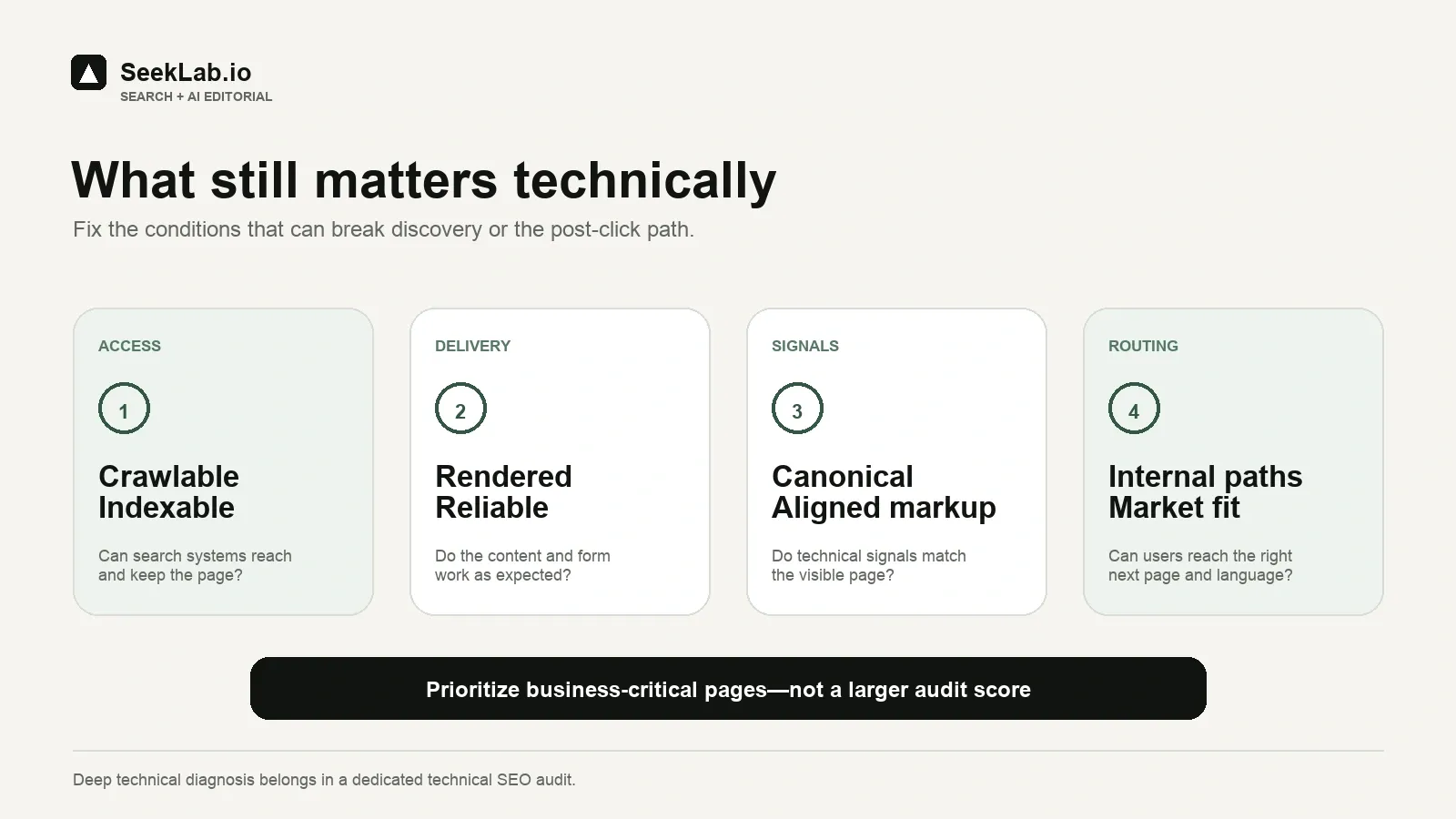
The priority is not to turn this article into a full audit checklist. It is to remove technical conditions that break the discovery-to-action path. Accidental noindex directives, blocked rendering, conflicting canonicals, orphaned commercial pages, broken forms, and wrong-language routing matter because they interrupt that path.
For deeper diagnosis, use SeekLab's guides to a technical SEO audit, JavaScript SEO and indexing, and internal-link optimization. The goal is not a longer issue list. It is a clear order of work for the pages that influence discovery, evaluation, and conversion.
How content strategy should change
A useful SEO content strategy no longer starts with, “How many keywords can we publish this quarter?” It starts with, “Which buyer decisions can our site support better than an AI summary alone?”
Generic content is most exposed to answer-layer substitution. A page that only defines a familiar term or rewrites common advice gives users little reason to visit. A page that helps a buyer compare options, validate a requirement, understand implementation, or assess fit still serves a real purpose.
Prioritize formats that support decisions:
| Content type | Why it remains valuable | Example |
|---|---|---|
| Comparison pages | Buyers need transparent trade-offs | In-house SEO versus agency SEO for a multilingual site |
| Use-case pages | They connect an offer to a specific commercial problem | SEO support for an exporter entering a new market |
| Technical documentation | Users need source-level detail before they act | Integration steps, specifications, or implementation constraints |
| First-party process content | It provides detail that generic summaries cannot reproduce | How an audit prioritizes rendering and indexation issues |
| Market-specific guidance | It addresses local requirements and terminology | Procurement, compliance, delivery, or service expectations |
| Proof pages | They let visitors validate capability | Documented process, policies, examples, authorship, and expertise |
| Decision-support tools | They reduce uncertainty during evaluation | Checklists, selectors, calculators, or requirement templates |
Sometimes the best SEO asset is not an article at all. A checker, calculator, selector, template, interactive tool, or structured comparison page may resolve the user's next question more efficiently than another long-form post.
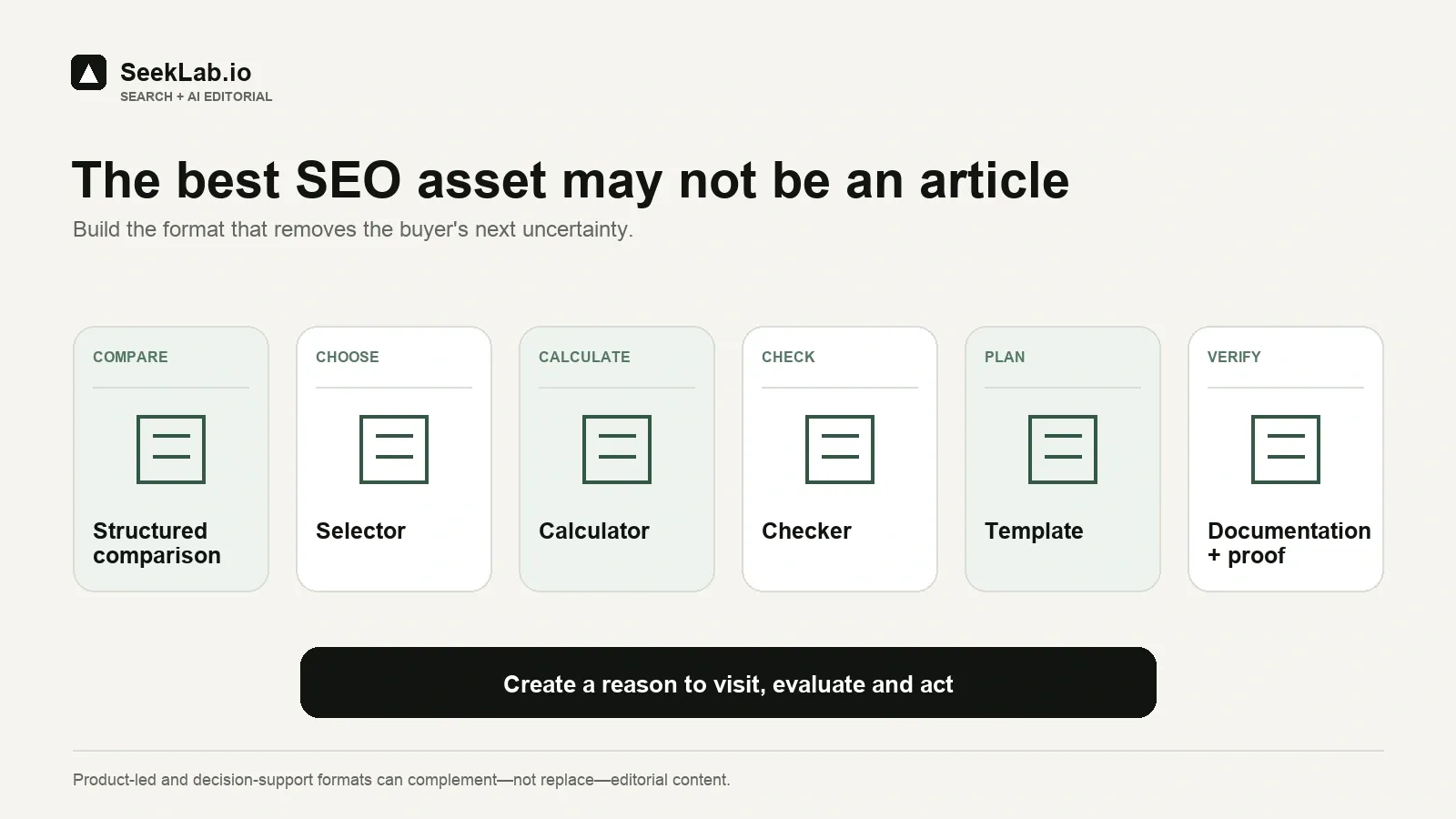
Every asset should also create a path. An educational page can lead to a comparison, relevant service, process explanation, proof page, or next-step tool. Useful internal links are not there to distribute authority mechanically; they help the visitor continue the decision.
The same distinction applies in AI search. A brand can be mentioned without being cited, and cited without becoming the recommended choice. SeekLab's analysis of AI citations versus brand mentions explains why visibility, source selection, and preference are separate outcomes. The broader SEO versus GEO comparison shows how the disciplines overlap without pretending they are identical.
For international sites, structure matters twice: search systems need clear language and market signals, while visitors need localized evidence, terminology, and contact routes. A literal translation of one global page rarely handles those needs well. The international SEO strategy guide covers the deeper architecture questions.
How to measure discovery-to-action performance
Search experience optimization connects the need expressed before the click with what happens after it. Rankings and sessions remain useful, but neither explains whether visibility produces business value.
Measurement should follow the journey:
| Measurement area | Useful signals |
|---|---|
| Search visibility | Indexed priority URLs, impressions, ranking distribution, branded and non-branded coverage |
| Qualified organic visits | Sessions reaching service, product, comparison, pricing, location, and documentation pages |
| Post-click progression | Internal-link clicks, key page sequences, repeat visits, and engagement with decision content |
| Conversion actions | Form starts and completions, quote requests, bookings, calls, downloads, and cart actions |
| Inquiry quality | Sales acceptance, market fit, product fit, opportunity progression, and order potential |
| Technical health | Crawl errors, rendering checks, Core Web Vitals, form uptime, and language-market routing |
| AI visibility signals | Identifiable referrals, tracked query samples, supporting links, and changes in branded search |
Do not assume every traffic decline is caused by AI search. Check rankings, index coverage, releases, analytics changes, seasonality, device differences, language versions, and template performance first. A page can lose value because it was incorrectly canonicalized or because a redesigned form fails on mobile. Those problems will be missed if every change is attributed to the answer layer.
A practical 90-day sequence keeps the work focused:
| Period | Priority action |
|---|---|
| Days 1–30 | Check indexability, rendering, canonicals, forms, internal paths, and priority landing pages |
| Days 31–60 | Upgrade core service, product, or category hubs and connect supporting content to proof and next actions |
| Days 61–90 | Measure qualified paths, fix high-impact template issues, refine calls to action, and fill verified decision gaps |
The strategic takeaway is simple: do not answer AI-assisted search by chasing imagined ranking hacks or flooding the site with generic pages. Build a website that answers clearly, proves its claims, exposes important pages through meaningful internal paths, works across languages and devices, and helps serious visitors act.
SeekLab connects technical SEO, content structure, internal linking, page architecture, GEO strategy, and conversion paths so search visibility can lead to useful business outcomes. Start with the free website audit, or explore SeekLab's SEO & GEO service for a deeper strategy and implementation program.