How to Assess AI Overview Risk Before Targeting a Keyword in 2026
Expert reviewed

The right way to assess AI Overview risk in keyword research 2026 is to score whether a keyword can still create qualified clicks, citations, trust, or inquiries after Google places an AI-generated answer on the SERP.
A keyword is no longer attractive just because it has search volume, manageable difficulty, or a high CPC. Before an independent website, official company website, exporter site, or multilingual brand site invests in content, the keyword needs a risk layer: AI Overview trigger likelihood, SERP answer completeness, click displacement risk, citation opportunity, buyer intent, technical readiness, and conversion path quality.
Use one practical rule from the start: a keyword is worth targeting only if it can still support a business outcome. That outcome may be direct inquiries, product evaluation, topic authority, internal link support, or stronger discoverability in AI-generated search results SEO. A broad informational term may rank and still bring little traffic. A lower-volume buying-intent keyword may create better leads because the searcher still needs proof, pricing context, vendor detail, or technical help.
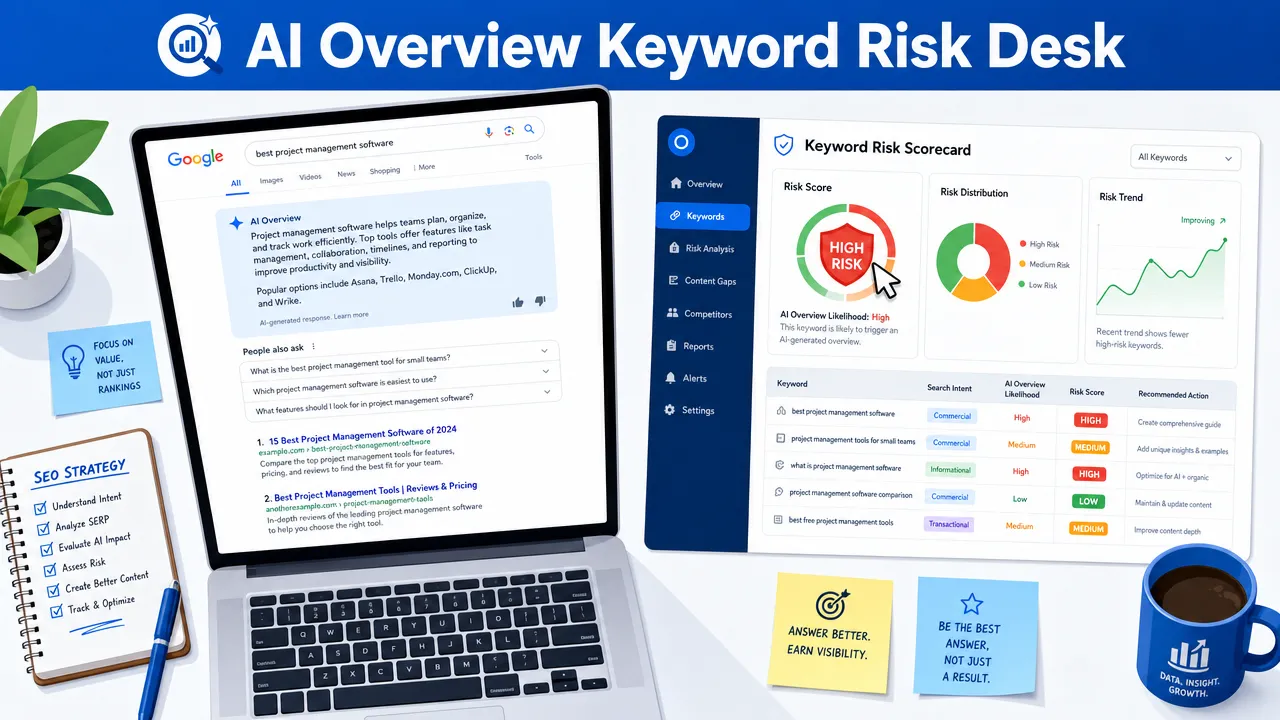
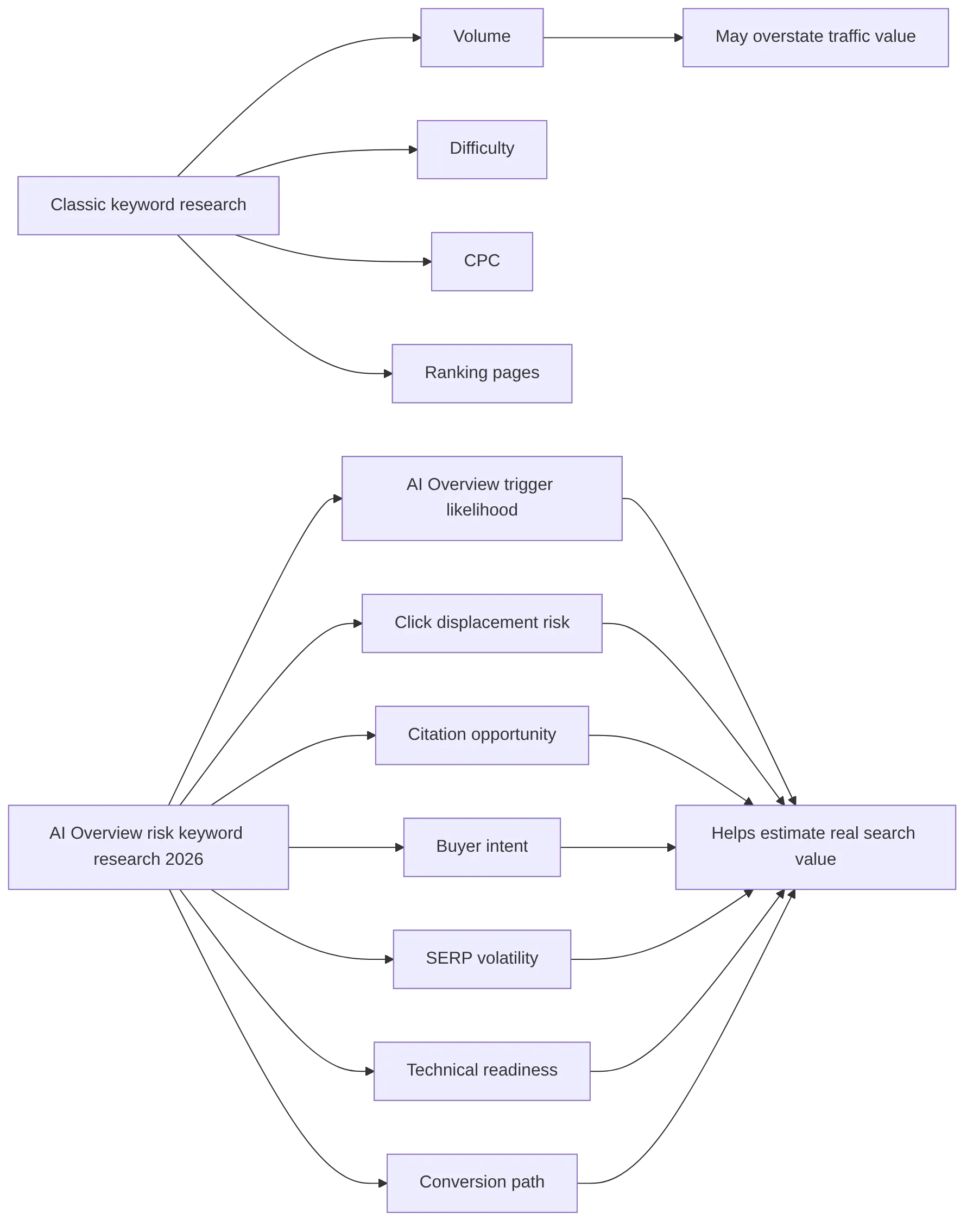
AI Overview risk keyword research 2026 starts by separating ranking value from business value
Classic keyword research asks, "Can we rank?" AI Overview keyword research asks a harder question: "If we rank, will the searcher still need to click, compare, contact, or buy?"
That difference matters for company websites that cannot afford to publish content only for vanity traffic. A page ranking for "what is technical SEO" may face high organic traffic risk because the answer can be summarized directly in the SERP. A page targeting "technical SEO audit for JavaScript indexing issues" has a different commercial profile because the searcher may need diagnosis, implementation detail, and expert review.
Google describes AI Overviews as AI-generated snapshots that help users understand a topic and explore links for more information. Its guidance for site owners still points back to Search fundamentals: crawlability, indexability, useful content, text accessibility, structured data that matches visible content, internal linking, and page experience. See Google's official guidance on AI features and your website and optimizing for generative AI features on Google Search.
The operational takeaway is simple: there is no separate shortcut for AI Overview risk keyword research 2026. The work is a better decision process before content production.
| Keyword evaluation layer | Old keyword research focus | 2026 risk-adjusted focus |
|---|---|---|
| Demand | Search volume | Real click potential after AI Overview and SERP features |
| Competition | Keyword difficulty | Competitor authority, cited source types, and SERP layout |
| Intent | Informational, commercial, transactional | Whether the SERP satisfies the searcher without a click |
| Value | CPC or ranking opportunity | Inquiry potential, trust-building value, or internal link support |
| Execution | Publish a page | Match format, structure, schema, visuals, and conversion path |
| Monitoring | Check rankings | Track SERP risk monitoring, CTR, citations, and inquiry quality |
A high-risk keyword is not always a bad keyword. It may still help a commercial page by building topical depth or answering a common pre-sales question. The mistake is treating every informational keyword as a traffic asset. Some should be concise supporting pages. Some should be avoided. Some need a sharper buying-intent angle.
AI Overview risk keyword research 2026 depends on a 12-point SERP and intent checklist
A practical AI search risk analysis starts with the SERP, not the spreadsheet. Open the keyword in the target country and language. Look at what appears before the first traditional organic result. Then decide whether the searcher still has a reason to leave Google.
For exporters and international sites, do this market by market. A keyword that looks safe in the United States may behave differently in Europe, Singapore, or another APAC market. A translated keyword list is rarely enough because local buyers phrase problems differently, expect different proof, and see different SERP features.
Use this checklist before assigning a keyword to a blog post, service page, category page, product page, or support article.
| Check | Question to answer | Warning sign | Better action |
|---|---|---|---|
| SERP layout | What appears above the first organic result? | AI Overview, ads, PAA, videos, and forums dominate the screen | Reassess click potential before writing |
| AI Overview presence | Is an AI Overview already visible? | The generated answer covers the whole query | Score answer completeness carefully |
| Trigger likelihood | Is the query question-based, explanatory, or broad? | "What is" and broad "how to" phrases often face higher exposure | Consider narrower long-tail or commercial variants |
| Answer completeness | Can the user solve the problem without clicking? | The SERP gives a complete checklist or definition | Add depth, examples, tools, visuals, or proof |
| Click displacement risk | Are organic results pushed far down? | Ranking third may still receive weak traffic | Prioritize stronger intent terms |
| Citation opportunity | Are similar business websites cited? | Only official, encyclopedia, or dominant publisher sources appear | Build credibility before competing |
| Query intent | Is the user learning, comparing, buying, or navigating? | Intent is vague or mixed | Match the page type to the dominant intent |
| Buying intent | Does the searcher need a vendor, quote, audit, or specification? | No obvious next step exists | Use as supporting content, not a primary target |
| Competitor authority | Who owns the visible SERP? | Large platforms or authoritative sources dominate every result | Narrow the angle or build topic support first |
| Content format | What format is winning? | The SERP favors tools, tables, videos, product pages, or reviews | Do not force a standard blog format |
| Technical readiness | Can the page be crawled, rendered, indexed, and loaded well? | JavaScript, indexability, schema, or internal link issues exist | Fix blocking issues before publishing |
| Conversion path | Can the visitor take a useful next step? | No contact, audit, quote, or inquiry path is visible | Add a clear conversion route |
The most common failure is not choosing an impossible keyword. It is choosing a plausible keyword with weak business value. For example, "SEO checklist" may look attractive, but it is broad, heavily summarized, and difficult to connect to a serious inquiry. "SEO audit checklist for exporter websites" is narrower, but it gives the page a clearer audience, scenario, and conversion path.
For technical readiness, keyword strategy should not be separated from site diagnosis. If a website has rendering issues, weak internal linking, duplicate metadata, missing structured data, or slow templates, a good keyword can underperform. If JavaScript is affecting crawlability or indexation, review SeekLab.io's guide to JavaScript SEO and indexing issues before investing heavily in new keyword targets.
AI Overview risk keyword research 2026 needs a simple scoring model before content investment
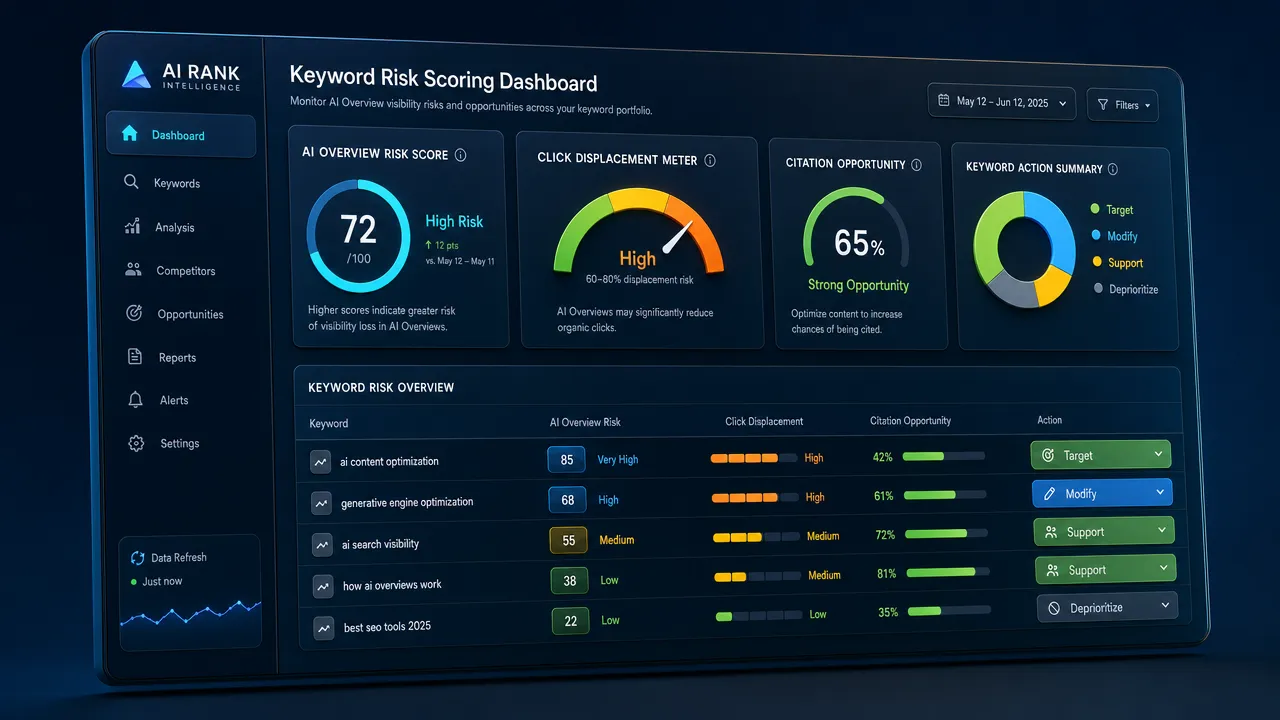
A scoring model will not predict Google perfectly. It will prevent expensive guessing. The goal is to decide whether to target, modify, support, or deprioritize the keyword before writers, designers, translators, and developers spend time on it.
Use a 100-point score where a higher number means greater search visibility risk and weaker direct opportunity.
| Score band | Risk level | Interpretation | Recommended action |
|---|---|---|---|
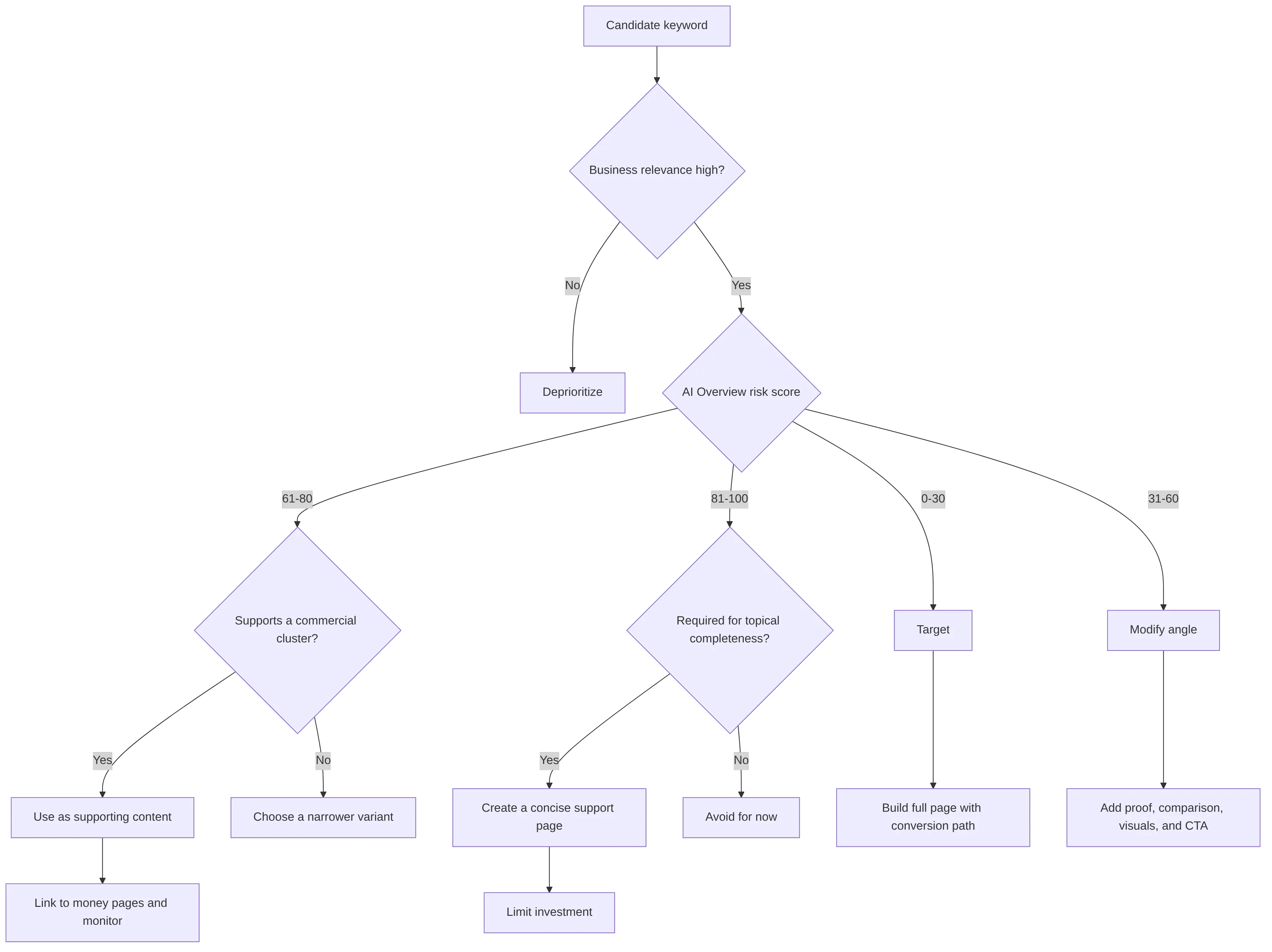
| 0-30 | Low risk | AI Overview is absent or weak, user likely still clicks, and intent is specific | Target aggressively if business relevance is strong |
| 31-60 | Medium risk | AI Overview or SERP features exist, but the query still needs proof, comparison, or action | Target with a sharper angle and stronger page structure |
| 61-80 | High risk | SERP answer is strong, click displacement is likely, and competitors dominate citations | Use as supporting content, narrow the keyword, or build authority first |
| 81-100 | Very high risk | Query is fully answered in the SERP, weak commercial intent, and poor fit for the site | Deprioritize unless needed for topical completeness |
A workable risk score can use these dimensions:
| Risk dimension | Suggested weight | What to inspect |
|---|---|---|
| AI Overview trigger likelihood | 18 | Existing AI Overview, question wording, explanatory intent |
| SERP answer completeness | 16 | Whether the generated answer solves the searcher's need |
| Click displacement risk | 14 | Ads, PAA, video, shopping, local packs, forums, and AI placement |
| Commercial intent weakness | 12 | Lack of vendor, pricing, comparison, or consultation intent |
| Citation competition | 10 | Whether cited sources are accessible competitors or dominant authorities |
| SERP volatility | 8 | Frequent layout changes, changing source types, unstable rankings |
| Site authority gap | 8 | Whether your site can credibly answer the topic |
| Content format mismatch | 6 | SERP favors a format your planned page does not provide |
| Technical readiness risk | 5 | Crawlability, rendering, indexation, speed, schema, internal links |
| International or language uncertainty | 3 | Unknown behavior across target markets |
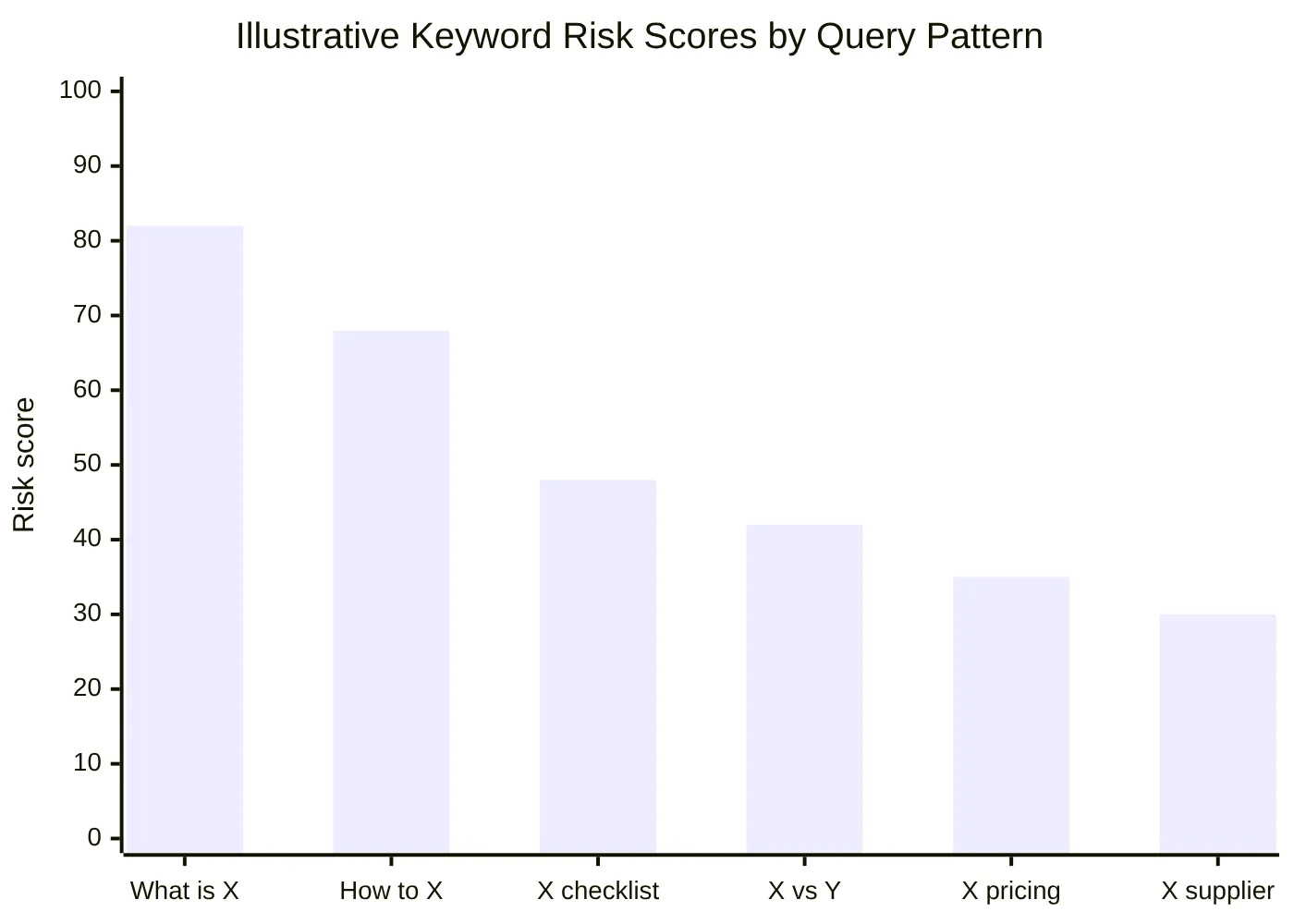
A broad definition query usually has high keyword volatility in AI Overview because the answer can be generated and rewritten easily. A supplier, pricing, audit, or comparison query often has lower risk because the user still needs specific details. That is why buying-intent keyword research should not be judged with the same lens as top-of-funnel content.
Use this decision tree after scoring:
After the scoring step, check whether the website can support the keyword technically and structurally. SeekLab.io provides a free SEO audit that can help identify crawlability, headings, metadata, resources, indexing, schema-related checks, and other site issues that affect whether a keyword target is realistic.
For teams that already have an audit report but are not sure how to act on it, SeekLab.io's guide on how to read an SEO audit report can help separate urgent growth blockers from low-impact cleanup tasks.
AI Overview risk keyword research 2026 changes how buying-intent keywords are evaluated
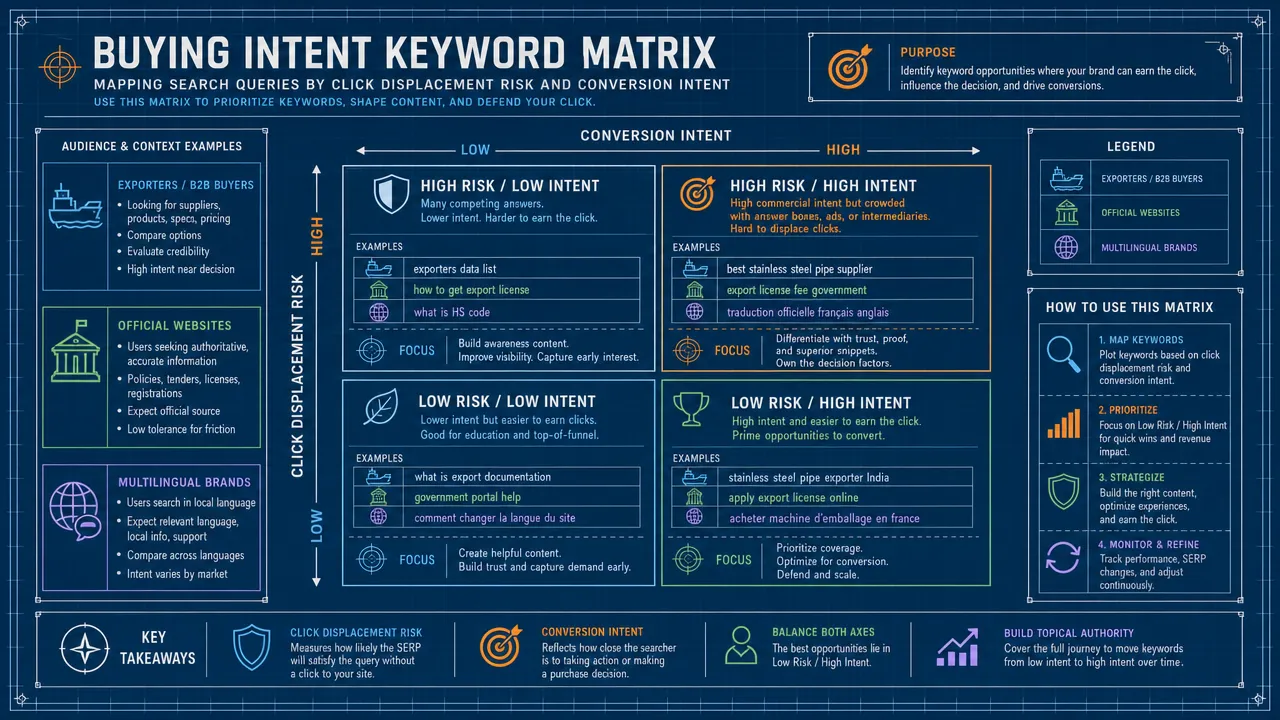
Buying-intent keywords are often more resilient, but they are not automatically safe. A generated answer can summarize vendor categories, feature comparisons, or general buying criteria. What it usually cannot do well is inspect a specific website, quote a project, evaluate a technical stack, or prove that a provider fits a buyer's exact situation.
That distinction matters for official company websites and independent sites where inquiry quality matters more than raw sessions. A keyword like "how to improve website traffic" may attract readers with unclear intent. A keyword like "SEO content strategy for official company website inquiries" is more specific and closer to a business outcome.
Compare these patterns:
| Riskier pattern | Why it is risky | Stronger alternative |
|---|---|---|
| "what is SEO audit" | Easy to define inside the SERP | "SEO audit service for B2B exporter websites" |
| "SEO checklist" | Broad, list-based, and easily summarized | "SEO audit checklist for international company websites" |
| "how to write a blog post" | Generic and low-fit for serious buyers | "SEO blog content plan for product inquiry growth" |
| "best SEO tips" | Crowded, vague, and weak conversion intent | "technical SEO priorities before website migration" |
| "multilingual SEO" | Broad topic with mixed intent | "multilingual SEO strategy for B2B manufacturers in Europe" |
A buying-intent keyword deserves a different evaluation checklist:
- Does the SERP show vendor pages, service pages, product pages, review pages, or directories?
- Does the AI Overview introduce solution types without fully resolving provider selection?
- Does the searcher likely need a quote, audit, consultation, sample, technical review, or specification?
- Can the page explain service scope, deliverables, process, and fit better than a generic summary?
- Does the page move the visitor toward an inquiry, not just another article?
A commercial page should not read like a generic explanation. It needs proof of understanding. For an exporter website, that might mean region-specific search behavior, multilingual architecture, product category clarity, and inquiry paths for distributors or buyers. For a software or technical website, that might mean crawlability, JavaScript rendering, Core Web Vitals, schema, and internal linking.
SeekLab.io's work sits at this point where keyword strategy, content production, and technical optimization meet. The goal is not to fix everything on a website. The practical value is identifying what truly affects growth, what can be deprioritized, and which keyword directions are not worth chasing.
For multilingual and cross-border planning, avoid translating an English keyword list and calling it localization. Query wording, proof expectations, SERP features, and AI-generated search results SEO behavior can differ by market. SeekLab.io's guide to multilingual SEO strategy for 2026 is a useful companion when keyword risk needs to be reviewed across languages and regions.
AI Overview risk keyword research 2026 must include technical readiness, content structure, and SERP monitoring
SERP risk monitoring should begin before publication and continue after the page is live. AI Overview presence can change. Cited sources can rotate. SERP layouts can become more crowded. A page can hold rankings while CTR falls because the visible SERP changed above it.
A useful monitoring workflow looks like this:

Monitoring should not only look at rankings. A page can be in position two and still disappoint if the AI Overview, ads, and People Also Ask take the meaningful attention. Track the following together:
| Monitoring signal | What it may indicate | Practical response |
|---|---|---|
| Impressions rise, CTR falls | SERP features or AI Overview may be reducing clicks | Review SERP layout and title relevance |
| Rankings stable, traffic drops | Click displacement or changed query mix | Compare live SERP snapshots by device and market |
| Traffic rises, inquiries do not | Intent mismatch or weak conversion path | Improve CTA, proof, comparison sections, and internal links |
| AI Overview appears after publishing | Keyword risk increased | Refresh answer structure and citation-ready sections |
| Cited sources change | Citation opportunity may shift | Improve clarity, evidence, tables, and topical support |
| Indexed page performs poorly | Technical or internal linking issue | Audit crawlability, rendering, indexation, schema, and links |
Content structure should be built for both search engines and real buyers. A strong page usually includes a clear answer block, practical examples, comparison tables, visuals, internal links, FAQs where relevant, schema that matches visible content, and a next step that fits the visitor's intent.
For example, a page targeting "technical SEO audit for JavaScript website" should not stop at defining JavaScript SEO. It should explain symptoms, diagnosis steps, common rendering failures, what developers need to check, what an audit should include, and when a business should request expert help. The page should also link to a relevant service or audit path, not leave the reader at a dead end.
If you suspect a site problem is limiting performance, start with a free SEO site check before expanding the keyword plan. Keyword selection alone will not compensate for blocked pages, poor rendering, confusing architecture, or weak internal links.
SeekLab.io helps brands build search visibility and AI-era discoverability through high-quality content production and technical optimization. That includes full-site crawling and structured analysis, Core Web Vitals and page performance diagnostics, indexing and rendering checks, JavaScript compatibility review, internal link equity analysis, schema enhancement, sitemap and robots.txt validation, content topic selection, SERP and AI-generated answer structure analysis, multilingual site architecture, and monthly performance review.
The stronger business point is prioritization. Before writing ten articles or fixing every technical issue, teams need to know which choices affect growth and which can wait. SeekLab.io focuses on identifying what truly impacts search visibility, credibility, and conversion potential, then providing clear solutions and technical guidance.
FAQ: AI Overview Risk Keyword Research 2026
What is AI Overview risk in keyword research?
AI Overview risk is the likelihood that a keyword will generate little or no qualified traffic because Google's AI-generated answer satisfies the searcher's need before they click any organic result. A keyword with high AI Overview risk may still rank on page one and receive almost no clicks. Assessing this risk before content production prevents wasted investment in keywords that cannot produce business outcomes even with strong rankings.
Which keywords have the highest AI Overview risk?
Broad informational queries have the highest AI Overview risk — particularly "what is X," "how does X work," and generic "how to" queries where the answer can be summarized completely in a paragraph. Specific commercial queries — supplier searches, pricing comparisons, audit requests, technical specifications, and vendor evaluations — typically have lower AI Overview risk because the searcher still needs specific detail that a generated answer cannot provide.
How do I check if a keyword triggers an AI Overview?
Search the keyword manually in your target market and device. If an AI Overview appears above the traditional organic results, the keyword is actively triggering one. Check whether the generated answer fully resolves the query or leaves the searcher needing more detail. A complete answer with a checklist, definition, and examples is higher risk than a summary that introduces a topic without resolving it.
Does a high AI Overview risk keyword mean I shouldn't target it?
Not necessarily. A high-risk keyword may still support commercial pages through internal linking and topical authority building. The recommendation depends on the risk score — 61-80 risk keywords can still be used as supporting content linked to money pages. The key is not investing full production resources (custom visuals, expert review, detailed examples) in keywords that will produce minimal traffic regardless of ranking position.
How is this different from the BID Framework?
The BID Framework is SeekLab's full keyword selection methodology — scoring Business Value, Intent Match, and Difficulty Reality to decide whether a keyword is worth targeting at all. AI Overview risk assessment is one specific input to that framework — specifically the Difficulty Reality dimension. A keyword that scores well on Business Value and Intent Match can still fail on Difficulty Reality if it triggers a complete AI Overview that eliminates click potential.
How often should I reassess AI Overview risk for published pages?
Monthly for active pages on important keywords, quarterly for supporting or long-tail content. SERP layouts change — a keyword with no AI Overview today may trigger one in 90 days as Google expands AI Overview coverage. Monitor rankings alongside CTR in Google Search Console: if impressions stay high but CTR drops, a new SERP feature (including AI Overviews) is likely the cause.
AI Overview risk keyword research 2026 final decision checklist
Run this final checklist before assigning budget to a keyword. It is short enough for a planning meeting and strict enough to prevent weak content briefs.
| Final check | Pass condition | If it fails |
|---|---|---|
| Business relevance | The keyword connects to a service, product, category, inquiry, or strategic topic cluster | Deprioritize or reframe |
| AI Overview risk | The SERP does not fully satisfy the intent, or the page can add practical value | Narrow the angle |
| Search visibility risk | Organic listings still have realistic attention and click potential | Use as support, not a primary traffic target |
| Citation opportunity | Similar credible websites can appear as supporting sources | Strengthen expertise, clarity, and structure |
| Buyer intent | The searcher may need comparison, pricing context, proof, audit, quote, or consultation | Shift toward a buying-intent variant |
| Content format | The planned page matches what the SERP rewards | Change the format before writing |
| Technical readiness | Target page can be crawled, rendered, indexed, loaded, and internally linked | Fix blockers first |
| Internal linking | The page supports commercial pages and user journeys | Add contextual links and page hierarchy |
| Conversion path | The visitor has a clear next step | Add audit, contact, quote, or inquiry CTA |
| Monitoring plan | SERP, CTR, traffic quality, and inquiries will be reviewed | Set monthly or quarterly review cadence |
The safest keyword strategy 2026 is not the most conservative one. It is the one that avoids obvious dead ends. Some high-volume topics deserve less investment because the SERP answers them too completely. Some lower-volume commercial terms deserve more attention because they reflect real buyer friction.
For independent websites, official company websites, exporters, and multilingual brands, the best use of AI Overview keyword research is to make better strategic decisions before content production. Choose keywords that can still earn qualified attention. Build pages that answer real decision concerns. Fix technical issues that prevent discovery. Monitor SERPs after publishing because keyword volatility in AI Overview can change the value of a page over time.
Not sure whether your target keywords are still worth the investment? Get a free SEO audit or contact SeekLab.io with your domain, target markets, and priority keyword list. SeekLab.io can help identify which SEO opportunities deserve action first and which topics should be modified, supported, or deprioritized before budget is wasted.
For a complete keyword selection framework that scores Business Value, Intent Match, and Difficulty Reality before content production begins, see What is the BID Framework? SeekLab's Keyword Selection Methodology.