Ecommerce SEO Strategy: A Practical Framework for Growing Organic Revenue
Expert reviewed

An ecommerce SEO strategy should connect search demand to the category, product and supporting pages most likely to influence revenue. The goal is not to maximize the number of indexed URLs or publish content without a commercial role. It is to make priority products easier to discover, understand and choose—and to measure whether that visibility contributes to useful business outcomes.
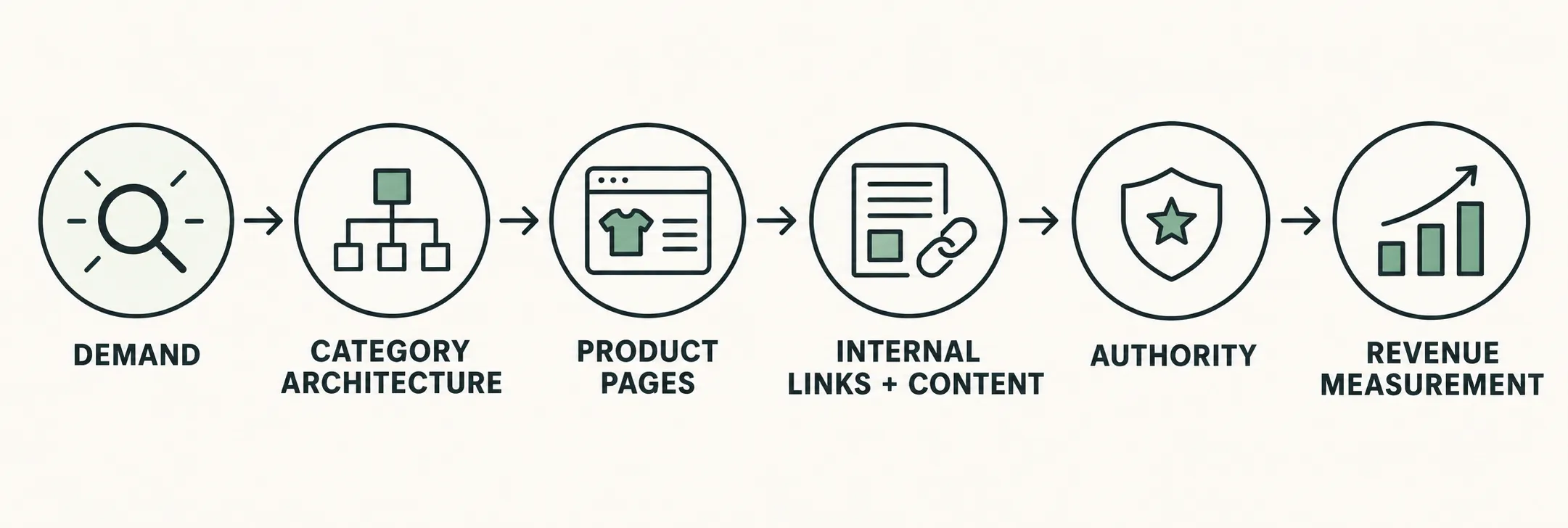
That requires more than optimizing title tags. Ecommerce sites combine large inventories, changing availability, filters, product variants, JavaScript, internal search and international markets. A workable strategy therefore needs one connected system: demand, architecture, technical eligibility, category and product experience, internal authority, supporting content, external authority, conversion and measurement.
Start with search demand and commercial value
Search volume is useful, but it does not tell you whether a query is relevant to the products you can profitably sell. Begin by combining search demand with inventory, margin, return rates, seasonality, market eligibility and conversion potential.
A lower-volume category with reliable stock and strong unit economics may deserve more attention than a larger topic tied to low availability or weak margins. Likewise, a technical problem affecting ten important collections may be more valuable to fix than hundreds of low-impact audit warnings.
Segment demand by the job a searcher is trying to complete.
| Query type | Typical page | Commercial role | SEO priority |
|---|---|---|---|
| Category | Category or collection page | Helps shoppers browse and compare a product type | High when demand, inventory and assortment are stable |
| Product | Product detail page | Captures exact product, model, SKU or attribute demand | High for important products with sustained availability |
| Comparison | Guide, comparison page or selected category | Helps shoppers evaluate alternatives | High when it supports a real purchase decision |
| Informational | Guide, help page or editorial article | Answers selection, use, care or troubleshooting questions | Prioritize when there is a clear route to commercial pages |
| Brand | Brand, category or product page | Serves people already looking for a known brand or range | Protect and improve where the brand is sold legitimately |
| Problem or use case | Guide, solution page or curated category | Connects a need to suitable product options | High when the use case maps cleanly to the catalogue |
Create one primary owner for each important intent. A category page for “mineral sunscreen” should not compete with a generic article targeting the same phrase. The category can own the commercial term, while a guide answers a narrower question such as how to choose mineral sunscreen for sensitive skin.
Use a simple opportunity score rather than treating every keyword equally. Useful inputs include:
- relevant demand and current visibility;
- commercial importance of the product range;
- stock stability and operational readiness;
- the quality gap between your page and the current results;
- the effort and risk involved in improving the page;
- whether the opportunity supports a priority market or customer segment.
This creates a defensible backlog: improve the pages that can affect product discovery and revenue first.
Build category architecture around how customers shop
Category architecture translates demand into a browseable site structure. It should use customer language, reflect meaningful product distinctions and keep priority pages within a reasonable click path from strong navigation pages.
A useful pattern is:
Home → Department → Category → Subcategory → Product
The exact depth depends on catalogue size. A small store may need a handful of strong collections. A large retailer may require governed subcategories, pagination, feed management and clear rules for which attributes deserve landing pages.
Before creating a new category, ask:
- Does it represent distinct and sustained search demand?
- Is there enough stable inventory to satisfy the query?
- Does the page help shoppers make a clearer choice?
- Can the business maintain the assortment and page content?
- Is the intent already owned by another category, product or guide?
Avoid category explosion. Creating a landing page for every colour, size, price band and attribute combination usually produces thin or unstable URLs. Create durable categories for durable customer needs; leave temporary or low-value combinations as user-facing filters where appropriate.
Google explains that it infers ecommerce structure largely from links between pages. Its ecommerce navigation guidance recommends crawlable links from menus to categories, from categories to subcategories and from those pages to products. Products reachable only through a search box or interaction may be harder to discover.
The architecture also needs consistent signals. Preferred URLs should align across internal links, canonicals and XML sitemaps. A clean URL alone does not establish importance; strong navigation and contextual links do more of that work.
For deeper implementation detail, see SeekLab.io’s guide to ecommerce site architecture.
Control faceted navigation deliberately
Filters help shoppers narrow a catalogue, but unrestricted filter combinations can create a very large number of low-value URLs. Common examples include size, colour, material, price, stock status, rating and sort order.
Do not apply one blanket rule to every facet. Separate valuable search landing pages from filters that exist only to support browsing.
| Filter-page condition | Recommended treatment | Example |
|---|---|---|
| Clear demand, stable inventory and distinct page value | Consider a governed, indexable landing page | Women’s waterproof hiking boots |
| Useful to shoppers but little standalone search value | Keep usable, but control crawl and indexation | Temporary price range or delivery-speed filter |
| Creates near-duplicate combinations | Prevent indexation and reduce crawl paths | Size + colour + sort order combinations |
| Empty, temporary or highly unstable | Keep out of active indexing paths | Seasonal filter after stock is depleted |
Google’s current faceted navigation guidance emphasizes controlling unnecessary facet crawling because these URLs can consume substantial resources without adding search value.
The implementation may use noindex rules, crawl controls, canonical signals, parameter handling or URL fragments depending on the platform. Do not choose a mechanism in isolation. Test whether important products remain discoverable, whether users can still filter normally and whether search engines receive consistent signals.
Make category pages useful commercial destinations
Category pages commonly own broad non-brand commercial demand. They should do more than display a product grid with a keyword added to the title.
A strong category page usually provides:
- a precise title and H1;
- an assortment that matches the query;
- useful filters and sorting;
- short selection guidance where it helps the decision;
- crawlable links to relevant subcategories and products;
- clear availability, delivery or return context where appropriate;
- breadcrumbs and other orientation cues;
- stable pagination or incremental loading that does not hide products from crawlers.
Keep category copy proportional to the decision. A mineral sunscreen collection might explain SPF options, tint, skin-type considerations and water resistance. It does not need a long generic essay about sunshine before the product grid.
Google’s pagination and incremental loading guidance is especially relevant for large collections. Search crawlers generally follow URLs in links; they do not click buttons or trigger every user interaction. Ensure products remain reachable through crawlable page URLs and links.
Give product pages a distinct, focused role
Product pages own exact product, model, SKU and specific attribute demand. This article does not replace a product-page optimization guide; the strategic question is how product pages fit into the broader system.
At minimum, important product pages should help a shopper answer:
- What is the product and who is it for?
- What are its specifications, materials, dimensions or compatibility requirements?
- Which variant is being viewed?
- What is included?
- Is it available, at what price and under what delivery conditions?
- How does it differ from relevant alternatives?
- What happens if it is returned or needs support?
Avoid copying supplier descriptions across many retailers or variants. Original decision support—accurate specifications, useful media, sizing, compatibility, application guidance and clearly maintained availability—creates more value than length alone.
For page-level implementation, use SeekLab.io’s dedicated product page SEO guide. For product information that may be interpreted by AI shopping systems, see the product-page structure AI shopping assistants actually read.
Use internal links to distribute commercial importance
Internal links connect the architecture to the content strategy. They help shoppers move between categories, products and guidance, while also helping search engines understand relationships and relative importance.
Use several link types together:
- Global navigation: links to primary departments and priority categories.
- Category hierarchy: parent, child and sibling category links.
- Product relationships: alternatives, accessories, bundles and compatible products.
- Editorial links: buying guides and comparison pages linking to relevant categories or products.
- Breadcrumbs: consistent paths that show hierarchy and allow upward navigation.
Prioritize links based on commercial relevance, not a fixed quota. A guide should link to the category that naturally resolves the reader’s next question. It should not contain unrelated commercial links merely to distribute authority.
Anchor text should describe the destination clearly. “Compare mineral sunscreens” is more useful than “click here.” Keep important links in crawlable HTML; do not rely solely on JavaScript events or internal search results.
Publish supporting content with a commercial role
Ecommerce content earns its place when it supports discovery, evaluation, use or retention. Common formats include:
- buying guides;
- product comparisons;
- sizing and fit guidance;
- compatibility or selection tools;
- use-case pages;
- installation and care resources;
- troubleshooting and replacement guidance.
Map each piece to a distinct question and a next step. A guide comparing ceramic and stainless-steel bottles can explain insulation, weight and care, then route readers to the appropriate product categories. A generic “everything about drinkware” article is less likely to own a clear intent or support a decision.
Large catalogues may also benefit from controlled template-based content. However, programmatic SEO should only be used when each page has a genuine user purpose, reliable data and enough differentiation to justify indexation.
Plan for product churn, out-of-stock items and discontinued URLs
Inventory changes are part of ecommerce SEO, not an edge case. The right action depends on whether the product will return, whether a close replacement exists and whether the URL has ongoing demand or authority.
| Product state | Practical treatment |
|---|---|
| Temporarily out of stock | Keep the page live, show accurate availability and offer useful alternatives or restock options where appropriate |
| Permanently discontinued with a close replacement | Consider a 301 redirect only when the replacement genuinely satisfies the same intent |
| Permanently discontinued with no equivalent | Keep a useful page when it still serves demand or has value; otherwise return an appropriate 404/410 response |
| Seasonal product expected to return | Preserve the stable URL and update availability rather than recreating the page each season |
| Variant unavailable but parent product remains | Keep variant and parent signals consistent; do not remove the whole product unnecessarily |
Do not redirect every discontinued product to the homepage or a loosely related category. That frustrates users and obscures the actual state. Google advises businesses to keep sites online during temporary pauses and to maintain accurate product availability. Product pages, structured data and feeds should agree.
Fix technical constraints on priority templates
Technical SEO for ecommerce should focus on whether important pages can be crawled, rendered, indexed and reached—not on producing the longest possible issue list.
Start with representative URLs from each important template:
- home and navigation;
- categories and subcategories;
- filter states;
- product pages and variants;
- pagination;
- editorial guides;
- localized versions.
Then check the constraints most likely to affect those templates:
| Area | What to validate | Why it matters |
|---|---|---|
| Crawlability | robots.txt, crawlable links, status codes, pagination | Priority pages and products must be discoverable |
| Indexability | meta robots, canonicals, duplicate templates, soft 404s | Search engines need a consistent preferred page |
| Rendering | server response, JavaScript dependencies, lazy loading | Essential content and links must be available after rendering |
| Sitemaps | canonical indexable URLs, freshness and segmentation | Sitemaps should reinforce—not contradict—the architecture |
| Performance | LCP, INP, CLS and template-specific causes | Mobile experience and conversion can suffer even when pages are indexable |
| Data consistency | price, stock, variants, shipping and returns | Conflicting page, markup and feed data reduces trust and eligibility |
Prioritize by affected revenue potential and scale. An accidental noindex on a major category deserves more urgency than a missing alt attribute on a decorative image. A broken canonical across every product template deserves more attention than an isolated heading inconsistency.
Google’s JavaScript SEO guidance and canonicalization documentation provide the current implementation principles. SeekLab.io’s technical SEO audit guide explains how to move from findings to a prioritized fix plan.
Treat structured data as a product-data quality layer
Structured data can help eligible pages receive richer product appearances, but it does not replace accurate visible content or guarantee rankings.
For ecommerce sites, review where these types are appropriate:
ProductandOfferon product pages;BreadcrumbListwhere breadcrumbs are visible;Organizationfor business identity details;- supported shipping and return policy properties when the information is maintained accurately;
- review and aggregate rating properties only when they comply with the relevant guidelines and reflect genuine visible content.
Keep price, currency, availability, identifiers and variants consistent across the page, structured data and Merchant Center feeds. Google’s product structured data documentation and merchant listing guidance describe the required and recommended fields for eligible experiences.
Test representative templates in the Rich Results Test and Search Console. Monitor after release, because valid markup can still become inaccurate when product data changes.
Localize international ecommerce strategy by market
International ecommerce SEO is not a translation project. A market version should reflect local demand, language, currency, availability, delivery, returns, terminology and customer support.
Before launching a country or language version, confirm:
- that the business can sell and support the product in that market;
- which language and search vocabulary customers use;
- how currency, taxes, shipping and returns are presented;
- whether the assortment differs;
- whether local regulations or claims affect the page;
- how equivalent pages will be linked and annotated.
Use stable, crawlable URLs and implement hreflang across equivalent localized pages. Google’s localized-version guidance explains the reciprocal annotation requirements. For the planning framework, see SeekLab.io’s international SEO strategy guide.
Build authority around categories, not only the homepage
External authority often accumulates around the brand homepage, while the pages that need to rank are deeper category and guide URLs. Plan authority building around useful, link-worthy assets that reinforce commercial topics.
Examples include original data, expert selection guides, technical reference material, calculators, compatibility resources, visual explainers and genuinely useful tools. The best format depends on the category and audience.
Promote resources to relevant publishers and communities, then link from those resources to the category or product system they support. Avoid manufacturing thin “linkable assets” that have no connection to the catalogue.
Authority is also an internal concept. If the navigation, breadcrumbs and editorial links consistently reinforce a category, search engines receive a clearer signal about its importance than they would from an isolated optimized page.
Measure discovery, conversion and organic revenue together
Traffic is an input, not the final outcome. Reporting should show whether priority pages became more visible, attracted qualified visits and influenced commercial actions.
Measure by page type and intent rather than combining the entire organic channel into one number.
| Measurement layer | Useful signals | Question answered |
|---|---|---|
| Discovery | Valid indexed pages, impressions, query coverage, crawl and rendering checks | Can priority pages be found and understood? |
| Engagement | Category-to-product clicks, product views, guide-to-category clicks, on-site search refinement | Are visitors progressing through the shopping journey? |
| Conversion | Add-to-cart, checkout starts, purchases, conversion rate | Are organic landing pages contributing to transactions? |
| Revenue quality | Organic revenue, assisted revenue, margin band, returns and stock coverage | Is growth commercially useful and sustainable? |
| Implementation | Fixes shipped, templates affected, validation status | Did the planned work actually change the site? |
Segment results by category, product, guide, market and device. Annotate releases and inventory events. If a category loses revenue because its best sellers are out of stock, that is different from losing visibility. If impressions rise but category-to-product clicks do not, the page may be attracting the wrong demand or providing weak selection support.
A practical 90-day ecommerce SEO plan
Ninety days is enough to establish priorities, fix critical constraints and improve a first set of commercial pages. It is not a promise that every catalogue problem can be solved in one quarter.
| Phase | Focus | Deliverables |
|---|---|---|
| Days 1–30 | Evidence and prioritization | Priority categories, products and markets; intent-to-page map; template crawl and rendering checks; baseline reporting |
| Days 31–60 | Architecture and page systems | Navigation and internal-link fixes; facet rules; priority category improvements; product-template requirements; data consistency checks |
| Days 61–90 | Content, authority and validation | Decision-support content; links into commercial pages; structured-data QA; post-release crawl/index checks; revenue and conversion review |
Give every action an owner, affected templates, implementation risk and validation method. “Improve category SEO” is not a task. “Add crawlable links from the running-shoes category to three demand-backed subcategories and verify them in rendered HTML” is.
Common ecommerce SEO mistakes
- Optimizing for total traffic without checking revenue relevance.
- Creating categories for every filter combination.
- Publishing informational content with no route to products.
- Hiding products behind internal search or interaction-only navigation.
- Allowing page, schema and feed availability to disagree.
- Deleting or redirecting discontinued products without checking intent and value.
- Treating all technical audit findings as equally urgent.
- Translating pages without localizing inventory and commercial terms.
- Measuring the entire organic channel without page-type segmentation.
Turn the framework into an implementation plan
SeekLab.io helps teams connect search demand, site architecture, content, technical eligibility and measurement through a practical SEO and GEO strategy. If you first need a quick view of crawl, indexation and on-page issues, you can also run the free technical SEO audit. The free automated report is a starting point; deeper strategy and implementation planning require business and page-level context.
FAQ
What should an ecommerce SEO strategy include?
It should include commercial priorities, query-to-page mapping, category and product roles, crawl and indexation controls, internal linking, product-data governance, supporting content, authority, conversion readiness and measurement by page type.
Should ecommerce sites optimize category pages or product pages first?
Prioritize the page type tied to the clearest commercial opportunity and confirmed constraint. Category pages often deserve early attention for broad non-brand demand. Product pages may come first when exact-product demand is stronger or when a shared product template lacks essential information.
How should faceted navigation be handled for SEO?
Create a filter policy. Allow indexation only for combinations with distinct demand, stable inventory and useful landing-page value. Keep low-value, empty, temporary and near-duplicate combinations out of active indexing paths while preserving a usable filtering experience.
What should happen to out-of-stock product pages?
Keep temporarily unavailable products live when they are expected to return, show accurate availability and offer relevant alternatives. For permanent discontinuation, decide whether to retain the page, redirect to a genuine replacement or return 404/410 based on demand, links and user intent.
Does product structured data improve rankings?
It does not guarantee higher rankings. Accurate product and offer markup can make eligible pages available for richer search appearances, but it must match visible, maintained page information.
How do internal links support ecommerce SEO?
They help shoppers and crawlers move from departments to categories, products and supporting guides. They also signal relationships and relative importance. Use navigation, hierarchy links, breadcrumbs, product relationships and contextual editorial links together.
How do you measure ecommerce SEO revenue impact?
Combine Search Console and analytics data with ecommerce transactions, add-to-cart actions, assisted conversions where available, inventory and product economics. Report separately for categories, products, guides, markets and devices.
How long does an ecommerce SEO strategy take to work?
Critical technical fixes may be validated soon after deployment and recrawling, while category, content and authority improvements usually require longer observation. Timing depends on catalogue size, site health, implementation speed, competition and search demand; avoid promising a universal timeframe.